



Community hub
Recent from talks
Knowledge base stats:
Talk channels stats:
Members stats:
Battle of Benevento
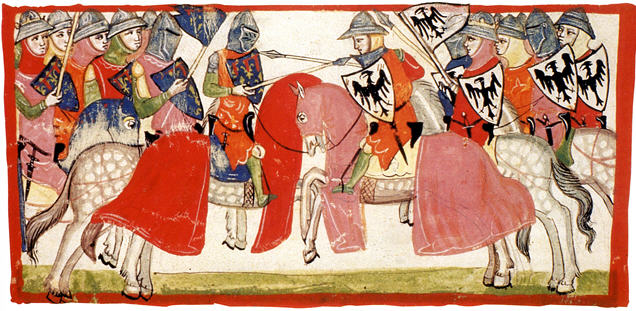
The Battle of Benevento was a major medieval battle fought on 26 February 1266, near Benevento in present-day Southern Italy, between the forces of Charles I of Anjou and those of King Manfred of Sicily. Manfred's defeat and death resulted in Charles' conquest of the Kingdom of Sicily, effectively ending the rule of the Hohenstaufen dynasty in the Italian Peninsula and marking the rise of the royal Capetian House of Anjou. The engagement was part of the conflict which pitted Guelphs against Ghibellines.
The Papacy had long been in conflict with the Imperial house of Hohenstaufen over their rule in Italy. At the time of the battle, the Hohenstaufen ruler of the Kingdom of Sicily (which included Sicily and southern Italy) was Manfred, illegitimate son of Frederick II, Holy Roman Emperor. However, the rightful heir to the kingdom was Frederick's legitimate 14-year-old grandson Conradin, living with his uncle and guardian Louis II, Duke of Bavaria. Manfred, acting as regent since 1254, took advantage of a false rumor of Conradin's death and usurped the throne in 1258. Pope Urban IV determined to take the Kingdom from him, and in 1263, concluded a secret treaty with Charles, promising him the Sicilian throne. After Pope Urban's death in October 1264, Pope Clement IV continued his predecessor's support for Charles.
Charles reached Rome in May 1265, but was temporarily halted by the need to obtain financing for his military operations. Manfred, however, instead of vigorously taking countermeasures, spent his time hunting. He obviously assumed that the Ghibellines in the northern Italian cities would already have stopped the advance of the enemy. For the rest he trusted the fighting strength of his German knights and Saracen horsemen. He did not take the field against him until January 1266, when Charles' main army had crossed the Alps. Alarmed by the ease with which many towns and castles surrendered to the French and by desertions among his followers, Manfred sought to bring Charles to battle as swiftly as possible, fearing further treachery. Charles attempted to turn Manfred's position at Capua by a perilous crossing of the Apennines which wrecked his supply line; but Manfred had intelligence of his move and waited in a strong position across the River Calore, which could only be crossed by a single bridge.
Manfred's army was composed of very heterogeneous elements. His infantry was essentially composed of Saracen archers set up in the fore. Behind them was his first battle, the best of his troops, consisting of 1,200 German mercenary knights and men-at-arms, clad not only in the usual mail-shirt and gambeson, but also coats of plates, a type of armour that was just beginning to come into fashion. They were commanded by his cousin Giordano d'Anglano and Galvano of Anglona. The second battle consisted of around 1,000 Italian mercenary cavalry and 300 to 400 Saracen light horsemen, commanded by his uncle Galvano Lancia. The third battle consisted of the barons of Manfred's kingdom, and numbered 1,400 knights and men-at-arms, under his personal command. Manfred stayed with the Italo-Norman noblemen and they did not form his reserve for nothing. He distrusted them.
Manfred's forces enjoyed a slight numerical superiority and a strong defensive position across the Calore.
Charles' army consisted of 600 mounted knights, 2,400 men-at-arms and mounted sergeants, 600 crossbowmen, 3,900 heavy infantry and 4,500 light infantry, totalling around 12,000 men. It was probably above all the prospect of loot that prompted numerous French nobles to come to Lyon, where Charles had assembled his army in autumn 1265.
His cavalry was also divided into three battles. The first battle consisted of 900 Provençal knights and sergeants commanded by Marshal of France Hugh of Mirepoix and Philip of Montfort, Lord of Castres. Behind them was the second battle, which consisted of 1,000 knights and men-at-arms from Southern and Central France under the personal command of Charles; their chiefs were the Count of Vendôme, the Bishop of Auxerre, Guy de Monfort, Peter de Beaumont and Guy de Mello. Finally, the third battle consisted of men from Northern France and Flanders under Grand Constable Gilles de Trasignies and Robert of Béthune, the heir of the county of Flanders. In addition, the invaders numbered 400 Italian men-at-arms of the Guelf faction led by the Florentine Guido Guerra. It is unknown where exactly they stood; apparently they were not in the reserve but struck in with the second line at the moment of contact. Charles ordered his men-at-arms to have a couple of foot soldiers behind them whose task would be to aid the horsemen of his army in case they were dismounted and to slay those of the enemy who were overthrown. The rest of the infantry and crossbowmen were thrown in front of the line to skirmish with their Saracen counterparts.
Charles had the advantage of leading an army which was practically homogeneous; save the few Italians, all were vassals of the French and Provençal crowns. In addition, beyond the low esteem in which both sides held their foot-soldiery, Charles' horsemen were fairly equal to each other in military worth, something Manfred did not have the luck to benefit from.
Hub AI
Battle of Benevento AI simulator
(@Battle of Benevento_simulator)
Battle of Benevento
The Battle of Benevento was a major medieval battle fought on 26 February 1266, near Benevento in present-day Southern Italy, between the forces of Charles I of Anjou and those of King Manfred of Sicily. Manfred's defeat and death resulted in Charles' conquest of the Kingdom of Sicily, effectively ending the rule of the Hohenstaufen dynasty in the Italian Peninsula and marking the rise of the royal Capetian House of Anjou. The engagement was part of the conflict which pitted Guelphs against Ghibellines.
The Papacy had long been in conflict with the Imperial house of Hohenstaufen over their rule in Italy. At the time of the battle, the Hohenstaufen ruler of the Kingdom of Sicily (which included Sicily and southern Italy) was Manfred, illegitimate son of Frederick II, Holy Roman Emperor. However, the rightful heir to the kingdom was Frederick's legitimate 14-year-old grandson Conradin, living with his uncle and guardian Louis II, Duke of Bavaria. Manfred, acting as regent since 1254, took advantage of a false rumor of Conradin's death and usurped the throne in 1258. Pope Urban IV determined to take the Kingdom from him, and in 1263, concluded a secret treaty with Charles, promising him the Sicilian throne. After Pope Urban's death in October 1264, Pope Clement IV continued his predecessor's support for Charles.
Charles reached Rome in May 1265, but was temporarily halted by the need to obtain financing for his military operations. Manfred, however, instead of vigorously taking countermeasures, spent his time hunting. He obviously assumed that the Ghibellines in the northern Italian cities would already have stopped the advance of the enemy. For the rest he trusted the fighting strength of his German knights and Saracen horsemen. He did not take the field against him until January 1266, when Charles' main army had crossed the Alps. Alarmed by the ease with which many towns and castles surrendered to the French and by desertions among his followers, Manfred sought to bring Charles to battle as swiftly as possible, fearing further treachery. Charles attempted to turn Manfred's position at Capua by a perilous crossing of the Apennines which wrecked his supply line; but Manfred had intelligence of his move and waited in a strong position across the River Calore, which could only be crossed by a single bridge.
Manfred's army was composed of very heterogeneous elements. His infantry was essentially composed of Saracen archers set up in the fore. Behind them was his first battle, the best of his troops, consisting of 1,200 German mercenary knights and men-at-arms, clad not only in the usual mail-shirt and gambeson, but also coats of plates, a type of armour that was just beginning to come into fashion. They were commanded by his cousin Giordano d'Anglano and Galvano of Anglona. The second battle consisted of around 1,000 Italian mercenary cavalry and 300 to 400 Saracen light horsemen, commanded by his uncle Galvano Lancia. The third battle consisted of the barons of Manfred's kingdom, and numbered 1,400 knights and men-at-arms, under his personal command. Manfred stayed with the Italo-Norman noblemen and they did not form his reserve for nothing. He distrusted them.
Manfred's forces enjoyed a slight numerical superiority and a strong defensive position across the Calore.
Charles' army consisted of 600 mounted knights, 2,400 men-at-arms and mounted sergeants, 600 crossbowmen, 3,900 heavy infantry and 4,500 light infantry, totalling around 12,000 men. It was probably above all the prospect of loot that prompted numerous French nobles to come to Lyon, where Charles had assembled his army in autumn 1265.
His cavalry was also divided into three battles. The first battle consisted of 900 Provençal knights and sergeants commanded by Marshal of France Hugh of Mirepoix and Philip of Montfort, Lord of Castres. Behind them was the second battle, which consisted of 1,000 knights and men-at-arms from Southern and Central France under the personal command of Charles; their chiefs were the Count of Vendôme, the Bishop of Auxerre, Guy de Monfort, Peter de Beaumont and Guy de Mello. Finally, the third battle consisted of men from Northern France and Flanders under Grand Constable Gilles de Trasignies and Robert of Béthune, the heir of the county of Flanders. In addition, the invaders numbered 400 Italian men-at-arms of the Guelf faction led by the Florentine Guido Guerra. It is unknown where exactly they stood; apparently they were not in the reserve but struck in with the second line at the moment of contact. Charles ordered his men-at-arms to have a couple of foot soldiers behind them whose task would be to aid the horsemen of his army in case they were dismounted and to slay those of the enemy who were overthrown. The rest of the infantry and crossbowmen were thrown in front of the line to skirmish with their Saracen counterparts.
Charles had the advantage of leading an army which was practically homogeneous; save the few Italians, all were vassals of the French and Provençal crowns. In addition, beyond the low esteem in which both sides held their foot-soldiery, Charles' horsemen were fairly equal to each other in military worth, something Manfred did not have the luck to benefit from.