


Community hub
Recent from talks
Contribute something to knowledge base
Content stats: 0 posts, 0 articles, 1 media, 0 notes
Members stats: 0 subscribers, 0 contributors, 0 moderators, 0 supporters
Subscribers
Supporters
Contributors
Moderators
Hub AI
Battle of Bennington AI simulator
(@Battle of Bennington_simulator)
Hub AI
Battle of Bennington AI simulator
(@Battle of Bennington_simulator)
Battle of Bennington
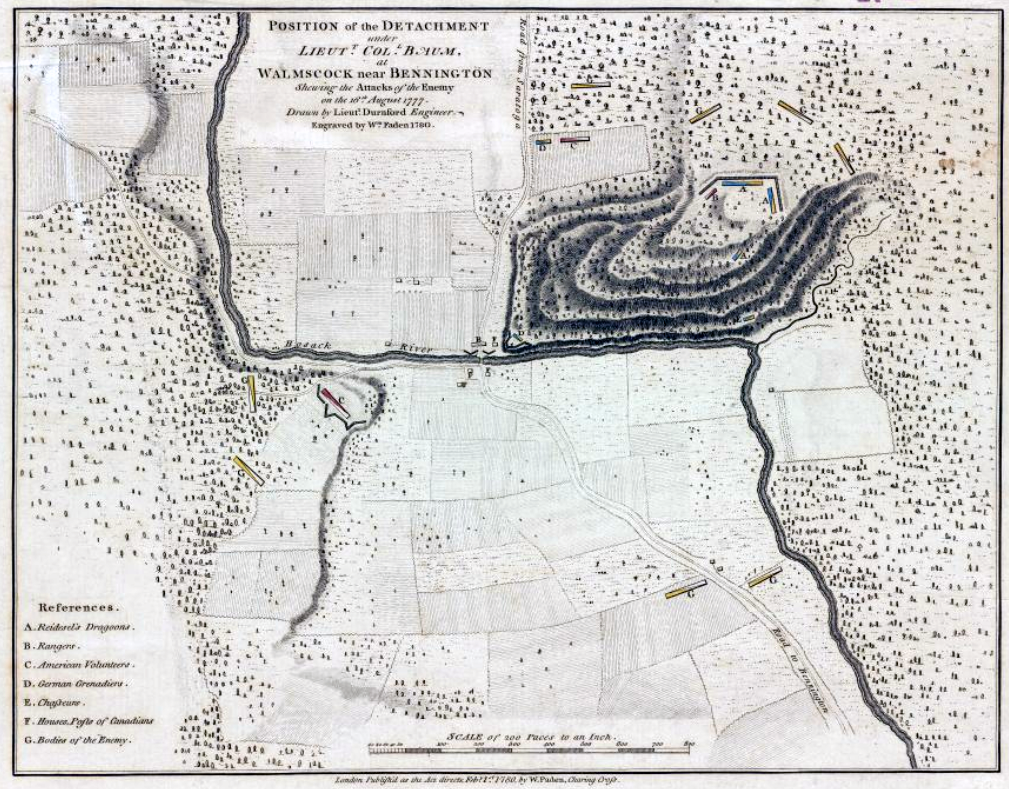
The Battle of Bennington was a battle of the American Revolutionary War, part of the Saratoga campaign, that took place on August 16, 1777, on the John Green farm in Walloomsac, New York, about 10 miles (16 km) from its namesake, Bennington, Vermont. An American force of 2,000 men, primarily New Hampshire and Massachusetts militiamen, led by General John Stark, and reinforced by militiamen from the independent Vermont Republic led by Colonel Seth Warner and members of the Green Mountain Boys, decisively defeated a detachment of General John Burgoyne's army led by Lieutenant-Colonel Friedrich Baum, and supported by additional troops under Lieutenant-Colonel Heinrich von Breymann.
Baum's detachment of 700 men consisted of Hessian and British Army troops, Canadian and Loyalist irregulars and a number of Iroquois warriors. He was sent by Burgoyne to raid Bennington in the disputed New Hampshire Grants area for horses, draft animals, provisions, and other supplies. Believing the town to be only lightly defended, Burgoyne and Baum were unaware that Stark and 1,500 American militiamen were stationed there. After a rain-caused standoff, Stark's men enveloped Baum's position, taking many prisoners, and killing Baum. Reinforcements for both sides arrived as Stark and his men were mopping up, and the battle restarted, with Warner and Stark driving away Breymann's reinforcements with heavy casualties.
The battle was a major strategic success for the American cause and is considered one of the turning points of the war; it reduced Burgoyne's army in size by almost 1,000 men, led his Native American allies to largely abandon him, and deprived him of much-needed supplies, such as mounts for his cavalry regiments, draft animals and provisions, all factors that contributed to Burgoyne's eventual defeat at Saratoga. The victory galvanized colonial support for the Patriot cause, and played a key role in bringing France into the war on the American side. The battle's anniversary is celebrated in the state of Vermont as Bennington Battle Day.
With the American Revolutionary War two years old, the British changed their plans. Giving up on the rebellious New England Colonies, they decided to split the Thirteen Colonies and isolate New England from what the British believed to be the more loyal Southern Colonies. The British command devised a grand plan to divide the colonies via a three-way pincer movement towards Albany. The western pincer, proceeding eastward from Lake Ontario under the command of Barry St. Leger, was repulsed when the Siege of Fort Stanwix failed, and the southern pincer, which was to progress up the Hudson valley from New York City, never started since General William Howe decided instead to capture Philadelphia.
The northern pincer, proceeding southward from Montreal, enjoyed the most success. After British victories at Fort Ticonderoga, Hubbardton, and Fort Anne, General John Burgoyne proceeded with the Saratoga campaign, with the goal of capturing Albany, New York and gaining control of the Hudson River valley, where Burgoyne's force could (as the plan went) meet the other pincers, dividing the colonies in two.
Burgoyne's progress towards Albany had initially met with some success, including the scattering of Seth Warner's men in the Battle of Hubbardton. However, his advance had slowed to a crawl by late July, due to logistical difficulties, exacerbated by the American destruction of a key road, and the army's supplies began to dwindle. Burgoyne's concern over supplies was magnified in early August when he received word that Howe was going to Philadelphia, rather than advance up the Hudson River valley. In response to a proposal first made on July 22 by the commander of his Hessian troops, Baron Riedesel, Burgoyne sent a detachment of about 800 soldiers under the command of Lieutenant-Colonel Friedrich Baum from Fort Miller on a foraging mission to acquire horses for Prince Ludwig's Dragoon Regiment, draft animals to assist in moving the army, and to harass the Americans. Baum's detachment was primarily made up of dismounted dragoons from Prince Ludwig's Dragoon Regiment. Along the way, 150 local Loyalists, 58 Canadian irregulars, around 100 Iroquois warriors, and 48 soldiers from the British Army's Company of Select Marksmen joined the detachment. Baum was originally ordered to proceed to the Connecticut River valley where they believed horses could be procured for the dragoons. However, as Baum was preparing to leave, Burgoyne changed the goal to be a supply depot at Bennington, having received intelligence reports that the town was defended only by 400 demoralized militia from Warner's command.
Unknown to Burgoyne, the citizens of the New Hampshire Grants territory (now Vermont, which was then disputed between New York and the Vermont Republic) had appealed to the states of New Hampshire and Massachusetts for protection from the invading army following the British capture of Ticonderoga. New Hampshire responded on July 18 by authorizing John Stark to raise a militia for the defense of the people "or the annoyance of the enemy". Using funds provided by John Langdon, Stark raised 1,500 New Hampshire militiamen in the space of six days, more than 10% of New Hampshire's male population over the age of sixteen. They were first marched to the Fort at Number 4 (modern-day Charlestown, New Hampshire), then crossed the Connecticut river border into the Grants and stopped at Manchester, where Stark conferred with Warner. While in Manchester, General Benjamin Lincoln, whose promotion in preference to Stark had been the cause for Stark's resignation from the Continental Army, attempted to assert Army authority over Stark and his men. Stark refused, stating that he was solely responsible to the New Hampshire authorities. Stark then went on to Bennington with Warner as a guide, while Warner's men remained in Manchester. Lincoln returned to the American camp at Stillwater, where he and General Philip Schuyler hatched a plan for Lincoln, with 500 men, to join with Stark and Warner in actions to harass Burgoyne's communications and supply lines at Skenesboro. Baum's movements significantly altered these plans.
Baum's troops left Burgoyne's camp at Fort Edward on August 9 and marched to Fort Miller, where they waited until they were joined by the Iroquois and the Company of Select Marksmen. The company marched off toward Bennington on August 11. In minor skirmishes along the way they learned from prisoners taken that a sizable force was in place at Bennington. On August 14 Baum's men encountered a detachment of Stark's men that had been sent out to investigate reports of British-allied Indians in the area. Stark's men retreated, destroying a bridge to delay Baum's advance. Stark, on receiving word of the approaching force, sent a request to Manchester for support, and then moved his troops out of Bennington toward Baum's force, setting up a defensive line. Baum sent a message to Burgoyne following the first contact indicating that the American force was larger than expected, but that it was likely to retreat before him. He then advanced a few miles further until he neared Stark's position. He then realized that at least part of his first message was incorrect, so he sent a second message to Burgoyne, requesting reinforcements.
Battle of Bennington
The Battle of Bennington was a battle of the American Revolutionary War, part of the Saratoga campaign, that took place on August 16, 1777, on the John Green farm in Walloomsac, New York, about 10 miles (16 km) from its namesake, Bennington, Vermont. An American force of 2,000 men, primarily New Hampshire and Massachusetts militiamen, led by General John Stark, and reinforced by militiamen from the independent Vermont Republic led by Colonel Seth Warner and members of the Green Mountain Boys, decisively defeated a detachment of General John Burgoyne's army led by Lieutenant-Colonel Friedrich Baum, and supported by additional troops under Lieutenant-Colonel Heinrich von Breymann.
Baum's detachment of 700 men consisted of Hessian and British Army troops, Canadian and Loyalist irregulars and a number of Iroquois warriors. He was sent by Burgoyne to raid Bennington in the disputed New Hampshire Grants area for horses, draft animals, provisions, and other supplies. Believing the town to be only lightly defended, Burgoyne and Baum were unaware that Stark and 1,500 American militiamen were stationed there. After a rain-caused standoff, Stark's men enveloped Baum's position, taking many prisoners, and killing Baum. Reinforcements for both sides arrived as Stark and his men were mopping up, and the battle restarted, with Warner and Stark driving away Breymann's reinforcements with heavy casualties.
The battle was a major strategic success for the American cause and is considered one of the turning points of the war; it reduced Burgoyne's army in size by almost 1,000 men, led his Native American allies to largely abandon him, and deprived him of much-needed supplies, such as mounts for his cavalry regiments, draft animals and provisions, all factors that contributed to Burgoyne's eventual defeat at Saratoga. The victory galvanized colonial support for the Patriot cause, and played a key role in bringing France into the war on the American side. The battle's anniversary is celebrated in the state of Vermont as Bennington Battle Day.
With the American Revolutionary War two years old, the British changed their plans. Giving up on the rebellious New England Colonies, they decided to split the Thirteen Colonies and isolate New England from what the British believed to be the more loyal Southern Colonies. The British command devised a grand plan to divide the colonies via a three-way pincer movement towards Albany. The western pincer, proceeding eastward from Lake Ontario under the command of Barry St. Leger, was repulsed when the Siege of Fort Stanwix failed, and the southern pincer, which was to progress up the Hudson valley from New York City, never started since General William Howe decided instead to capture Philadelphia.
The northern pincer, proceeding southward from Montreal, enjoyed the most success. After British victories at Fort Ticonderoga, Hubbardton, and Fort Anne, General John Burgoyne proceeded with the Saratoga campaign, with the goal of capturing Albany, New York and gaining control of the Hudson River valley, where Burgoyne's force could (as the plan went) meet the other pincers, dividing the colonies in two.
Burgoyne's progress towards Albany had initially met with some success, including the scattering of Seth Warner's men in the Battle of Hubbardton. However, his advance had slowed to a crawl by late July, due to logistical difficulties, exacerbated by the American destruction of a key road, and the army's supplies began to dwindle. Burgoyne's concern over supplies was magnified in early August when he received word that Howe was going to Philadelphia, rather than advance up the Hudson River valley. In response to a proposal first made on July 22 by the commander of his Hessian troops, Baron Riedesel, Burgoyne sent a detachment of about 800 soldiers under the command of Lieutenant-Colonel Friedrich Baum from Fort Miller on a foraging mission to acquire horses for Prince Ludwig's Dragoon Regiment, draft animals to assist in moving the army, and to harass the Americans. Baum's detachment was primarily made up of dismounted dragoons from Prince Ludwig's Dragoon Regiment. Along the way, 150 local Loyalists, 58 Canadian irregulars, around 100 Iroquois warriors, and 48 soldiers from the British Army's Company of Select Marksmen joined the detachment. Baum was originally ordered to proceed to the Connecticut River valley where they believed horses could be procured for the dragoons. However, as Baum was preparing to leave, Burgoyne changed the goal to be a supply depot at Bennington, having received intelligence reports that the town was defended only by 400 demoralized militia from Warner's command.
Unknown to Burgoyne, the citizens of the New Hampshire Grants territory (now Vermont, which was then disputed between New York and the Vermont Republic) had appealed to the states of New Hampshire and Massachusetts for protection from the invading army following the British capture of Ticonderoga. New Hampshire responded on July 18 by authorizing John Stark to raise a militia for the defense of the people "or the annoyance of the enemy". Using funds provided by John Langdon, Stark raised 1,500 New Hampshire militiamen in the space of six days, more than 10% of New Hampshire's male population over the age of sixteen. They were first marched to the Fort at Number 4 (modern-day Charlestown, New Hampshire), then crossed the Connecticut river border into the Grants and stopped at Manchester, where Stark conferred with Warner. While in Manchester, General Benjamin Lincoln, whose promotion in preference to Stark had been the cause for Stark's resignation from the Continental Army, attempted to assert Army authority over Stark and his men. Stark refused, stating that he was solely responsible to the New Hampshire authorities. Stark then went on to Bennington with Warner as a guide, while Warner's men remained in Manchester. Lincoln returned to the American camp at Stillwater, where he and General Philip Schuyler hatched a plan for Lincoln, with 500 men, to join with Stark and Warner in actions to harass Burgoyne's communications and supply lines at Skenesboro. Baum's movements significantly altered these plans.
Baum's troops left Burgoyne's camp at Fort Edward on August 9 and marched to Fort Miller, where they waited until they were joined by the Iroquois and the Company of Select Marksmen. The company marched off toward Bennington on August 11. In minor skirmishes along the way they learned from prisoners taken that a sizable force was in place at Bennington. On August 14 Baum's men encountered a detachment of Stark's men that had been sent out to investigate reports of British-allied Indians in the area. Stark's men retreated, destroying a bridge to delay Baum's advance. Stark, on receiving word of the approaching force, sent a request to Manchester for support, and then moved his troops out of Bennington toward Baum's force, setting up a defensive line. Baum sent a message to Burgoyne following the first contact indicating that the American force was larger than expected, but that it was likely to retreat before him. He then advanced a few miles further until he neared Stark's position. He then realized that at least part of his first message was incorrect, so he sent a second message to Burgoyne, requesting reinforcements.
Recent media
Recent media