
Recent from talks
Battle of Crug Mawr
Knowledge base stats:
Talk channels stats:
Members stats:
Battle of Crug Mawr
The Battle of Crug Mawr (Welsh: Brwydr Crug Mawr), sometimes referred to as the Battle of Cardigan, took place in September or October 1136, as part of a struggle between the Welsh and Normans for control of Ceredigion, West Wales.
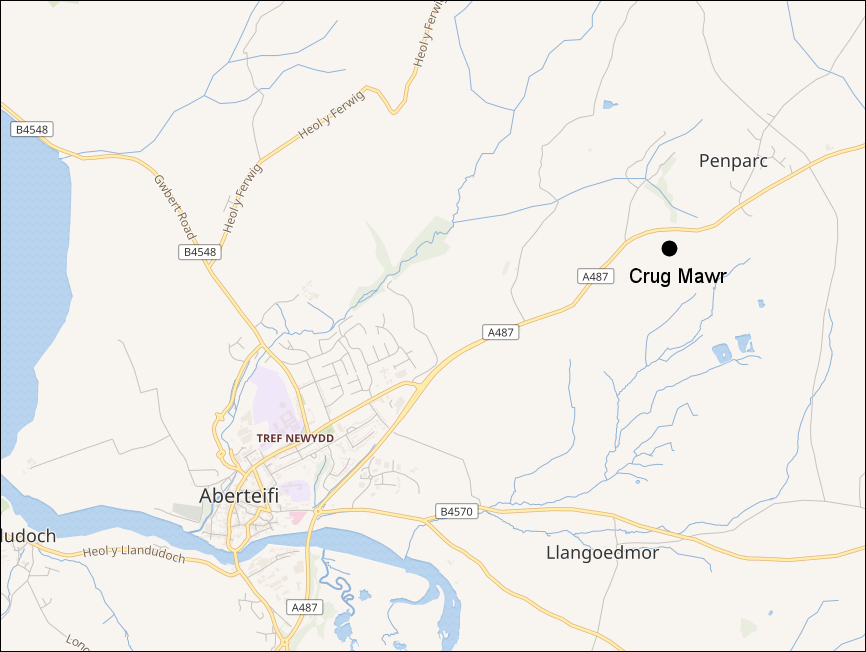
The battle was fought near Penparc, northeast of Cardigan, probably on the hill now known as Banc-y-Warren; it resulted in a rout of the Norman forces, setting back their expansion in West Wales for some years.
A Welsh revolt against Norman rule had begun in South Wales, where on 1 January 1136 the Welsh won a victory over the local Norman forces at the Battle of Llwchwr between Loughor and Swansea, killing about 500 of their opponents. Richard Fitz Gilbert de Clare, the Norman lord of Ceredigion, had been away from his lordship in the early part of the year. Returning to the borders of Wales in April, he ignored warnings of the danger and pressed on towards Ceredigion with a small force. He had not gone far when he was ambushed and killed by the men of Iorwerth ab Owain, grandson of Caradog ap Gruffydd (the penultimate prince of Gwent).
The news of Richard's death led to an invasion by the forces of Gwynedd, led by Owain Gwynedd and Cadwaladr ap Gruffydd, sons of the king of Gwynedd, Gruffudd ap Cynan. They captured a number of castles in northern Ceredigion before returning home to dispose of the plunder. Around Michaelmas (11 October in the Julian Calendar used at the time) they again invaded Ceredigion and made an alliance with Gruffydd ap Rhys of Deheubarth.
The combined Welsh forces headed for the town of Cardigan. The Normans were said to have a substantial force.
The exact location of the battlefield is not known. The Royal Commission on the Ancient and Historical Monuments of Wales puts the site of the battle on the southeast slopes of Banc y Warren (or Banc-y-Warren), a prominent conical hill near Penparc, 2 miles (3.2 km) northeast of Cardigan. There is a farm on the southeast slope named Crugmore. A geophysical survey and archaeological appraisal were carried out at Crugmore Farm in 2014 in support of planning applications. No evidence indicative of a battle was found in the areas covered by the surveys. Some accounts place the site on the northeast of the hill, which may be more likely because the road from Cardigan bends round the northeast side of the hill before turning more northerly again. The southeast side of the hill does not coincide with a road. The hill was known as Crug Mawr at least as early as the 9th century.
Gerald of Wales, in his Itinerarium Cambriae of 1191, describes (56 years after the battle):
We proceeded on our journey from Cilgarran towards Pont-Stephen, leaving Cruc Mawr, i.e. the great hill, near Aberteivi, on our left hand. On this spot Gruffydh, son of Rhys ap Theodor, soon after the death of King Henry I, by a furious onset gained a signal victory against the English army...
Hub AI
Battle of Crug Mawr AI simulator
(@Battle of Crug Mawr_simulator)
Battle of Crug Mawr
The Battle of Crug Mawr (Welsh: Brwydr Crug Mawr), sometimes referred to as the Battle of Cardigan, took place in September or October 1136, as part of a struggle between the Welsh and Normans for control of Ceredigion, West Wales.
The battle was fought near Penparc, northeast of Cardigan, probably on the hill now known as Banc-y-Warren; it resulted in a rout of the Norman forces, setting back their expansion in West Wales for some years.
A Welsh revolt against Norman rule had begun in South Wales, where on 1 January 1136 the Welsh won a victory over the local Norman forces at the Battle of Llwchwr between Loughor and Swansea, killing about 500 of their opponents. Richard Fitz Gilbert de Clare, the Norman lord of Ceredigion, had been away from his lordship in the early part of the year. Returning to the borders of Wales in April, he ignored warnings of the danger and pressed on towards Ceredigion with a small force. He had not gone far when he was ambushed and killed by the men of Iorwerth ab Owain, grandson of Caradog ap Gruffydd (the penultimate prince of Gwent).
The news of Richard's death led to an invasion by the forces of Gwynedd, led by Owain Gwynedd and Cadwaladr ap Gruffydd, sons of the king of Gwynedd, Gruffudd ap Cynan. They captured a number of castles in northern Ceredigion before returning home to dispose of the plunder. Around Michaelmas (11 October in the Julian Calendar used at the time) they again invaded Ceredigion and made an alliance with Gruffydd ap Rhys of Deheubarth.
The combined Welsh forces headed for the town of Cardigan. The Normans were said to have a substantial force.
The exact location of the battlefield is not known. The Royal Commission on the Ancient and Historical Monuments of Wales puts the site of the battle on the southeast slopes of Banc y Warren (or Banc-y-Warren), a prominent conical hill near Penparc, 2 miles (3.2 km) northeast of Cardigan. There is a farm on the southeast slope named Crugmore. A geophysical survey and archaeological appraisal were carried out at Crugmore Farm in 2014 in support of planning applications. No evidence indicative of a battle was found in the areas covered by the surveys. Some accounts place the site on the northeast of the hill, which may be more likely because the road from Cardigan bends round the northeast side of the hill before turning more northerly again. The southeast side of the hill does not coincide with a road. The hill was known as Crug Mawr at least as early as the 9th century.
Gerald of Wales, in his Itinerarium Cambriae of 1191, describes (56 years after the battle):
We proceeded on our journey from Cilgarran towards Pont-Stephen, leaving Cruc Mawr, i.e. the great hill, near Aberteivi, on our left hand. On this spot Gruffydh, son of Rhys ap Theodor, soon after the death of King Henry I, by a furious onset gained a signal victory against the English army...
Recent media