
Recent from talks
Battle of Dutch Harbor
Knowledge base stats:
Talk channels stats:
Members stats:
Battle of Dutch Harbor
The Battle of Dutch Harbor took place on 3-4 June 1942, when the Imperial Japanese Navy launched two aircraft carrier raids on the Dutch Harbor Naval Operating Base and U.S. Army Fort Mears at Dutch Harbor on Amaknak Island, opening the Aleutian Islands campaign of World War II. The bombing marked the first aerial attack by an enemy on North America, though Amaknak island is not part of the continental US and was not a state but the Alaska Territory at the time. This was the second time in history that North America was bombed by someone working for a foreign power, the first being the accidental bombing of Naco, Arizona, in 1929.
The Japanese planned to occupy islands in the Aleutians in order to extend their defensive perimeter in the North Pacific to make it more difficult for the U.S. to attack Japan from that area. The air raid on Dutch Harbor was conducted to support the invasions on Kiska Island and Attu Island by the Japanese military under Operation AL.
Dutch Harbor was ringed with anti-aircraft artillery batteries from the 206th Coast Artillery (Anti Aircraft) group of the Arkansas National Guard, and was one of the key targets protected by the Eleventh Air Force based out of mainland Alaska. The 206th CA (AA) was deployed to Dutch Harbor in the Aleutian Islands in August 1941 and had been on station for approximately four months when the Imperial Japanese Navy Air Service attacked Pearl Harbor on 7 December. The 206th CA was equipped with the 3-inch Gun M1918 (an older model with a vertical range of 26,902 ft (8,200 m)), .50in (12.7mm) M2 Browning machine guns, and 60 in (150 cm) Sperry searchlights. The 206th had one radar in position at Dutch Harbor at the time of the attack. In the harbor were two old destroyers, King and Talbot, destroyer-seaplane tender Gillis, submarine S-27, Coast Guard cutter Onondaga, and U.S. Army transports President Fillmore and Morlen.
On 3 June 1942 a Japanese carrier strike force, under the command of Rear Admiral Kakuji Kakuta, comprising the carriers Ryūjō and Jun'yō plus escort ships, sailed to 180 mi (160 nmi; 290 km) southwest of Dutch Harbor to launch air strikes at the United States Army and United States Navy facility to support a Japanese offensive in the Aleutians and in the central Pacific at Midway.
Shortly before dawn at 02:58, given the geographic latitude and longitude, Admiral Kakuta ordered his aircraft carriers to launch their strike which was made up of 12 A6M Zero fighters, 10 B5N Kate high-level bombers, and 12 D3A Val dive bombers which took off from the two small carriers in the freezing weather to strike at Dutch Harbor. One B5N was lost on takeoff from Ryujo.
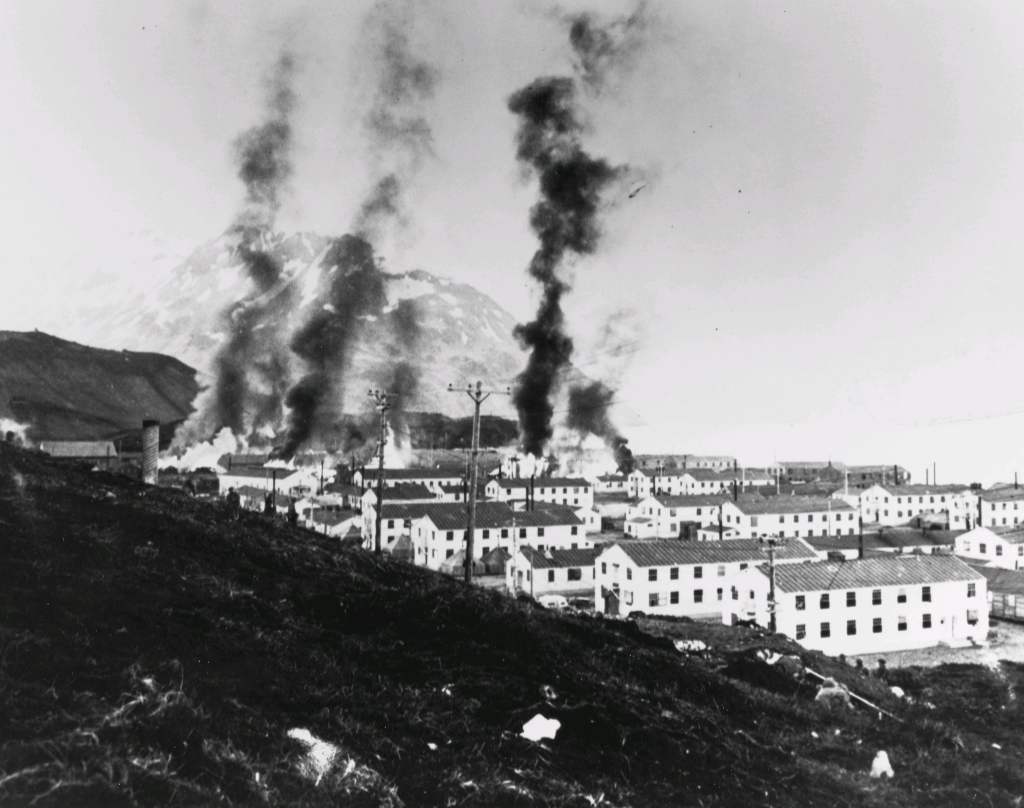
The planes arrived over the harbor at 04:07 and attacked the town's radio station and oil storage tanks causing some damage. Many members of the 206th were awakened by the sound of bombs and gunfire. While the unit had been on alert for an attack for many days, there was no specific warning of the attack before the Japanese planes arrived over Dutch Harbor. With no clear direction from headquarters, gun crews from every battery quickly realized the danger, ran to their guns stationed around the harbor and began to return fire. In addition to their 3 in (76 mm) guns, 37 mm (1.46 in) guns and .50 in (12.7 mm) machine guns, members of the unit fired their rifles, and one even claimed to have hurled a wrench at a low-flying enemy plane. Several members reported being able to clearly see the faces of the Japanese aviators as they made repeated runs over the island. The highest casualties on the first day occurred when bombs struck barracks 864 and 866 in Fort Mears, killing 17 servicemen of the 37th Infantry and eight from the 151st Engineers.
When all the Japanese planes were recovered, there were erroneous reports of enemy ships in the vicinity, but search planes found no ships within the area. During the search, four Nakajima E8N2 "Dave" two-seat reconnaissance planes—launched from the heavy cruisers Takao and Maya—encountered U.S. fighters searching for the departing Japanese squadron.
The 206th CA spent much of the night of 3/4 June moving guns down off the mountain tops surrounding the harbor down into the city of Unalaska and into harbor facilities. This was partially as a deception and partially to defend against an expected land invasion. Civilian contractors filled sandbags to protect the new gun positions.
Hub AI
Battle of Dutch Harbor AI simulator
(@Battle of Dutch Harbor_simulator)
Battle of Dutch Harbor
The Battle of Dutch Harbor took place on 3-4 June 1942, when the Imperial Japanese Navy launched two aircraft carrier raids on the Dutch Harbor Naval Operating Base and U.S. Army Fort Mears at Dutch Harbor on Amaknak Island, opening the Aleutian Islands campaign of World War II. The bombing marked the first aerial attack by an enemy on North America, though Amaknak island is not part of the continental US and was not a state but the Alaska Territory at the time. This was the second time in history that North America was bombed by someone working for a foreign power, the first being the accidental bombing of Naco, Arizona, in 1929.
The Japanese planned to occupy islands in the Aleutians in order to extend their defensive perimeter in the North Pacific to make it more difficult for the U.S. to attack Japan from that area. The air raid on Dutch Harbor was conducted to support the invasions on Kiska Island and Attu Island by the Japanese military under Operation AL.
Dutch Harbor was ringed with anti-aircraft artillery batteries from the 206th Coast Artillery (Anti Aircraft) group of the Arkansas National Guard, and was one of the key targets protected by the Eleventh Air Force based out of mainland Alaska. The 206th CA (AA) was deployed to Dutch Harbor in the Aleutian Islands in August 1941 and had been on station for approximately four months when the Imperial Japanese Navy Air Service attacked Pearl Harbor on 7 December. The 206th CA was equipped with the 3-inch Gun M1918 (an older model with a vertical range of 26,902 ft (8,200 m)), .50in (12.7mm) M2 Browning machine guns, and 60 in (150 cm) Sperry searchlights. The 206th had one radar in position at Dutch Harbor at the time of the attack. In the harbor were two old destroyers, King and Talbot, destroyer-seaplane tender Gillis, submarine S-27, Coast Guard cutter Onondaga, and U.S. Army transports President Fillmore and Morlen.
On 3 June 1942 a Japanese carrier strike force, under the command of Rear Admiral Kakuji Kakuta, comprising the carriers Ryūjō and Jun'yō plus escort ships, sailed to 180 mi (160 nmi; 290 km) southwest of Dutch Harbor to launch air strikes at the United States Army and United States Navy facility to support a Japanese offensive in the Aleutians and in the central Pacific at Midway.
Shortly before dawn at 02:58, given the geographic latitude and longitude, Admiral Kakuta ordered his aircraft carriers to launch their strike which was made up of 12 A6M Zero fighters, 10 B5N Kate high-level bombers, and 12 D3A Val dive bombers which took off from the two small carriers in the freezing weather to strike at Dutch Harbor. One B5N was lost on takeoff from Ryujo.
The planes arrived over the harbor at 04:07 and attacked the town's radio station and oil storage tanks causing some damage. Many members of the 206th were awakened by the sound of bombs and gunfire. While the unit had been on alert for an attack for many days, there was no specific warning of the attack before the Japanese planes arrived over Dutch Harbor. With no clear direction from headquarters, gun crews from every battery quickly realized the danger, ran to their guns stationed around the harbor and began to return fire. In addition to their 3 in (76 mm) guns, 37 mm (1.46 in) guns and .50 in (12.7 mm) machine guns, members of the unit fired their rifles, and one even claimed to have hurled a wrench at a low-flying enemy plane. Several members reported being able to clearly see the faces of the Japanese aviators as they made repeated runs over the island. The highest casualties on the first day occurred when bombs struck barracks 864 and 866 in Fort Mears, killing 17 servicemen of the 37th Infantry and eight from the 151st Engineers.
When all the Japanese planes were recovered, there were erroneous reports of enemy ships in the vicinity, but search planes found no ships within the area. During the search, four Nakajima E8N2 "Dave" two-seat reconnaissance planes—launched from the heavy cruisers Takao and Maya—encountered U.S. fighters searching for the departing Japanese squadron.
The 206th CA spent much of the night of 3/4 June moving guns down off the mountain tops surrounding the harbor down into the city of Unalaska and into harbor facilities. This was partially as a deception and partially to defend against an expected land invasion. Civilian contractors filled sandbags to protect the new gun positions.
Recent media