


Community hub
Recent from talks
Contribute something to knowledge base
Content stats: 0 posts, 0 articles, 1 media, 0 notes
Members stats: 0 subscribers, 0 contributors, 0 moderators, 0 supporters
Subscribers
Supporters
Contributors
Moderators
Hub AI
Battle of Fraustadt AI simulator
(@Battle of Fraustadt_simulator)
Hub AI
Battle of Fraustadt AI simulator
(@Battle of Fraustadt_simulator)
Battle of Fraustadt
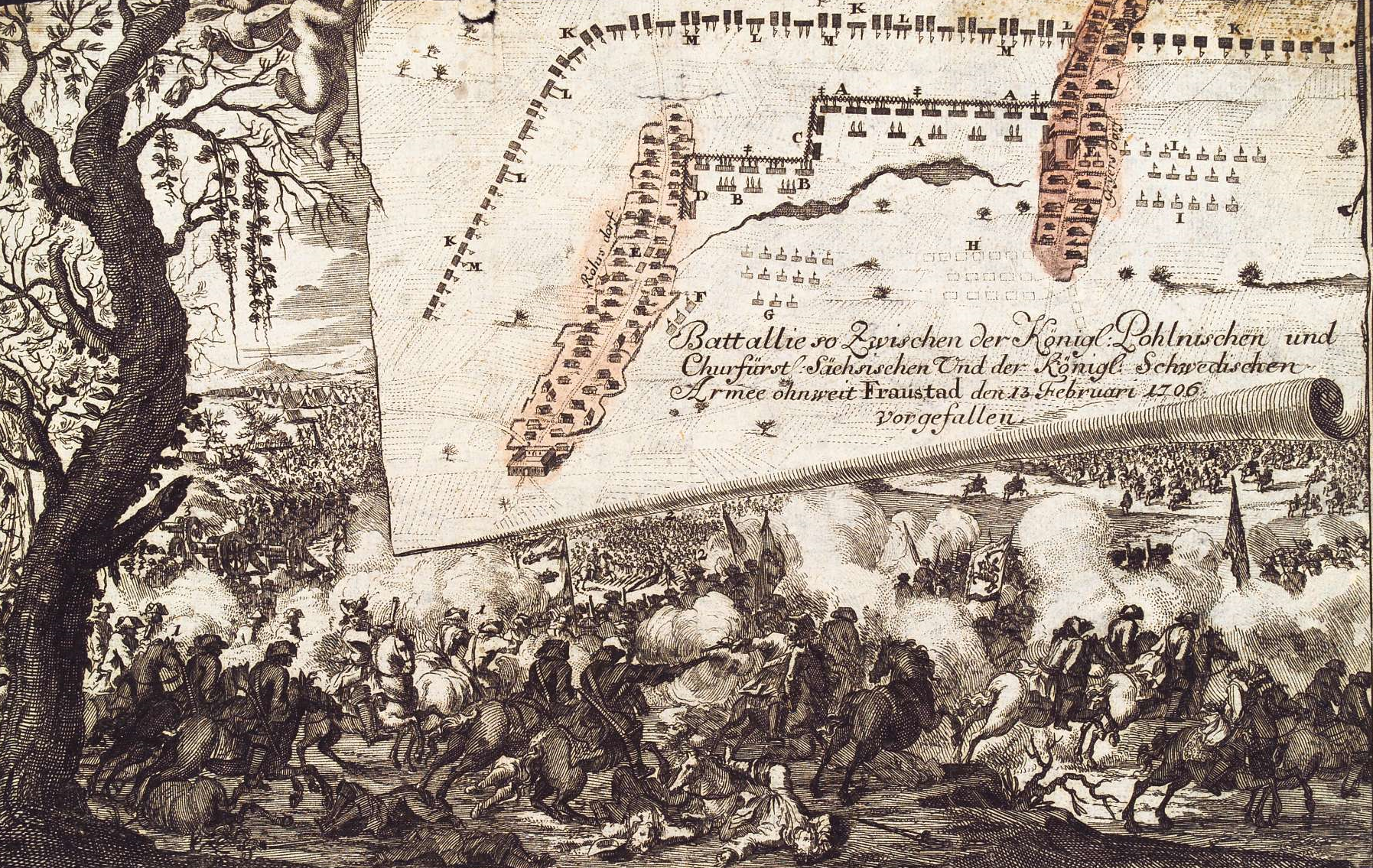
The Battle of Fraustadt was fought on 2 February 1706 (O.S.) / 3 February 1706 (Swedish calendar) / 13 February 1706 (N.S.) between Sweden and Saxony-Poland and their Russian allies near Fraustadt (now Wschowa) in Poland. During the Battle of Fraustadt on February 3, August II was only 120 km away, with a cavalry force about 8,000 men strong. According to Cathal Nolan that caused Swedish General Rehnskiöld to rush to engage Schulenburg. The Swedes were outnumbered by more than two to one by Saxons, mercenaries, and Russians. Ignoring the odds, Rehnsköld attacked the enemy's well-entrenched position. He sent cavalry to drive off defending Saxon horse on either wing and complete a classic double envelopment. The manoeuvre meant they could attack from behind into the center rear of the enemy's main line. The result was 8,000 Russian deaths and 5,000 Saxons and German mercenaries taken prisoner. The battle is a textbook example of a perfect pincer movement and was one of Sweden's key victories in the Great Northern War.
After King Charles XII of Sweden's victory against the Saxon-Russian army in the Battle of Düna, he was able to begin his campaign against Poland. After the victory at the Battle of Kliszów in July 1702, Charles XII negotiated to depose August II from the throne of Poland, but to no avail. The Swedish army then subjected the well-fortified city of Thorn (Torun) on the river Weichsel to a long-term blockade from May to October 1703. The city fell and its entire garrison of 4,800 Saxon soldiers was taken prisoner. The strength of the Swedish army, combined with August's agreement with Tsar Peter I, caused many Polish nobles to defect to the pro-Swedish opposition. In February 1704, August was declared no longer king of Poland, and in July of the same year Stanisław Leszczyński was elected king.
However, August II was not defeated and the Russians had an interest in supporting him. The Russo-Saxon strategic plan was for a Saxon army under Johann Matthias von der Schulenburg to break into Poland to join a larger cavalry force led by August II himself and then with the main Russian force, which was in Livonia, defeat the Swedish main army. In western Poland, however, there was a Swedish army corps under Rehnskiöld, which either had to be bypassed or fought by Schulenburg before the unification could take place.
In early March 1705, the Russian field marshal Boris Sheremetev organized a meeting with the Saxon general Otto Arnold von Paijkull to agree on a joint plan of action to defeat Charles XII. The basis of the strategy was a plan drawn up by the nobleman Johann Patkul as early as 1703, which included a combined attack that would neutralize the Swedish army. Von Paijkull was impressed by Patkul's plans, and advocated that the plan could be used as a way to lure Charles XII and the main Swedish army out of Greater Poland and move east towards Brest-Litovsk. This was to be achieved by the convergence of the main Russian army under Georg Benedikt von Ogilvy and von Paijkull's troops stationed at Brest, forcing Charles XII to meet them in battle. At the same time, the main Saxon army from Saxony would march past Poland and attack Charles XII from the rear. Patkul considered the plan too risky and suggested that the Allies should first crush Lewenhaupt's Courland army, before Ogilvy's troops would face Charles XII. Otherwise, Ogilvy's back would be threatened. A compromise was made between the two strategies, in which it was agreed that Sheremetev would engage Lewenhaupt while Ogilvy marched on the fortified city of Grodno. There, the allies believed that Ogilvy could hold out against Charles XII's troops long enough for the main Saxon army to arrive from Kraków. Meanwhile, von Paykull would attack with his combined Saxon-Polish troops on Warsaw to interrupt Stanisław's coronation.
The Saxon army had not chosen its position carefully; Schulenburg had been maneuvered into a position chosen by the Swedes. Rehnskiöld withdrew his forces from Schlawa to Fraustadt. Rehnskiöld later stated in his journals, (in Swedish) “Så resolverade jag att draga mig till Fraustadt tillbaka i den tanken att locka till mig fienden efter mig utur sin fördel, inbillandes honom att jag ville alldeles draga mig av” roughly translated as ”Thus I resolved to withdraw to Fraustadt with the thought to lure the enemy to me away from his advantageous position, deceiving him into thinking I was in full retreat”.
The Saxons, superior in numbers regarding infantry (9,000 Saxons and 6,300 Russians), but with less cavalry (4,000 Saxons) than the Swedes, took a strong defensive position behind lines of chevaux de frise littered by artillery. In two lines, with cavalry on both flanks, between the villages of Geyersdorf and Röhrsdorf and ahead of the town of Fraustadt, entrenched behind frozen lakes and marshes opposing the Saxon-Russian army, Rehnskiöld placed his infantry of 3,700 men in the center in three columns and his cavalry consisting of 5,700 units on both flanks.
On the left flank, the Swedish cavalry under Alexander Hummerhielm had some trouble passing through a frozen swamp, but the Saxon cavalry did not use that advantage. After regrouping, the Swedes charged the Saxon Garde du Corps and Chevaliers Garde regiments three times, utterly routing them. Colonel von Krassow, commander of the Swedish cavalry on the right flank, passed outside the left Russian flank with 12 dragoon squadrons, near the village of Röhrsdorf, and engaged the Saxon Cavalry covering the Russian flank. After witnessing the destruction of the Saxon right flank, the left flank fled, and were routed by the Swedish dragoons. Colonel von Krassow's cavalry then wheeled clock-wise into the Saxon-Russian rear, which caused several of the Saxon regiments to break formation.
On the Saxon left flank, facing Rehnskiöld's infantry, the Russians were deployed with their uniforms inside-out so they would look more like Saxons with their red colors instead of the Russian-standard green. This was however an order from Schulenburg who questioned their battle skills to reveal the weakness of the flank. The Swedish infantry assaulted the Saxon-Russian line frontally, under heavy cannon and musket fire. Upon discovering that the left wing of the enemy line was held by the Russian troops, Rehnskiöld directed his infantry to assault their positions, which were also being attacked from the rear by colonel von Krassow's cavalry. The Russian infantry were quickly surrounded and dispersed.
Battle of Fraustadt
The Battle of Fraustadt was fought on 2 February 1706 (O.S.) / 3 February 1706 (Swedish calendar) / 13 February 1706 (N.S.) between Sweden and Saxony-Poland and their Russian allies near Fraustadt (now Wschowa) in Poland. During the Battle of Fraustadt on February 3, August II was only 120 km away, with a cavalry force about 8,000 men strong. According to Cathal Nolan that caused Swedish General Rehnskiöld to rush to engage Schulenburg. The Swedes were outnumbered by more than two to one by Saxons, mercenaries, and Russians. Ignoring the odds, Rehnsköld attacked the enemy's well-entrenched position. He sent cavalry to drive off defending Saxon horse on either wing and complete a classic double envelopment. The manoeuvre meant they could attack from behind into the center rear of the enemy's main line. The result was 8,000 Russian deaths and 5,000 Saxons and German mercenaries taken prisoner. The battle is a textbook example of a perfect pincer movement and was one of Sweden's key victories in the Great Northern War.
After King Charles XII of Sweden's victory against the Saxon-Russian army in the Battle of Düna, he was able to begin his campaign against Poland. After the victory at the Battle of Kliszów in July 1702, Charles XII negotiated to depose August II from the throne of Poland, but to no avail. The Swedish army then subjected the well-fortified city of Thorn (Torun) on the river Weichsel to a long-term blockade from May to October 1703. The city fell and its entire garrison of 4,800 Saxon soldiers was taken prisoner. The strength of the Swedish army, combined with August's agreement with Tsar Peter I, caused many Polish nobles to defect to the pro-Swedish opposition. In February 1704, August was declared no longer king of Poland, and in July of the same year Stanisław Leszczyński was elected king.
However, August II was not defeated and the Russians had an interest in supporting him. The Russo-Saxon strategic plan was for a Saxon army under Johann Matthias von der Schulenburg to break into Poland to join a larger cavalry force led by August II himself and then with the main Russian force, which was in Livonia, defeat the Swedish main army. In western Poland, however, there was a Swedish army corps under Rehnskiöld, which either had to be bypassed or fought by Schulenburg before the unification could take place.
In early March 1705, the Russian field marshal Boris Sheremetev organized a meeting with the Saxon general Otto Arnold von Paijkull to agree on a joint plan of action to defeat Charles XII. The basis of the strategy was a plan drawn up by the nobleman Johann Patkul as early as 1703, which included a combined attack that would neutralize the Swedish army. Von Paijkull was impressed by Patkul's plans, and advocated that the plan could be used as a way to lure Charles XII and the main Swedish army out of Greater Poland and move east towards Brest-Litovsk. This was to be achieved by the convergence of the main Russian army under Georg Benedikt von Ogilvy and von Paijkull's troops stationed at Brest, forcing Charles XII to meet them in battle. At the same time, the main Saxon army from Saxony would march past Poland and attack Charles XII from the rear. Patkul considered the plan too risky and suggested that the Allies should first crush Lewenhaupt's Courland army, before Ogilvy's troops would face Charles XII. Otherwise, Ogilvy's back would be threatened. A compromise was made between the two strategies, in which it was agreed that Sheremetev would engage Lewenhaupt while Ogilvy marched on the fortified city of Grodno. There, the allies believed that Ogilvy could hold out against Charles XII's troops long enough for the main Saxon army to arrive from Kraków. Meanwhile, von Paykull would attack with his combined Saxon-Polish troops on Warsaw to interrupt Stanisław's coronation.
The Saxon army had not chosen its position carefully; Schulenburg had been maneuvered into a position chosen by the Swedes. Rehnskiöld withdrew his forces from Schlawa to Fraustadt. Rehnskiöld later stated in his journals, (in Swedish) “Så resolverade jag att draga mig till Fraustadt tillbaka i den tanken att locka till mig fienden efter mig utur sin fördel, inbillandes honom att jag ville alldeles draga mig av” roughly translated as ”Thus I resolved to withdraw to Fraustadt with the thought to lure the enemy to me away from his advantageous position, deceiving him into thinking I was in full retreat”.
The Saxons, superior in numbers regarding infantry (9,000 Saxons and 6,300 Russians), but with less cavalry (4,000 Saxons) than the Swedes, took a strong defensive position behind lines of chevaux de frise littered by artillery. In two lines, with cavalry on both flanks, between the villages of Geyersdorf and Röhrsdorf and ahead of the town of Fraustadt, entrenched behind frozen lakes and marshes opposing the Saxon-Russian army, Rehnskiöld placed his infantry of 3,700 men in the center in three columns and his cavalry consisting of 5,700 units on both flanks.
On the left flank, the Swedish cavalry under Alexander Hummerhielm had some trouble passing through a frozen swamp, but the Saxon cavalry did not use that advantage. After regrouping, the Swedes charged the Saxon Garde du Corps and Chevaliers Garde regiments three times, utterly routing them. Colonel von Krassow, commander of the Swedish cavalry on the right flank, passed outside the left Russian flank with 12 dragoon squadrons, near the village of Röhrsdorf, and engaged the Saxon Cavalry covering the Russian flank. After witnessing the destruction of the Saxon right flank, the left flank fled, and were routed by the Swedish dragoons. Colonel von Krassow's cavalry then wheeled clock-wise into the Saxon-Russian rear, which caused several of the Saxon regiments to break formation.
On the Saxon left flank, facing Rehnskiöld's infantry, the Russians were deployed with their uniforms inside-out so they would look more like Saxons with their red colors instead of the Russian-standard green. This was however an order from Schulenburg who questioned their battle skills to reveal the weakness of the flank. The Swedish infantry assaulted the Saxon-Russian line frontally, under heavy cannon and musket fire. Upon discovering that the left wing of the enemy line was held by the Russian troops, Rehnskiöld directed his infantry to assault their positions, which were also being attacked from the rear by colonel von Krassow's cavalry. The Russian infantry were quickly surrounded and dispersed.
Recent media
Recent media