



Community hub
Recent from talks
Contribute something to knowledge base
Content stats: 0 posts, 0 articles, 1 media, 0 notes
Members stats: 0 subscribers, 0 contributors, 0 moderators, 0 supporters
Subscribers
Supporters
Contributors
Moderators
Hub AI
Battle of Grand Port AI simulator
(@Battle of Grand Port_simulator)
Hub AI
Battle of Grand Port AI simulator
(@Battle of Grand Port_simulator)
Battle of Grand Port
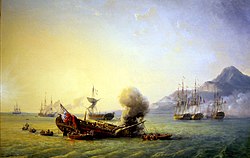
The Battle of Grand Port was a naval battle fought on 20–27 August 1810 between squadrons of frigates from the French Navy and the British Royal Navy over possession of the harbour of Grand Port on Isle de France (now Mauritius), as part of the Mauritius campaign during the Napoleonic Wars. A British squadron of four frigates sought to blockade the port to prevent its use by the French through the capture of the fortified Île de la Passe at its entrance. This position was seized by a British landing party on 13 August and, when a French squadron under Captain Guy-Victor Duperré approached the bay nine days later, the British commander, Captain Samuel Pym, decided to lure them into coastal waters where his forces could ambush them.
Four of the five French ships managed to break past the British blockade, taking shelter in the protected anchorage, which was only accessible through a series of complicated routes between reefs and sandbanks that were impassable without an experienced harbour pilot. When Pym ordered his frigates to attack the anchored French on 22 and 23 August, his ships became trapped in the narrow channels of the bay: two were irretrievably grounded; a third, outnumbered by the combined French squadron, was defeated; and a fourth was unable to close to within effective gun range. Although the French ships were also badly damaged, the battle was a disaster for the British: one ship was captured after suffering irreparable damage, the grounded ships were set on fire to prevent their capture by French boarding parties, and the remaining vessel was seized as it left the harbour by the main French squadron from Port Napoleon under Commodore Jacques Hamelin.
The British defeat is often considered the worst suffered by the Royal Navy during all of the Napoleonic Wars. It left the Indian Ocean and its vital trade convoys exposed to attack from Hamelin's frigates. In response, British authorities sought to reinforce the squadron on Isle Bourbon under Commodore Josias Rowley by ordering all available ships to the region, but this piecemeal reinforcement resulted in a series of desperate actions as individual British ships were attacked by the confident and more powerful French squadron. In December an adequate reinforcement was assembled with the provision of a strong battle squadron under Admiral Albemarle Bertie, which rapidly invaded and captured Isle de France.
During the early 19th century, the Indian Ocean formed an essential part of the network of trade routes that connected the British Empire. Heavily laden East Indiamen travelled from ports in British India such as Bombay and Calcutta to the United Kingdom carrying millions of pounds of goods. From Britain, the ships returned on the same routes, often carrying soldiers for the growing British Indian Army, then under the control of the Honourable East India Company (HEIC). Following the outbreak of the Napoleonic Wars in 1803, the British Admiralty had made the security of these routes a priority, and by 1807, the Dutch bases at the Cape of Good Hope and Java had been neutralised by expeditionary forces to prevent their use by enemy raiders. The French Indian Ocean possessions, principally Isle Bonaparte and Isle de France, were more complicated targets, protected from attack not only by the great distances involved in preparing an invasion attempt but also by heavy fortifications and a substantial garrison of French Army soldiers augmented by large local militias.
The French had recognised the importance of these islands as bases for raiding warships during the French Revolutionary Wars (1793–1801), but by late 1807 the only naval resources allocated to the region were a few older frigates and a large number of local privateers. Following the reduction of these remaining naval forces on Isle de France by defeat in battle and disarmaments due to age and unseaworthiness during 1808, French naval authorities made a serious attempt to disrupt British trade in the region, ordering five large modern frigates to sail to Isle de France under Commodore Jacques Félix Emmanuel Hamelin. Four of these ships broke through the British blockade of the French coast, arriving in the Indian Ocean in the spring of 1809, where Hamelin dispersed them into the Bay of Bengal with orders to intercept, attack, and capture or destroy the heavily armed but extremely valuable convoys of East Indiamen. The first French success came at the end of the spring, when the frigate Caroline successfully attacked a convoy in the action of 31 May 1809, seizing two heavily laden merchant ships.
Commodore Josias Rowley was given command of the British response, a hastily assembled force composed mainly of those ships which happened to be available at the Cape of Good Hope in early 1809. Ordered to stop the French raiders, Rowley was unable to spread his small squadron wide enough to pursue the roving French frigates, instead using his forces to blockade and raid the French islands in anticipation of Hamelin's return. In August, Caroline arrived with her prizes at Saint-Paul on Isle Bonaparte and Rowley determined to seize the frigate. He planned a successful invasion of the town, launched on 20 September, which resulted in the capture of the port's defences, Caroline, and the captured East Indiamen. With his objectives complete, Rowley withdrew five days later. Almost a year later, Rowley returned with a larger task force and made a second landing around the capital of Isle Bonaparte, Saint-Denis. Marching on the seat of government, Rowley's troops rapidly overwhelmed the defences and forced the island's garrison to surrender, renaming the island Isle Bourbon and installing a British governor.
Hamelin had used the British preoccupation with Isle Bonaparte to send additional frigates to sea during 1809 and early 1810, including his flagship Vénus, which captured three East Indiamen in the action of 18 November 1809, and Bellone, which took the Portuguese frigate Minerva in the Bay of Bengal a few days later. Minerva, renamed Minerve in French hands, was subsequently involved in the action of 3 July 1810, when a further two East Indiamen were captured. The squadron in this action was commanded by Guy-Victor Duperré in Bellone, whose ships were so badly damaged that Duperré was forced to spend nearly a month repairing his vessels in the Comoros Islands before they were ready to return to Isle de France.
With Isle Bourbon secured in July 1810, the British now occupied a large fortified island base within easy sailing distance of Isle de France. Even before Isle Bourbon was completely in British hands, Rowley had detached HMS Sirius from the invasion squadron with orders to restore the blockade of Isle de France. Shortly afterwards, Captain Samuel Pym of HMS Sirius led his men in a raid on a coastal vessel moored off the southern side of the island. Two days after this successful operation, British reinforcements arrived in the form of the frigates HMS Iphigenia and HMS Nereide, and the small brig HMS Staunch. Nereide carried 100 specially selected infantrymen from the 69th and 33rd Regiments and some artillerymen from the garrison at Madras to be used in storming and garrisoning offshore islands, beginning with Île de la Passe, a heavily fortified islet off the southeastern shore which protected the entrance to the natural harbour of Grand Port. These fortified islands could be used to block entry to the ports of Isle de France and thus trap Hamelin's squadron.
Battle of Grand Port
The Battle of Grand Port was a naval battle fought on 20–27 August 1810 between squadrons of frigates from the French Navy and the British Royal Navy over possession of the harbour of Grand Port on Isle de France (now Mauritius), as part of the Mauritius campaign during the Napoleonic Wars. A British squadron of four frigates sought to blockade the port to prevent its use by the French through the capture of the fortified Île de la Passe at its entrance. This position was seized by a British landing party on 13 August and, when a French squadron under Captain Guy-Victor Duperré approached the bay nine days later, the British commander, Captain Samuel Pym, decided to lure them into coastal waters where his forces could ambush them.
Four of the five French ships managed to break past the British blockade, taking shelter in the protected anchorage, which was only accessible through a series of complicated routes between reefs and sandbanks that were impassable without an experienced harbour pilot. When Pym ordered his frigates to attack the anchored French on 22 and 23 August, his ships became trapped in the narrow channels of the bay: two were irretrievably grounded; a third, outnumbered by the combined French squadron, was defeated; and a fourth was unable to close to within effective gun range. Although the French ships were also badly damaged, the battle was a disaster for the British: one ship was captured after suffering irreparable damage, the grounded ships were set on fire to prevent their capture by French boarding parties, and the remaining vessel was seized as it left the harbour by the main French squadron from Port Napoleon under Commodore Jacques Hamelin.
The British defeat is often considered the worst suffered by the Royal Navy during all of the Napoleonic Wars. It left the Indian Ocean and its vital trade convoys exposed to attack from Hamelin's frigates. In response, British authorities sought to reinforce the squadron on Isle Bourbon under Commodore Josias Rowley by ordering all available ships to the region, but this piecemeal reinforcement resulted in a series of desperate actions as individual British ships were attacked by the confident and more powerful French squadron. In December an adequate reinforcement was assembled with the provision of a strong battle squadron under Admiral Albemarle Bertie, which rapidly invaded and captured Isle de France.
During the early 19th century, the Indian Ocean formed an essential part of the network of trade routes that connected the British Empire. Heavily laden East Indiamen travelled from ports in British India such as Bombay and Calcutta to the United Kingdom carrying millions of pounds of goods. From Britain, the ships returned on the same routes, often carrying soldiers for the growing British Indian Army, then under the control of the Honourable East India Company (HEIC). Following the outbreak of the Napoleonic Wars in 1803, the British Admiralty had made the security of these routes a priority, and by 1807, the Dutch bases at the Cape of Good Hope and Java had been neutralised by expeditionary forces to prevent their use by enemy raiders. The French Indian Ocean possessions, principally Isle Bonaparte and Isle de France, were more complicated targets, protected from attack not only by the great distances involved in preparing an invasion attempt but also by heavy fortifications and a substantial garrison of French Army soldiers augmented by large local militias.
The French had recognised the importance of these islands as bases for raiding warships during the French Revolutionary Wars (1793–1801), but by late 1807 the only naval resources allocated to the region were a few older frigates and a large number of local privateers. Following the reduction of these remaining naval forces on Isle de France by defeat in battle and disarmaments due to age and unseaworthiness during 1808, French naval authorities made a serious attempt to disrupt British trade in the region, ordering five large modern frigates to sail to Isle de France under Commodore Jacques Félix Emmanuel Hamelin. Four of these ships broke through the British blockade of the French coast, arriving in the Indian Ocean in the spring of 1809, where Hamelin dispersed them into the Bay of Bengal with orders to intercept, attack, and capture or destroy the heavily armed but extremely valuable convoys of East Indiamen. The first French success came at the end of the spring, when the frigate Caroline successfully attacked a convoy in the action of 31 May 1809, seizing two heavily laden merchant ships.
Commodore Josias Rowley was given command of the British response, a hastily assembled force composed mainly of those ships which happened to be available at the Cape of Good Hope in early 1809. Ordered to stop the French raiders, Rowley was unable to spread his small squadron wide enough to pursue the roving French frigates, instead using his forces to blockade and raid the French islands in anticipation of Hamelin's return. In August, Caroline arrived with her prizes at Saint-Paul on Isle Bonaparte and Rowley determined to seize the frigate. He planned a successful invasion of the town, launched on 20 September, which resulted in the capture of the port's defences, Caroline, and the captured East Indiamen. With his objectives complete, Rowley withdrew five days later. Almost a year later, Rowley returned with a larger task force and made a second landing around the capital of Isle Bonaparte, Saint-Denis. Marching on the seat of government, Rowley's troops rapidly overwhelmed the defences and forced the island's garrison to surrender, renaming the island Isle Bourbon and installing a British governor.
Hamelin had used the British preoccupation with Isle Bonaparte to send additional frigates to sea during 1809 and early 1810, including his flagship Vénus, which captured three East Indiamen in the action of 18 November 1809, and Bellone, which took the Portuguese frigate Minerva in the Bay of Bengal a few days later. Minerva, renamed Minerve in French hands, was subsequently involved in the action of 3 July 1810, when a further two East Indiamen were captured. The squadron in this action was commanded by Guy-Victor Duperré in Bellone, whose ships were so badly damaged that Duperré was forced to spend nearly a month repairing his vessels in the Comoros Islands before they were ready to return to Isle de France.
With Isle Bourbon secured in July 1810, the British now occupied a large fortified island base within easy sailing distance of Isle de France. Even before Isle Bourbon was completely in British hands, Rowley had detached HMS Sirius from the invasion squadron with orders to restore the blockade of Isle de France. Shortly afterwards, Captain Samuel Pym of HMS Sirius led his men in a raid on a coastal vessel moored off the southern side of the island. Two days after this successful operation, British reinforcements arrived in the form of the frigates HMS Iphigenia and HMS Nereide, and the small brig HMS Staunch. Nereide carried 100 specially selected infantrymen from the 69th and 33rd Regiments and some artillerymen from the garrison at Madras to be used in storming and garrisoning offshore islands, beginning with Île de la Passe, a heavily fortified islet off the southeastern shore which protected the entrance to the natural harbour of Grand Port. These fortified islands could be used to block entry to the ports of Isle de France and thus trap Hamelin's squadron.
Recent media
Recent media