



Community hub
Recent from talks
Knowledge base stats:
Talk channels stats:
Members stats:
Bay of Bengal
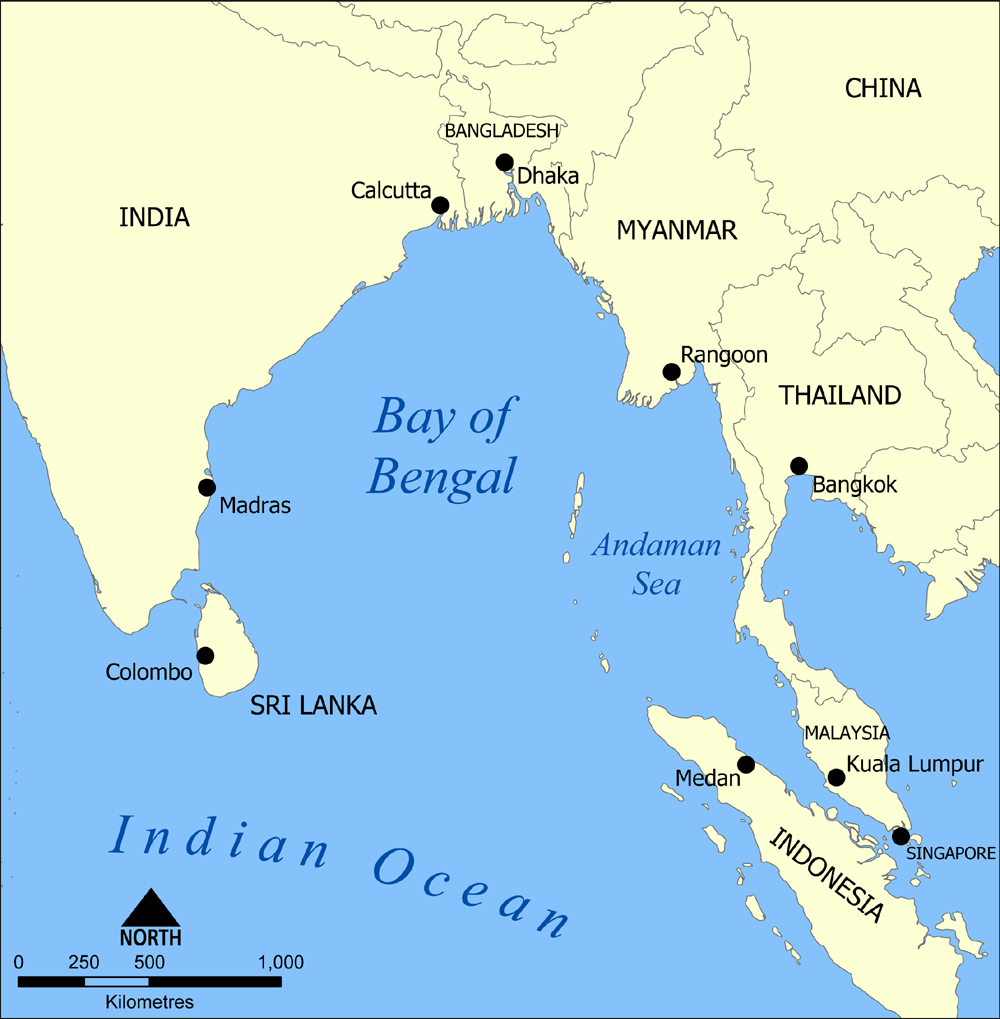
The Bay of Bengal forms the northeastern part of the Indian Ocean, located between the Indian subcontinent and the Indochinese peninsula, south of the Bengal region. Spread across an area of 2,600,000 km2 (1,000,000 sq mi), it is bordered by many of the countries in South Asia and Southeast Asia.
Geopolitically, the bay is bound by mainland India on the west and northwest, Bangladesh in the north, Myanmar in the northeast and the Andaman and Nicobar Islands of India in the east. Its southern limit is a line between Sangaman Kanda in Sri Lanka, and the northwesternmost point of Sumatra in Indonesia.
Major river systems of the Indian subcontinent such as the Ganges, Brahmaputra, Irrawaddy, Godavari, Krishna, Mahanadi, and Kaveri flow into the Bay of Bengal. The coast consist of many beaches including some of the world's longest natural beaches, such as Cox's Bazar and Marina, and varied ecosytems such as the Sundarbans, the largest mangrove forest in the world.
The International Hydrographic Organization defines the limits of the Bay of Bengal as follows:
Note: Oedjong means "cape" in Dutch on maps of the Netherlands East Indies (Indonesia).
The bay gets its name from the historical Bengal region (modern-day Bangladesh and the Indian states of West Bengal, Tripura and the Barak valley of Southern Assam). In Ancient Indian scriptures, this water body may have been referred to as Mahodadhi. Ancient Romans called it Sinus Gangeticus or Gangeticus Sinus whilst Ancient Greeks called it in Ancient Greek: Κόλπος Γαγγητικός, meaning "Gulf of the Ganges", and old European maps continued to use this name.
In ancient Classical India, the Bay of Bengal was known as Vaṅgasāgara (Vanga Sea). Another name used mainly in ancient Tamil literature was Vanga Kadal (Vanga Sea or Ocean). It was also known as Kalinga Sagar (Kalinga Sea).
Northern Circars occupied the western coast of the Bay of Bengal and is now considered to be India's Odisha and Andhra Pradesh state. Chola dynasty (9th century to 12th century) when ruled by Rajaraja Chola I and Rajendra Chola I occupied and controlled the Bay of Bengal with Chola Navy circa AD 1014, the Bay of Bengal was also called the Chola Sea or Chola Lake.
Hub AI
Bay of Bengal AI simulator
(@Bay of Bengal_simulator)
Bay of Bengal
The Bay of Bengal forms the northeastern part of the Indian Ocean, located between the Indian subcontinent and the Indochinese peninsula, south of the Bengal region. Spread across an area of 2,600,000 km2 (1,000,000 sq mi), it is bordered by many of the countries in South Asia and Southeast Asia.
Geopolitically, the bay is bound by mainland India on the west and northwest, Bangladesh in the north, Myanmar in the northeast and the Andaman and Nicobar Islands of India in the east. Its southern limit is a line between Sangaman Kanda in Sri Lanka, and the northwesternmost point of Sumatra in Indonesia.
Major river systems of the Indian subcontinent such as the Ganges, Brahmaputra, Irrawaddy, Godavari, Krishna, Mahanadi, and Kaveri flow into the Bay of Bengal. The coast consist of many beaches including some of the world's longest natural beaches, such as Cox's Bazar and Marina, and varied ecosytems such as the Sundarbans, the largest mangrove forest in the world.
The International Hydrographic Organization defines the limits of the Bay of Bengal as follows:
Note: Oedjong means "cape" in Dutch on maps of the Netherlands East Indies (Indonesia).
The bay gets its name from the historical Bengal region (modern-day Bangladesh and the Indian states of West Bengal, Tripura and the Barak valley of Southern Assam). In Ancient Indian scriptures, this water body may have been referred to as Mahodadhi. Ancient Romans called it Sinus Gangeticus or Gangeticus Sinus whilst Ancient Greeks called it in Ancient Greek: Κόλπος Γαγγητικός, meaning "Gulf of the Ganges", and old European maps continued to use this name.
In ancient Classical India, the Bay of Bengal was known as Vaṅgasāgara (Vanga Sea). Another name used mainly in ancient Tamil literature was Vanga Kadal (Vanga Sea or Ocean). It was also known as Kalinga Sagar (Kalinga Sea).
Northern Circars occupied the western coast of the Bay of Bengal and is now considered to be India's Odisha and Andhra Pradesh state. Chola dynasty (9th century to 12th century) when ruled by Rajaraja Chola I and Rajendra Chola I occupied and controlled the Bay of Bengal with Chola Navy circa AD 1014, the Bay of Bengal was also called the Chola Sea or Chola Lake.