


Community hub
Recent from talks
Contribute something to knowledge base
Content stats: 0 posts, 0 articles, 1 media, 0 notes
Members stats: 0 subscribers, 0 contributors, 0 moderators, 0 supporters
Subscribers
Supporters
Contributors
Moderators
Hub AI
Battle of Hatteras Inlet Batteries AI simulator
(@Battle of Hatteras Inlet Batteries_simulator)
Hub AI
Battle of Hatteras Inlet Batteries AI simulator
(@Battle of Hatteras Inlet Batteries_simulator)
Battle of Hatteras Inlet Batteries
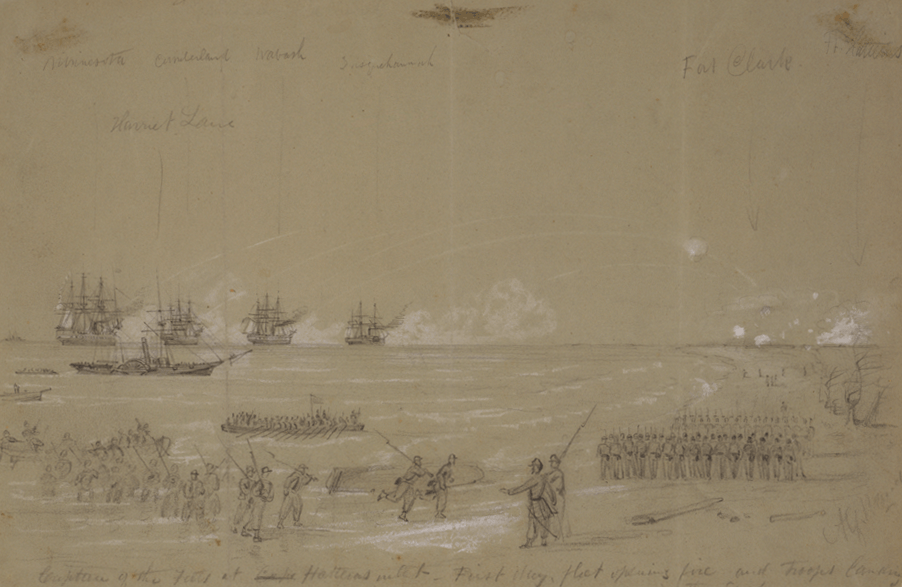
The Battle of Hatteras Inlet Batteries (August 28–29, 1861) was the first combined operation of the Union Army and Navy in the American Civil War, resulting in Union domination of the strategically important North Carolina Sounds.
Two forts on the Outer Banks, Fort Clark and Fort Hatteras, had been built by the Confederates to protect their commerce-raiding activity. These were lightly defended, however, and their artillery could not engage the bombarding fleet under Flag Officer Silas H. Stringham, commandant of the Atlantic Blockading Squadron, which had been ordered to keep moving, to avoid presenting a static target. Although held up by bad weather, the fleet was able to land troops under General Benjamin Butler, who took the surrender of Flag Officer Samuel Barron.
This battle represented the first application of the naval blockading strategy. The Union retained both forts, providing valuable access to the sounds, and commerce raiding was much reduced. The victory was welcomed by a demoralized Northern public after the humiliating First Battle of Bull Run. The engagement is sometimes known as the Battle of Forts Hatteras and Clark.
The North Carolina Sounds occupy most of the coast from Cape Lookout (North Carolina) to the Virginia border. With their eastern borders marked by the Outer Banks, they were almost ideally located for raiding Northern maritime commerce. Cape Hatteras, the easternmost point in the Confederacy, is within sight of the Gulf Stream, which moves at a speed of about 3 knots (1.5 m/s) at this latitude. Ships in the Caribbean trade would reduce the time of their homeward journeys to New York, Philadelphia, or Boston by riding the stream to the north. Raiders, either privateers or state-owned vessels, could lie inside, protected from both the weather and from Yankee blockaders, until an undefended victim appeared. Watchers stationed at the Hatteras lighthouse would then signal a raider, which would dash out and make a capture, often being able to return the same day.
To protect the raiders from Federal reprisal, the state of North Carolina immediately after seceding from the Union established forts at the inlets, waterways that allowed entrance to and egress from the sounds. In 1861, only four inlets were deep enough for ocean-going vessels to pass: Beaufort, Ocracoke, Hatteras, and Oregon Inlets. Hatteras Inlet was the most important of these, so it was given two forts, named Fort Hatteras and Fort Clark Fort Hatteras was sited adjacent to the inlet, on the sound side of Hatteras Island. Fort Clark was about half a mile (800 m) to the southeast, closer to the Atlantic Ocean. The forts were not very strong; Fort Hatteras had only ten guns mounted by the end of August, with another five guns in the fort but not mounted. Fort Clark had only five. Furthermore, most of the guns were rather light 32-pounders or smaller, of limited range and inadequate for coastal defense.
The personnel problem was even worse. North Carolina had raised and equipped 22 infantry regiments to serve in the war, but 16 of these had been drawn off for the campaigns in Virginia. The six regiments remaining were responsible for the defense of the entire North Carolina coastline. Only a fraction of one regiment, the 7th North Carolina Volunteers, occupied the two forts at Hatteras Inlet. The other forts were likewise only weakly held. Fewer than a thousand men garrisoned Forts Ocracoke, Hatteras, Clark, and Oregon. Reinforcements, if needed, would have to come from as far away as Beaufort.
Strangely, the military authorities in North Carolina did little to keep the poor state of their defenses secret. Several Yankee captains, victims of either capture or shipwreck, were loosely detained at or near Hatteras Island while awaiting return to their homes. They were allowed virtually free access to the forts, and made mental notes of everything. When they returned to the North, at least two of them gave full and valuable descriptions to the Navy Department.
The depredations on Northern commerce emanating from Hatteras Inlet could not pass unnoticed. Insurance underwriters pressured Union Secretary of the Navy Gideon Welles for remedy. Welles needed no prodding. He already had on his desk a report from the Blockade Strategy Board suggesting a way to perfect the blockade of the North Carolina coast. The board recommended that the coast be rendered useless to the South by sinking old, useless, ballast-laden ships in the inlets to block them.
Battle of Hatteras Inlet Batteries
The Battle of Hatteras Inlet Batteries (August 28–29, 1861) was the first combined operation of the Union Army and Navy in the American Civil War, resulting in Union domination of the strategically important North Carolina Sounds.
Two forts on the Outer Banks, Fort Clark and Fort Hatteras, had been built by the Confederates to protect their commerce-raiding activity. These were lightly defended, however, and their artillery could not engage the bombarding fleet under Flag Officer Silas H. Stringham, commandant of the Atlantic Blockading Squadron, which had been ordered to keep moving, to avoid presenting a static target. Although held up by bad weather, the fleet was able to land troops under General Benjamin Butler, who took the surrender of Flag Officer Samuel Barron.
This battle represented the first application of the naval blockading strategy. The Union retained both forts, providing valuable access to the sounds, and commerce raiding was much reduced. The victory was welcomed by a demoralized Northern public after the humiliating First Battle of Bull Run. The engagement is sometimes known as the Battle of Forts Hatteras and Clark.
The North Carolina Sounds occupy most of the coast from Cape Lookout (North Carolina) to the Virginia border. With their eastern borders marked by the Outer Banks, they were almost ideally located for raiding Northern maritime commerce. Cape Hatteras, the easternmost point in the Confederacy, is within sight of the Gulf Stream, which moves at a speed of about 3 knots (1.5 m/s) at this latitude. Ships in the Caribbean trade would reduce the time of their homeward journeys to New York, Philadelphia, or Boston by riding the stream to the north. Raiders, either privateers or state-owned vessels, could lie inside, protected from both the weather and from Yankee blockaders, until an undefended victim appeared. Watchers stationed at the Hatteras lighthouse would then signal a raider, which would dash out and make a capture, often being able to return the same day.
To protect the raiders from Federal reprisal, the state of North Carolina immediately after seceding from the Union established forts at the inlets, waterways that allowed entrance to and egress from the sounds. In 1861, only four inlets were deep enough for ocean-going vessels to pass: Beaufort, Ocracoke, Hatteras, and Oregon Inlets. Hatteras Inlet was the most important of these, so it was given two forts, named Fort Hatteras and Fort Clark Fort Hatteras was sited adjacent to the inlet, on the sound side of Hatteras Island. Fort Clark was about half a mile (800 m) to the southeast, closer to the Atlantic Ocean. The forts were not very strong; Fort Hatteras had only ten guns mounted by the end of August, with another five guns in the fort but not mounted. Fort Clark had only five. Furthermore, most of the guns were rather light 32-pounders or smaller, of limited range and inadequate for coastal defense.
The personnel problem was even worse. North Carolina had raised and equipped 22 infantry regiments to serve in the war, but 16 of these had been drawn off for the campaigns in Virginia. The six regiments remaining were responsible for the defense of the entire North Carolina coastline. Only a fraction of one regiment, the 7th North Carolina Volunteers, occupied the two forts at Hatteras Inlet. The other forts were likewise only weakly held. Fewer than a thousand men garrisoned Forts Ocracoke, Hatteras, Clark, and Oregon. Reinforcements, if needed, would have to come from as far away as Beaufort.
Strangely, the military authorities in North Carolina did little to keep the poor state of their defenses secret. Several Yankee captains, victims of either capture or shipwreck, were loosely detained at or near Hatteras Island while awaiting return to their homes. They were allowed virtually free access to the forts, and made mental notes of everything. When they returned to the North, at least two of them gave full and valuable descriptions to the Navy Department.
The depredations on Northern commerce emanating from Hatteras Inlet could not pass unnoticed. Insurance underwriters pressured Union Secretary of the Navy Gideon Welles for remedy. Welles needed no prodding. He already had on his desk a report from the Blockade Strategy Board suggesting a way to perfect the blockade of the North Carolina coast. The board recommended that the coast be rendered useless to the South by sinking old, useless, ballast-laden ships in the inlets to block them.
Recent media
Recent media