
Recent from talks
Battle of Java (1942)
Knowledge base stats:
Talk channels stats:
Members stats:
Battle of Java (1942)
The Battle of Java (Invasion of Java, Operation J) was a battle of the Pacific theatre of World War II. It occurred on the island of Java from 28 February – 12 March 1942. It involved forces from the Empire of Japan, which invaded on 28 February 1942, and Allied personnel. Allied commanders signed a formal surrender at Japanese headquarters at Bandung on 12 March.
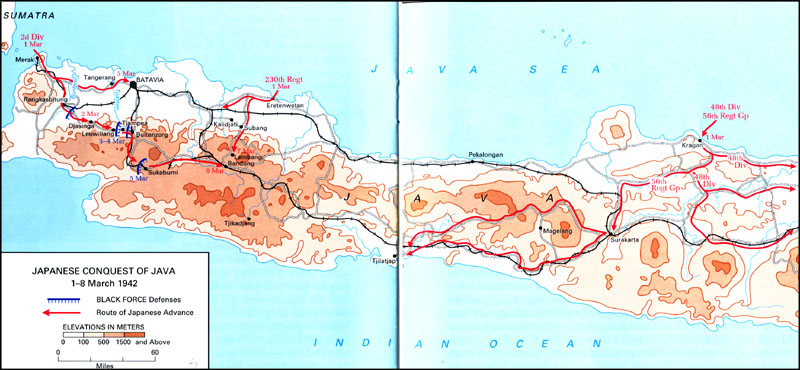
The Japanese forces were composed of a western and an eastern invasion force. On 18 February, the western force sailed from Cam Ranh Bay with 56 transports carrying the 16th Army Headquarters, 2nd Infantry Division, the 38th Infantry Division, and the 230th Infantry Regiment. On 8 February, the eastern force sailed from Lingayen Gulf with 41 transports carrying elements of the 56th Regimental Combat Group. Their goal was the capture of the Kalidjati airfield, where Japanese bombers and fighters would then be based in support of the invasion.
The allies naval forces under the command of Helfrich, were likewise deployed into an Eastern Strike Force out of Soerabaja, and a Western Strike Force out of Tanjung Priok. On 25 February Helfrich combined these forces when the Japanese eastern force was spotted moving south from Balikpapan. Exeter and Perth then joined De Ruyter, Java, with their associated destroyer screens. Air coverage was provided by six Brewster F2A Buffalos and seven Hawker Hurricanes.
The Allied forces were commanded by the Royal Netherlands East Indies Army (KNIL) commander, General Hein ter Poorten. Java Air Command was led by Ludolph Hendrik van Oyen. The 6th Infantry Regiment remained in eastern Java to guard the naval base, while remaining troops were deployed to western Java. West Group of 21,200 troops, was led by W. Schilling, consisting of the 1st Infantry Regiment and Blackforce. Java Bandoeng Group of 5,900 troops, was led by Jacob Pesman, consisting of the 4th Infantry Regiment and the IInd Mountain Artillery Battalion.
The British, Australian and United States units were commanded by British Major General H. D. W. Sitwell. The British forces were predominantly anti-aircraft units: the 77th Heavy AA Regiment, 21st Light AA Regiment and 48th Light AA Regiment. The only British armoured unit on Java was B squadron from the British 3rd Hussars, which was equipped with light tanks. Two British AA regiments without guns, the 6th Heavy AA Regt and the 35th Light AA Regiment, were equipped as infantry to defend airfields. The British also had transport and administrative units.
The Australian formation – named "Blackforce" after its commander, Brigadier Arthur Blackburn V.C. – included the Australian 2/3rd Machine Gun Battalion, the Australian 2/2nd Pioneer Battalion, 2/6th Field Company Royal Australian Engineers, a platoon from the 2/1st Headquarters Guard Battalion, about 100 reinforcements diverted en route to Singapore, a handful of soldiers who had escaped from Singapore following its fall to the Japanese, two transport companies, a casualty clearing station, and a company headquarters unit. Blackburn decided to re-organise his troops as an infantry brigade. They were well equipped in terms of Bren guns, light armoured cars, and trucks, but they had few rifles, sub-machine guns, anti-tank rifles, mortars, grenades, radio equipment or Bren gun carriers. Blackburn managed to assemble an HQ staff and three infantry battalions based on the 2/3rd Machine Gun, the 2/2nd Pioneers, and a mixed "Reserve Group".
The only U.S. ground forces in Java, the 2nd Battalion of the 131st Field Artillery (a Texas National Guard unit intended for the Philippines) was attached to Black Force.
On 27 February, Helfich ordered the evacuation of all seaworthy ships in Tjilatjap after Chūichi Nagumo's 1st Air Fleet was sighted to the south. On 28 February, Helfich ordered Koenraad to evacuate Soerabaja. On 1 March, Helfich then dissolved the Allied Naval Forces on Java, freeing William A. Glassford's United States Navy ships to head for Exmouth Gulf, and Arthur Palliser's Royal Navy ships to head for India. Helfich also ordered damaged Dutch submarines to head for Colombo, while those remaining were ordered to resist as long as possible, then break out or be scuttled. Starting on 2 March, remaining Dutch ships in the Netherlands East Indies were scuttled over the next week, along with the destruction of the Morokrembangan Naval Air Base and Perak Airfield.
Hub AI
Battle of Java (1942) AI simulator
(@Battle of Java (1942)_simulator)
Battle of Java (1942)
The Battle of Java (Invasion of Java, Operation J) was a battle of the Pacific theatre of World War II. It occurred on the island of Java from 28 February – 12 March 1942. It involved forces from the Empire of Japan, which invaded on 28 February 1942, and Allied personnel. Allied commanders signed a formal surrender at Japanese headquarters at Bandung on 12 March.
The Japanese forces were composed of a western and an eastern invasion force. On 18 February, the western force sailed from Cam Ranh Bay with 56 transports carrying the 16th Army Headquarters, 2nd Infantry Division, the 38th Infantry Division, and the 230th Infantry Regiment. On 8 February, the eastern force sailed from Lingayen Gulf with 41 transports carrying elements of the 56th Regimental Combat Group. Their goal was the capture of the Kalidjati airfield, where Japanese bombers and fighters would then be based in support of the invasion.
The allies naval forces under the command of Helfrich, were likewise deployed into an Eastern Strike Force out of Soerabaja, and a Western Strike Force out of Tanjung Priok. On 25 February Helfrich combined these forces when the Japanese eastern force was spotted moving south from Balikpapan. Exeter and Perth then joined De Ruyter, Java, with their associated destroyer screens. Air coverage was provided by six Brewster F2A Buffalos and seven Hawker Hurricanes.
The Allied forces were commanded by the Royal Netherlands East Indies Army (KNIL) commander, General Hein ter Poorten. Java Air Command was led by Ludolph Hendrik van Oyen. The 6th Infantry Regiment remained in eastern Java to guard the naval base, while remaining troops were deployed to western Java. West Group of 21,200 troops, was led by W. Schilling, consisting of the 1st Infantry Regiment and Blackforce. Java Bandoeng Group of 5,900 troops, was led by Jacob Pesman, consisting of the 4th Infantry Regiment and the IInd Mountain Artillery Battalion.
The British, Australian and United States units were commanded by British Major General H. D. W. Sitwell. The British forces were predominantly anti-aircraft units: the 77th Heavy AA Regiment, 21st Light AA Regiment and 48th Light AA Regiment. The only British armoured unit on Java was B squadron from the British 3rd Hussars, which was equipped with light tanks. Two British AA regiments without guns, the 6th Heavy AA Regt and the 35th Light AA Regiment, were equipped as infantry to defend airfields. The British also had transport and administrative units.
The Australian formation – named "Blackforce" after its commander, Brigadier Arthur Blackburn V.C. – included the Australian 2/3rd Machine Gun Battalion, the Australian 2/2nd Pioneer Battalion, 2/6th Field Company Royal Australian Engineers, a platoon from the 2/1st Headquarters Guard Battalion, about 100 reinforcements diverted en route to Singapore, a handful of soldiers who had escaped from Singapore following its fall to the Japanese, two transport companies, a casualty clearing station, and a company headquarters unit. Blackburn decided to re-organise his troops as an infantry brigade. They were well equipped in terms of Bren guns, light armoured cars, and trucks, but they had few rifles, sub-machine guns, anti-tank rifles, mortars, grenades, radio equipment or Bren gun carriers. Blackburn managed to assemble an HQ staff and three infantry battalions based on the 2/3rd Machine Gun, the 2/2nd Pioneers, and a mixed "Reserve Group".
The only U.S. ground forces in Java, the 2nd Battalion of the 131st Field Artillery (a Texas National Guard unit intended for the Philippines) was attached to Black Force.
On 27 February, Helfich ordered the evacuation of all seaworthy ships in Tjilatjap after Chūichi Nagumo's 1st Air Fleet was sighted to the south. On 28 February, Helfich ordered Koenraad to evacuate Soerabaja. On 1 March, Helfich then dissolved the Allied Naval Forces on Java, freeing William A. Glassford's United States Navy ships to head for Exmouth Gulf, and Arthur Palliser's Royal Navy ships to head for India. Helfich also ordered damaged Dutch submarines to head for Colombo, while those remaining were ordered to resist as long as possible, then break out or be scuttled. Starting on 2 March, remaining Dutch ships in the Netherlands East Indies were scuttled over the next week, along with the destruction of the Morokrembangan Naval Air Base and Perak Airfield.
Recent media