Hubbry Logo
BandungBandungMain
Open search
Bandung
Community hub
Bandung
logo
8 pages, 0 posts
0 subscribers
Be the first to start a discussion here.
Contribute something
Bandung
Bandung
from Wikipedia

Key Information

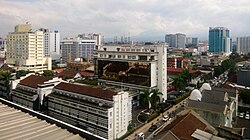
Bandung[a] is the capital city of the West Java province of Indonesia.[9] Located on the island of Java, the city is the third largest city in Indonesia and Greater Bandung (Bandung Basin Metropolitan Area / BBMA) is the country's second-largest and second most populous metropolitan area, with over 11 million inhabitants.[10][5] Situated 708 meters (2,323 feet) above sea level (the highest point in the North area is at an altitude of 892 meters (2,927 feet), and the lowest in the South at 666 meters (2,185 feet) above sea level), approximately 135 kilometres (84 miles) southeast of Jakarta, Bandung has cooler year-round temperatures than most other Indonesian cities. The city lies in a river basin surrounded by volcanic mountains that provide a natural defense system, which was the primary reason for the Dutch East Indies government's plan to move the capital from Batavia (modern-day Jakarta) to Bandung.[11]

The Dutch first established tea plantations around the mountains in the 18th century, and a road was constructed to connect the plantation area to the colonial capital Batavia (180 kilometres (112 miles) to the northwest). In the early 20th century, the Dutch inhabitants of Bandung demanded the establishment of a municipality (gemeente), which was granted in 1906, and Bandung gradually developed into a resort city for plantation owners. Luxurious hotels, restaurants, cafés, and European boutiques were opened, leading the city to be nicknamed Parijs van Java (Dutch: "The Paris of Java").

After Indonesia declared independence in 1945, the city experienced ongoing development and urbanization, transforming from an idyllic town into a dense 16,500 people/km2 (per square kilometer) metropolitan area with living space for over 8 million people. New skyscrapers, high-rise buildings, bridges, and gardens have been constructed. Natural resources have been heavily exploited, particularly by conversion of the protected upland area into highland villas and real estate. Although the city has encountered many problems (ranging from waste disposal and floods to a complicated traffic system resulting from a lack of road infrastructure), it still attracts large numbers of tourists, weekend sightseers, and migrants from other parts of Indonesia. In 2017 the city won a regional environmental sustainability award for having the cleanest air among major cities in ASEAN.[12] The city is also known as a Smart City, leveraging technology to improve government services and social media that alert residents to issues such as floods or traffic jams. The city is part of the UNESCO Creative Cities Network, which it joined in 2015.[13] Bandung is Indonesia's major technology centre.[14][15][16]

The first Asian-African Conference, the Bandung Conference, was hosted in Bandung by President Sukarno in 1955 and now decennial event. Redevelopment of the existing Husein Sastranegara International Airport (BDO) was completed in 2016. The new larger second airport for Greater Bandung Kertajati International Airport (KJT) opened in June 2018, just in time for the 2018 Asian Games.[citation needed]

History

[edit]
Coat of Arms of Bandung during the Dutch colonial era, granted in 1928

The official name of the city during the colonial Dutch East Indies period was Bandoeng. The earliest reference to the area dates back to 1488, although archaeological findings suggest a type of Homo erectus species had long previously lived on the banks of the Cikapundung River and around the old lake of Bandung.[17] During the 17th and 18th centuries, the Dutch East Indies Company (VOC) established plantations in the Bandung area. In 1786, a supply road connecting Batavia (now Jakarta), Bogor, Cianjur, Bandung, Sumedang and Cirebon was constructed. In 1809, Napoleon ordered Governor Herman Willem Daendels to improve the defensive systems of Java to protect against a possible British invasion. Daendels ordered the construction of a road stretching approximately 1,000 km (620 mi) from the west to the east coast of Java, passing through Bandung.[18][19] In 1810, the road was laid down in Bandung and was named De Groote Postweg (or the 'Great Post Road'), the present-day location of Jalan Asia-Afrika. Under Daendels' orders, R. A. Wiranatakusumah II, the Chief Administrator of the Bandung regency at that time, moved the office from Krapyak, in the south, to a place near a pair of holy city wells (sumur Bandung), the present-day site of the city square (alun-alun). He built his dalem (palace), masjid agung (the grand mosque) and pendopo (public-official meeting place) in the classical Sundanese orientation,[20] with the pendopo facing Tangkuban Perahu mountain, which was believed to have a mystical ambience. In 1856, Bandung also became the capital of the Preanger Regencies Residency, which it would remain until 1925.

The first major railroad between Batavia and Bandung was completed in 1880,[21] boosting the light industry in Bandung. Chinese flocked into the city to help run facilities, services and vendors. The area adjacent to the train station is still recognizable as the old Chinatown district. In 1906, Bandung was given the status of gemeente (municipality), and then twenty years later, stadsgemeente (city municipality).

From the early 1920s, the Dutch East Indies government made plans to move their capital from Batavia to Bandung. Accordingly, during this decade, the Dutch colonial government commenced construction of military barracks, the building housing the colonial Department of State-Owned Enterprises (Department van Gouvernmentsbedrijven, the present-day Gedung Sate) and other government buildings. However, this plan was cut short by World War II, after which the Dutch were not able to re-establish their colony due to the Indonesian Declaration of Independence.

The fertile area of the Parahyangan Mountains surrounding Bandung supports productive tea plantations. In the nineteenth century, Franz Junghuhn introduced the cinchona (kina) plant.[22] With its cooler elevated landscape, surrounded by major plantations, Bandung became an exclusive European resort area.[23] Wealthy plantation owners visited the city on weekends, attracting ladies and business people from the capital, Batavia. Jalan Braga grew into a promenade street with cafés, restaurants and boutique shops. Two art-deco style hotels, Savoy Homann and Preanger, were built in the vicinity of the Concordia Society, a clubhouse for the wealthy with a large ballroom and a theatre.[21]

After Indonesian independence in 1945, Bandung was designated as the capital of West Java province. During the Indonesian National Revolution, some of the most massive battles occurred in and around Bandung. Dutch troops were virtually absent in Java at the end of World War II. To assist the restoration of Dutch sovereignty, British forces established a military presence in several of Java's largest cities, and issued an ultimatum to Indonesian forces in Bandung in an attempt to make them leave the city. In response, on 24 March 1946, much of the southern part of Bandung was deliberately set alight by Indonesian forces as they withdrew.[24]

In 1955, the first Asian-African Conference, also known as the Bandung Conference, was hosted in Bandung by President Sukarno and attended by the heads of states representing twenty-nine independent countries from Asia and Africa.[25] The conference venue was at the Gedung Merdeka, the former Concordia Society building. The conference announced ten points of declaration for the promotion of world peace and opposition against colonialism and is known as the Declaration of Bandung. This was followed by a wave of nationalism and decolonization movements around the globe which remapped world politics.[26] The conference was also the first international conference of people of colour in history.[27] In his book The Color Curtain, Richard Wright claims that there was an epic meaning to the conference for people of colour around the world.[27]

In 1987, the city boundary was expanded by the 'Greater Bandung' (Bandung Raya) plan, with the relocation of higher concentration development zones outside the city in an attempt to dilute population density in the old city. During this development, the city core was often uprooted, with old buildings torn down, lot sizes regrouped and rezoned, changing idyllic residential areas to commercial zones with bustling chain supermarkets, malls, banks and upscale developments.[23]

In 2005, an Asian-African Conference was partly held in Bandung, attended by world leaders including Indonesian President Susilo B. Yudhoyono, President of China Hu Jintao, Prime Minister of India Manmohan Singh, President of South Africa Thabo Mbeki and President of Nigeria Obasanjo.[28]

Geography

[edit]

Bandung, the capital of West Java province, is located about 180 kilometres (110 mi) southeast of Jakarta. Its elevation is 768 metres (2,520 ft) above sea level and is surrounded by up to 2,400 metres (7,900 feet) high Late Tertiary and Quaternary volcanic terrain.[29] The 400 km2 (150 sq mi) flat of central Bandung plain is situated in the middle of 2,340.88 square kilometres (903.82 sq mi) wide of the Bandung Basin; the basin comprises Bandung, the Cimahi city, part of Bandung Regency, part of West Bandung Regency, and part of Sumedang Regency.[30] The basin's main river is the Citarum; one of its branches, the Cikapundung, divides Bandung from north to south before it merges with Citarum again in Dayeuhkolot. The Bandung Basin is an essential source of water for potable water, irrigation, and fisheries, with its 6,147 million m3 (217.1 billion cu ft) of groundwater being a significant reservoir for the city.[30]

The northern section of Bandung is hillier than other parts of the city, and the unique truncated flat-peak shape of the Tangkuban Perahu volcano (Tangkuban Perahu literally means 'upside-down boat') can be seen from the city to the north. Long-term volcanic activity has created fertile andisol soil in the north, suitable for intensive rice, fruit, tea, tobacco, and coffee plantations. In the south and east, alluvial soils deposited by the Cikapundung river predominate.[31]

Geological data show that the Bandung Basin is located on an ancient volcano, known as Mount Sunda, erected up to 3,000–4,000 metres (9,800–13,100 feet) during the Pleistocene age.[32] Two large-scale eruptions took place; the first formed the basin, and the second (est. 55,000 BCE) blocked the Citarum river, turning the basin into a lake known as "the Great Prehistoric Lake of Bandung".[33] The lake drained away; for reasons which are the subject of ongoing debate among geologists.[34][35]

Architecture

[edit]
The Savoy Homann Bidakara Hotel architectural design by Albert Aalbers in 1939 is one of the most significant examples of the Art Deco style for which Bandung is renowned.

Bandung is home to numerous examples of Dutch colonial architecture, most notably the tropical Art Deco, dubbed New Indies Style. Henri Maclaine Pont was among the first Dutch architects to recognize the importance of combining each architectural style with local cultural traditions. He stressed that modern architecture should interact with local history and native elements.[36] In 1920, Pont planned and designed buildings for the first technical university in the Dutch East Indies, Technische Hogeschool te Bandung (the present-day Bandung Institute of Technology). He was named a Professor of Architecture at the university. A striking local Sundanese roof style is seen adorning the top of the campus' ceremonial hall and is embedded in his artwork.[36]

In the same year, another Dutch architect J Gerber designed Gouverments Bedrijven (Government Companies) in line with the colonial government's plan to move the capital from Batavia to Bandung. The building is known as Gedung Sate, named after the distinguished small satay-shaped structure on the roof, and is today used as the head office of the West Java provincial government and House of Representatives. The building is an example of a harmonious mixture between West and East architectural styles, particularly the Italian Renaissance style of arch structures in the wings and pendopo-like structures commonly found in Java in the middle section.

Villa Isola, is an art-deco building in the northern part of Bandung, now it serves as the rectorate building of Indonesia University of Education.

Several Dutch architects who shaped the city landmarks the architectural blending of modern and native traditions. In the 1930s, Bandung became known as an architectural laboratory due to the many Dutch architects who experimented with new architectural designs. Albert Aalbers added the streamline moderne style to the Art Deco by designing the DENIS bank (1936) and renovating the Savoy Homann Hotel (1939). Charles Prosper Wolff Schoemaker was one of the architects who enormously added native elements in his artworks, including the Villa Isola (1932), Hotel Preanger (1929), the regional military headquarters (1918), Gedung Merdeka (1921) and ITB Rectorate Building (1925).[36]

Though Bandung is known for its many old Dutch architecture buildings, the city is recently going through a high-rise building boom. There are more than 100 high rise buildings in the city, and many more are under construction or planned.[37] The following list includes buildings in Bandung that are completed or topped off and above 300 ft (91 m).

Environmental problems

[edit]

The north of the city serves as a water reservoir for Bandung. However, the area has seen substantial residential development. Several attempts to protect this area have been made, including creating reserves such as the Juanda National Park and Punclut, but development continues. Regular flooding in Bandung's south also presents a real and dangerous ongoing problem.[38]

From mid-2005, Bandung faced another environmental disaster when the city's landfill site was re-evaluated after a garbage slide in 2005 which buried a village, Kampung Gajah, beneath it, killing over a hundred people.[39] The accumulation of 8,000 m3/d (3,300 cu ft/ks) of domestic garbage causes severe air pollution by local burning, the spread of disease, and water contamination. The provincial government has failed in its attempts to solve the garbage issue.[40][41] Nevertheless, it was awarded in 1997 and 2015 as the least polluted city in the country.[42][43] Further, a regional award in 2017 was also given from ASEAN for the cleanest air among other major cities in ASEAN countries.[44]

Bandung is also well known for its tornado hotspot. The first deadly tornado in the area occurred in Rancaekek (during the Dutch Occupation in 1933 where a tornado struck the town, killing 1 and injuring none, the funnel destroyed 17 homes and left 30 homes badly damaged, many trees were either snapped or downed.[45] Another deadly tornado to occur on Bandung was on 18 December 2014, in Gedebage, the tornado struck the area in the afternoon. It left 85 houses either unroofed or destroyed, a large factory building suffered significant damage, a warehouse levelled and a library suffered roof loss, one person died due to crushed by a collapsed wall.[46][47][48]

Climate

[edit]

Bandung experiences tropical monsoon climate (Köppen: Am) that closely borders a tropical rainforest climate (Köppen: Af) as the driest month precipitation total is below 60 millimetres (2.4 in). March and August are the wettest and driest months, respectively. The average temperature throughout the year tends to be cooler than most cities in Indonesia due to the influence of altitude. The average temperature throughout the year only has little variation due to its location near the equator.

Climate data for Bandung (Husein Sastranegara International Airport) (elevation 740 m or 2,430 ft, 2013–2023, extremes 1957–1994)
Month Jan Feb Mar Apr May Jun Jul Aug Sep Oct Nov Dec Year
Record high °C (°F) 32.2
(90.0)
31.1
(88.0)
32.2
(90.0)
30.6
(87.1)
31.1
(88.0)
30.6
(87.1)
30.6
(87.1)
31.1
(88.0)
32.8
(91.0)
34.4
(93.9)
33.9
(93.0)
31.1
(88.0)
34.4
(93.9)
Mean daily maximum °C (°F) 28.0
(82.4)
27.7
(81.9)
28.7
(83.7)
28.9
(84.0)
28.9
(84.0)
28.7
(83.7)
28.6
(83.5)
29.3
(84.7)
30.0
(86.0)
30.0
(86.0)
29.1
(84.4)
28.5
(83.3)
28.9
(84.0)
Daily mean °C (°F) 24.2
(75.6)
24.0
(75.2)
24.5
(76.1)
24.8
(76.6)
24.6
(76.3)
24.2
(75.6)
23.8
(74.8)
24.0
(75.2)
24.6
(76.3)
24.9
(76.8)
24.7
(76.5)
24.4
(75.9)
24.4
(75.9)
Mean daily minimum °C (°F) 20.4
(68.7)
20.3
(68.5)
20.4
(68.7)
20.7
(69.3)
20.3
(68.5)
19.7
(67.5)
19.0
(66.2)
18.6
(65.5)
19.2
(66.6)
19.9
(67.8)
20.3
(68.5)
20.3
(68.5)
19.9
(67.9)
Record low °C (°F) 15.0
(59.0)
15.6
(60.1)
15.0
(59.0)
13.9
(57.0)
13.9
(57.0)
11.7
(53.1)
11.1
(52.0)
11.7
(53.1)
11.7
(53.1)
13.9
(57.0)
12.8
(55.0)
15.0
(59.0)
11.1
(52.0)
Average precipitation mm (inches) 174.8
(6.88)
199.9
(7.87)
343.2
(13.51)
275.5
(10.85)
212.5
(8.37)
109.9
(4.33)
77.0
(3.03)
59.8
(2.35)
85.3
(3.36)
174.9
(6.89)
329.5
(12.97)
273.8
(10.78)
2,316.1
(91.19)
Average precipitation days 14.4 15.3 19.3 18.3 13.9 9.2 7.0 6.0 7.0 13.0 18.5 18.1 160
Average relative humidity (%) 83 82 82 83 82 78 76 73 74 76 80 81 79.2
Source 1: Meteomanz[49]
Source 2: Sistema de Clasificación Bioclimática Mundial (extremes and humidity)[50]
Climate data for Bandung, Indonesia
Month Jan Feb Mar Apr May Jun Jul Aug Sep Oct Nov Dec Year
Mean monthly sunshine hours 155 168 186 210 217 240 248 248 210 217 180 186 2,465
Mean daily sunshine hours 5.0 6.0 6.0 7.0 7.0 8.0 8.0 8.0 7.0 7.0 6.0 6.0 6.8
Mean daily daylight hours 12.5 12.3 12.1 12.0 11.8 11.7 11.8 11.9 12.1 12.3 12.4 12.5 12.1
Percentage possible sunshine 40 49 50 58 59 68 68 67 58 57 48 48 56
Average ultraviolet index 12 12 12 12 11 10 11 12 12 12 12 12 12
Source: Weather Atlas [51]

Government

[edit]

The city area in 1906 was 19.22 square kilometres (7.42 square miles), and by 1987, it had expanded to 167.2965 km2.[52] The city administration is divided into 30 districts (kecamatan) and 153 villages (kelurahan). For development purposes, the 30 districts are grouped into eight sub-city regions.[53] The sub-city regions of Bandung are Arcamanik, Cibeunying, Kerees, Kordon, Gedebage, Ujungberung, Bojonagara and Tegalega. The mayor (walikota) - Bambang Tirtoyuliono from 2023 - leads the city administration. Since 2008, city residents have directly voted for a mayor; previously, mayors were nominated and selected by the city council - the Bandung City Regional House of Representatives (DPRD Kota Bandung), which has 50 members. As of 2003, the total number of city administration personnel was 20,163.[52][54]

Administrative divisions

[edit]
Villages (kelurahan) of Bandung, with all villages in the same district (kecamatan) having the same color.

Bandung City is divided into 30 districts[55] (kecamatan), listed below with their areas and their populations at the 2010 Census[56] and 2020 Census,[57] together with the official estimates as at mid 2022.[58] The table also includes the locations of the district administrative centres, the numbers of administrative villages (totaling 151, all classed as urban kelurahan) in each district, and its postal codes.

Kode
Wilayah
Name of
District
(kecamatan)
Area
in
km2
Pop'n
2010
Census
Pop'n
2020
Census
Pop'n
mid 2023
Estimate
Admin
centre
No.
of
kelurahan
Post
codes
Arcamanik region
ᮃᮁᮎᮙᮔᮤᮊ᮪
32.73.24 Arcamanik

ᮃᮁᮎᮙᮔᮤᮊ᮪

5.87 65,607 77,214 82,025 Cisaranten Kulon

ᮎᮤᮞᮛᮔ᮪ᮒᮨᮔ᮪ ᮊᮥᮜᮧᮔ᮪

4 40293 - 40294
32.73.20 Antapani

ᮃᮔ᮪ᮒᮕᮔᮤ

3.79 72,006 79,260 82,578 Antapani Wetan

ᮃᮔ᮪ᮒᮤᮕᮒᮤ ᮝᮦᮒᮔ᮪

4 40291
32.73.30 Mandalajati

ᮙᮔ᮪ᮓᮜᮏᮒᮤ

6.67 60,825 71,422 73,821 Karang Pamulang

ᮊᮛᮀ ᮕᮙᮥᮜᮀ

4 40195
Bojonagara region
ᮘᮧᮏᮧᮔᮌᮛ
32.73.05 Andir

ᮃᮔ᮪ᮓᮤᮁ

3.71 94,361 96,262 98,102 Garuda

ᮌᮛᮥᮓ

6 40181 - 40184
32.73.06 Cicendo

ᮎᮤᮎᮦᮔ᮪ᮓᮧ

6.86 96,491 92,327 93,549 Arjuna

ᮃᮁᮏᮥᮔ

6 40171 - 40175
32.73.07 Sukajadi

ᮞᮥᮊᮏᮓᮤ

4.30 104,805 100,668 102,000 Sukagalih

ᮞᮥᮊᮌᮜᮤᮂ

5 40161 - 40164
32.73.01 Sukasari

ᮞᮥᮊᮞᮛᮤ

6.27 79,211 74,886 75,877 Sukarasa

ᮞᮥᮊᮛᮞ

4 40151 - 40154
Cibeunying region
ᮎᮤᮘᮩᮑᮤᮀ
32.73.09 Bandung Wétan

ᮘᮔ᮪ᮓᮥᮀ ᮝᮦᮒᮔ᮪

3.39 29,807 26,854 27,209 Tamansari

ᮒᮙᮔ᮪ᮞᮛᮤ

3 40114 - 40116
32.73.18 Cibeunying Kaler

ᮎᮤᮘᮩᮑᮤᮀ ᮊᮜᮦᮁ

4.50 68,807 67,104 67,992 Cigadung

ᮎᮤᮌᮓᮥᮀ

4 40122 - 40191
32.73.14 Cibeunying Kidul

ᮎᮤᮘᮩᮑᮤᮀ ᮊᮤᮓᮥᮜ᮪

5.25 104,575 107,389 109,652 Cikutra

ᮎᮤᮊᮥᮒᮢ

6 40121 - 40192
32.73.08 Cidadap

ᮎᮤᮓᮓᮕ᮪

6.11 56,325 52,702 53,399 Hegarmanah

ᮠᮦᮌᮁᮙᮔᮂ

3 40141 - 40143
32.73.02 Coblong

ᮎᮧᮘᮣᮧᮀ

7.35 127,588 110,205 111,663 Dago

ᮓᮌᮧ

6 40131 - 40135
32.73.19 Sumur Bandung

ᮞᮥᮙᮥᮁ ᮘᮔ᮪ᮓᮥᮀ

3.40 34,486 34,137 34,589 Merdeka

ᮙᮨᮁᮓᮦᮊ

4 40111 - 40117
Gedébagé region
ᮌᮨᮓᮦᮘᮌᮦ
32.73.23 Rancasari

ᮛᮔ᮪ᮎᮞᮛᮤ

7.33 72,406 83,655 88,391 Cipamokolan

ᮎᮤᮕᮙᮧᮊᮧᮜᮔ᮪

4 40292 - 40295
32.73.27 Gedébagé

ᮌᮨᮓᮦᮘᮌᮦ

9.58 34,299 41,653 44,653 Rancabolang

ᮛᮔ᮪ᮎᮘᮧᮜᮀ

4 40294
Karéés region
ᮊᮛᮦᮆᮞ᮪
32.73.12 Batununggal

ᮘᮒᮥᮔᮥᮀᮌᮜ᮪

5.03 116,935 115,501 117,030 Gumuruh

ᮌᮥᮙᮥᮛᮥᮂ

8 40271 - 40275
32.73.16 Kiaracondong

ᮊᮤᮃᮛᮎᮧᮔ᮪ᮓᮧᮀ

6.12 127,616 126,657 128,333 Babakan Sari

ᮘᮘᮊᮔ᮪ ᮞᮛᮤ

6 40281 - 40285
32.73.13 Lengkong

ᮜᮦᮀᮊᮧᮀ

5.90 69,307 66,231 67,108 Malabar

ᮙᮜᮘᮁ

7 40261 - 40265
32.73.11 Regol

ᮛᮦᮌᮧᮜ᮪

4.30 79,316 79,136 80,183 Ciseureuh

ᮎᮤᮞᮩᮛᮩᮂ

7 40251 - 40255
Kordon region
ᮊᮧᮁᮓᮧᮔ᮪
32.73.21 Bandung Kidul

ᮘᮔ᮪ᮓᮥᮀ ᮊᮤᮓᮥᮜ᮪

6.06 57,398 59,984 61.560 Mengger

ᮙᮦᮀᮌᮦᮁ

4 40256 - 40287
32.73.22 Buah Batu

ᮘᮥᮃᮂ ᮘᮒᮥ

7.93 92,140 100,360 104,255 Margasari

ᮙᮁᮌᮞᮛᮤ

4 40286 - 40287
Tegalega region
ᮒᮨᮌᮜᮨᮌ
32.73.15 Bandung Kulon

ᮘᮔ᮪ᮓᮥᮀ ᮊᮥᮜᮧᮔ᮪

6.46 138,644 138,813 140,700 Caringin

ᮎᮛᮤᮍᮤᮔ᮪

8 40211 - 40215
32.73.03 Babakan Ciparay

ᮘᮘᮊᮔ᮪ ᮎᮤᮕᮛᮚ᮪

7.45 143,203 142,440 144,327 Babakan Ciparay

ᮘᮘᮊᮔ᮪ ᮎᮤᮕᮛᮚ᮪

6 40221 - 40227
32.73.04 Bojongloa Kaler

ᮘᮧᮏᮧᮀᮜᮧᮃ ᮊᮜᮦᮁ

3.03 117,218 119,193 121,358 Suka Asih

ᮞᮥᮊ ᮃᮞᮤᮂ

5 40231 - 40233
32.73.17 Bojongloa Kidul

ᮘᮧᮏᮧᮀᮜᮧᮃ ᮊᮤᮓᮥᮜ᮪

6.26 83,600 86,740 88,834 Situsaeur

ᮞᮤᮒᮥᮞᮉᮁ

6 40234 - 40239
32.73.10 Astana Anyar

ᮃᮞ᮪ᮒᮔ ᮃᮑᮁ

2.89 66,658 68,315 69,714 Panjunan

ᮕᮔ᮪ᮏᮩᮔᮔ᮪

6 40241 - 40243
Ujungberung region
ᮅᮏᮥᮀᮘᮨᮛᮥᮀ
32.73.25 Cibiru

ᮎᮤᮘᮤᮛᮥ

6.32 67,412 72,090 74,481 Cipadung

ᮎᮤᮕᮓᮥᮀ

4 40614 - 40615
32.73.28 Panyileukan

ᮕᮑᮤᮜᮩᮊᮔ᮪

5.10 37,691 39,892 41,091 Mekar Mulya

ᮙᮨᮊᮁ ᮙᮥᮜ᮪ᮚ

4 40614
32.73.26 Ujungberung

ᮅᮏᮥᮀᮘᮨᮛᮥᮀ

6.40 72,414 87,698 93,939 Cigending

ᮎᮤᮌᮨᮔ᮪ᮓᮤᮀ

5 40611 - 40619
32.73.29 Cinambo

ᮎᮤᮔᮙ᮪ᮘᮧ

3.68 23,762 25,363 26,190 Pakemitan

ᮕᮊᮨᮙᮤᮒᮔ᮪

4 40296

Economy

[edit]
Trans Studio Mall Bandung, is the second largest shopping mall in Bandung after Paris Van Java Mall.

The city's economy is mainly built upon tourism, business, creative industry, high-tech and manufacturing industries, educational institutions, technology, retail services, financial services, pharmaceutical companies, and food production.[28] The once quiet residential district of Dago has become an important business and entertainment centre with chic cafés and restaurants spread out along Jalan Dago. In the early 1990s, Jalan Cihampelas became a popular clothing store location and remains so today. Some important shopping malls of the city which are Trans Studio Mall Bandung, Summarecon Mall Bandung, Bandung Indah Plaza, Cihampelas Walk, Paris Van Java Mall, and 23 Paskal Shopping Center are among the popular shopping centres in Bandung.

Creative culture has shaped specific parts of the city's economy. Small businesses, known as "distro", sell non-trademarked products made by local designers. Typical distro products are books, indie label records, magazines, fashion products, and other accessories. Distros are popular with young people and distance themselves from factory outlets in terms of philosophy. They arise from individual designers and young entrepreneurs, while factory outlet products generally come from large-scale garment factories.[59]

The city administration has agreed to substantially develop seven industrial and trade areas for Bandung specialty products.[60] These include Binong Jati Knitting Industrial and Trade Center, Cigondewah Textile Trade Center, Cihampelas Jeans Trade Center, Suci (T and Oblong) Shirt Industrial Center, Cibaduyut Shoes Industrial Center, Cibuntu Tofu and Tempeh Industrial Center, Sukamulya Sukajadi Doll Industrial Center.

Tourism

[edit]
The Asian-African Street Tunnel is an iconic place in Bandung with quotes about the city's beauty.
The museum of Sri Baduga, whose name is dedicated to the historical figure of Sri Baduga Maharaja.

Bandung is a popular weekend destination for residents of Jakarta. The colder climate of the highland plantation area, variety of food, less expensive fashion shops located in factory outlets and distros, golf courses, and the zoo, are some of the attractions of the city.[61] Bandung is also a popular shopping destination due to the cheap textile and fashion products, especially for Malaysian and Singaporean tourists.[62]

In the 1990s, local designers opened denim clothing stores along Jalan Cihampelas, which was transformed into a "jeans street". The city attracts people from other big cities to buy local fashion wares, as they are cheaper than branded items.[63] Beside Jalan Cihampelas, many factory outlets also opened at Jalan Riau, Jalan Braga, Jalan Setiabudi, and Jalan Djuanda (known as Dago). Textile factories on the outskirts of Bandung have opened factory outlets on site selling what is marketed as sisa export (rejected or over-produced export quality items).[64]

Significant tourist sites near Bandung include the Tangkuban Prahu volcano crater to the north, the Kawah Putih volcano lake, and Patenggang Lake, a lake surrounded by tea plantations about 50 kilometres (31 miles) to the south of the city.

To view the Bandung Basin clearly in its mountain surroundings, visitors travel to the Bongkor protected forest area (kawasan hutan lindung), Saung Daweung and Arcamanik; to the slopes of West Manglayang Mountain in an area known as Caringin Tilu, with entry from Padasuka and Cicaheum to the north. The forest is located in 1,500 metres (4,900 feet) above sea level and is covered with pine trees managed by a government corporation Perhutani and can be accessed with 30 minutes drive from downtown.[65][66] Visitors going to the north of the city also find Taman Hutan Raya Ir. H. Djuanda. The Cicaheum area also hosts Bukit Moko, a tourist spot famous for its views and its steel statue of a giant star called Puncak Bintang. Bandung has several museums that should be visited by tourists, such as the Geological Museum of Bandung, the Indonesia Postal Museum, Sri Baduga Museum, and the Asian-African Conference Museum.[67] The city government operates Bandros, a tourist bus, since 2014.[68]

Demographics

[edit]
Religion in Bandung (2023 Census)[69]
  1. Islam (92.3%)
  2. Protestantism (5.09%)
  3. Roman Catholic (2.11%)
  4. Buddhism (0.46%)
  5. Hinduism (0.06%)
  6. Others (0.01%)

Traditionally, Bandung's population is of Sundanese descent. Javanese are the most significant ethnic Indonesian minority and mostly come from the central and the eastern parts of Java. Other minorities include Minang, Minahasan, Chinese, Batak, Malay, Korean, Indian, and Arabs. Bandung's population are mainly Muslims but small communities of Christians, Hindus and Buddhists also exist in the city.

Year 2005 2010 2015 2020 2023
Population 2,288,570 2,394,873 2,480,615 2,444,160 2,506,603
Population density (per km2) 13,679 14,314 14,826 14,609 14,982

In 2005, the population of Bandung was 2.29 million people with a density of 13,690/km2 (35,457/sq mi).[70] The May 2010 census enumerated 2.395 million people[71] and that of May 2020 enumerated 2.444 million.[57] Based on data from Statistics Indonesia, the population of Bandung in mid 2023 was 2,506,603 (comprising 1,259,236 males and 1,247,367 females),[3] making Bandung the third-most populous city in Indonesia.

Culture

[edit]

Bandung is a significant cultural hub in Indonesia. Most people in the surrounding province of West Java are ethnically Sundanese, with Sundanese often spoken as a first language, and the standard and informal language for communication in streets, school, work, and markets. As in the rest of the country, standard Indonesian serves as the lingua franca and primary language of government, business, media, and formal education.

Music

[edit]
Angklung Performance at Saung Angklung Udjo in Bandung.

Bandung is one of the cities in Indonesia with a rich musical history, known for traditional instruments such as the Angklung, Suling, and Kacapi, which are commonly used in Tembang Sunda. Since the Dutch colonial era, Bandung has been the center of music in Indonesia.[72] Bandung has notable UNESCO with creative cities with specially music band is majority founded over there.[73]

Bands such as Kahitna, The Changcuters, SM*SH, Yovie & Nuno, Noah, and Project Pop were founded and established in Bandung.

Sports

[edit]
Opening National Paralympic Week 2016 (XV) in Siliwangi Stadium

Bandung is the home of Persib Bandung, a professional football club currently competing in the highest tier of Indonesian football, the Liga 1. Bandung is also home of Prawira Bandung (ex Garuda Bandung), a professional basketball club currently competes in the Indonesian Basketball League, with its home games in the GOR Citra Arena. The roads leading up to Lembang and Dago are popular routes for mountain cycling on weekends, as Jalan Ir. H. Djuanda and Jalan Buah Batu is zoned as car-free on Sunday mornings.[74]

Other popular sports in Bandung include badminton and golf, with several golf courses surrounding the city.

Media

[edit]

Bandung has several local daily newspapers, including Pikiran Rakyat, Galamedia, and Tribun Jabar. Several local television stations operate in Bandung, including TVRI Jawa Barat (a public regional station serving West Java, which headquartered in the city), Bandung TV, MQTV and PJTV. Many radio stations, such as Ardan FM, KLCBS, MQFM and OZ Radio, also broadcast from Bandung.

The city of Bandung was featured in the 9th and 10th leg of the American reality series The Amazing Race 23.

Transport

[edit]
Pasupati Bridge is the most famous bridge in Bandung and second-longest bridge in Indonesia.

Bandung can be accessed by highways from Jakarta. An intercity toll highway called Cipularang Toll Road, connecting Jakarta, Karawang, Purwakarta, Padalarang and Bandung, was completed in May 2005, and is the fastest way to reach Bandung from the capital by road. Driving time is about 1.5 hours on average. There are three other options: the Puncak route (Jakarta-Cianjur/Sukabumi-Bandung), Purwakarta route (Jakarta-Cikampek-Purwakarta-Cikalong Wetan-Padalarang-Cimahi-Bandung) and the Subang route (Jakarta-Cikampek-Subang-Lembang-Bandung). From cities further east (Cirebon, Tasikmalaya and Central Java province), Bandung can be accessed through the main provincial road. Indonesian National Route 3 links Bandung with the rest of Java towards Cilegon and Ketapang (Banyuwangi).

The Pasupati Bridge was built to relieve traffic congestion in the city for east–west transport. The 2.8-kilometre (1.7 mi) cable-stayed bridge lies through the Cikapundung Valley. It is 30 to 60 metres (98 to 197 feet) wide and, after extensive delays, it was finally completed in June 2005, following financial investment from Kuwait.[75] The bridge is part of Bandung's comprehensive inner-city highways plan.

Bandung has two intercity bus terminals: Leuwipanjang, serving buses from the west, and Cicaheum, serving buses from the east. Both are at full capacity and are to be replaced by a new terminal at Gedebage on 15 hectares (37 acres) land, after which the old terminals will function as inner-city terminals. The new terminal will be located next to the Gedebage railway station near Gedebage container dry port.[76]

Taxis and Carpooling are widely available. The primary means of public transportation is by angkot minibuses (from angkutan, "transportation" and kota, "city"); angkot are privately operated and serve multiple routes throughout the city, and although cheap, they are considered basic and uncomfortable.[77] To find exact angkot routes, passengers may look for information available through the drivers or at terminals.

Due to the current extent of railway lines in Bandung, only two named regional railway services, Lokal Bandung Raya and Lokal Garut Cibatuan, are serving the city, serving a single line. It catered for the suburban areas east and west of the city such as Cimahi, Padalarang, Rancaekek, Cicalengka, as well as some other neighbouring towns such as Garut and Purwakarta. KAI Commuter took over the operations of both services from its mother company KAI in 2022, anticipating planned electrification of the route by Ministry of Transport.[78]

Boseh is a dock-based bicycle-sharing system provided by the Transport Service (Dinas Perhubungan) of Bandung.[79]

Metro Jabar Trans corridor 2D bus stopping at IKEA Kota Baru Parahyangan

Public buses in Bandung and its surrounding urban area are operated by various operators, with a total 16 bus lines currently operating. DAMRI buses used to dominate as the main bus operator serving the city and its surrounding metropolitan area, first operating in the 1970s, with at some point operating more than 10 routes. However, it collapsed in October 2021, leaving 5 routes still operating.[80][81] Following the example of TransJakarta, the city government introduced its own BRT system called Trans Metro Bandung on 24 September 2009. By 2022, it served 5 trunk corridors and 1 feeder routes.[82] Both DAMRI and Trans Metro Bandung buses uses higher deck buses similar to TransJakarta, but could be stopped anywhere along its route and do not run separately from traffic.

Trans Metro Bandung Corridor 5 Buses stopped at Gedebage Bus Garage

Provincial government of West Java also operates a bus route called as Safe and Healthy Bus Rapid Transit (shortened Buratas), serving only a single line.[83] As part of nationwide bus services modernization program called as Teman Bus, a more disciplined system branded as Trans Metro Pasundan was introduced by central government's Ministry of Transportation in December 2021. Two operators, Big Bird (part of Blue Bird Group) and DAMRI operated 5 routes inherited from former DAMRI routes under a contract with Ministry of Transport.[84] Introduction of new bus routes in Bandung often faced resistance from angkots and extortion attempts by so-called local patrons due to perception that their revenues being stolen, leading to blockades and verbal threats against bus drivers.[85][86] Due to fragmentation of brands and operators, passengers must pay again when transiting to other bus lines or to other modes such as trains. Only Trans Metro Pasundan has integrated tariff, enabling users not to pay again when transferring to other routes within the system.

An Angkot serving Sadang Serang to Caringin

A more comprehensive plan to revitalize the bus system will be implemented in 2024, extending from the Trans Metro Pasundan project. It would integrate all operators within a single system called Trans Bagja,[87] with proper Bus Rapid Transit features such as dedicated lanes, frequent bus availability and bus stops.[88] The planned system intended to use electric powered buses, both imported and locally produced.[89] Bandung city government also operated a fleet of city tour buses called as Bandung Tour on Bus (shortened Bandros).

Commuter rail
HSR
Various rail-based means of transport in Bandung; from up to down: Commuter rail, HSR

Bandung has two large railway stations, Bandung and Kiaracondong Stations. Other smaller stations are Cimindi, Andir, Ciroyom, Cikudapateuh, and Gedebage Stations. Railway lines connect Bandung to Cianjur, Jakarta, Purwakarta, Bekasi, Karawang, and Cikampek to the west, and Surabaya, Malang, Yogyakarta, and Solo to the east. The Whoosh high-speed rail line currently provides train service from nearby Padalarang and Tegalluar to Jakarta's Halim station. Due to constraints, stations serving Bandung are neither within Bandung city centre nor the limits of Bandung city. Instead, a feeder service will ply between Padalarang HSR station and the main Bandung station, using existing tracks.

Airport

[edit]

Bandung's main airport, Husein Sastranegara Airport (BDO). The airport is located near the Dirgantara aerospace complex and Dirgantara Fairground. The Kertajati International Airport in Majalengka Regency was built to replace the Husein Sastranegara Internasional Airport.[90][91] Redevelopment of the existing Husein Sastranegara Internasional Airport (BDO) was completed in 2016. The new and larger second airport for the Greater Bandung Area; Kertajati International Airport (KJT) opened in June 2018, just in time for the 2018 Asian Games. On 11 July 2023, Indonesian President Joko Widodo announced that Husein Sastranegara Internasional Airport will be retired and all commercial flights will be moved to Kertajati starting October 2023 when it is fully operational.[92]

Education

[edit]
Bandung Institute of Technology (ITB) campus building
Padjadjaran University (UNPAD) rectorate building

Bandung has nearly 50 higher educational institutions and is among the most popular destinations for education in Indonesia. There are hundreds of public and private schools in the city and several state-funded and administered Junior High Schools (SMP Negeri), State High Schools (SMA Negeri) and State Vocational School (SMK). At least sixteen universities—three of which are state-owned—and 45 professional schools are scattered across the city. Education from social sciences and technology to tourism education can be found at one of these universities.

Among the universities located in Bandung include Bandung Institute of Technology (Institut Teknologi Bandung, ITB), Universitas Padjadjaran (Padjadjaran University), Telkom University (Universitas Telkom), National Institute of Technology (Indonesia) (Institut Teknologi Nasional), Parahyangan Catholic University, Universitas Islam Bandung (Bandung Islamic University), Universitas Kristen Maranatha (Maranatha Christian University), Universitas Islam Nusantara (Nusantara Islamic University), Universitas Pendidikan Indonesia (Indonesia University of Education), Universitas Islam Negeri Sunan Gunung Djati (Sunan Gunung Djati Islamic State University), Universitas Pasundan (Pasundan University), Politeknik Negeri Bandung (Bandung State Polytechnic), and Sekolah Tinggi Pariwisata Bandung (Bandung Institute of Tourism), Institut Seni Budaya Indonesia (Art and culture institute Indonesia) all being considered among the best universities in their respective fields of speciality in Indonesia. Established in 1920, ITB is Indonesia's oldest and most prestigious technical university. Universitas Pendidikan Indonesia (formerly IKIP Bandung, established in 1954) is one of the first institutions of higher education established after Indonesian independence and is currently a leading education university in the country. Universitas Padjadjaran (established in 1956) is considered to be one of the best universities in the country in the fields of medicine, law, communication, and economics.

International schools are also available in the city. They include the Bandung Alliance Intercultural School, Bandung Independent School, Bandung Japanese School (バンドン日本人学校), Bina Bangsa School Bandung, Bina Persada School, and Stamford School. In the north of Bandung, Bosscha Observatory is the only observatory in Indonesia. Construction of the observatory began in 1923 and was completed in 1928. In 1922, the first international publication from Bosscha Observatory was published, and in 1959, the observatory was absorbed as a part of the Department of Astronomy at the Bandung Institute of Technology.

International relations

[edit]
Monument to the sister-city relationship between Bandung and Liuzhou, China.

Several countries have set up their consulates in Bandung, including France, Netherlands, Poland, Latvia, Hungary, Austria, etc.

Bandung has sister relationships with a number of cities worldwide:

Notable people

[edit]

See also

[edit]

Notes

[edit]

References

[edit]

Further reading

[edit]
[edit]
Revisions and contributorsEdit on WikipediaRead on Wikipedia
from Grokipedia
Bandung is the capital and most populous city of province in , located in a highland basin on the island of at an elevation of approximately 725 meters above , which contributes to its cooler with average annual temperatures around 23°C and distinct wet and dry seasons. The city proper has a population of about 2.5 million residents as of mid-2025, while its exceeds 9 million, making it one of 's largest urban agglomerations and a hub for , , and such as textiles and . Founded by the Dutch in 1810 as a planned colonial settlement exemplifying , Bandung features preserved and that earned it the moniker " of " for its aesthetic appeal and layout. The city's defining historical moment came in 1955 when it hosted the Asian-African Conference, attended by representatives from 29 newly independent or colonially oppressed nations representing over half the world's population at the time; this gathering condemned and , fostered economic and cultural cooperation, and established principles that influenced the subsequent amid Cold War bipolarity. Economically, Bandung drives West Java's growth through , garment production, and a burgeoning digital sector, with the province's GDP expanding 4.95% in 2024 despite national headwinds; it also anchors regional innovation as home to institutions like the , fostering advancements in and . Challenges include high —over 15,000 people per square kilometer—leading to urban strain, but its strategic location and natural surroundings sustain it as a vital center for Indonesia's western Java economic corridor.

History

Pre-Colonial and Colonial Foundations

The region encompassing modern Bandung was part of the Sundanese Kingdom of Pajajaran, with indigenous settlements primarily consisting of agrarian communities cultivating rice and other crops in the fertile Priangan highlands. These early inhabitants, known as the Sundanese, maintained pastoral and farming lifestyles, with the area's first documented reference appearing in 1488 during the kingdom's era. Pre-colonial activity centered on local and rather than large-scale , shaped by the topography's suitability for wet-rice farming and the kingdom's decentralized governance. Dutch interest in the area emerged in the late amid efforts to secure inland routes for plantation oversight. In 1786, a supply road was constructed linking Batavia (modern ) through Buitenzorg, , , and Bandung, facilitating access to highland resources. The formal establishment of Bandung (then spelled Bandoeng) occurred on September 25, 1810, when Governor-General ordered its development as a military to counter regional unrest and consolidate control over the Priangan Residency. This outpost was strategically placed for its elevated terrain, which offered a cooler mitigating tropical diseases prevalent in coastal lowlands, thereby supporting European administrators' health and operational efficiency. By the mid-19th century, Bandung evolved from a rudimentary into a planned administrative hub, driven by colonial priorities for efficient and resource extraction. Infrastructure expansions, including grid-patterned streets around the central alun-alun (), accommodated influxes of Dutch officials, , and local laborers, with accelerating through the century. The completion of Indonesia's first major railway line in 1880, connecting Batavia to Bandung, further catalyzed development by enabling faster transport of goods and personnel, reinforcing the city's role as a highland retreat and administrative node. These causal factors—climatic advantages for , necessities, and infrastructural investments—underpinned the shift from sparse settlements to a structured colonial , prioritizing functionality over indigenous patterns.

Japanese Occupation and Path to Independence

In March 1942, Japanese Imperial Army forces captured Bandung after the rapid defeat of Dutch colonial defenses in the Netherlands East Indies campaign, establishing over the city as part of broader control of . The occupation prioritized resource extraction for Japan's , including , , and rubber, which disrupted local agriculture and distribution networks. From 1942 to 1945, Japanese authorities enforced romusha , mobilizing over 4 million Javanese laborers—including many from Bandung—for projects such as railways and fortifications, with mortality rates exceeding 70% in some groups due to , , and abuse. Economic policies, including crop requisitions and export controls, triggered acute shortages, culminating in the 1944–1945 across that caused an estimated net loss of 3.3 million, driven by and related epidemics. Bandung's urban , previously around 150,000–200,000 pre-war, suffered displacement and demographic contraction from these factors, with forced migrations exacerbating conditions. Japan's surrender on August 15, 1945, prompted Indonesian nationalists, led by and , to proclaim on August 17 in , though Bandung quickly became a focal point for Republican resistance against returning Dutch and Allied (primarily British) forces during the 1945–1949 National Revolution. militias and youth groups in Bandung organized defenses, engaging in urban guerrilla warfare amid British efforts to secure the city for Dutch reinstatement under Operation Masterdom. Intensified clashes peaked in early 1946, with British commander Eric Mansergh issuing an on March 22 for Republican evacuation south of the railroad line; in response, Indonesian forces implemented scorched-earth measures on –24, burning over 200,000 structures in southern Bandung to deny strategic assets to adversaries, an action termed the that displaced tens of thousands but preserved Republican mobility. , as provisional president, coordinated national strategy from after the capital's relocation, emphasizing Bandung's symbolic role in galvanizing Java-wide support. The revolution concluded with Dutch recognition of Indonesian sovereignty on December 27, 1949, via the Round Table Conference agreements, integrating Bandung into the federal before its 1950 transition to a unitary under Sukarno's presidency. Post-war recovery involved repatriation of surviving romusha—fewer than 30% of deportees—and influxes of internal migrants, restoring Bandung's population to pre-occupation levels by the early through urban rebuilding and economic stabilization.

The 1955 Bandung Conference

The Asian-African Conference, commonly known as the Bandung Conference, convened from April 18 to 24, 1955, in Bandung, Indonesia, at the Gedung Merdeka building. Hosted by Indonesian President Sukarno, it brought together delegations from 29 Asian and African countries, representing approximately 1.5 billion people or more than half of the global population at the time. Prominent attendees included Chinese Premier Zhou Enlai, Egyptian President Gamal Abdel Nasser, Indian Prime Minister Jawaharlal Nehru, and delegates from nations such as Ghana and Yugoslavia. The conference sought to foster solidarity among newly independent states against colonialism, promote mutual economic and cultural cooperation, and address peaceful coexistence amid Cold War tensions. The event produced a final communiqué on April 24, 1955, which articulated ten principles for interstate relations, including respect for and fundamental freedoms, national sovereignty and , non-aggression, non-interference in internal affairs, equality among nations, and abstention from the use of arrangements of defense to serve aggressive aims. These principles emphasized peaceful dispute settlement and refraining from indirect aggression or subversion. The communiqué also urged economic development through cooperation, technical assistance, and diversification to reduce dependence on industrialized powers, alongside calls for cultural exchanges and . While not establishing formal institutions, the Bandung principles influenced the subsequent formation of the in 1961, serving as a symbolic precursor for third-world . Despite its rhetorical emphasis on non-alignment and , the exerted limited causal influence on long-term global alignments, as many participants rapidly gravitated toward one superpower bloc or the other based on security and economic incentives. For instance, deepened ties with the , while aligned with the through alliances like SEATO and ; similarly, under Nasser pursued Soviet arms deals shortly after. Economic initiatives yielded negligible concrete outcomes, with no binding mechanisms for trade or aid implementation, resulting in persistent dependencies rather than diversification. Critics, including realist observers, have noted inherent contradictions, such as unresolved ideological tensions and the failure to curb participant interventions in regional conflicts, which undermined the non-interference pledges. Subsequent exploitation of the "Bandung Spirit" by authoritarian leaders to legitimize domestic repression further highlighted its symbolic rather than substantive durability in fostering stable, independent .

New Order Era under Suharto

Following Suharto's assumption of power in 1966, Bandung experienced accelerated industrialization as part of the New Order's emphasis on economic stabilization and growth through centralized planning via Repelita (five-year development plans). The regime prioritized light , positioning Bandung—already a hub for s inherited from colonial times—as a key node in West Java's industrial corridor, with policies incentivizing foreign investment and factory establishments in sectors like garments and . By the 1980s, expansions in mills and assembly plants contributed to national growth exceeding 7% annually, though Bandung-specific output data reflected Java's dominance in low-skill export-oriented production amid protected domestic markets. Urbanization policies under drove rapid population influx to Bandung, fueled by rural-to-urban migration and limited transmigration relief for Java's pressures, transforming the city into a with over 2 million residents by the . projects, including road networks and industrial estates like those around , were efficiently executed through state-directed , enabling Bandung's GDP per capita to rise alongside national averages of approximately 6-7% yearly growth from 1970 to the mid-. However, this development model entrenched inequality, as crony-linked conglomerates captured benefits while informal kampung economies faced evictions and restricted expansion to maintain urban order. The regime's authoritarian controls, including surveillance and suppression of labor unions, facilitated short-term efficiency in factory scaling—evident in Bandung's 1980s boom of over 500 textile-related enterprises—but curtailed innovation by prioritizing state-guided replication over adaptive entrepreneurship. Economic vulnerabilities surfaced in the , exacerbating urban and leading to localized riots in Bandung in May 1998, where targeted Chinese-owned shops amid anti-regime protests, resulting in arson damage to commercial districts and dozens of casualties before military intervention restored order. These events underscored the causal limits of top-down growth: rapid infrastructure gains masked fiscal imbalances and social tensions, contributing to Suharto's resignation without fostering resilient local governance.

Democratization and Post-2000 Growth

Following the collapse of the regime in 1998, initiated democratization reforms that profoundly impacted Bandung's governance through regional autonomy legislation. Law No. 22 of 1999 on Regional Government devolved extensive powers from the central authority to local administrations, excluding sectors like defense and , thereby enabling municipalities such as Bandung to manage , , and independently. This framework shifted Bandung's policy focus toward local revenue mobilization and development priorities, transitioning from centralized New Order controls to participatory local decision-making. Initial mayoral selections in Bandung occurred via indirect elections by the city parliament (DPRD), but nationwide direct elections for local heads, mandated under subsequent reforms like Law No. 32 of 2004, commenced in 2005, introducing competitive politics and multiple leadership turnovers, including terms under mayors like Dada Rosada (2003–2008) and (2013–2018). In the 2000s and 2010s, decentralization facilitated Bandung's urban expansion and innovation-driven growth, with the city designated a UNESCO Creative City of Design in November 2015 for its robust fashion, craft, and architectural sectors supported by over 50 higher education institutions. This status amplified creative industries, contributing to a burgeoning tech startup ecosystem; by 2025, Bandung ranked second in Indonesia for startups, hosting over 37 notable firms in areas like agritech (e.g., eFishery) and edtech, fostering job creation and diversification beyond traditional manufacturing. The planning and 2023 operationalization of the Jakarta-Bandung high-speed rail further integrated the city into spillover economic corridors from the capital, reducing travel times to 40 minutes and boosting metropolitan accessibility. Regional gross domestic product (GRDP) growth reflected these dynamics, aligning with West Java's 4.95% expansion in 2024, though heavily influenced by Jakarta's proximity and commuter flows rather than purely endogenous local initiatives. Decentralization's effects in Bandung, however, have been mixed, with persistent inefficiencies offsetting gains in political pluralism. Corruption scandals, including graft cases tied to local procurement and land deals post-1999, have proliferated, as evidenced by prosecutions under the (KPK) involving city officials and DPRD members, eroding accountability despite electoral reforms. Analyses reveal uneven benefits, where advanced electoral participation but often prioritized elite networks over equitable service delivery, leading to fiscal imbalances and suboptimal amid rapid population inflows. These shortcomings underscore decentralization's causal limitations in Indonesia's context, where weak oversight mechanisms have amplified local without proportionally enhancing administrative capacity or broad-based prosperity.

Geography and Climate

Physical Location and Topography

Bandung is located in the Priangan highlands of West Java province, Indonesia, approximately 140 kilometers southeast of Jakarta, at coordinates 6°55′S 107°36′E. The city proper spans 166.59 km² within the Bandung Basin, a highland plateau formed by tectonic subsidence amid volcanic activity. The basin floor averages 650–700 meters above , rising to 768 meters in the urban core, and is ringed by mountains of late Tertiary and volcanic origin exceeding 2,400 meters in height. To the north, the active dominates the skyline, contributing to the enclosing rim of fault-bounded highlands. The , originating from the northern slopes near Lembang, flows southward through the basin, carving a valley that provided fertile ground for initial settlements and influencing linear urban development along its course. Topographic constraints have directed urban sprawl into the gentler foothills, while the basin's structural setting exposes the area to seismic risks from nearby faults, notably the Lembang Fault, capable of generating strong ground motions impacting up to 2.7 million residents in the metropolitan region.

Architectural Development and Urban Form


Bandung's architectural development during the Dutch colonial period featured a planned urban expansion initiated in the early 20th century, as the city was selected as the new capital of the Dutch East Indies, prompting a construction surge that incorporated tropical adaptations such as elevated structures and wide verandas for ventilation and shade. Key exemplars include Gedung Sate, designed by Dutch architect J. Gerber with construction beginning in 1920 and completing around 1924, blending neoclassical facades with indigenous motifs like the sate skewer-inspired tower to serve administrative purposes while accommodating local climatic needs through cross-ventilation. Similarly, the Institut Teknologi Bandung (ITB) campus, established in 1920 under architect Henri Maclaine Pont, integrated Sundanese roof forms and open courtyards to facilitate airflow and earthquake resistance in the highland setting.
Art Deco influences proliferated in the , manifesting in facade ornamentation on otherwise functional buildings, as seen in the where structures employed streamlined geometries and local materials for durability against humidity and seismic activity. Preservation efforts in since the post-colonial era have maintained these facades through , prioritizing structural integrity over ornamental restoration to counter urban encroachment. Indigenous Sundanese elements, such as framing and steeply pitched thatched roofs in houses, provided practical models for moisture resistance and thermal regulation, influencing hybrid colonial designs despite the predominance of European styles in formal urban cores. Post-independence urbanization from the 1950s onward shifted toward mixed-use high-rises and informal settlements, reflecting rapid influx and economic pressures that favored vertical expansion over expansive colonial grids. By the 2020s, Bandung's urban form had densified to over 14,000 inhabitants per square kilometer, incorporating concrete-framed apartments alongside retained kampung layouts to optimize amid topographic constraints. This evolution emphasized pragmatic , with central areas preserving select colonial assets like ITB and for institutional continuity while peripheral zones absorbed density through incremental infill, adapting to seismic risks via reinforced materials.

Climatic Conditions and Variability

Bandung features a tropical highland characterized by mild temperatures and significant seasonal rainfall variation, with annual averages ranging from 18°C to 23°C due to its of approximately 768 meters above . The Köppen classification designates it as Aw (tropical ), reflecting a distinct from November to March, during which monthly peaks at around 310 mm in March, contributing to an annual total of approximately 2,000–2,500 mm. The , spanning May to , sees reduced rainfall averaging 30–100 mm per month, with as the driest at about 30 mm, allowing for clearer skies and lower humidity. This climatic regime, often described as an "eternal spring" for its consistent mildness, supports urban comfort and agriculture, drawing residents seeking respite from Indonesia's lowland heat. However, interannual variability arises primarily from El Niño-Southern Oscillation (ENSO) events, where El Niño phases correlate with reduced rainfall and delayed onset in , exacerbating dry conditions and water stress. La Niña events, conversely, intensify precipitation, increasing flood risks. Urban expansion has introduced a heat island effect, elevating local temperatures by up to 7°C in densely built areas compared to rural peripheries, as biophysical changes like reduced and increased impervious surfaces trap . This trend, observed in recent decades, amplifies discomfort during dry seasons and interacts with ENSO-driven variability, with higher intensity during El Niño periods due to enhanced storage . Despite these shifts, the baseline highland cooling persists, mitigating extreme relative to coastal Indonesian cities.

Demographics

As of the 2020 Indonesian census conducted by Badan Pusat Statistik (BPS), the population of Bandung Municipality stood at 2,444,160 residents. By 2023, this figure had risen to approximately 2.57 million, reflecting steady urban expansion. The broader Greater Bandung metropolitan area, encompassing Bandung City, Bandung Regency, West Bandung Regency, Cimahi City, and adjacent districts, supported over 9 million inhabitants as of mid-2023, making it one of Indonesia's largest urban agglomerations. Bandung's annual rate has averaged around 1.5% in recent years, primarily fueled by net in-migration rather than natural increase alone. Rural-to-urban migration from surrounding regions drives this trend, drawn by opportunities in higher education—Bandung hosts over 50 universities—and , as well as its role as a regional commercial and hub. The city's hovers near 2.1 children per woman, close to replacement level and lower than the national average due to Java's more advanced , which limits organic growth contributions. Youthful in-migrants counteract potential aging effects, maintaining a relatively balanced age structure despite national declines. Post-2000, Bandung experienced accelerated growth, with the expanding by over 20% from 2000 to 2020, accelerated by policies post-Suharto that boosted local economic appeal and investments. BPS projections for 2020–2035 anticipate continued moderate increases, with the municipal potentially reaching 2.8–3.0 million by 2030 under baseline assumptions of sustained 1.2–1.5% annual growth, though migration volatility could alter trajectories. This expansion exerts pressures on urban density, which exceeded 15,000 persons per square kilometer by 2023, underscoring the need for managed sprawl to mitigate strains.

Ethnic, Religious, and Linguistic Composition

Bandung's population is predominantly composed of , the indigenous ethnic group of , who form the cultural and demographic core of the city. According to data from Indonesia's 2020 Census long form results, Sundanese individuals account for approximately 76.5% of Bandung Municipality's residents, reflecting the city's location in the Priangan highlands, the historical Sundanese heartland. migrants constitute about 12.7%, largely from central and eastern due to internal migration for and opportunities. represent around 3.3%, a minority that has historically dominated retail and sectors since Dutch colonial times, when they were encouraged to settle in urban trading posts. Smaller groups include (1.8%) and Betawi (0.4%), often resulting from post-independence transmigration policies aimed at balancing population distribution across . Religiously, Islam predominates, with 92.2% of Bandung's population adhering to it as of the latest available municipal statistics, consistent with West Java's overall profile where has been entrenched since the through trade and royal conversions. Protestants make up 5.2%, Catholics 2.1%, and Buddhists 0.4%, with negligible shares for , , and other beliefs; these non-Muslim groups are concentrated in urban enclaves, often tied to historical missionary activities and Chinese communities. Government-mandated registration under Indonesia's six officially recognized religions shapes these figures, potentially undercounting informal or indigenous practices. Linguistically, Sundanese serves as the primary vernacular for the majority ethnic group, used in daily interactions and media, while Indonesian functions as the for administration, , and inter-ethnic communication, mandated by since . Urbanization and schooling have increased Indonesian's prevalence, particularly among younger residents and migrants, though Sundanese retains strong vitality in family and cultural contexts. Javanese speakers form a minority presence due to migration patterns.

Government and Administration

Local Governance Structure

Bandung's operates within Indonesia's decentralized framework established by Law No. 22/1999 on Regional Government, which devolved significant authority to municipalities following the 1998 Reformasi, with implementation accelerating around 2001. The city employs a -council system, where the (wali kota), serving as the executive head, is directly elected by popular vote alongside a , while the Bandung Regional (DPRD Kota Bandung) functions as the unicameral legislative body responsible for oversight, budgeting approval, and policy formulation. The manages daily administration through appointed regional apparatus, including secretariats and technical agencies, with funding derived primarily from transfers (about 70-80% of revenue), local-owned enterprise profits, and regional taxes under the Annual Regional Revenue and Expenditure Budget (APBD). Key policies include the Regional Spatial Layout Plan (RTRW), which guides land use, urban development, and environmental management through for residential, commercial, and green spaces, as mandated by national spatial laws and updated periodically for Bandung's RTRW 2011-2031 to address overurbanization. mechanisms feature the city inspectorate for internal audits and coordination with the national (KPK), achieving an Administrative and Reporting Public Accountant (APIP) capability level of 3 in 2023, indicating moderate proficiency in preventive oversight. The 2024 APBD totaled approximately IDR 7.7 trillion, with revenue allocations of IDR 7.38 trillion and expenditures focused on and services, though realization rates hovered at 96%, leaving unspent funds (SiLPA) of IDR 770 billion, signaling inefficiencies in execution. Empirical metrics reveal persistent challenges, including elevated incidence—Bandung ranked highest among Indonesian cities at 10.8% of public interactions involving "tea money" in a 2017 survey—despite past improvements under innovative administrations that elevated bureaucratic rankings via digital transparency tools. Such issues reflect broader pitfalls, like fragmented and capacity gaps, where local performance indices lag national benchmarks; for instance, while inspectorate prevention efforts reached 100% implementation in 2023, systemic risks in persist, undermining service delivery efficiency.

Administrative Divisions and Decentralization

Bandung City is administratively divided into 30 kecamatan (districts), each further subdivided into kelurahan (urban administrative villages), totaling 151 kelurahan as the primary units for local service provision and community administration. These divisions encompass predominantly urban areas in the city center, transitioning to semi-urban and peri-urban zones in outer kecamatan like Gedebage, which spans the largest area at approximately 7.9 square kilometers and includes mixed land uses supporting residential and light industrial activities. The structure facilitates localized , with kelurahan heads (lurah) managing resident registries, basic maintenance, and social services under district-level oversight. Indonesia's decentralization framework, initiated by Law No. 22/1999 on Regional and Law No. 25/1999 on Fiscal Balance, devolved significant authority to municipalities like Bandung, granting fiscal autonomy through revenue-sharing mechanisms and local taxes to fund services independently of central directives. This shift causally enabled Bandung's to prioritize urban-specific needs, such as expanded public infrastructure investments, by aligning expenditures with demographic pressures from a population exceeding 2.5 million, though initial implementation revealed capacity gaps in technical expertise and budgeting. Decentralization's outcomes on service delivery in Bandung have been mixed: it improved responsiveness in areas like and local road repairs through direct community input at the kelurahan level, fostering higher accountability via elected district heads (camat), yet overlapping jurisdictions with Province and adjacent regencies—such as Bandung Regency—have caused coordination delays in cross-boundary projects like flood control and utilities, exacerbating inefficiencies in . For instance, infrastructure development post-1999 has seen partial successes in coverage expansion but persistent underperformance due to fragmented planning between municipal and regional entities, with coverage rates lagging behind national urban averages as of 2019 data. In the 2020s, Bandung has pursued administrative refinements to address growth-induced strains, including proposals for kecamatan rezoning and enhanced metropolitan coordination under the Bandung Raya framework to mitigate effects on peripheral kelurahan, though major boundary expansions remain limited compared to earlier adjustments. These efforts aim to streamline service delivery amid exceeding 14,000 persons per square kilometer, but persistent fiscal dependencies on central transfers—averaging 60-70% of municipal revenue—underscore ongoing challenges to full autonomy.

Economy

Key Sectors and Industrial Base

Bandung's industrial base is primarily driven by subsectors, including textiles and apparel, food and beverage processing, and light engineering, which form clusters integrated with the city's creative and educational institutions. The processing industry, encompassing these activities, ranks among the leading contributors to the (GRDP), alongside wholesale and retail , reflecting a structure where industrial output supports both local consumption and export-oriented production. In 2023, the city's overall GRDP reached Rp 351.28 trillion at current prices, with activities bolstered by small and medium enterprises (SMEs) that leverage proximity to raw material suppliers and skilled labor from nearby universities. The and sector stands out as a core strength, with Bandung hosting dense clusters of garment and producers that dominate the local , accounting for over 60% of in clothing-related firms. These clusters emphasize design innovation and brand differentiation, drawing on diverse local materials and artisanal techniques to produce apparel for domestic markets and exports, though specific city-level export figures remain embedded within West Java's broader outflows exceeding $13 billion nationally in recent years. complements this base, with operations of firms such as PT Frisian Flag and PT Gandum Mas Kencana focusing on , grains, and , utilizing regional agricultural inputs to meet urban demand and supply chains. Emerging (IT) and activities represent a growing segment, supported by linkages to institutions like Institut Teknologi Bandung, fostering and digital services amid a landscape of over a dozen creative-tech clusters. These sectors benefit from policy incentives aimed at SME clustering, though challenges persist in scaling exports due to constraints and competition from larger Java hubs.

Tourism and Creative Economy

Bandung serves as a major domestic tourism destination in , drawing visitors primarily for its affordable , landscapes, and colonial-era ambiance. Key attractions include factory outlets like Rumah Mode, Heritage, and The Secret, which offer discounted apparel and attract budget-conscious shoppers from and beyond, as well as the volcano in nearby Lembang, featuring accessible craters such as Kawah Ratu for hiking and vent viewing. These sites contribute to seasonal peaks, particularly during long weekends and holidays, when domestic influxes strain roads and parking facilities. Prior to the , Bandung hosted substantial visitor volumes, with domestic tourism approaching pre-2020 levels of around 7-8 million annually by 2023, while international arrivals peaked at in before dropping sharply. generates revenue via hotel taxes and direct spending, correlating with growth in accommodations and related services, yet over-reliance has led to challenges like on access routes from and overcrowding at outlets and volcanic sites, prompting calls for better . The creative economy bolsters through Bandung's designation as a Creative City of in 2015, emphasizing innovation in , , and crafts amid its historical role as an early 20th-century center. Hubs like the Bandung Creative Hub, opened in 2017, provide spaces for media, film, and collaborations, hosting events that integrate creative outputs with visitor experiences such as workshops and exhibitions. Sub-sectors including and IT contribute to economic diversification, though rapid creative growth amplifies pressures on public spaces and transport during peak periods.

Economic Performance and Growth Metrics

![Bank BJB Headquarters in Braga street, Bandung][float-right] The economy of Bandung Municipality expanded by 4.99% in 2024 relative to 2023, reflecting sustained post-pandemic recovery amid national economic trends. This growth rate aligned closely with province's 4.95% annual increase, driven by contributions from , services, and enhancements. (GRDP) at current prices stood at IDR 351.28 trillion in 2023, underscoring Bandung's role as a key economic hub in , though updated 2024 figures indicate continued upward trajectory influenced by external investments. Key drivers included the operationalization of the Jakarta-Bandung (HSR), completed in 2023, which improved inter-city connectivity and facilitated commuter flows, boosting productivity and logistics efficiency. (FDI) realization in Bandung reached IDR 10.7 trillion in , surpassing targets and reflecting inflows from sectors like and , with significant Chinese involvement in projects such as the HSR. These factors supported levels estimated around IDR 80 million, though precise metrics remain provisional pending full BPS aggregation. Despite positive metrics, structural challenges persisted, including income inequality with a of approximately 0.35 in Bandung Regency and higher at 0.417 province-wide, indicating uneven distribution of growth benefits. The informal sector's dominance, employing over 50% of the workforce akin to national patterns where 59% of workers operate informally, limited formal job creation and fiscal revenues, exacerbating vulnerability to economic shocks. These issues highlight the need for reforms to formalize and address disparities, as informal activities often yield low despite comprising a substantial share of urban economic activity.

Infrastructure and Transportation

Urban Roads and Public Transit

Bandung's urban road network consists primarily of municipal roads totaling approximately 1,245 kilometers as of 2016, encompassing national, provincial, and city-managed segments, though targets for 2025 indicate ongoing repairs across 29.52 kilometers amid broader strain. The system relies heavily on informal like angkot minibuses, with 5,521 vehicles operating on 39 routes as of 2020, serving as the dominant public transit mode despite covering only fragmented service areas. modal share remains low at around 10 percent, reflecting widespread preference for private vehicles driven by inadequate service reliability and coverage. Traffic congestion is acute, with Bandung ranking as Indonesia's most congested city in the 2024 Traffic Index, where the average time to travel 10 kilometers reaches 32 minutes and 37 seconds, yielding a 48 percent congestion rate and 108 hours of annual delay per driver. Peak-hour delays exacerbate this, as surging private volumes—particularly motorcycles comprising over 85 percent of the 2.39 million registered motor vehicles in April 2025—overwhelm road capacity, prioritizing individual mobility over collective systems due to factors like affordability and flexibility absent in formal transit. Approximately 66 percent of private users avoid options, citing unreliability and discomfort, underscoring causal links between high motorcycle prevalence and rather than idealized transit solutions. Initiatives like the Trans Metro Bandung bus rapid transit (BRT) system, launched to enhance mass transit, have seen low ridership and declining usage, with load factors hampered by route inefficiencies, from angkot operators resisting integration, and to address underlying for door-to-door convenience. Despite plans for dedicated lanes and expanded corridors, adoption lags due to persistent private vehicle dominance and suboptimal planning, as evidenced by stalled expansions from operator pushback and low commuter loyalty amid ride-hailing alternatives. This realism highlights how empirical vehicle growth outpaces transit reforms, perpetuating reliance on roads ill-suited for unchecked motorization.

Airports, Rail, and Major Connectivity Projects

Husein Sastranegara Airport serves as Bandung's primary facility, but its operations are constrained by a central urban location spanning 145 hectares and shared use with activities, limiting expansion and passenger throughput to under 1 million annually in recent years. Local authorities have advocated for its full civilian reopening as of October 2025 to alleviate these bottlenecks, though capacity remains below demand amid regional growth. Passengers often rely on nearby for larger-scale international links, underscoring Husein Sastranegara's role as a supplementary rather than primary hub. The –Bandung High-Speed Railway (HSR), managed by PT Kereta Cepat Indonesia China (KCIC), represents the cornerstone of connectivity, spanning 142.3 km with a design speed of 350 km/h that compresses the former three-hour journey to 40 minutes. Financed at a total cost of $7.3 billion—with 75% via low-interest loans from the —the project faced delays from land acquisition issues and the , entering commercial operation on October 17, 2023, two years behind schedule. By October 2025, the HSR had carried over 12 million passengers across more than 15,000 trips, covering 2.57 million km and enabling empirical gains in time savings that support business integration and flows between Jakarta's economic core and Bandung's industrial base. Integration with existing commuter lines at intermediate stations like Padalarang and Tegalluar extends these benefits to regional networks, fostering spillovers such as heightened foreign investment in connected industrial zones. Nonetheless, ridership falls short of projections needed for , amplifying servicing pressures from the $5.5 billion principal and prompting audits into overruns that exceeded initial estimates by 20-30%. While socioeconomic analyses confirm localized growth in employment and GDP contributions along the corridor, broader alleviation remains statistically insignificant, highlighting uneven causal distribution of benefits amid fiscal strain.

Education and Research

Higher Education Institutions

Bandung is home to numerous higher education institutions, collectively enrolling approximately 197,632 students and emphasizing fields such as , and sciences that bolster the region's development. The Institut Teknologi Bandung (ITB), founded on July 3, 1920, as the Technische Hoogeschool te Bandoeng under Dutch colonial administration, stands as 's premier technical university with a strong STEM orientation, producing graduates integral to national industry and innovation sectors. ITB's curriculum prioritizes disciplines, contributing to in technology-driven enterprises and infrastructure projects across . Universitas Padjadjaran (UNPAD), established on September 11, 1957, maintains significant campuses and facilities in Bandung alongside its primary site in , serving over 35,000 registered students in programs spanning , , and . UNPAD supports formation through diverse faculties that address both technical and social needs, with its Bandung-based operations facilitating access for local and regional learners. Complementing these, the Universitas Pendidikan Indonesia (UPI), originating as a teachers' in 1954 and formalized as a university in 1999, enrolls around 32,000 students focused on and , enhancing Bandung's output of qualified educators for 's schooling system. These institutions collectively drive research productivity, exemplified by ITB's contributions to peer-reviewed publications in and sciences, as tracked in international indices, though specific filings from Bandung universities remain modest relative to enrollment scale.

Innovation Hubs and Research Output

Bandung features several innovation hubs aimed at fostering technology startups and research commercialization, including the ITB Innovation Park within Bandung Technopolis, which integrates university research with industry downstreaming in areas like Gedebage. Other facilities include BLOCK71 Indonesia's Bandung site, providing incubation, mentorship, and investor connections, and The Greater Hub, focused on venture creation and small business support. In October 2025, the Garuda Spark Innovation Hub launched as the first of its kind in Bandung, collaborating with entities like KOMDIGI and BLOCK71 to accelerate digital innovation. These hubs, often tied to Institut Teknologi Bandung (ITB), offer co-creation spaces and pitching events, such as the Bandung Startup Pitching Day, which in 2024 selected 21 startups from 90 applicants for investor pitches. The city's startup ecosystem supports dozens of active ventures, with StartupBlink ranking 37 notable ones in Bandung as of October 2025, spanning sectors like (Evermos) and (Waste4Change). Earlier data from the Bandung Startup Community indicated around 250 startups by 2019, reflecting growth driven by local incubators, though the total remains modest compared to Jakarta's thousands. Government incentives, including tax breaks and funding programs under Indonesia's push, have spurred events and collaborations, but effectiveness is mixed: while hubs like Skystar Ventures facilitated $120 million in collective funding for Bandung startups in 2023, overall inflows grew only 20% city-wide in 2024 amid national slowdowns. Research outputs from these hubs show limited patent generation specific to Bandung, with Indonesia's national patent filings reaching 1,680 in 2023—up 8% but dominated by Java hubs like —while Bandung's contributions via ITB remain tied to academic prototypes rather than commercial breakthroughs. Venture funding ties heavily to Jakarta ecosystems, where most scaling capital originates, underscoring Bandung's role as a secondary node rather than an independent powerhouse. Despite incentives, challenges hinder scaling: brain drain sees skilled tech talent migrate to Jakarta or abroad for better opportunities, exacerbating Indonesia's broader exodus of intellectuals. Regulatory complexities and gaps limit local startups' growth beyond early stages, with many failing to achieve status or sustained profitability independent of national networks, tempering hype around Bandung's "Silicon Valley of Indonesia" aspirations.

Culture and Society

Arts, Music, and Performing Traditions

Bandung's performing traditions are rooted in Sundanese culture, featuring -based instruments and rhythmic dances that emphasize communal participation and harmony. The , a set of tuned tubes shaken to produce notes, originated in West Java's rural traditions and symbolizes cooperation, as each player contributes a unique pitch to form melodies. Recognized by as an of Humanity in 2010, angklung performances in Bandung often involve audiences learning to play during interactive sessions, preserving its role in ceremonies and education. Jaipongan dance, developed in the 1960s by artist Gugum Gumbira Tirasianda in Bandung, fuses traditional Sundanese elements like ketuk tilu rhythms with modern influences, creating an energetic, improvisational style performed by female dancers with male drummer accompaniment. This genre gained popularity through local theater groups and remains a staple in cultural shows, highlighting expressive movements synced to degung ensembles. Key venues sustain these traditions, notably Saung Angklung Udjo, established in 1972 on Bandung's eastern outskirts, where daily performances blend with and , attracting over 100,000 visitors annually for workshops and shows. The center also crafts instruments on-site, supporting artisan livelihoods tied to Sundanese heritage. In contemporary contexts, Bandung hosts an active , with underground venues fostering punk, electronic, and alternative acts since the 2000s, influenced by the city's student population from institutions like ITB. Festivals such as the Bandung Music feature local and international performers, drawing thousands for multi-genre lineups that integrate traditional motifs with modern sounds, as seen in events like LaLaLa Fest in nearby forests. These gatherings, often held annually since 2010, promote fusions like angklung-infused electronic tracks, bridging heritage and innovation without diluting core techniques.

Cuisine, Festivals, and Daily Life

Bandung's cuisine reflects its Sundanese heritage, emphasizing simple, flavorful preparations often centered on and grilled or fried proteins. Nasi timbel, a staple dish, consists of steamed compacted and wrapped in leaves, infused with subtle earthy flavors, and typically served with accompaniments such as , salted fish, , and like lalab (raw greens). , an abbreviation for tahu goreng (fried meatball tofu), features deep-fried tofu or fish cakes stuffed with seasoned meat, served with and chili, representing a fusion of local and Chinese-influenced traditions. The city's scene thrives in markets and night stalls, supporting a robust where vendors offer affordable, portable snacks like these, drawing both residents and visitors for quick meals amid urban bustle. Festivals in Bandung often commemorate historical resilience and cultural identity, with the annual Bandung Lautan Api (Bandung Sea of Fire) event marking the March 23–24, 1946, incident when residents torched much of the city to prevent its recapture by Dutch colonial forces during Indonesia's struggle. Commemorations include ceremonies, theatrical reenactments, and gatherings at sites like the , fostering communal reflection on sacrifice and unity. Other events, such as elements of the Festival, highlight regional traditions through performances and crafts, though they emphasize broader Sunda customs rather than city-specific spectacles. Daily life in Bandung revolves around a vibrant social rhythm, with cafe culture serving as a hub for relaxation and , particularly in nature-themed venues offering Sundanese dishes alongside variants like luwak or drip. Weekend markets, such as the Lembang or Street Food , exemplify communal gathering spots where families and friends sample grilled meats, , and local sweets amid bargaining and live preparations, underscoring a preference for outdoor, affordable leisure over structured entertainment. This pattern reflects practical adaptations to the city's and economic accessibility, prioritizing informal interactions in public spaces.

Sports and Community Activities

Persib Bandung, the city's premier football club, anchors local sports participation, drawing large crowds to community matches and youth academies. The club's primary venue, , accommodates 38,000 spectators and opened in March 2013 at a construction cost of Rp545 billion. Matches frequently achieve high attendance, including 99.9% capacity—or nearly 38,000 fans—during the June 2022 fixture against . This enthusiasm supports programs, with Persib's fan base fostering widespread involvement in leagues and training sessions across Bandung's neighborhoods. Beyond football, , Indonesia's indigenous martial art emphasizing balance, rhythm, and self-defense, sees active community practice in local dojos and cultural events. Participants engage in regular training and demonstrations, integrating physical discipline with traditional values. draws residents to nearby trails, such as those around volcano and Kawah Putih crater, where groups navigate forested paths for recreation and fitness. Running communities like Riot Bandung further promote accessible participation, offering free access to professional trainers and venues for members of all levels since its establishment. These initiatives, alongside public facilities from events like the —which utilized Bandung venues for select competitions—enhance infrastructure for youth and adult programs, though specific participation rates remain underreported in local surveys.

Urban Challenges and Criticisms

Environmental Degradation and Pollution

Bandung experiences significant , primarily driven by vehicular emissions from rapid and industrial activities. Annual average PM2.5 concentrations in the city ranged from 31.7 to 41.3 μg/m³ in 2024, exceeding the World Health Organization's guideline of 5 μg/m³ by a factor of 6 to 8. These levels classify the air quality as unhealthy for sensitive groups, with spikes attributed to and in the surrounding Greater Bandung area. Long-term exposure correlates with elevated risks of respiratory diseases, cardiovascular conditions, and premature mortality, as evidenced by studies linking fine particulate matter to over two million annual global deaths from respiratory damage. Water pollution in Bandung is acutely severe, centered on the , which flows through the region and has been designated the world's most polluted waterway due to untreated discharges. Daily inputs include approximately 20,000 tonnes of solid and 280,000 tonnes of industrial wastewater, with domestic sources contributing 64% of the biological oxygen demand through raw sewage. Contaminants encompass like and , alongside organic pollutants from and manufacturing industries, rendering much of the river moderately to heavily polluted across 38 of 98 assessed segments. This degradation stems from urban expansion and inadequate , impacting and exacerbating health risks such as stunting in children via contaminated . Deforestation in Bandung and contributes to broader by accelerating and runoff into polluted waterways. In 2024, Bandung lost 1 of natural , while recorded 60 hectares, reflecting ongoing pressures from and agricultural conversion despite national declines in overall rates. These losses, historically higher at rates exceeding 1% annually in the , amplify and pollutant transport in rivers like the Citarum, compounding decline without direct ties to air metrics.

Flooding, Waste, and Infrastructure Strain

Bandung experiences recurrent flooding, exacerbated by inadequate drainage systems, land conversion for urban development, and encroachment on waterways. In November 2024, heavy rains caused the to overflow, flooding homes up to 1 meter deep in affected areas. The same period saw the collapse of the Cisunggala River dam, resulting in severe damage to three houses, minor injuries to four people, and displacement of nine families. Earlier in May 2024, floods inflicted structural damage on roads, bridges, and drainage across , including Bandung, highlighting persistent vulnerabilities from policy shortfalls in maintaining critical waterways despite existing planning frameworks. These events stem from systemic issues like poor and drainage , alongside illegal constructions that obstruct flow, as identified in analyses of local flood control policies. Waste management strains Bandung's capacity, with the city generating approximately 1,800 tons of solid waste daily as of October 2024, much of it directed to overburdened landfills. The Sarimukti landfill, receiving about 80% of the city's waste, neared overcapacity by October 2024, prompting provincial orders for closure to Greater Bandung traffic starting January 2024, though overflows and accumulation persisted. By February 2025, over 400 tons of unattended garbage piled up at 136 city points, reflecting enforcement gaps in upstream sorting mandates like the "Not Sorted, Not Transported" policy implemented from October 2024. Efforts toward circular economy models, including organic waste bans in landfills, aim to mitigate methane emissions—estimated at over 575,000 tons of CO2 equivalent annually nationwide—but local implementation lags due to inadequate technological and regulatory follow-through. Infrastructure faces additional pressure from land , primarily driven by excessive extraction to meet urban demand, with rates reaching 10-15 centimeters per year in districts like Gedebage since 2000. This damages buildings, pipelines, and dams while amplifying flood risks by altering basin and reducing drainage efficacy. Utility gaps compound the issue, including a significant shortfall in clean amid rising needs and depletion, as noted in basin-wide assessments. Policy critiques point to failures in integrating monitoring with , allowing unchecked extraction despite known causal links to degradation.

Social Issues: Crime, Poverty, and Urban Sprawl

Bandung experiences a relatively low official rate of 3.87 percent as of March 2024, down 0.09 percentage points from the previous year, according to data from Indonesia's Central Bureau of Statistics (BPS). This figure reflects the city's economic vibrancy driven by and services, yet it masks persistent pockets of deprivation in informal settlements, where inadequate access to formal and services sustains vulnerability despite overall growth. The Depth Index stood at 0.60 and the Severity Index at 0.14 in March 2024, indicating shallow but widespread hardship among the poor, exacerbated by rapid rural-to-urban migration that outpaces job creation and social safety nets. Crime in Bandung has shown an upward trajectory, with 2,626 reported cases in 2022, the highest on record up to that point, predominantly involving and . This marks an increase from 2,481 cases in 2021, yielding a crime rate of approximately 98 incidents per 100,000 residents, linked directly to and economic disparities from unchecked population influx. Poor in zoning and policing contributes causally, as sprawling informal areas foster opportunistic crimes amid limited surveillance and community cohesion, with clearance rates remaining inconsistent per provincial BPS data. Urban sprawl manifests prominently through informal settlements, or kampungs, which comprise about 8.7 percent of Bandung's housing stock under national slum assessment criteria. Driven by decades of rapid industrialization attracting migrants without corresponding expansion, these settlements on marginal lands like steep slopes lead to tensions during efforts, as seen in ongoing formalization drives. Governance failures in amplify this, resulting in fragmented urban form, heightened inequality—mirroring Indonesia's national of 0.361 in 2023—and strained public services that perpetuate cycles of and petty .

Notable People

Political Figures and Leaders

Ridwan Kamil, born in Bandung on October 4, 1971, served as from September 2013 to February 2018, during which he prioritized through initiatives like expanding green public spaces, digitizing services to cut bureaucratic delays, and fostering a "politics of happiness" to boost resident satisfaction amid Indonesia's polarized elections. His administration invested in infrastructure upgrades and creative economy programs, contributing to Bandung's reputation as an innovation hub while facing scrutiny for rapid development straining local resources. Subsequently elected governor of in 2018, Kamil held office until 2023, overseeing policies that enhanced provincial connectivity and garment industry competitiveness, with Bandung benefiting from expanded digital governance and flood mitigation efforts inherited from his mayoral playbook. His tenure emphasized youth engagement and measures, though it drew criticism for uneven implementation in rural areas outside Bandung. In the independence era, local commanders led the "" on March 23, 1946, directing fighters and civilians to torch key upon Dutch advances, evacuating over 100,000 residents and preserving strategic denial at the cost of —a tactical pivot credited with galvanizing national resistance but lacking centralized attribution to individual names in declassified accounts. Muhammad Farhan, inaugurated as on February 20, 2025, for the 2025-2030 term alongside Vice Mayor Erwin, represents the latest in Bandung's elected leadership, focusing initial priorities on sustaining post-pandemic recovery and administrative continuity amid ongoing urban pressures.

Cultural Icons and Innovators

Iwan Fals, born Virgiawan Listanto on September 3, 1961, in but who spent much of his formative years in Bandung learning guitar through street performances, emerged as a pivotal figure in Indonesian folk and protest music during the 1980s. His lyrics critiqued social injustices, including urban poverty and government corruption, as seen in tracks like "Bongkar Kaca" (1981) and "Sore di Tebet" (1987), which resonated amid Suharto-era . By 2020, he had released over 35 albums, selling millions and influencing subsequent generations of Indonesian musicians with his raw acoustic style and refusal to compromise artistic integrity for commercial gain. Melly Goeslaw, born on January 7, 1977, in Bandung, represents a cornerstone of modern Indonesian pop composition, beginning her career as a in the early 1990s and rising to prominence with hits like "Karena Kucinta Kau" (1996). She has penned over 100 songs for films and artists, earning multiple Anugerah Musik Indonesia awards between 2000 and 2010 for her melodic structures blending Sundanese influences with contemporary pop. Her work, including soundtracks for box-office successes like Ada Apa Dengan Cinta? (2002), has shaped 's music industry, with sales exceeding 5 million units across collaborations. In technological innovation, Institut Teknologi Bandung (ITB) alumni have produced empirical advancements, exemplified by R.M. Sedyatmo, who graduated in from ITB in 1934 and invented the "ayam kampung" (chicken claw) foundation system in the 1960s to stabilize structures on soft volcanic soil prevalent in . This method, involving interlocking concrete claws driven into the ground, has supported over 200 bridges in , reducing settlement failures by up to 70% in seismic zones according to post-implementation tests. Another ITB mechanical engineering alumnus, Stephanus Widjanarko, joined the Mercedes-AMG Petronas Formula One team in 2012, contributing to chassis and aerodynamics designs that helped secure seven Constructors' Championships from 2014 to 2021. His optimizations, informed by computational fluid dynamics simulations, improved lap times by milliseconds through drag reduction, demonstrating Bandung's engineering talent on the global stage.

International Relations and Legacy

Sister Cities and Global Partnerships

Bandung maintains formal relationships with several international municipalities, primarily to foster practical collaborations in areas such as , environmental management, , and cultural exchanges, rather than purely ceremonial . These partnerships, initiated since the 1960s, emphasize tangible outcomes like joint programs and support, though implementation varies in effectiveness across agreements. The city's earliest sister city tie is with , , established via a signed on May 24, 1960, focusing on mutual development and extended in 2022 to explore broader opportunities including sustainable . This partnership has facilitated exchanges in vocational training and city governance, contributing to Bandung's efforts in realizing local potentials through foreign expertise. Other key agreements include the 1990 partnership with , USA—the first such U.S.-Indonesia link—which has supported academies and youth exchanges, enhancing participants' global awareness (75% reported increased understanding of international issues) and professional skills (80% noted improvements). The 1997 tie with , , targets education quality enhancement through teacher training and sharing, though evaluations indicate suboptimal utilization due to limited involvement.
Partner CityCountryYear EstablishedKey Focus Areas
1960Urban planning, vocational training
Fort Worth1990Leadership programs, cultural exchanges
1997Education improvement
Kawasaki2017Environmental sustainability,
More recent partnerships, such as the 2017 memorandum with Kawasaki, , have yielded concrete environmental gains, including improved waste infrastructure and green city initiatives through shared knowledge on practices. Overall, these ties have driven investments in local capacity, with examples like enhanced recycling systems from Japanese collaboration, prioritizing economic and technical exchanges over symbolic gestures.

Enduring Impact of the Bandung Conference

The Bandung Conference of 1955 laid the groundwork for the (NAM), formally established in 1961 at the Belgrade Summit by leaders including Yugoslavia's , India's , and Egypt's , drawing directly on the conference's principles of peaceful coexistence and opposition to bloc politics during the . The NAM grew to encompass over 120 member states by the 21st century, serving as a platform for Global South countries to assert collective interests outside superpower alignments, though its influence waned post-Cold War amid internal divergences. This legacy persists in rhetorical invocations of "Bandung spirit" for South-South cooperation, as seen in Indonesia's full membership in effective January 2025 under Brazilian chairmanship, where leaders referenced the conference's anti-colonial ethos to frame multipolar economic partnerships. Despite these symbolic echoes, the conference failed to institutionalize lasting unity, producing no permanent Asian-African or secretariat despite proposals, which contributed to ideological fractures as participating states pursued divergent paths—such as India's tilt toward Soviet alliances or Egypt's pan-Arab —undermining non-alignment's cohesion. Economically, it yielded no equivalent to a or coordinated development framework; the 29 participants, representing 54% of the world's in with combined GDPs dwarfed by Western economies, experienced stark divergences in post-conference growth, with Asian attendees like and achieving substantial per capita GDP increases ( from under $100 in to over $12,000 by 2023) while many African states stagnated or declined relative to global averages, averaging below $2,000 amid dependence and governance failures unrelated to Bandung's aspirational calls. These outcomes reflect causal limits: anti-colonial did not translate to shared , as domestic policies and external pressures prevailed over conference rhetoric. In 2025, marking the 70th anniversary, events including symposia at the London School of Economics and , alongside UN South-South cooperation forums in , revived Bandung principles for discussions on equitable global order amid contemporary crises like multipolarity and de-dollarization. However, these commemorations demonstrate primarily rhetorical endurance rather than causal relevance to modern Global South dynamics, where empirical unity remains elusive—evidenced by internal tensions and NAM's marginal role in trade volumes, which constitute less than 10% of intra-group flows compared to over 60% in Western blocs—highlighting Bandung's legacy as inspirational but ineffectual for sustained institutional or economic impact.

References

Add your contribution
Related Hubs
Contribute something
User Avatar
No comments yet.