
Recent from talks
Battle of Jerusalem
Knowledge base stats:
Talk channels stats:
Members stats:
Battle of Jerusalem
The Battle of Jerusalem also known as the Fall of Jerusalem occurred during the British Empire's "Jerusalem Operations" against the Ottoman Empire, in World War I, when fighting for the city developed from 17 November, continuing after the surrender until 30 December 1917, to secure the final objective of the Southern Palestine Offensive during the Sinai and Palestine Campaign of World War I. Before Jerusalem could be secured, two battles were recognised by the British as being fought in the Hebron Hills to the north and east of the Hebron–Junction Station line. These were the Battle of Nebi Samwill from 17 to 24 November and the Defence of Jerusalem from 26 to 30 December 1917. They also recognised within these Jerusalem Operations, the successful second attempt on 21 and 22 December 1917 to advance across the Nahr el Auja, as the Battle of Jaffa, although Jaffa had been occupied as a consequence of the Battle of Mughar Ridge on 16 November.
This series of battles was successfully fought by the British Empire's XX Corps, XXI Corps, and the Desert Mounted Corps against strong opposition from the Yildirim Army Group's Seventh Army in Hebron Hills and the Eighth Army north of Jaffa on the Mediterranean coast. The loss of Jaffa and Jerusalem, together with the loss of 50 mi (80 km) of territory during the Egyptian Expeditionary Force (EEF) advance from Gaza, after the capture of Beersheba, Gaza, Hareira and Sheria, Tel el Khuweilfe and the Battle of Mughar Ridge, constituted a grave setback for the Ottoman Army and the Ottoman Empire.
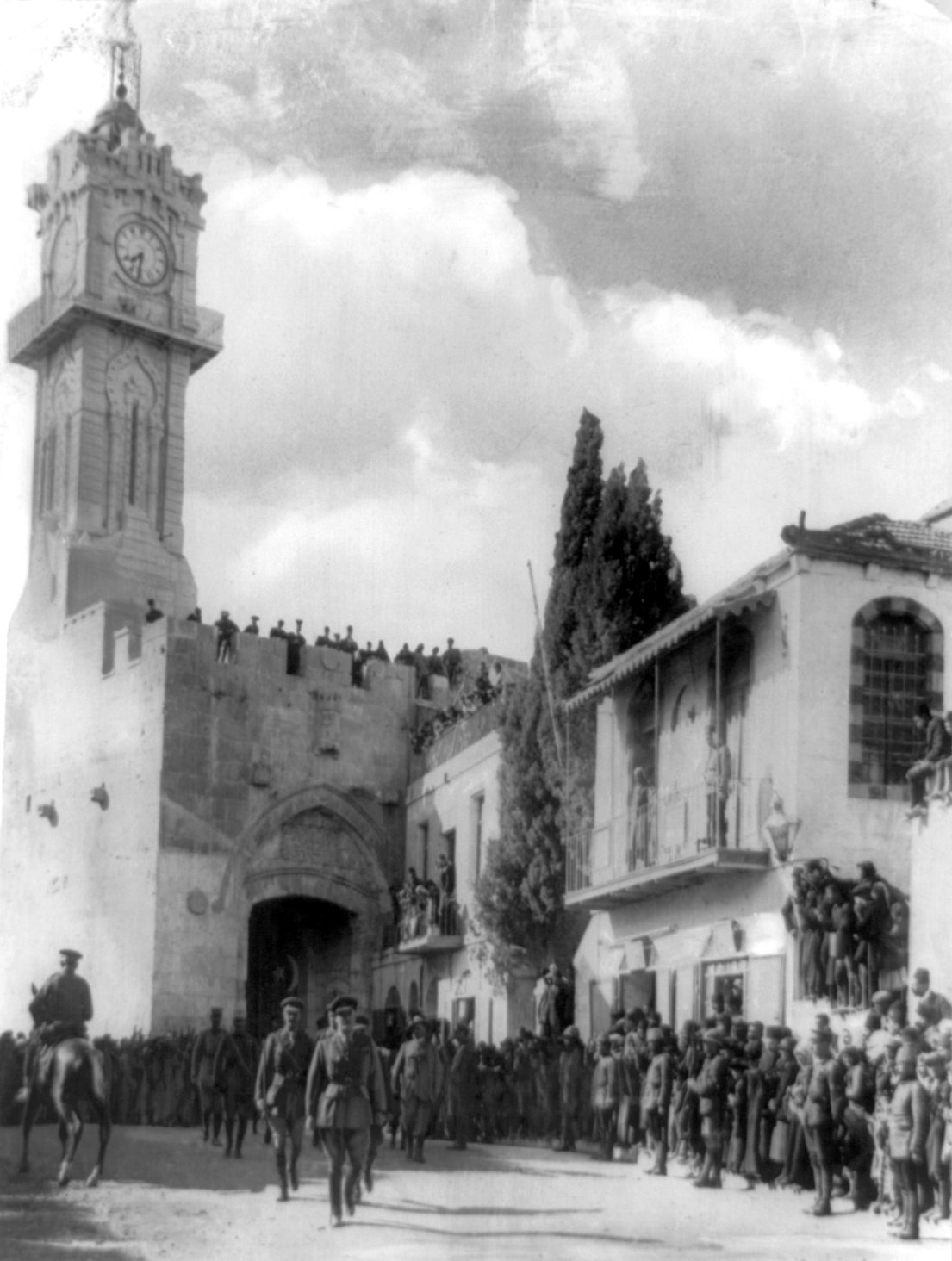
As a result of these victories, the British Empire forces captured Jerusalem and established a new strategically strong fortified line. This line ran from well to the north of Jaffa on the maritime plain, across the Hebron Hills to Bireh north of Jerusalem, and continued eastwards of the Mount of Olives. With the capture of the road from Be'e Elsabe' (Beersheba) to Jerusalem via Hebron and Bethlehem, together with substantial Ottoman territory south of Jerusalem, the city was secured. On 11 December, General Edmund Allenby entered the Old City on foot through the Jaffa Gate instead of horse or vehicles to show respect for the holy city. He was the first Christian in many centuries to control Jerusalem, a city held holy by three great religions. The prime minister of the United Kingdom, David Lloyd George, described the capture as "a Christmas present for the British people". The battle was a great morale boost for the British Empire.
British General Edmund Allenby, Commander-in-Chief of the Egyptian Expeditionary Force (EEF), had won a decisive victory against the German General Erich von Falkenhayn, commander of Ottoman forces in Palestine, at the Battle of Mughar Ridge on 13 November. The British Empire victory forced von Falkenhayn to withdraw his Seventh and Eighth Armies (commanded by Fevzi Pasha and Kress von Kressenstein respectively) and move his headquarters from Jerusalem to Nablus on 14 November. As the Ottoman III Corps (Seventh Army) reached Jerusalem via the Hebron road after its defeat at Beersheba, it was ordered to develop defences around Jerusalem. This corps held the city while the XX Corps retreated from Junction Station into the Hebron Hills towards Jerusalem. As they retired the XX Corps left strong rearguards to stop or slow the British advance. Time was needed to construct defences and for reorganisation of the depleted and disorganised Seventh Army. When they arrived in the city XX Corps took over responsibility for Jerusalem's defences, while III Corps continued to move northwards from Jerusalem along the Nablus road.
The British War Cabinet had cautioned Allenby not to commit to any operations that might not be sustainable in the long term if the strength of British forces in the area could not be maintained. Their concerns were possibly linked to a peace proposal published on 8 November by the new Russian Bolshevik government between Russia and Germany. The document, scheduled to be signed on 3 March 1918, would constitute a separate peace treaty and result in the withdrawal of all Russian troops from the war. All German forces on the eastern front could then turn their attention to fighting British and French forces elsewhere.
Allenby was aware of the lack of accurate maps of the Hebron Hills and that the history of previous campaigns in the region gave clear warnings against hasty or lightly supported assaults on the strong western ramparts. His front-line forces had been fighting and advancing for an extended period fighting many miles from their bases and were tired and depleted. Now 35 mi (56 km) from the railhead at Deir el Belah, Allenby's troops did not have a line of defensive entrenchments behind which they could stop a concerted push by these two Ottoman armies. Such a counterattack could well see them driven back to Gaza and Beersheba.
Allenby reviewed the threat of counterattack and his supply situation and decided that a force large enough to attack into the Hebron Hills and a separate force to operate on the maritime plain could be maintained far from base. He decided to quickly attack Fevzi Pasha's Ottoman 7th Army in the Hebron Hills with the hope of capturing Jerusalem. This would keep pressure on this army in the hope of denying them time to complete their reorganisation, dig deep trenches or worst of all, counterattack.
The planned advance into the Hebron Hills would rely heavily on the ability of the lines of communications to keep the front line troops supplied with food, water and ammunition. These were already operating at considerable distances from the railhead and base areas, and as a result the advance was forced to pause on 17 November to enable supplies to be brought forward by columns under corps control, which had been sent back to railhead for rations and supplies.
Hub AI
Battle of Jerusalem AI simulator
(@Battle of Jerusalem_simulator)
Battle of Jerusalem
The Battle of Jerusalem also known as the Fall of Jerusalem occurred during the British Empire's "Jerusalem Operations" against the Ottoman Empire, in World War I, when fighting for the city developed from 17 November, continuing after the surrender until 30 December 1917, to secure the final objective of the Southern Palestine Offensive during the Sinai and Palestine Campaign of World War I. Before Jerusalem could be secured, two battles were recognised by the British as being fought in the Hebron Hills to the north and east of the Hebron–Junction Station line. These were the Battle of Nebi Samwill from 17 to 24 November and the Defence of Jerusalem from 26 to 30 December 1917. They also recognised within these Jerusalem Operations, the successful second attempt on 21 and 22 December 1917 to advance across the Nahr el Auja, as the Battle of Jaffa, although Jaffa had been occupied as a consequence of the Battle of Mughar Ridge on 16 November.
This series of battles was successfully fought by the British Empire's XX Corps, XXI Corps, and the Desert Mounted Corps against strong opposition from the Yildirim Army Group's Seventh Army in Hebron Hills and the Eighth Army north of Jaffa on the Mediterranean coast. The loss of Jaffa and Jerusalem, together with the loss of 50 mi (80 km) of territory during the Egyptian Expeditionary Force (EEF) advance from Gaza, after the capture of Beersheba, Gaza, Hareira and Sheria, Tel el Khuweilfe and the Battle of Mughar Ridge, constituted a grave setback for the Ottoman Army and the Ottoman Empire.
As a result of these victories, the British Empire forces captured Jerusalem and established a new strategically strong fortified line. This line ran from well to the north of Jaffa on the maritime plain, across the Hebron Hills to Bireh north of Jerusalem, and continued eastwards of the Mount of Olives. With the capture of the road from Be'e Elsabe' (Beersheba) to Jerusalem via Hebron and Bethlehem, together with substantial Ottoman territory south of Jerusalem, the city was secured. On 11 December, General Edmund Allenby entered the Old City on foot through the Jaffa Gate instead of horse or vehicles to show respect for the holy city. He was the first Christian in many centuries to control Jerusalem, a city held holy by three great religions. The prime minister of the United Kingdom, David Lloyd George, described the capture as "a Christmas present for the British people". The battle was a great morale boost for the British Empire.
British General Edmund Allenby, Commander-in-Chief of the Egyptian Expeditionary Force (EEF), had won a decisive victory against the German General Erich von Falkenhayn, commander of Ottoman forces in Palestine, at the Battle of Mughar Ridge on 13 November. The British Empire victory forced von Falkenhayn to withdraw his Seventh and Eighth Armies (commanded by Fevzi Pasha and Kress von Kressenstein respectively) and move his headquarters from Jerusalem to Nablus on 14 November. As the Ottoman III Corps (Seventh Army) reached Jerusalem via the Hebron road after its defeat at Beersheba, it was ordered to develop defences around Jerusalem. This corps held the city while the XX Corps retreated from Junction Station into the Hebron Hills towards Jerusalem. As they retired the XX Corps left strong rearguards to stop or slow the British advance. Time was needed to construct defences and for reorganisation of the depleted and disorganised Seventh Army. When they arrived in the city XX Corps took over responsibility for Jerusalem's defences, while III Corps continued to move northwards from Jerusalem along the Nablus road.
The British War Cabinet had cautioned Allenby not to commit to any operations that might not be sustainable in the long term if the strength of British forces in the area could not be maintained. Their concerns were possibly linked to a peace proposal published on 8 November by the new Russian Bolshevik government between Russia and Germany. The document, scheduled to be signed on 3 March 1918, would constitute a separate peace treaty and result in the withdrawal of all Russian troops from the war. All German forces on the eastern front could then turn their attention to fighting British and French forces elsewhere.
Allenby was aware of the lack of accurate maps of the Hebron Hills and that the history of previous campaigns in the region gave clear warnings against hasty or lightly supported assaults on the strong western ramparts. His front-line forces had been fighting and advancing for an extended period fighting many miles from their bases and were tired and depleted. Now 35 mi (56 km) from the railhead at Deir el Belah, Allenby's troops did not have a line of defensive entrenchments behind which they could stop a concerted push by these two Ottoman armies. Such a counterattack could well see them driven back to Gaza and Beersheba.
Allenby reviewed the threat of counterattack and his supply situation and decided that a force large enough to attack into the Hebron Hills and a separate force to operate on the maritime plain could be maintained far from base. He decided to quickly attack Fevzi Pasha's Ottoman 7th Army in the Hebron Hills with the hope of capturing Jerusalem. This would keep pressure on this army in the hope of denying them time to complete their reorganisation, dig deep trenches or worst of all, counterattack.
The planned advance into the Hebron Hills would rely heavily on the ability of the lines of communications to keep the front line troops supplied with food, water and ammunition. These were already operating at considerable distances from the railhead and base areas, and as a result the advance was forced to pause on 17 November to enable supplies to be brought forward by columns under corps control, which had been sent back to railhead for rations and supplies.
Recent media