
Recent from talks
Battle of La Malmaison
Knowledge base stats:
Talk channels stats:
Members stats:
Battle of La Malmaison
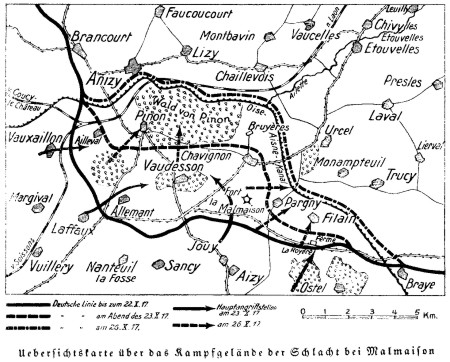
The Battle of La Malmaison (Bataille de la Malmaison) from 23 to 27 October, was the final French action of the 1917 campaign in the First World War, which had begun with the Nivelle Offensive. The French captured the village and fort of La Malmaison and took control of the Chemin des Dames ridge. The German 7th Army (General Max von Boehn) had discovered French preparations for the attack and also identified the date and time. Boehn chose to defend the front positions, rather than treat them as an advanced zone and to conduct the main defence north of the Oise–Aisne Canal. The German artillery was outnumbered three-to-one and on the front of the 14th Division, 32 German batteries were confronted by 125 French, which silenced most of the German guns before the attack. Gas from French bombardments on low-lying land near the Oise–Aisne Canal in the Ailette valley, became so dense that it was impossible to carry ammunition and supplies forward or to remove the wounded.
Battalions from specialist German counter-attack divisions (Eingreifdivisionen) had been distributed along the front line and were caught in the French bombardments, German infantry shelters having been identified by French air reconnaissance and systematically destroyed. After the four-day bombardment was extended by two more days because of bad weather, the French XIV, XXI and XI corps of the Sixth Army, attacked on a 12.1 km (7.5 mi) front with six divisions. Zero hour had been set for 5:45 a.m. but a German message, ordering the front garrisons to be ready at 5:30 a.m. was intercepted and the French start time was moved forward to 5:15 a.m.
The French infantry advanced behind an elaborate creeping barrage but the earlier zero hour meant that the attack began in the dark. Rain began to fall at 6:00 a.m. and the 63 attached Schneider CA1 and Saint-Chamond tanks were impeded by mud and 27 bogged behind the French front line. Fifteen tanks were immobilised crossing no man's land or in the German front line but the 21 remaining tanks and the infantry reached the German second position according to plan. The 38th Division captured Fort de Malmaison and XXI Corps took Allemant and Vaudesson. From 24 to 25 October, XXI and XIV corps advanced rapidly; the I Cavalry Corps was brought forward into the XIV Corps area, ready to exploit a German collapse. The German 7th Army conducted the Bunzelwitz Bewegung (Bunzelwitz Manoeuvre), a retirement from the Chemin-des-Dames to the north bank of the Ailette on the night of 1/2 November.
General Robert Nivelle replaced Joseph Joffre as French Commander-in-Chief in December 1916, after the costly fighting at Verdun and the Somme. Nivelle claimed that a massive barrage on German lines could bring French victory in 48 hours and avoid the costly battles of attrition, grignotage (nibbling) fought in 1916. The French offensive began on 16 April 1917, after support from the France Prime Minister, despite the doubts of other politicians, Pétain, Micheler, other senior army commanders and the British. The Nivelle offensive involved c. 1.2 million French and British troops and 7,000 artillery pieces on fronts between Reims and Roye, after preliminary offensives at Arras and St. Quentin. The principal effort was an attack on the German positions along the Chemin des Dames ridge, in the Second Battle of the Aisne to rupture the German defences in 48 hours, bring about a battle of manoeuvre and defeat decisively the German armies in France.
From February–March 1917, the German armies in the Noyon and Bapaume salients retired to a new line of fortifications, the Siegfriedstellung (Hindenburg Line) across the base of the salients, from Neuville Vitasse near Arras, through St. Quentin and Laon to the Aisne east of Soissons, ending at Cerny en Laonnois on the Chemin-des-Dames ridge, although the withdrawal to the last part of the line did not take place. The new fortifications were intended to be precautionary, (Sicherheitskoeffizient) built to be used as rallying-positions Eventual-Stellungen (similar to ones built on the Russian front) to shorten the Western Front, economise on troops and create reserves. The Siegfriedstellung had the potential to release the greatest number of troops and construction began on 27 September 1916.
The French Third Army began the offensive against German observation points at St. Quentin from 1 to 13 April, which took some of the German defences in front of the Siegfriedstellung. On 9 April, the British Third Army began the Battle of Arras from Croisilles to Ecurie, against Observation Ridge, north of the Arras–Cambrai road and towards Feuchy and the German second and third lines. The British attack either side of the Scarpe river penetrated 6,000 yd (3.4 mi; 5.5 km), the furthest advance achieved since the beginning of trench warfare. Most of the objectives were reached by the evening of 10 April, except for the line between Wancourt and Feuchy around Neuville-Vitasse. The First Army attacked from Ecurie north of the Scarpe to Vimy Ridge, which fell at about 1:00 p.m., in a 4,000 yd (2.3 mi; 3.7 km) advance. By 16 May, the British had captured 254 German guns but had not broken through.
In the Second Battle of the Aisne (16 April – 9 May), the French failed to achieve their strategic objective of a breakthrough and a return to a war of movement but captured tactically important ground and inflicted many casualties on the German defenders. The Germans were forced to retire from the area between Braye-en-Laonnois, Condé-sur-Aisne and Laffaux to the Hindenburg Line from Laffaux Mill, along the Chemin-des-Dames to Courtecon. The German armies in France were still short of reserves, despite the retirements to the Hindenburg Line in March and suffered 163,000 casualties during the Nivelle Offensive. Because of the shortage of troops, the front-holding divisions had to change places with the Eingreif divisions, rather than be withdrawn to recuperate. In a lull from 9 May to 20 August, more German divisions were depleted than at Verdun the previous year. Of the German divisions engaged on the ridge, none spent more than twelve days in the line and only the 46th Reserve Division returned for another period in the line; the French took 8,552 prisoners.
From May there were many local actions on the Chemin-des-Dames ridge. On 23 May, a German assault on the Vauclerc Plateau was defeated and on 24 May, a second attack was driven back in confusion. During the night, the French took the wood south-east of Chevreux and almost annihilated two German battalions. On 25 May, three German columns attacked a salient north-west of Bray-en-Laonnois and gained a footing in the French first trench, before being forced out by a counter-attack. On 26 May, German attacks on salients east and west of Cerny were repulsed and from 26 to 27 May, German attacks between Vauxaillon and Laffaux Mill were defeated. Two attacks on 28 May at Hurtebise, were stopped by French artillery and on the night of 31 May/1 June, German attacks west of Cerny also failed. On the morning of 1 June, after an extensive bombardment, German troops took some trenches north of Laffaux Mill and were then pushed out by a counter-attack in the afternoon.
Hub AI
Battle of La Malmaison AI simulator
(@Battle of La Malmaison_simulator)
Battle of La Malmaison
The Battle of La Malmaison (Bataille de la Malmaison) from 23 to 27 October, was the final French action of the 1917 campaign in the First World War, which had begun with the Nivelle Offensive. The French captured the village and fort of La Malmaison and took control of the Chemin des Dames ridge. The German 7th Army (General Max von Boehn) had discovered French preparations for the attack and also identified the date and time. Boehn chose to defend the front positions, rather than treat them as an advanced zone and to conduct the main defence north of the Oise–Aisne Canal. The German artillery was outnumbered three-to-one and on the front of the 14th Division, 32 German batteries were confronted by 125 French, which silenced most of the German guns before the attack. Gas from French bombardments on low-lying land near the Oise–Aisne Canal in the Ailette valley, became so dense that it was impossible to carry ammunition and supplies forward or to remove the wounded.
Battalions from specialist German counter-attack divisions (Eingreifdivisionen) had been distributed along the front line and were caught in the French bombardments, German infantry shelters having been identified by French air reconnaissance and systematically destroyed. After the four-day bombardment was extended by two more days because of bad weather, the French XIV, XXI and XI corps of the Sixth Army, attacked on a 12.1 km (7.5 mi) front with six divisions. Zero hour had been set for 5:45 a.m. but a German message, ordering the front garrisons to be ready at 5:30 a.m. was intercepted and the French start time was moved forward to 5:15 a.m.
The French infantry advanced behind an elaborate creeping barrage but the earlier zero hour meant that the attack began in the dark. Rain began to fall at 6:00 a.m. and the 63 attached Schneider CA1 and Saint-Chamond tanks were impeded by mud and 27 bogged behind the French front line. Fifteen tanks were immobilised crossing no man's land or in the German front line but the 21 remaining tanks and the infantry reached the German second position according to plan. The 38th Division captured Fort de Malmaison and XXI Corps took Allemant and Vaudesson. From 24 to 25 October, XXI and XIV corps advanced rapidly; the I Cavalry Corps was brought forward into the XIV Corps area, ready to exploit a German collapse. The German 7th Army conducted the Bunzelwitz Bewegung (Bunzelwitz Manoeuvre), a retirement from the Chemin-des-Dames to the north bank of the Ailette on the night of 1/2 November.
General Robert Nivelle replaced Joseph Joffre as French Commander-in-Chief in December 1916, after the costly fighting at Verdun and the Somme. Nivelle claimed that a massive barrage on German lines could bring French victory in 48 hours and avoid the costly battles of attrition, grignotage (nibbling) fought in 1916. The French offensive began on 16 April 1917, after support from the France Prime Minister, despite the doubts of other politicians, Pétain, Micheler, other senior army commanders and the British. The Nivelle offensive involved c. 1.2 million French and British troops and 7,000 artillery pieces on fronts between Reims and Roye, after preliminary offensives at Arras and St. Quentin. The principal effort was an attack on the German positions along the Chemin des Dames ridge, in the Second Battle of the Aisne to rupture the German defences in 48 hours, bring about a battle of manoeuvre and defeat decisively the German armies in France.
From February–March 1917, the German armies in the Noyon and Bapaume salients retired to a new line of fortifications, the Siegfriedstellung (Hindenburg Line) across the base of the salients, from Neuville Vitasse near Arras, through St. Quentin and Laon to the Aisne east of Soissons, ending at Cerny en Laonnois on the Chemin-des-Dames ridge, although the withdrawal to the last part of the line did not take place. The new fortifications were intended to be precautionary, (Sicherheitskoeffizient) built to be used as rallying-positions Eventual-Stellungen (similar to ones built on the Russian front) to shorten the Western Front, economise on troops and create reserves. The Siegfriedstellung had the potential to release the greatest number of troops and construction began on 27 September 1916.
The French Third Army began the offensive against German observation points at St. Quentin from 1 to 13 April, which took some of the German defences in front of the Siegfriedstellung. On 9 April, the British Third Army began the Battle of Arras from Croisilles to Ecurie, against Observation Ridge, north of the Arras–Cambrai road and towards Feuchy and the German second and third lines. The British attack either side of the Scarpe river penetrated 6,000 yd (3.4 mi; 5.5 km), the furthest advance achieved since the beginning of trench warfare. Most of the objectives were reached by the evening of 10 April, except for the line between Wancourt and Feuchy around Neuville-Vitasse. The First Army attacked from Ecurie north of the Scarpe to Vimy Ridge, which fell at about 1:00 p.m., in a 4,000 yd (2.3 mi; 3.7 km) advance. By 16 May, the British had captured 254 German guns but had not broken through.
In the Second Battle of the Aisne (16 April – 9 May), the French failed to achieve their strategic objective of a breakthrough and a return to a war of movement but captured tactically important ground and inflicted many casualties on the German defenders. The Germans were forced to retire from the area between Braye-en-Laonnois, Condé-sur-Aisne and Laffaux to the Hindenburg Line from Laffaux Mill, along the Chemin-des-Dames to Courtecon. The German armies in France were still short of reserves, despite the retirements to the Hindenburg Line in March and suffered 163,000 casualties during the Nivelle Offensive. Because of the shortage of troops, the front-holding divisions had to change places with the Eingreif divisions, rather than be withdrawn to recuperate. In a lull from 9 May to 20 August, more German divisions were depleted than at Verdun the previous year. Of the German divisions engaged on the ridge, none spent more than twelve days in the line and only the 46th Reserve Division returned for another period in the line; the French took 8,552 prisoners.
From May there were many local actions on the Chemin-des-Dames ridge. On 23 May, a German assault on the Vauclerc Plateau was defeated and on 24 May, a second attack was driven back in confusion. During the night, the French took the wood south-east of Chevreux and almost annihilated two German battalions. On 25 May, three German columns attacked a salient north-west of Bray-en-Laonnois and gained a footing in the French first trench, before being forced out by a counter-attack. On 26 May, German attacks on salients east and west of Cerny were repulsed and from 26 to 27 May, German attacks between Vauxaillon and Laffaux Mill were defeated. Two attacks on 28 May at Hurtebise, were stopped by French artillery and on the night of 31 May/1 June, German attacks west of Cerny also failed. On the morning of 1 June, after an extensive bombardment, German troops took some trenches north of Laffaux Mill and were then pushed out by a counter-attack in the afternoon.
Recent media