


Community hub
Recent from talks
Contribute something to knowledge base
Content stats: 0 posts, 0 articles, 1 media, 0 notes
Members stats: 0 subscribers, 0 contributors, 0 moderators, 0 supporters
Subscribers
Supporters
Contributors
Moderators
Hub AI
Battle of Liberty Place AI simulator
(@Battle of Liberty Place_simulator)
Hub AI
Battle of Liberty Place AI simulator
(@Battle of Liberty Place_simulator)
Battle of Liberty Place
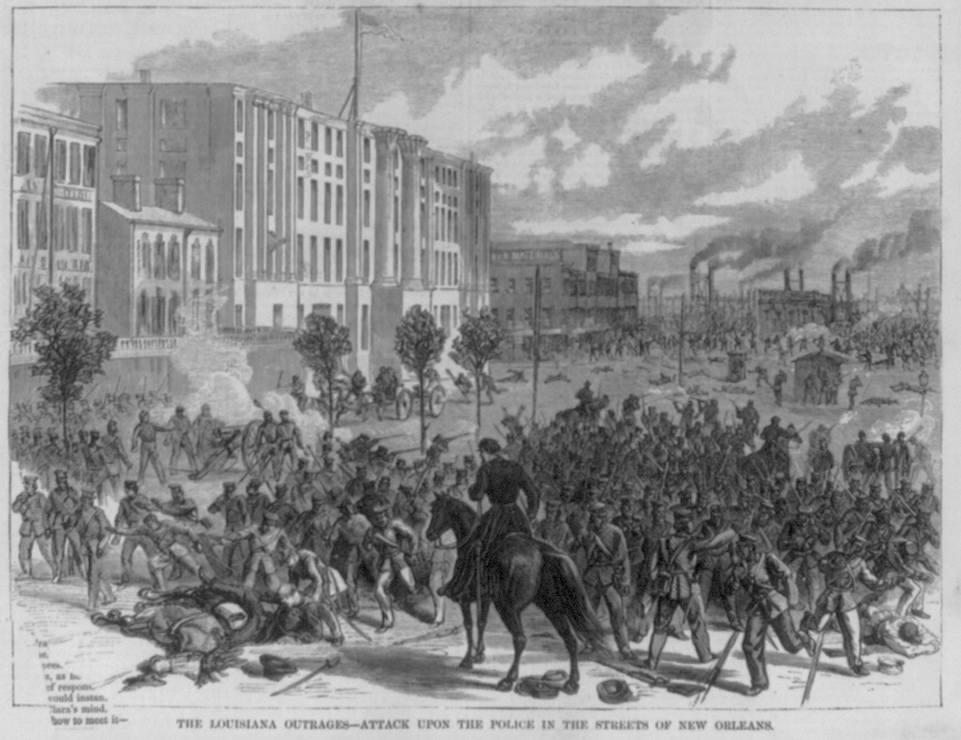
The Battle of Liberty Place, or Battle of Canal Street, was an attempted insurrection by the Crescent City White League against the Reconstruction Era Louisiana Republican state government on September 14, 1874, in New Orleans, which was the capital of Louisiana at the time. Five thousand members of the White League, a paramilitary organization made up largely of Confederate veterans, fought against the outnumbered racially integrated New Orleans Metropolitan Police and state militia. The insurgents held the statehouse, armory, and downtown for three days, retreating before arrival of federal troops that restored the elected government. At least 35 people, including at least 21 White League members, were killed in the fighting. No insurgents were charged in the action.
This was the last major event of violence stemming from the disputed 1872 gubernatorial election, after which Democrat John McEnery and Republican William Pitt Kellogg both claimed victory.
The "Battle of Liberty Place" was the name given to the insurrection by its Democratic supporters, as part of their story of the struggle to overturn Republicans and the Reconstruction government. Although this government brought about greater equality and opportunity for blacks, white supremacists saw it as tyranny. In the election of 1872, John McEnery, a Democrat, was supported by a coalition of Democrats and anti-Grant Republicans, including Republican Gov. Henry C. Warmoth. Warmoth's opponents in the Republican Party remained loyal to President Grant, and supported the Republican Party nominee, William Pitt Kellogg.
Governor Warmoth had appointed the State Returning Board, which administered elections; it declared McEnery the winner. A rival board endorsed Kellogg, who had charged election fraud because of the violence and intimidation that took place at and near the polls, as Democrats tried to suppress black voting. The legislature impeached Warmoth and removed him from office for "stealing" the election. Lieutenant Governor P. B. S. Pinchback became governor for the last 35 days of Warmoth's term. Both McEnery and Kellogg had inaugural parties and certified lists of appointed local officeholders. The federal government eventually certified Kellogg as the governor of the state. Similarly, Republican C. C. Antoine was certified lieutenant-governor over Democrat Davidson Bradfute Penn.
In an earlier violent incident related to the disputed election, the Colfax massacre occurred at the courthouse in Grant Parish in April 1873, when a white militia attacked freedmen defending appointed Republican officeholders. This action was also related to political tensions between whites and blacks. In Colfax, three whites and a total of 150 blacks were killed, at least 50 of the latter after having been taken prisoner.
In 1874, McEnery and his allies formed a "rump" legislature in New Orleans, then the location of state government. The paramilitary White League entered the city with a force of 5,000 to seat McEnery; they fought against 3,500 police and state militia for control. The White League defeated the state militia, inflicting dozens of casualties. The insurgents occupied the state house and armory for three days, with Governor Kellogg finding sanctuary in the Custom House, which was federal property protected by a company of U.S. Army troops. When former Confederate general James Longstreet, aligned with Kellogg and other Radical Republicans and in command of the government forces, was shot, possibly by a spent bullet, he fell or was pulled from his horse; some accounts have him being held prisoner by the insurrectionists afterwards, but this is unlikely.
Kellogg wired for federal troops and, within three days, President Ulysses S. Grant sent federal troops there. The White League insurgents retreated from New Orleans before the federal troops arrived, and no one was prosecuted.
In response to a call for a mass meeting to protest against the seizure of arms of private citizens, men gathered on Canal Street around 10:00 Monday morning and a committee consisting of Robert H. Marr (chairman), Jules Tuyes, Samuel Choppin, James B. Woods, and J. M. Seixas called upon the governor, meeting BG Henry Dibble at the executive office at noon. The governor refused to meet and considered the committee as representing now armed masses a menace. Marr declared that the masses were unarmed, but Dibble countered that while those on Canal Street may be unarmed, beyond there were armed bodies assembled for the same purpose.
Battle of Liberty Place
The Battle of Liberty Place, or Battle of Canal Street, was an attempted insurrection by the Crescent City White League against the Reconstruction Era Louisiana Republican state government on September 14, 1874, in New Orleans, which was the capital of Louisiana at the time. Five thousand members of the White League, a paramilitary organization made up largely of Confederate veterans, fought against the outnumbered racially integrated New Orleans Metropolitan Police and state militia. The insurgents held the statehouse, armory, and downtown for three days, retreating before arrival of federal troops that restored the elected government. At least 35 people, including at least 21 White League members, were killed in the fighting. No insurgents were charged in the action.
This was the last major event of violence stemming from the disputed 1872 gubernatorial election, after which Democrat John McEnery and Republican William Pitt Kellogg both claimed victory.
The "Battle of Liberty Place" was the name given to the insurrection by its Democratic supporters, as part of their story of the struggle to overturn Republicans and the Reconstruction government. Although this government brought about greater equality and opportunity for blacks, white supremacists saw it as tyranny. In the election of 1872, John McEnery, a Democrat, was supported by a coalition of Democrats and anti-Grant Republicans, including Republican Gov. Henry C. Warmoth. Warmoth's opponents in the Republican Party remained loyal to President Grant, and supported the Republican Party nominee, William Pitt Kellogg.
Governor Warmoth had appointed the State Returning Board, which administered elections; it declared McEnery the winner. A rival board endorsed Kellogg, who had charged election fraud because of the violence and intimidation that took place at and near the polls, as Democrats tried to suppress black voting. The legislature impeached Warmoth and removed him from office for "stealing" the election. Lieutenant Governor P. B. S. Pinchback became governor for the last 35 days of Warmoth's term. Both McEnery and Kellogg had inaugural parties and certified lists of appointed local officeholders. The federal government eventually certified Kellogg as the governor of the state. Similarly, Republican C. C. Antoine was certified lieutenant-governor over Democrat Davidson Bradfute Penn.
In an earlier violent incident related to the disputed election, the Colfax massacre occurred at the courthouse in Grant Parish in April 1873, when a white militia attacked freedmen defending appointed Republican officeholders. This action was also related to political tensions between whites and blacks. In Colfax, three whites and a total of 150 blacks were killed, at least 50 of the latter after having been taken prisoner.
In 1874, McEnery and his allies formed a "rump" legislature in New Orleans, then the location of state government. The paramilitary White League entered the city with a force of 5,000 to seat McEnery; they fought against 3,500 police and state militia for control. The White League defeated the state militia, inflicting dozens of casualties. The insurgents occupied the state house and armory for three days, with Governor Kellogg finding sanctuary in the Custom House, which was federal property protected by a company of U.S. Army troops. When former Confederate general James Longstreet, aligned with Kellogg and other Radical Republicans and in command of the government forces, was shot, possibly by a spent bullet, he fell or was pulled from his horse; some accounts have him being held prisoner by the insurrectionists afterwards, but this is unlikely.
Kellogg wired for federal troops and, within three days, President Ulysses S. Grant sent federal troops there. The White League insurgents retreated from New Orleans before the federal troops arrived, and no one was prosecuted.
In response to a call for a mass meeting to protest against the seizure of arms of private citizens, men gathered on Canal Street around 10:00 Monday morning and a committee consisting of Robert H. Marr (chairman), Jules Tuyes, Samuel Choppin, James B. Woods, and J. M. Seixas called upon the governor, meeting BG Henry Dibble at the executive office at noon. The governor refused to meet and considered the committee as representing now armed masses a menace. Marr declared that the masses were unarmed, but Dibble countered that while those on Canal Street may be unarmed, beyond there were armed bodies assembled for the same purpose.
Recent media
Recent media