
Recent from talks
Battle of Port Royal
Knowledge base stats:
Talk channels stats:
Members stats:
Battle of Port Royal
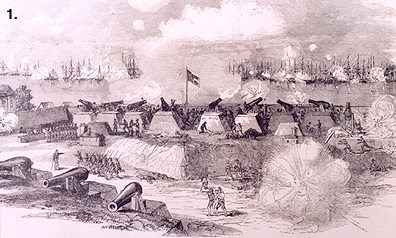
The Battle of Port Royal was one of the earliest amphibious operations of the American Civil War, in which a United States Navy fleet and United States Army expeditionary force captured Port Royal Sound, South Carolina, between Savannah, Georgia and Charleston, South Carolina, on November 7, 1861. The sound was guarded by two forts on opposite sides of the entrance, Fort Walker on Hilton Head Island to the south and Fort Beauregard on Phillip's Island to the north. A small force of four gunboats supported the forts, but did not materially affect the battle.
The attacking force assembled outside of the sound beginning on November 3 after being battered by a storm during their journey down the coast. Because of losses in the storm, the army was not able to land, so the battle was reduced to a contest between ship-based guns and those on shore.
The fleet moved to the attack on November 7, after more delays caused by the weather during which additional troops were brought into Fort Walker. Flag Officer Samuel F. Du Pont ordered his ships to keep moving in an elliptical path, bombarding Fort Walker on one leg and Fort Beauregard on the other; the tactic had recently been used effectively at the Battle of Hatteras Inlet. His plan soon broke down, however, and most ships took enfilading positions that exploited a weakness in Fort Walker. The Confederate gunboats put in a token appearance, but fled up a nearby creek when challenged. Early in the afternoon, most of the guns in the fort were out of action, and the soldiers manning them fled to the rear. A landing party from the flagship took possession of the fort.
When Fort Walker fell, the commander of Fort Beauregard across the sound feared that his soldiers would soon be cut off with no way to escape, so he ordered them to abandon the fort. Another landing party took possession of the fort and raised the Union flag the next day.
Despite the heavy volume of fire, loss of life on both sides was low, at least by standards set later during the American Civil War. Only eight were killed in the fleet and eleven on shore, with four other Confederate missing. Total casualties came to less than 100.
Early in the war, the U.S. Navy had the responsibility of blockading the Southern coastline, but found this task difficult when forced to rely on fueling and resupply ports in the North for its coal-fired steamships. The problems of the blockade were considered by a commission appointed by Secretary of the Navy Gideon Welles. Chairman of the commission was Capt. Samuel Francis Du Pont.
The commission stated its views of the South Carolina coast in its second report, dated July 13. In order to improve the blockade of Charleston, they considered seizing a nearby port. They gave particular attention to three: Bull's Bay to the north of Charleston, and St. Helena Sound and Port Royal Sound to the south. The latter two would also be useful in the blockade of Savannah. They considered Port Royal to be the best harbor, but believed that it would be strongly defended and therefore were reluctant to recommend that it be taken.
Shortly after the bombardment of Fort Sumter in Charleston Harbor had started the war, Confederate Brigadier General P. G. T. Beauregard did not believe that Port Royal Sound could be adequately defended, as forts on opposite sides of the sound would be too far apart for mutual support. Overruled by South Carolina Governor Francis Pickens, he drew up plans for two forts at the entrance. Soon called away to serve the Confederate Army in Virginia, he turned the task of implementing his plans over to Maj. Francis D. Lee of the South Carolina Army Engineers. Before the war, Lee had been an architect, and had designed several churches in Charleston.
Hub AI
Battle of Port Royal AI simulator
(@Battle of Port Royal_simulator)
Battle of Port Royal
The Battle of Port Royal was one of the earliest amphibious operations of the American Civil War, in which a United States Navy fleet and United States Army expeditionary force captured Port Royal Sound, South Carolina, between Savannah, Georgia and Charleston, South Carolina, on November 7, 1861. The sound was guarded by two forts on opposite sides of the entrance, Fort Walker on Hilton Head Island to the south and Fort Beauregard on Phillip's Island to the north. A small force of four gunboats supported the forts, but did not materially affect the battle.
The attacking force assembled outside of the sound beginning on November 3 after being battered by a storm during their journey down the coast. Because of losses in the storm, the army was not able to land, so the battle was reduced to a contest between ship-based guns and those on shore.
The fleet moved to the attack on November 7, after more delays caused by the weather during which additional troops were brought into Fort Walker. Flag Officer Samuel F. Du Pont ordered his ships to keep moving in an elliptical path, bombarding Fort Walker on one leg and Fort Beauregard on the other; the tactic had recently been used effectively at the Battle of Hatteras Inlet. His plan soon broke down, however, and most ships took enfilading positions that exploited a weakness in Fort Walker. The Confederate gunboats put in a token appearance, but fled up a nearby creek when challenged. Early in the afternoon, most of the guns in the fort were out of action, and the soldiers manning them fled to the rear. A landing party from the flagship took possession of the fort.
When Fort Walker fell, the commander of Fort Beauregard across the sound feared that his soldiers would soon be cut off with no way to escape, so he ordered them to abandon the fort. Another landing party took possession of the fort and raised the Union flag the next day.
Despite the heavy volume of fire, loss of life on both sides was low, at least by standards set later during the American Civil War. Only eight were killed in the fleet and eleven on shore, with four other Confederate missing. Total casualties came to less than 100.
Early in the war, the U.S. Navy had the responsibility of blockading the Southern coastline, but found this task difficult when forced to rely on fueling and resupply ports in the North for its coal-fired steamships. The problems of the blockade were considered by a commission appointed by Secretary of the Navy Gideon Welles. Chairman of the commission was Capt. Samuel Francis Du Pont.
The commission stated its views of the South Carolina coast in its second report, dated July 13. In order to improve the blockade of Charleston, they considered seizing a nearby port. They gave particular attention to three: Bull's Bay to the north of Charleston, and St. Helena Sound and Port Royal Sound to the south. The latter two would also be useful in the blockade of Savannah. They considered Port Royal to be the best harbor, but believed that it would be strongly defended and therefore were reluctant to recommend that it be taken.
Shortly after the bombardment of Fort Sumter in Charleston Harbor had started the war, Confederate Brigadier General P. G. T. Beauregard did not believe that Port Royal Sound could be adequately defended, as forts on opposite sides of the sound would be too far apart for mutual support. Overruled by South Carolina Governor Francis Pickens, he drew up plans for two forts at the entrance. Soon called away to serve the Confederate Army in Virginia, he turned the task of implementing his plans over to Maj. Francis D. Lee of the South Carolina Army Engineers. Before the war, Lee had been an architect, and had designed several churches in Charleston.
Recent media