



Community hub
Recent from talks
Contribute something to knowledge base
Content stats: 0 posts, 0 articles, 1 media, 0 notes
Members stats: 0 subscribers, 0 contributors, 0 moderators, 0 supporters
Subscribers
Supporters
Contributors
Moderators
Hub AI
Bayerisch Gmain AI simulator
(@Bayerisch Gmain_simulator)
Hub AI
Bayerisch Gmain AI simulator
(@Bayerisch Gmain_simulator)
Bayerisch Gmain
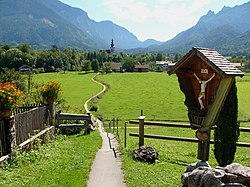
Bayerisch Gmain is a municipality and a village in the district of Berchtesgadener Land in Bavaria in Germany.
“Auf der Gmain” is a name used for centuries for the settlement area between Untersberg and Lattengebirge, Hallthurm and Kirchholz.
Even the Bronze Age people appreciated the richness of the soil (salt in Reichenhall) and the favorable location of the surrounding area and settled here permanently. During Roman times, the area was called Mona, from which the name "Gmain" developed. The place name first appears in connection with a donation from the Bavarian Duke Theotpert (reigned c. 711–716) to Nonnberg Abbey in Salzburg in 712. Around 1100, the Counts of Plain appear, who, with the construction of Plainburg Castle, made the Gmain area the center of the upper county in the Salzburg region. Despite the territorial border, which divided the widely scattered farms into a Bavarian and a Salzburgian half after the decline of Plain's rule even before 1300 (around 1295), the village community was always perceived by the inhabitants as a single entity.
The former ducal Bavarian catchment area of the municipality thus socio-culturally distinguishes itself within the district of Berchtesgadener Land from its southern region of Berchtesgadener Land within the historical borders of the prince-provost's core territory and at the same time formed a link to the former Archbishopric of Salzburg.
In the practice of religious life, the unity of canon law formed a community-building foundation for all the inhabitants of Gmain. Regarding the economic structure, cultural life in general, and schooling in particular, the state border along the Weißbach stream played virtually no role. The numerous family ties across the border also naturally formed a strong bond. The only dividing line was the Salzburg and Bavarian jurisdiction, which ended at the Weißbach and established the different sovereignties.
The separation of the two towns only gained real significance from 1816 onwards, when, after a brief period of unity under Bavarian administration, the political differences became increasingly pronounced throughout the 19th century. Despite the formation of two independent municipalities, a sense of community remained. Shared economic interests, particularly in tourism, contributed to this, as did the practicality of shared technical facilities. The special appeal – and also an obligation – lies in preserving their shared historical heritage despite the independence that has since developed.
On December 1, 1905, part of the dissolved municipality of Sankt Zeno was incorporated, namely the hamlet of Leopoldstal, a small exclave of Sankt Zeno east of the Kirchholz on the Weißbach.
On November 10, 1926, the municipality of Gmain was renamed to its current name.
Bayerisch Gmain
Bayerisch Gmain is a municipality and a village in the district of Berchtesgadener Land in Bavaria in Germany.
“Auf der Gmain” is a name used for centuries for the settlement area between Untersberg and Lattengebirge, Hallthurm and Kirchholz.
Even the Bronze Age people appreciated the richness of the soil (salt in Reichenhall) and the favorable location of the surrounding area and settled here permanently. During Roman times, the area was called Mona, from which the name "Gmain" developed. The place name first appears in connection with a donation from the Bavarian Duke Theotpert (reigned c. 711–716) to Nonnberg Abbey in Salzburg in 712. Around 1100, the Counts of Plain appear, who, with the construction of Plainburg Castle, made the Gmain area the center of the upper county in the Salzburg region. Despite the territorial border, which divided the widely scattered farms into a Bavarian and a Salzburgian half after the decline of Plain's rule even before 1300 (around 1295), the village community was always perceived by the inhabitants as a single entity.
The former ducal Bavarian catchment area of the municipality thus socio-culturally distinguishes itself within the district of Berchtesgadener Land from its southern region of Berchtesgadener Land within the historical borders of the prince-provost's core territory and at the same time formed a link to the former Archbishopric of Salzburg.
In the practice of religious life, the unity of canon law formed a community-building foundation for all the inhabitants of Gmain. Regarding the economic structure, cultural life in general, and schooling in particular, the state border along the Weißbach stream played virtually no role. The numerous family ties across the border also naturally formed a strong bond. The only dividing line was the Salzburg and Bavarian jurisdiction, which ended at the Weißbach and established the different sovereignties.
The separation of the two towns only gained real significance from 1816 onwards, when, after a brief period of unity under Bavarian administration, the political differences became increasingly pronounced throughout the 19th century. Despite the formation of two independent municipalities, a sense of community remained. Shared economic interests, particularly in tourism, contributed to this, as did the practicality of shared technical facilities. The special appeal – and also an obligation – lies in preserving their shared historical heritage despite the independence that has since developed.
On December 1, 1905, part of the dissolved municipality of Sankt Zeno was incorporated, namely the hamlet of Leopoldstal, a small exclave of Sankt Zeno east of the Kirchholz on the Weißbach.
On November 10, 1926, the municipality of Gmain was renamed to its current name.
Recent media
Recent media