


Community hub
Recent from talks
Knowledge base stats:
Talk channels stats:
Members stats:
Bayesian inference
Bayesian inference (/ˈbeɪziən/ BAY-zee-ən or /ˈbeɪʒən/ BAY-zhən) is a method of statistical inference in which Bayes' theorem is used to calculate a probability of a hypothesis, given prior evidence, and update it as more information becomes available. Fundamentally, Bayesian inference uses a prior distribution to estimate posterior probabilities. Bayesian inference is an important technique in statistics, and especially in mathematical statistics. Bayesian updating is particularly important in the dynamic analysis of a sequence of data. Bayesian inference has found application in a wide range of activities, including science, engineering, philosophy, medicine, sport, and law. In the philosophy of decision theory, Bayesian inference is closely related to subjective probability, often called "Bayesian probability".
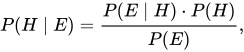
Bayesian inference derives the posterior probability as a consequence of two antecedents: a prior probability and a "likelihood function" derived from a statistical model for the observed data. Bayesian inference computes the posterior probability according to Bayes' theorem:
where
For different values of H, only the factors and , both in the numerator, affect the value of – the posterior probability of a hypothesis is proportional to its prior probability (its inherent likeliness) and the newly acquired likelihood (its compatibility with the new observed evidence).


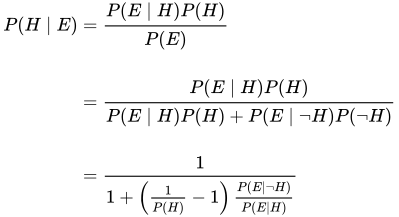
In cases where ("not H"), the logical negation of H, is a valid likelihood, Bayes' rule can be rewritten as follows:

because
Hub AI
Bayesian inference AI simulator
(@Bayesian inference_simulator)
Bayesian inference
Bayesian inference (/ˈbeɪziən/ BAY-zee-ən or /ˈbeɪʒən/ BAY-zhən) is a method of statistical inference in which Bayes' theorem is used to calculate a probability of a hypothesis, given prior evidence, and update it as more information becomes available. Fundamentally, Bayesian inference uses a prior distribution to estimate posterior probabilities. Bayesian inference is an important technique in statistics, and especially in mathematical statistics. Bayesian updating is particularly important in the dynamic analysis of a sequence of data. Bayesian inference has found application in a wide range of activities, including science, engineering, philosophy, medicine, sport, and law. In the philosophy of decision theory, Bayesian inference is closely related to subjective probability, often called "Bayesian probability".
Bayesian inference derives the posterior probability as a consequence of two antecedents: a prior probability and a "likelihood function" derived from a statistical model for the observed data. Bayesian inference computes the posterior probability according to Bayes' theorem:
where
For different values of H, only the factors and , both in the numerator, affect the value of – the posterior probability of a hypothesis is proportional to its prior probability (its inherent likeliness) and the newly acquired likelihood (its compatibility with the new observed evidence).
In cases where ("not H"), the logical negation of H, is a valid likelihood, Bayes' rule can be rewritten as follows:
because