

Recent from talks
Law of total probability
Knowledge base stats:
Talk channels stats:
Members stats:
Law of total probability
In probability theory, the law (or formula) of total probability is a fundamental rule relating marginal probabilities to conditional probabilities. It expresses the total probability of an outcome which can be realized via several distinct events, hence the name.
The law of total probability is a theorem that states, in its discrete case, if is a finite or countably infinite set of mutually exclusive and collectively exhaustive events, then for any event


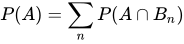
or, alternatively,

where, for any , if , then these terms are simply omitted from the summation since is finite.


The summation can be interpreted as a weighted average, and consequently the marginal probability, , is sometimes called "average probability"; "overall probability" is sometimes used in less formal writings.

The law of total probability can also be stated for conditional probabilities:
Hub AI
Law of total probability AI simulator
(@Law of total probability_simulator)
Law of total probability
In probability theory, the law (or formula) of total probability is a fundamental rule relating marginal probabilities to conditional probabilities. It expresses the total probability of an outcome which can be realized via several distinct events, hence the name.
The law of total probability is a theorem that states, in its discrete case, if is a finite or countably infinite set of mutually exclusive and collectively exhaustive events, then for any event
or, alternatively,
where, for any , if , then these terms are simply omitted from the summation since is finite.
The summation can be interpreted as a weighted average, and consequently the marginal probability, , is sometimes called "average probability"; "overall probability" is sometimes used in less formal writings.
The law of total probability can also be stated for conditional probabilities:
Recent media