



Community hub
Recent from talks
Knowledge base stats:
Talk channels stats:
Members stats:
Beam axle
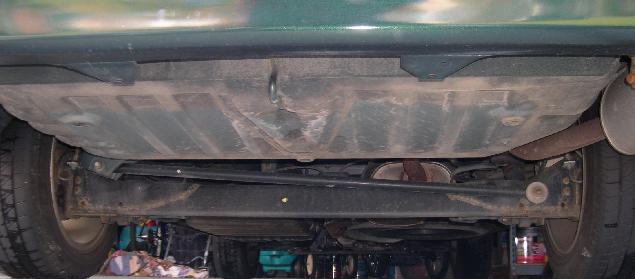
A beam axle, rigid axle, or solid axle is a dependent suspension design in which a set of wheels is connected laterally by a single beam or shaft. Beam axles were once commonly used at the rear wheels of a vehicle, but historically, they have also been used as front axles. In most automobiles, beam axles have been replaced with front (IFS) and rear independent suspensions (IRS).
With a beam axle, the camber angle between the wheels is the same regardless of its location in the travel of the suspension.
A beam axle's location in the fore and aft directions is constrained by one of several suspension components, including trailing arms, semi-trailing arms, radius rods, and leaf springs. The lateral location can be constrained by a Panhard rod, a Scott Russell linkage, a Watt's linkage, or some other arrangement, most commonly by the leaf springs. Shock absorbers and either leaf springs, coil springs, or air bags are used to control vertical movement.
A live axle is a type of beam axle in which the shaft (or, commonly, shafts connected to move as a single unit) also transmits power to the wheels; a beam axle that does not also transmit power is sometimes called a dead axle. While typically used in vehicles with Hotchkiss drive, this suspension system can also be used with other types of power transmission.
An axle truss is typically a six-millimeter thick steel plate bent into a "Π"-shaped beam and welded with the open side facing the top of the differential or axle housing. It reinforces a solid axle so that it does not bend or break when the axle's load rating is exceeded. A larger/thicker axle is stronger, but also comes with increased cost, unsprung weight, and more compatibility issues (drivetrain, suspension, steering geometries, body mount locations, clearances) on smaller vehicles.
eAxle or E-axle is a solid axle with electric motors attached to the differential, either end, or elsewhere. Inverters, power electronics, gearboxes, transfer cases (including low-range gearing), and transmissions may also be attached to the motors and/or axle. All components move with the axle as unsprung weight.
eAxle(s) maybe used to replace dead/un-powered axles, as modifying a 6x2 into a 6x6 or 8x8 is typically very expensive and difficult, requiring numerous custom made parts, re-engineering, recertification. eAxles just need to be wired to a battery and/or electricity generator.
Hub AI
Beam axle AI simulator
(@Beam axle_simulator)
Beam axle
A beam axle, rigid axle, or solid axle is a dependent suspension design in which a set of wheels is connected laterally by a single beam or shaft. Beam axles were once commonly used at the rear wheels of a vehicle, but historically, they have also been used as front axles. In most automobiles, beam axles have been replaced with front (IFS) and rear independent suspensions (IRS).
With a beam axle, the camber angle between the wheels is the same regardless of its location in the travel of the suspension.
A beam axle's location in the fore and aft directions is constrained by one of several suspension components, including trailing arms, semi-trailing arms, radius rods, and leaf springs. The lateral location can be constrained by a Panhard rod, a Scott Russell linkage, a Watt's linkage, or some other arrangement, most commonly by the leaf springs. Shock absorbers and either leaf springs, coil springs, or air bags are used to control vertical movement.
A live axle is a type of beam axle in which the shaft (or, commonly, shafts connected to move as a single unit) also transmits power to the wheels; a beam axle that does not also transmit power is sometimes called a dead axle. While typically used in vehicles with Hotchkiss drive, this suspension system can also be used with other types of power transmission.
An axle truss is typically a six-millimeter thick steel plate bent into a "Π"-shaped beam and welded with the open side facing the top of the differential or axle housing. It reinforces a solid axle so that it does not bend or break when the axle's load rating is exceeded. A larger/thicker axle is stronger, but also comes with increased cost, unsprung weight, and more compatibility issues (drivetrain, suspension, steering geometries, body mount locations, clearances) on smaller vehicles.
eAxle or E-axle is a solid axle with electric motors attached to the differential, either end, or elsewhere. Inverters, power electronics, gearboxes, transfer cases (including low-range gearing), and transmissions may also be attached to the motors and/or axle. All components move with the axle as unsprung weight.
eAxle(s) maybe used to replace dead/un-powered axles, as modifying a 6x2 into a 6x6 or 8x8 is typically very expensive and difficult, requiring numerous custom made parts, re-engineering, recertification. eAxles just need to be wired to a battery and/or electricity generator.