



Community hub
Recent from talks
Contribute something to knowledge base
Content stats: 0 posts, 0 articles, 1 media, 0 notes
Members stats: 0 subscribers, 0 contributors, 0 moderators, 0 supporters
Subscribers
Supporters
Contributors
Moderators
Hub AI
Bearing (navigation) AI simulator
(@Bearing (navigation)_simulator)
Hub AI
Bearing (navigation) AI simulator
(@Bearing (navigation)_simulator)
Bearing (navigation)
In navigation, bearing or azimuth is the horizontal angle between the direction of an object and north or another object. The angle value can be specified in various angular units, such as degrees, mils, or grad. More specifically:
Alternatively, the US Army defines the bearing from point A to point B as the smallest angle between the ray AB and either north or south, whichever is closest. The bearing is expressed in terms of 2 characters and 1 number: first, the character is either N or S; next is the angle numerical value; third, the character representing the perpendicular direction, either E or W. The bearing angle value will always be less than 90 degrees. For example, if Point B is located exactly southeast of Point A, the bearing from Point A to Point B is "S 45° E". For example, if the bearing between Point A and Point B is S 45° E, the azimuth between Point A and Point B is 135°.
In nautical navigation the absolute bearing is the clockwise angle between north and an object observed from the vessel.
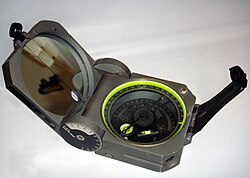
If the north used as reference is the true geographical north then the bearing is a true bearing whereas if the reference used is magnetic north then the bearing is a magnetic bearing. An absolute bearing is measured with a bearing compass.
The measurement of absolute bearings of fixed landmarks and other navigation aids is useful for the navigator because this information can be used on the nautical chart together with simple geometrical techniques to aid in determining the position of the vessel.
A grid bearing (also known as grid azimuth) is measured in relation to the fixed horizontal reference plane of grid north, that is, using the direction northwards along the grid lines of the map projection as a reference point.
A compass bearing, as in vehicle or marine navigation, is measured in relation to the magnetic compass of the navigator's vehicle or vessel (if aboard ship). It should be very close to the magnetic bearing. The difference between a magnetic bearing and a compass bearing is the deviation caused to the compass by ferrous metals and local magnetic fields generated by any variety of vehicle or shipboard sources (steel vehicle bodies/frames or vessel hulls, ignition systems, etc.)
In nautical navigation the relative bearing of an object is the clockwise angle from the heading of the vessel to a straight line drawn from the observation station on the vessel to the object.
Bearing (navigation)
In navigation, bearing or azimuth is the horizontal angle between the direction of an object and north or another object. The angle value can be specified in various angular units, such as degrees, mils, or grad. More specifically:
Alternatively, the US Army defines the bearing from point A to point B as the smallest angle between the ray AB and either north or south, whichever is closest. The bearing is expressed in terms of 2 characters and 1 number: first, the character is either N or S; next is the angle numerical value; third, the character representing the perpendicular direction, either E or W. The bearing angle value will always be less than 90 degrees. For example, if Point B is located exactly southeast of Point A, the bearing from Point A to Point B is "S 45° E". For example, if the bearing between Point A and Point B is S 45° E, the azimuth between Point A and Point B is 135°.
In nautical navigation the absolute bearing is the clockwise angle between north and an object observed from the vessel.
If the north used as reference is the true geographical north then the bearing is a true bearing whereas if the reference used is magnetic north then the bearing is a magnetic bearing. An absolute bearing is measured with a bearing compass.
The measurement of absolute bearings of fixed landmarks and other navigation aids is useful for the navigator because this information can be used on the nautical chart together with simple geometrical techniques to aid in determining the position of the vessel.
A grid bearing (also known as grid azimuth) is measured in relation to the fixed horizontal reference plane of grid north, that is, using the direction northwards along the grid lines of the map projection as a reference point.
A compass bearing, as in vehicle or marine navigation, is measured in relation to the magnetic compass of the navigator's vehicle or vessel (if aboard ship). It should be very close to the magnetic bearing. The difference between a magnetic bearing and a compass bearing is the deviation caused to the compass by ferrous metals and local magnetic fields generated by any variety of vehicle or shipboard sources (steel vehicle bodies/frames or vessel hulls, ignition systems, etc.)
In nautical navigation the relative bearing of an object is the clockwise angle from the heading of the vessel to a straight line drawn from the observation station on the vessel to the object.
Recent media
Recent media