
Recent from talks
Beckhole Incline
Knowledge base stats:
Talk channels stats:
Members stats:
Beckhole Incline
Beckhole Incline was a steep, rope-worked gradient on the railway line between Whitby and Pickering, in the North Riding of Yorkshire, England. Opened in May 1836 as part of the horse-worked Whitby & Pickering Railway, the line was operated by three railway companies before becoming redundant on the opening of a diversionary line to the east that allowed through working by steam engines on the entire line. Although the incline was closed to regular traffic in 1865, it was used for a very brief period in 1872, to test a special locomotive intended for railways with steep gradients.
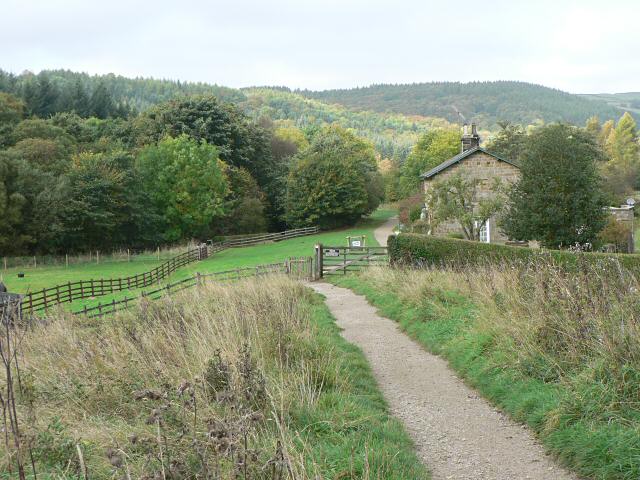
The site of the incline can now be walked, as part of the Rail Trail between Goathland and Grosmont.
Opened as part of the Whitby and Pickering Railway (W&PR) in May 1836, the incline allowed for trains to be hauled up and down from Beckhole to Goathland Bank Top station. At Beckhole, the height above sea level was 200 feet (61 m), and at Goathland Bank Top, it was 350 feet (110 m). The incline (or inclined plane), was engineered by Frederick Swanwick to a design by George Stephenson.
The incline was 1,500 yards (1,400 m) long, and whilst it was rated at 1-in-12, it did reach 1-in-10 at one point. The first version of the incline workings involved a hemp rope attached to the wagons or carriages, and the 5.75-inch (146 mm) rope was wound around a drum 10 feet (3 m) in diameter. A tank with wheels fitted was filled with water at the top, and was then attached to one end of the rope which ran on a series of pulley wheels (174 in total). As some parts of the incline were curved, the wheels were angled and wooden rollers were added at these points to lessen friction and provide some 'give' in the rope. The tank was allowed to descend hauling the railway vehicles up the bank by its "gravitational force". The journey to the top took about 4½ minutes, (a speed of around 11 miles per hour (18 km/h)) through "an avenue of trees". At the bottom of the incline, the water tank was emptied into the beck, and it was returned to the top of the incline to be filled with water. A local farmer was employed to carry out this function, returning the tank by horse-power. If he was required to move the tank, a white flag was displayed at Beck Hole. A reservoir for supplying water for the tanks was located in Gale Field next to Goathland Bank Top. When the incline was closed, the water supply was retained for filling the water tower on Goathland station.
In the days of horse operation, apart from the opening ceremony when three carriages ascended at the same time, carriages were generally taken up the incline one at a time. On the return journey of the opening ceremony (26 May 1836), the carriages descending the incline were held near the bottom and the rope was removed. Then the brakes were released, which allowed the gravity to move the carriages to "..within 6 miles (9.7 km) of Whitby..". The company charged a flat rate for the transportation of goods along the Whitby and Pickering Railway, however, goods ascending the incline were subject to an extra Shilling per ton (1836 prices), which goods descending were not. Services were spartan in the early days with the timetable from 1844, showing just two workings in either direction. This continued right up until the conversion to full steam operation, the timetable for March 1847, still showing two trains in either direction.
The incline was listed in the Guinness Railway Book as one of the best known work-roped inclines, which were designed to carry passengers. Most inclines at that time, were used in quarrying or mining operations. Charles Dickens travelled along the incline in 1861, later writing to Wilkie Collins and describing it as a "..quaint old railway..", and its operation he described as you "did it like a Blondin".
The Whitby & Pickering Line was bought out in 1845 by the York and North Midland Railway (Y&NM), who set about adapting the entire Whitby & Pickering Line from single track to double track, (with a southern connection at Pickering to York) which it achieved in 1847. The Y&NM also implemented the conversion of the line to steam-engine operation in the same year, and the method of working the incline changed from water balancing, into a stationary steam-worked engine, with the capability of 10 brake horsepower (7.5 kW). The previous water-loading system was viewed as unreliable in the face of heavier traffic and more frequent services, with the Y&NM also considering the water tank method and communications between the railway and the farmer as "primitive". The stationary engine was located at the bank top in Goathland, and had a wire rope that was wound around a drum 6 feet (1.8 m) in diameter. The wire rope was attached to a specially-built six-wheeled van, which would be at the head of the train whilst descending, and at the rear of the train (pushing) when ascending. By 1854, the operation of the line had been subsumed into the North Eastern Railway (NER).
Initially, locomotives to be used on the line were rebuilt steam engines with different springs and wheel arrangements than in normal engines. This was in case the engines needed to visit York Works for maintenance; the route south over the incline being the only option until 1865, when the North Eastern Railway's branch from Battersby reached Grosmont station, and the deviation line opened.
Hub AI
Beckhole Incline AI simulator
(@Beckhole Incline_simulator)
Beckhole Incline
Beckhole Incline was a steep, rope-worked gradient on the railway line between Whitby and Pickering, in the North Riding of Yorkshire, England. Opened in May 1836 as part of the horse-worked Whitby & Pickering Railway, the line was operated by three railway companies before becoming redundant on the opening of a diversionary line to the east that allowed through working by steam engines on the entire line. Although the incline was closed to regular traffic in 1865, it was used for a very brief period in 1872, to test a special locomotive intended for railways with steep gradients.
The site of the incline can now be walked, as part of the Rail Trail between Goathland and Grosmont.
Opened as part of the Whitby and Pickering Railway (W&PR) in May 1836, the incline allowed for trains to be hauled up and down from Beckhole to Goathland Bank Top station. At Beckhole, the height above sea level was 200 feet (61 m), and at Goathland Bank Top, it was 350 feet (110 m). The incline (or inclined plane), was engineered by Frederick Swanwick to a design by George Stephenson.
The incline was 1,500 yards (1,400 m) long, and whilst it was rated at 1-in-12, it did reach 1-in-10 at one point. The first version of the incline workings involved a hemp rope attached to the wagons or carriages, and the 5.75-inch (146 mm) rope was wound around a drum 10 feet (3 m) in diameter. A tank with wheels fitted was filled with water at the top, and was then attached to one end of the rope which ran on a series of pulley wheels (174 in total). As some parts of the incline were curved, the wheels were angled and wooden rollers were added at these points to lessen friction and provide some 'give' in the rope. The tank was allowed to descend hauling the railway vehicles up the bank by its "gravitational force". The journey to the top took about 4½ minutes, (a speed of around 11 miles per hour (18 km/h)) through "an avenue of trees". At the bottom of the incline, the water tank was emptied into the beck, and it was returned to the top of the incline to be filled with water. A local farmer was employed to carry out this function, returning the tank by horse-power. If he was required to move the tank, a white flag was displayed at Beck Hole. A reservoir for supplying water for the tanks was located in Gale Field next to Goathland Bank Top. When the incline was closed, the water supply was retained for filling the water tower on Goathland station.
In the days of horse operation, apart from the opening ceremony when three carriages ascended at the same time, carriages were generally taken up the incline one at a time. On the return journey of the opening ceremony (26 May 1836), the carriages descending the incline were held near the bottom and the rope was removed. Then the brakes were released, which allowed the gravity to move the carriages to "..within 6 miles (9.7 km) of Whitby..". The company charged a flat rate for the transportation of goods along the Whitby and Pickering Railway, however, goods ascending the incline were subject to an extra Shilling per ton (1836 prices), which goods descending were not. Services were spartan in the early days with the timetable from 1844, showing just two workings in either direction. This continued right up until the conversion to full steam operation, the timetable for March 1847, still showing two trains in either direction.
The incline was listed in the Guinness Railway Book as one of the best known work-roped inclines, which were designed to carry passengers. Most inclines at that time, were used in quarrying or mining operations. Charles Dickens travelled along the incline in 1861, later writing to Wilkie Collins and describing it as a "..quaint old railway..", and its operation he described as you "did it like a Blondin".
The Whitby & Pickering Line was bought out in 1845 by the York and North Midland Railway (Y&NM), who set about adapting the entire Whitby & Pickering Line from single track to double track, (with a southern connection at Pickering to York) which it achieved in 1847. The Y&NM also implemented the conversion of the line to steam-engine operation in the same year, and the method of working the incline changed from water balancing, into a stationary steam-worked engine, with the capability of 10 brake horsepower (7.5 kW). The previous water-loading system was viewed as unreliable in the face of heavier traffic and more frequent services, with the Y&NM also considering the water tank method and communications between the railway and the farmer as "primitive". The stationary engine was located at the bank top in Goathland, and had a wire rope that was wound around a drum 6 feet (1.8 m) in diameter. The wire rope was attached to a specially-built six-wheeled van, which would be at the head of the train whilst descending, and at the rear of the train (pushing) when ascending. By 1854, the operation of the line had been subsumed into the North Eastern Railway (NER).
Initially, locomotives to be used on the line were rebuilt steam engines with different springs and wheel arrangements than in normal engines. This was in case the engines needed to visit York Works for maintenance; the route south over the incline being the only option until 1865, when the North Eastern Railway's branch from Battersby reached Grosmont station, and the deviation line opened.
Recent media