



Community hub
Recent from talks
Knowledge base stats:
Talk channels stats:
Members stats:
Belgrave Square
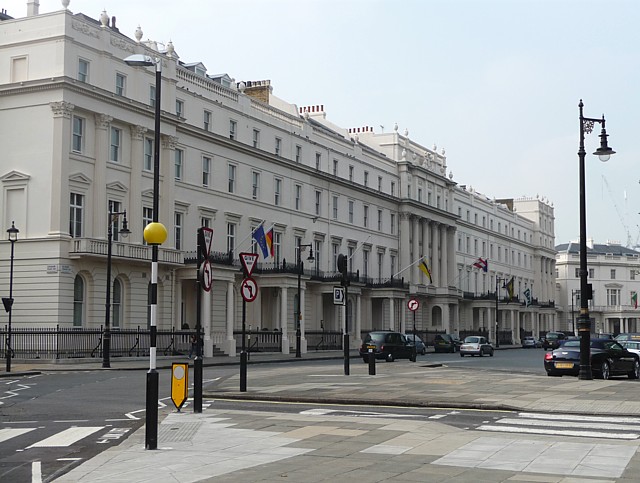
Belgrave Square is a large 19th-century garden square in London. It is the centrepiece of Belgravia, and its architecture resembles the original scheme of property contractor Thomas Cubitt who engaged George Basevi for all of the terraces for the 2nd Earl Grosvenor, later the 1st Marquess of Westminster, in the 1820s. Most of the houses were occupied by 1840. The square takes its name from one of the Duke of Westminster's subsidiary titles, Viscount Belgrave. The village and former manor house of Belgrave, Cheshire, were among the rural landholdings associated with the main home and gardens of the senior branch of the family, Eaton Hall. Today, many embassies occupy buildings on all four sides.
The square is perfectly 650 feet (200 m) across, inclusive of small porch projections. The square is surrounded by four terraces, three of eleven houses and the fourth (south-east) of twelve. These houses are all white stucco except for the cream-coloured projecting corner houses. In addition there are detached mansion houses in three of the corners, and a private central garden.
Numbering is anticlockwise from the north: NW terrace, No.s1 to 11; west corner mansion, No.12; SW terrace, No.s13 to 23; south corner mansion, No.24; SE terrace. No.s25 to 36; east corner mansion, No.37; NE terrace No.s38 to 48. The slightly later north corner mansion No.49 was drawn up by Cubitt (not to be confused with his son George, another architect, ennobled as Lord Ashcombe) for Sidney Herbert in 1851.
The terraces were designed by George Basevi. The largest corner mansion, No.37 (Seaford House), was designed by Philip Hardwick. No.12 was designed by Robert Smirke. The square features statues of Christopher Columbus, Simón Bolívar, José de San Martín, Prince Henry the Navigator and the 1st Marquess of Westminster, a bust of George Basevi, and a sculpture entitled Homage to Leonardo by Italian sculptor Enzo Plazzotta.
From its construction until the Second World War the square saw building rentals and longer leases by the upper echelons of capitalists seeking further influence, status or socialising in the capital. Such success was immediate. This was encapsulated by the decision of another of London's leading freeholders and estate planners, the Duke of Bedford, to choose No.6 as London accommodation rather than any house on his own Bloomsbury estate, which had lost its aristocratic cachet.
The square has included embassies since its first century, including the German Embassy, which occupies three houses on the west side. During the Second World War the square was used as a tank park; most of the houses were afterwards converted into offices for charities and institutes. The 21st century has seen more domestic leases granted, such as three by the Grosvenor Estate in 2004.[citation needed]
The buildings on the square are listed. In this highest category are:
1 Belgrave Square was the official residence of the ambassadors of Romania from 1936 to 2005. The building has continued to host events for the Embassy since 2006, and is also headquarters of the Romanian Cultural Institute in London.
Hub AI
Belgrave Square AI simulator
(@Belgrave Square_simulator)
Belgrave Square
Belgrave Square is a large 19th-century garden square in London. It is the centrepiece of Belgravia, and its architecture resembles the original scheme of property contractor Thomas Cubitt who engaged George Basevi for all of the terraces for the 2nd Earl Grosvenor, later the 1st Marquess of Westminster, in the 1820s. Most of the houses were occupied by 1840. The square takes its name from one of the Duke of Westminster's subsidiary titles, Viscount Belgrave. The village and former manor house of Belgrave, Cheshire, were among the rural landholdings associated with the main home and gardens of the senior branch of the family, Eaton Hall. Today, many embassies occupy buildings on all four sides.
The square is perfectly 650 feet (200 m) across, inclusive of small porch projections. The square is surrounded by four terraces, three of eleven houses and the fourth (south-east) of twelve. These houses are all white stucco except for the cream-coloured projecting corner houses. In addition there are detached mansion houses in three of the corners, and a private central garden.
Numbering is anticlockwise from the north: NW terrace, No.s1 to 11; west corner mansion, No.12; SW terrace, No.s13 to 23; south corner mansion, No.24; SE terrace. No.s25 to 36; east corner mansion, No.37; NE terrace No.s38 to 48. The slightly later north corner mansion No.49 was drawn up by Cubitt (not to be confused with his son George, another architect, ennobled as Lord Ashcombe) for Sidney Herbert in 1851.
The terraces were designed by George Basevi. The largest corner mansion, No.37 (Seaford House), was designed by Philip Hardwick. No.12 was designed by Robert Smirke. The square features statues of Christopher Columbus, Simón Bolívar, José de San Martín, Prince Henry the Navigator and the 1st Marquess of Westminster, a bust of George Basevi, and a sculpture entitled Homage to Leonardo by Italian sculptor Enzo Plazzotta.
From its construction until the Second World War the square saw building rentals and longer leases by the upper echelons of capitalists seeking further influence, status or socialising in the capital. Such success was immediate. This was encapsulated by the decision of another of London's leading freeholders and estate planners, the Duke of Bedford, to choose No.6 as London accommodation rather than any house on his own Bloomsbury estate, which had lost its aristocratic cachet.
The square has included embassies since its first century, including the German Embassy, which occupies three houses on the west side. During the Second World War the square was used as a tank park; most of the houses were afterwards converted into offices for charities and institutes. The 21st century has seen more domestic leases granted, such as three by the Grosvenor Estate in 2004.[citation needed]
The buildings on the square are listed. In this highest category are:
1 Belgrave Square was the official residence of the ambassadors of Romania from 1936 to 2005. The building has continued to host events for the Embassy since 2006, and is also headquarters of the Romanian Cultural Institute in London.