
Recent from talks
Belmont transmitting station
Knowledge base stats:
Talk channels stats:
Members stats:
Belmont transmitting station
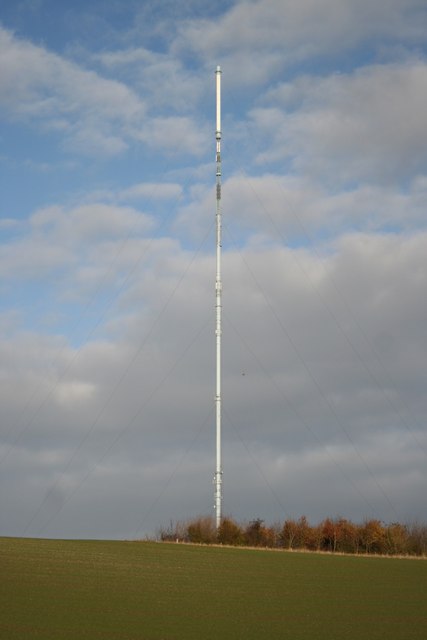
The Belmont Transmitting Station is a broadcasting and telecommunications facility next to the B1225, 1 mile (1.6 km) west of the village of Donington on Bain in the civil parish of South Willingham, near Market Rasen and Louth in Lincolnshire, England (grid reference TF217837). It is owned and operated by Arqiva.
It has a guyed tubular steel mast, with a lattice upper section. The mast was shortened in April 2010 and is now 1,154 feet (351.7 m) in height. Before this it was 1,272 feet (387.7 m) high and was considered to be the tallest structure of its kind in the world (taller masts, such as the KVLY-TV mast in the United States, use steel lattice construction), and the tallest structure of any type in the United Kingdom. After the top section was removed, the mast's reduced height relegated it to the second-highest in the UK after Skelton in Cumbria.
Despite the mast being shortened it can be seen in daylight on clear days from most areas close to and within the Lincolnshire Wolds. On clear nights its bright red aircraft warning lights can be very widely seen across much of Lincolnshire from as far north as the Humber estuary and Barton-Upon-Humber; from the west of the county it can be seen from Lincoln, Gainsborough and Grantham; from the south of the county it can be seen from Spalding and Bourne; and from the east it can be seen from Skegness, Mablethorpe and most areas along the Lincolnshire coast. The lights can also be seen from many parts of Nottinghamshire, coastal areas of North West Norfolk and a few parts of Derbyshire on very clear nights.
A planning application was made in October 1963 to Louth Rural District. Work had started by April 1964.
The foundations were laid on 30 June 1964. The concrete foundation was built by the end of October 1964, with tube sections being added from November 1964 at the site, near Benniworth.
It would be the seventh highest mast in the world. The first 900 ft would be a 9-ft diameter steel cylinder, with the rest a steel lattice. There would be a 12 ft cylinder around this lattice, with the top 150 ft being 9 ft wide. 1200 cubic feet of concrete was poured into its 32 square feet foundations. 12 people would work on the site.
The mast was constructed in 1965 and it came into service on 20 December of that year. As built it was a tubular pipe 900 feet (274.3 m) long by 9 feet (2.7 m) in diameter, surmounted by a 365 feet (111.3 m) lattice upper section (an identical mast was constructed in 1964 at Emley Moor near Huddersfield in Yorkshire, but the other mast collapsed due to guy failure caused by icing and high winds on 19 March 1969). Its ropes weigh 85 tons, made by British Ropes, with steel from Steel, Peech and Tozer of Templeborough in South Yorkshire. The column weighs 210 tons and has 375 segments, with steel from United Steel Companies at Scunthorpe in northern Lincolnshire.
In September 1967, meteorological equipment was added to the 1,265 feet (385.6 m) mast extending its height to 1,272 feet (387.7 m). The imperial measurement was the accepted value quoted by publications including the 1993 edition of the Guinness Book of Records. The metric measurement quoted by the current owners is 0.2 m (8 in) shorter.
Hub AI
Belmont transmitting station AI simulator
(@Belmont transmitting station_simulator)
Belmont transmitting station
The Belmont Transmitting Station is a broadcasting and telecommunications facility next to the B1225, 1 mile (1.6 km) west of the village of Donington on Bain in the civil parish of South Willingham, near Market Rasen and Louth in Lincolnshire, England (grid reference TF217837). It is owned and operated by Arqiva.
It has a guyed tubular steel mast, with a lattice upper section. The mast was shortened in April 2010 and is now 1,154 feet (351.7 m) in height. Before this it was 1,272 feet (387.7 m) high and was considered to be the tallest structure of its kind in the world (taller masts, such as the KVLY-TV mast in the United States, use steel lattice construction), and the tallest structure of any type in the United Kingdom. After the top section was removed, the mast's reduced height relegated it to the second-highest in the UK after Skelton in Cumbria.
Despite the mast being shortened it can be seen in daylight on clear days from most areas close to and within the Lincolnshire Wolds. On clear nights its bright red aircraft warning lights can be very widely seen across much of Lincolnshire from as far north as the Humber estuary and Barton-Upon-Humber; from the west of the county it can be seen from Lincoln, Gainsborough and Grantham; from the south of the county it can be seen from Spalding and Bourne; and from the east it can be seen from Skegness, Mablethorpe and most areas along the Lincolnshire coast. The lights can also be seen from many parts of Nottinghamshire, coastal areas of North West Norfolk and a few parts of Derbyshire on very clear nights.
A planning application was made in October 1963 to Louth Rural District. Work had started by April 1964.
The foundations were laid on 30 June 1964. The concrete foundation was built by the end of October 1964, with tube sections being added from November 1964 at the site, near Benniworth.
It would be the seventh highest mast in the world. The first 900 ft would be a 9-ft diameter steel cylinder, with the rest a steel lattice. There would be a 12 ft cylinder around this lattice, with the top 150 ft being 9 ft wide. 1200 cubic feet of concrete was poured into its 32 square feet foundations. 12 people would work on the site.
The mast was constructed in 1965 and it came into service on 20 December of that year. As built it was a tubular pipe 900 feet (274.3 m) long by 9 feet (2.7 m) in diameter, surmounted by a 365 feet (111.3 m) lattice upper section (an identical mast was constructed in 1964 at Emley Moor near Huddersfield in Yorkshire, but the other mast collapsed due to guy failure caused by icing and high winds on 19 March 1969). Its ropes weigh 85 tons, made by British Ropes, with steel from Steel, Peech and Tozer of Templeborough in South Yorkshire. The column weighs 210 tons and has 375 segments, with steel from United Steel Companies at Scunthorpe in northern Lincolnshire.
In September 1967, meteorological equipment was added to the 1,265 feet (385.6 m) mast extending its height to 1,272 feet (387.7 m). The imperial measurement was the accepted value quoted by publications including the 1993 edition of the Guinness Book of Records. The metric measurement quoted by the current owners is 0.2 m (8 in) shorter.
Recent media