


Community hub
Recent from talks
Contribute something to knowledge base
Content stats: 0 posts, 0 articles, 1 media, 0 notes
Members stats: 0 subscribers, 0 contributors, 0 moderators, 0 supporters
Subscribers
Supporters
Contributors
Moderators
Hub AI
Belturbet AI simulator
(@Belturbet_simulator)
Hub AI
Belturbet AI simulator
(@Belturbet_simulator)
Belturbet
Belturbet (/bɛlˈtɜːrbət/; Irish: Béal Tairbirt, meaning 'mouth of the isthmus') is a town in County Cavan, Ireland. It lies on the N3 road, around 14 km (8.7 mi) north of Cavan town and 123 km (76 mi) from Dublin. It is also located around 4 km (2.5 mi) south of the border with County Fermanagh, part of Northern Ireland, and is 36 km (22 mi) from Enniskillen. As of the 2022 census, the population was 1,610.
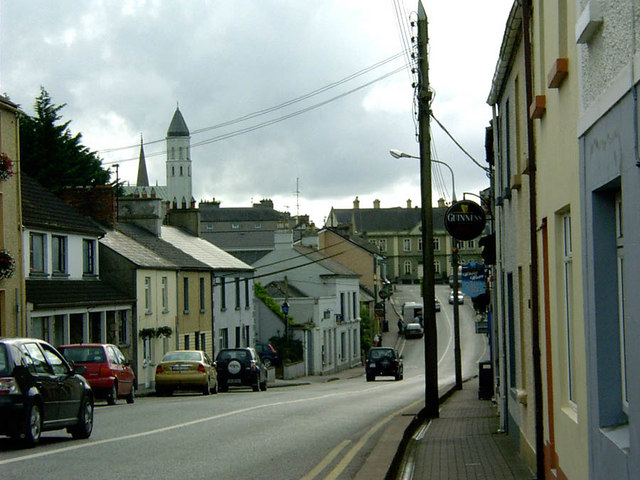
The main street leads to the square or 'diamond' where all of the town's important buildings are situated. The Church of Ireland church dominates the skyline.
Belturbet's location is historically one of the best places for crossing the River Erne. When the Anglo-Normans tried to conquer in the early 13th century, Walter de Lacy built a motte-and-bailey on Turbet Island (an island in the Erne). The fort was probably made of wood and has not survived although the steep mound of earth where it was built can still be seen.
Belturbet was the capital of the Kingdom of East Breifne which was an historic kingdom of Ireland roughly corresponding to County Cavan that existed from 1256 to 1607. In the late 16th century the local O'Reilly chieftains built a castle opposite Turbet Island, but this has not survived.
As part of the Plantation of Ulster in the early 17th century, the lands around Belturbet were granted to the English "undertaker" Stephen Butler. He soon established a thriving urban centre, whose prosperity relied heavily on its position on the Erne. The main street leads to the square or 'diamond' where all of the town's important buildings are situated. The Church of Ireland church dominates the skyline; some of it dates from the early 17th century, and it was one of the first Anglican churches built in Ireland, reputedly using materials from Drumlane Abbey.
The town was seized by the Irish during the Irish Rebellion of 1641, and was the site of one of the massacres of planters, in which over two dozen people were thrown from the town's bridge and drowned. Following the death of Owen Roe O'Neill commander of the Confederate Ulster army, a meeting at Belturbet on 18 March 1650 appointed the inexperienced Heber MacMahon, Catholic Bishop of Clogher, in his place.[verification needed] In March 1653, under Viscount Magennis of Iveagh, it was the last town in Ireland to fall to Cromwell; the final Irish stronghold at nearby Cloughoughter held out for a further month.
Belturbet acquired an English garrison in the late 17th century. Many of the original fortifications are in good repair. The proto-Quaker leader, William Edmundson, was detained in Belturbet in the 1650s, and put in the stocks.
In 1689 during the Williamite War, Tyrconnell promoted the writer Antoine Hamilton major-general[verification needed] sending his army north to Belturbet[verification needed] to fight the rebels of Enniskillen. In the battle of Newtownbutler, in July, Hamilton commanded the horse. The outcome would show that he was "better with his pen than with his sword".
Belturbet
Belturbet (/bɛlˈtɜːrbət/; Irish: Béal Tairbirt, meaning 'mouth of the isthmus') is a town in County Cavan, Ireland. It lies on the N3 road, around 14 km (8.7 mi) north of Cavan town and 123 km (76 mi) from Dublin. It is also located around 4 km (2.5 mi) south of the border with County Fermanagh, part of Northern Ireland, and is 36 km (22 mi) from Enniskillen. As of the 2022 census, the population was 1,610.
The main street leads to the square or 'diamond' where all of the town's important buildings are situated. The Church of Ireland church dominates the skyline.
Belturbet's location is historically one of the best places for crossing the River Erne. When the Anglo-Normans tried to conquer in the early 13th century, Walter de Lacy built a motte-and-bailey on Turbet Island (an island in the Erne). The fort was probably made of wood and has not survived although the steep mound of earth where it was built can still be seen.
Belturbet was the capital of the Kingdom of East Breifne which was an historic kingdom of Ireland roughly corresponding to County Cavan that existed from 1256 to 1607. In the late 16th century the local O'Reilly chieftains built a castle opposite Turbet Island, but this has not survived.
As part of the Plantation of Ulster in the early 17th century, the lands around Belturbet were granted to the English "undertaker" Stephen Butler. He soon established a thriving urban centre, whose prosperity relied heavily on its position on the Erne. The main street leads to the square or 'diamond' where all of the town's important buildings are situated. The Church of Ireland church dominates the skyline; some of it dates from the early 17th century, and it was one of the first Anglican churches built in Ireland, reputedly using materials from Drumlane Abbey.
The town was seized by the Irish during the Irish Rebellion of 1641, and was the site of one of the massacres of planters, in which over two dozen people were thrown from the town's bridge and drowned. Following the death of Owen Roe O'Neill commander of the Confederate Ulster army, a meeting at Belturbet on 18 March 1650 appointed the inexperienced Heber MacMahon, Catholic Bishop of Clogher, in his place.[verification needed] In March 1653, under Viscount Magennis of Iveagh, it was the last town in Ireland to fall to Cromwell; the final Irish stronghold at nearby Cloughoughter held out for a further month.
Belturbet acquired an English garrison in the late 17th century. Many of the original fortifications are in good repair. The proto-Quaker leader, William Edmundson, was detained in Belturbet in the 1650s, and put in the stocks.
In 1689 during the Williamite War, Tyrconnell promoted the writer Antoine Hamilton major-general[verification needed] sending his army north to Belturbet[verification needed] to fight the rebels of Enniskillen. In the battle of Newtownbutler, in July, Hamilton commanded the horse. The outcome would show that he was "better with his pen than with his sword".
Recent media
Recent media