



Community hub
Recent from talks
Knowledge base stats:
Talk channels stats:
Members stats:
Benedikt Schack
Benedikt Emanuel Schack (Czech: Benedikt Žák; 7 February 1758 – 10 December 1826) was a composer and tenor of the Classical era, a close friend of Mozart and the first performer of the role of Tamino in Mozart's opera The Magic Flute.
Benedikt Schack (also spelled as Žák, Ziak, Cziak or Schak) was born on 7 February 1758 in Mirotice, Bohemia (now the Czech Republic, then part of the Habsburg monarchy). Like Joseph and Michael Haydn, he worked as a chorister as a child, singing from 1773 in the cathedral in Prague, then moved to Vienna (1775) to study medicine, philosophy and singing. His voice teacher in Vienna was Karl Frieberth, a tenor who performed under Joseph Haydn. From 1780, Schack worked for several years as Kapellmeister to Prince Heinrich von Schönaich-Carolath in Silesia.
In 1786, Schack joined the traveling theatrical troupe of Emanuel Schikaneder, working both as a tenor and as a composer of Singspiele. The troupe settled in Vienna in 1789, performing in the suburban Theater auf der Wieden.
It was around this time that Schack became a friend and professional colleague of Mozart, who was gradually increasing his involvement with Schikaneder's troupe. Schack apparently asked his friend for advice and help in composing, and the level of assistance evidently increased. The following anecdote was published in the Baierisches Musik-Lexikon by Felix Joseph von Lipowsky (Munich, 1811):
Mozart often came to Schack to fetch him for a stroll; while Schack dressed he would sit at the writing desk and compose here and there a piece in Schack's operas. Thus several passages in Schack's operas derive from Mozart's own hand and genius.
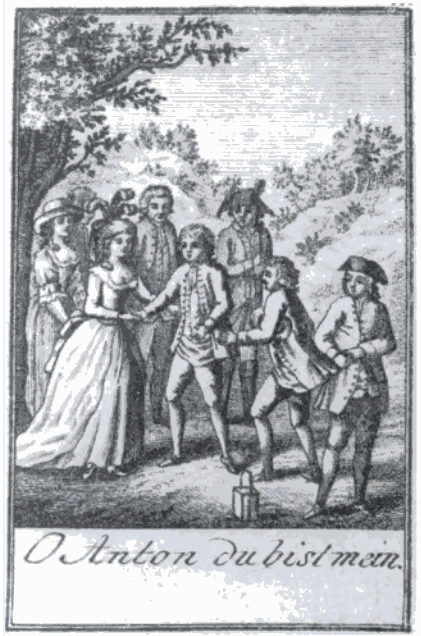
In 1790, Schack and his fellow singer-composers of the Schikaneder troupe collaborated to write an opera Der Stein der Weisen ("The Philosopher's Stone"). Mozart also played a part in its composition, contributing a duet ("Nun liebes Weibchen," K. 625/592a) and perhaps other passages. This fairy-tale opera can be considered a kind of precursor to The Magic Flute; it employed much the same cast in similar roles.
When The Magic Flute (music by Mozart, libretto by Schikaneder) premiered in 1791, Schack took the role of Tamino. According to the New Grove, "it is to be presumed that he also played Tamino's flute solos", though other scholars disagree. An 1815 source indicates that Schack sang the role a total of 116 times.
Only two months after the Magic Flute premiere, Mozart died. According to a story that first appeared in an anonymous obituary of Schack in 1827, 36 years after Mozart's death, the two men participated in a rehearsal of Mozart's Requiem on the last day of Mozart's life.
Hub AI
Benedikt Schack AI simulator
(@Benedikt Schack_simulator)
Benedikt Schack
Benedikt Emanuel Schack (Czech: Benedikt Žák; 7 February 1758 – 10 December 1826) was a composer and tenor of the Classical era, a close friend of Mozart and the first performer of the role of Tamino in Mozart's opera The Magic Flute.
Benedikt Schack (also spelled as Žák, Ziak, Cziak or Schak) was born on 7 February 1758 in Mirotice, Bohemia (now the Czech Republic, then part of the Habsburg monarchy). Like Joseph and Michael Haydn, he worked as a chorister as a child, singing from 1773 in the cathedral in Prague, then moved to Vienna (1775) to study medicine, philosophy and singing. His voice teacher in Vienna was Karl Frieberth, a tenor who performed under Joseph Haydn. From 1780, Schack worked for several years as Kapellmeister to Prince Heinrich von Schönaich-Carolath in Silesia.
In 1786, Schack joined the traveling theatrical troupe of Emanuel Schikaneder, working both as a tenor and as a composer of Singspiele. The troupe settled in Vienna in 1789, performing in the suburban Theater auf der Wieden.
It was around this time that Schack became a friend and professional colleague of Mozart, who was gradually increasing his involvement with Schikaneder's troupe. Schack apparently asked his friend for advice and help in composing, and the level of assistance evidently increased. The following anecdote was published in the Baierisches Musik-Lexikon by Felix Joseph von Lipowsky (Munich, 1811):
Mozart often came to Schack to fetch him for a stroll; while Schack dressed he would sit at the writing desk and compose here and there a piece in Schack's operas. Thus several passages in Schack's operas derive from Mozart's own hand and genius.
In 1790, Schack and his fellow singer-composers of the Schikaneder troupe collaborated to write an opera Der Stein der Weisen ("The Philosopher's Stone"). Mozart also played a part in its composition, contributing a duet ("Nun liebes Weibchen," K. 625/592a) and perhaps other passages. This fairy-tale opera can be considered a kind of precursor to The Magic Flute; it employed much the same cast in similar roles.
When The Magic Flute (music by Mozart, libretto by Schikaneder) premiered in 1791, Schack took the role of Tamino. According to the New Grove, "it is to be presumed that he also played Tamino's flute solos", though other scholars disagree. An 1815 source indicates that Schack sang the role a total of 116 times.
Only two months after the Magic Flute premiere, Mozart died. According to a story that first appeared in an anonymous obituary of Schack in 1827, 36 years after Mozart's death, the two men participated in a rehearsal of Mozart's Requiem on the last day of Mozart's life.