
Recent from talks
Benin City
Knowledge base stats:
Talk channels stats:
Members stats:
Benin City
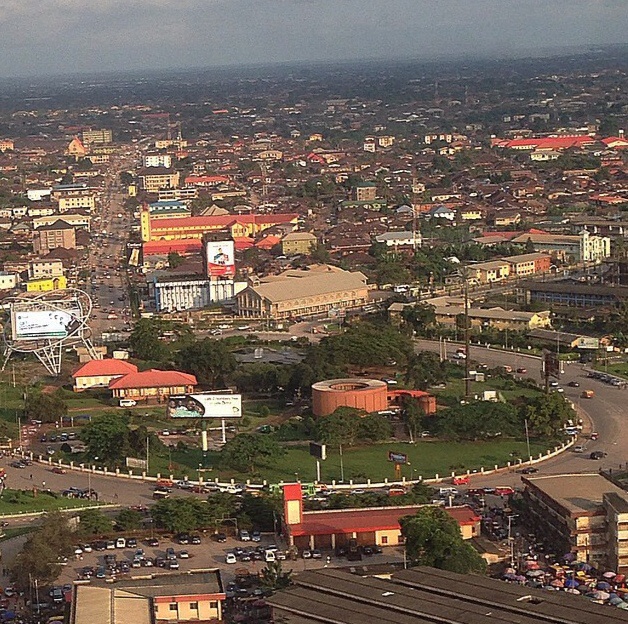
Benin City serves as the capital and largest metropolitan centre of Edo State, situated in southern Nigeria. It ranks as the fourth-most populous city in Nigeria, according to the 2006 national census, preceded by Lagos, Kano, and Ibadan.
Benin City is located in close proximity to the Benin River, situated approximately 40 kilometres (25 mi) to the north, whilst its eastern perimeter lies 320 kilometres (200 mi) from Lagos via the arterial road network. The city's municipal boundaries converge with those of several prominent neighbouring towns in southern Nigeria, notably Agbor, Oghara, and Ekpoma.[citation needed]
Benin City boasts an exceptionally fertile agricultural landscape and serves as the epicentre of Nigeria's thriving rubber industry. Additionally, the production of palm oil constitutes a substantial sector, further underscoring the city's prominence in Nigeria's agricultural economy.
The city of Benin served as the paramount settlement of the Edo Kingdom of Benin, a pre-colonial polity that flourished from the 13th to the 19th centuries. During its final centuries, the kingdom maintained significant trade relations with Portugal, prior to being captured, sacked, and razed in 1897 by a British punitive expedition. This expedition resulted in the looting of numerous bronze sculptures from the Benin City palace, collectively referred to as the Benin Bronzes. Subsequent to their punitive victory, the British gradually colonised the area, eventually incorporating the region into Colonial Nigeria.
The indigenous inhabitants of Benin City are the Edo people, also referred to as the Benin people, who communicate in the Edo language, also known as the Bini language. The city's populace boasts one of the richest dress cultures on the African continent, renowned for their elaborate adornments, including beads symbolising royalty, body marks, bangles, anklets, and intricate raffia work. Additionally, the people of Benin City engage in subsistence farming, primarily cultivating yams, plantains, and cassava.
According to tradition, the original inhabitants and founders of the Ẹdo Empire and the Edo people were ruled by the kings known as the Ogiso dynasty, who referred to the land as Igodomigodo. The first Ogiso, Igodo, wielded significant influence and gained popularity as a benevolent ruler. He died after a protracted reign and was succeeded by Ere, his eldest son.
A battle for power soon erupted between the wife of the last Ogiso and Prince Ekaladerhan, son of the last Ogiso. Prince Ekaladerhan was falsely accused by his father's wife and sentenced to death. However, the men sent to execute him released him at Ughoton. The exiled prince made his way to Ile-Ife, where he changed his name to Izoduwa, meaning "I have found prosperity".
During a period of confusion, elders, led by Chief Oliha, mounted a search for the banished Prince Ekaladerhan – whom the Ife people now called Oduduwa. The exiled Oduduwa refused to return to Benin due to the circumstances of his departure. Instead, he sent his son, Ọranmiyan, to become king in his place.
Hub AI
Benin City AI simulator
(@Benin City_simulator)
Benin City
Benin City serves as the capital and largest metropolitan centre of Edo State, situated in southern Nigeria. It ranks as the fourth-most populous city in Nigeria, according to the 2006 national census, preceded by Lagos, Kano, and Ibadan.
Benin City is located in close proximity to the Benin River, situated approximately 40 kilometres (25 mi) to the north, whilst its eastern perimeter lies 320 kilometres (200 mi) from Lagos via the arterial road network. The city's municipal boundaries converge with those of several prominent neighbouring towns in southern Nigeria, notably Agbor, Oghara, and Ekpoma.[citation needed]
Benin City boasts an exceptionally fertile agricultural landscape and serves as the epicentre of Nigeria's thriving rubber industry. Additionally, the production of palm oil constitutes a substantial sector, further underscoring the city's prominence in Nigeria's agricultural economy.
The city of Benin served as the paramount settlement of the Edo Kingdom of Benin, a pre-colonial polity that flourished from the 13th to the 19th centuries. During its final centuries, the kingdom maintained significant trade relations with Portugal, prior to being captured, sacked, and razed in 1897 by a British punitive expedition. This expedition resulted in the looting of numerous bronze sculptures from the Benin City palace, collectively referred to as the Benin Bronzes. Subsequent to their punitive victory, the British gradually colonised the area, eventually incorporating the region into Colonial Nigeria.
The indigenous inhabitants of Benin City are the Edo people, also referred to as the Benin people, who communicate in the Edo language, also known as the Bini language. The city's populace boasts one of the richest dress cultures on the African continent, renowned for their elaborate adornments, including beads symbolising royalty, body marks, bangles, anklets, and intricate raffia work. Additionally, the people of Benin City engage in subsistence farming, primarily cultivating yams, plantains, and cassava.
According to tradition, the original inhabitants and founders of the Ẹdo Empire and the Edo people were ruled by the kings known as the Ogiso dynasty, who referred to the land as Igodomigodo. The first Ogiso, Igodo, wielded significant influence and gained popularity as a benevolent ruler. He died after a protracted reign and was succeeded by Ere, his eldest son.
A battle for power soon erupted between the wife of the last Ogiso and Prince Ekaladerhan, son of the last Ogiso. Prince Ekaladerhan was falsely accused by his father's wife and sentenced to death. However, the men sent to execute him released him at Ughoton. The exiled prince made his way to Ile-Ife, where he changed his name to Izoduwa, meaning "I have found prosperity".
During a period of confusion, elders, led by Chief Oliha, mounted a search for the banished Prince Ekaladerhan – whom the Ife people now called Oduduwa. The exiled Oduduwa refused to return to Benin due to the circumstances of his departure. Instead, he sent his son, Ọranmiyan, to become king in his place.
Recent media