


Community hub
Recent from talks
Contribute something
Nothing was collected or created yet.
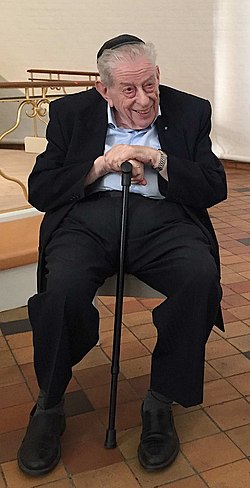
Bent Melchior
View on Wikipedia | This article includes a list of references, related reading, or external links, but its sources remain unclear because it lacks inline citations. (July 2021) |

Bent Melchior (24 June 1929 – 28 July 2021[1]) was a chief rabbi of Denmark.
Life and career
[edit]Melchior was born to Danish parents in the German city of Beuthen (now Bytom in Poland), where his father, Marcus Melchior, was rabbi. In 1943, during the Nazi occupation of Denmark, Marcus Melchior was instrumental in saving Danish Jews,[2] and became chief rabbi of Denmark in 1947.[3] From October 1943 to mid-1945, Melchior and his family lived as refugees in Sweden.[2] Melchior served as a soldier in the 1947–1949 Palestine war, beginning in pre-statehood battles in 1947.[4] Subsequently, at the age of 21, he received a Ph.D. from Copenhagen University.[4]
After a period as a teacher in Copenhagen, Melchior had his rabbinical education in London. In 1963, he became rabbi at the synagogue in Copenhagen. When his father died in 1969, he succeeded him as chief rabbi. He translated the Torah, the siddur (Jewish prayer book), and other books into Danish, as well as writing several books, including his autobiography. He was a prolific speaker and writer in the Danish community and media.
Melchior retired from the rabbinate in 1996. His successor was Bent Lexner. Melchior continued his humanitarian and charitable work in Denmark and abroad in retirement.
Personal life
[edit]Bent Melchior married Lilian Weissdorf in 1951.[4] The couple had four sons,[2] including Michael Melchior. His grandson Jair Melchior is currently the chief rabbi of Denmark.
References
[edit]- ^ "Bent Melchior er død". DR. 28 July 2021.
- ^ a b c Otzen, Ellen (8 October 2013). "The mass escape of Jews from Nazi-occupied Denmark". BBC News. bbc.co.uk. Retrieved 8 October 2013.
- ^ Berenbaum, Michael; Skolnik, Fred, eds. (2007). "Melchior, Marcus". Encyclopaedia Judaica. Vol. 14 (2nd ed.). Detroit: Macmillan Reference. pp. 10–11. ISBN 978-0-02-866097-4.
- ^ a b c "Chief Rabbi of Denmark Speaker for Synagogue Council Dinner". The Jewish Floridian (Miami, Florida). 28 January 1972.p. 5A. Via Florida Digital Newspaper Library, George A. Smathers Libraries, University of Florida. Retrieved 3 May 2018.
External links
[edit]| International | |
|---|---|
| National | |
| Other | |

  | This Danish biographical article is a stub. You can help Wikipedia by expanding it. |
 | This biographical article about a European rabbi is a stub. You can help Wikipedia by expanding it. |
Bent Melchior
View on GrokipediaEarly Life
Birth and Family Background
Bent Melchior was born on 24 June 1929 in Beuthen, Germany (now Bytom, Poland), to Danish parents. [7] [8] His father, Rabbi Marcus Melchior, held a rabbinical position in Beuthen at the time, serving there as a prominent rabbi. [8] [9] The family maintained Danish heritage and relocated to Denmark in 1933. [8] ,_Holocaust_survivor)Nazi Occupation and Escape to Sweden
The German occupation of Denmark began in 1940, placing the country's Jewish community—including the Melchior family in Copenhagen—under Nazi control, though initial conditions were less harsh than in other occupied countries. [10] In late September 1943, the situation escalated when German authorities planned to round up and deport Denmark's Jews, prompting Rabbi Marcus Melchior, Bent's father and a leading figure in the community, to warn congregants of the danger during a synagogue service on September 29, the eve of Rosh Hashanah. [11] This timely alert, aided by information from sympathetic sources, spurred widespread evasion efforts and contributed to the successful rescue of most Danish Jews. [1] At age 14, Bent Melchior fled Copenhagen with his family in October 1943, joining the mass escape to neutral Sweden facilitated by Danish citizens who transported thousands of Jews across the strait in fishing boats and other small vessels. [8] During the escape and in Sweden, Bent and his brother participated in fundraising efforts to help other Jews flee Denmark, collaborating with the Danish resistance. [10] The family remained in refuge in Sweden until mid-1945, returning to Denmark after the country's liberation in May 1945. [11]Education and Early Adulthood
Academic Studies and Ph.D.
Bent Melchior completed his secondary education at Frederiksberg Gymnasium, graduating in 1947 after returning to Denmark following the war years. [12] He later pursued an academic role at the University of Copenhagen, serving as ekstern lektor (external lecturer) in klassisk jødisk litteratur (classical Jewish literature) from 1971 to 1984. [12] This position enabled him to teach and contribute to scholarship in the field of classical Jewish texts alongside his rabbinical duties. [13] In 1997, he received an honorary Doctor of Humane Letters from Trinity College in Hartford, Connecticut, recognizing his broader contributions to Jewish scholarship and public life. [12]Military Service in the Palestine War
Bent Melchior served as a soldier in the Palestine War of 1947–1949. He participated in the fighting beginning in 1947, volunteering to join the Jewish defense forces during the civil war phase in Mandatory Palestine that preceded the declaration of Israeli independence in 1948. After the war, he returned to Denmark. His involvement came after he had relocated to Palestine following the end of World War II and the liberation from Nazi occupation in Denmark. [14] As a young man, Melchior contributed to the defense efforts during this critical period in Jewish history, though specific details of his military role or units remain limited in available records. [15]Rabbinical Training
After completing his Ph.D. from the University of Copenhagen in 1950 at the age of 21 and following a period of work as a teacher, Bent Melchior pursued his rabbinical education in London. [8] [1] There he received his rabbinical ordination, marking his formal transition from secular academic and teaching activities to preparation for the rabbinate. [1] This training in London represented the culmination of his early adult efforts to qualify for rabbinical service. [8]Rabbinical Career
Early Positions and Appointment in Copenhagen
After returning to Copenhagen following the war, Bent Melchior worked as a teacher for a period. He then completed his rabbinical training in London. In 1963, he was appointed rabbi at the synagogue in Copenhagen. [16] He served in this role from 1963. [16] This appointment represented his first major rabbinical position in Denmark following his education. [16]Service as Chief Rabbi of Denmark
Bent Melchior succeeded his father, Marcus Melchior, as Chief Rabbi of Denmark in 1969 following Marcus's death in 1969. [17][18] He served in the position until his retirement in 1996. [19] Prior to this appointment, Melchior had served as rabbi of the synagogue in Copenhagen since 1963. [16] Upon Melchior's retirement, Bent Lexner succeeded him as Chief Rabbi of Denmark. [18] His nearly three-decade tenure marked a period of continuity in leadership for the Danish Jewish community, building on the foundation established by his father. [19]Scholarly Work and Translations
Bent Melchior contributed significantly to Jewish scholarship through his academic role and his translations of core religious texts into Danish, enhancing accessibility for the Danish Jewish community and promoting understanding of Hebrew literature. From 1971 to 1984, he served as associate professor in Classical Hebrew literature at the University of Copenhagen. [2] His major translational work includes rendering the Five Books of Moses (the Torah) into Danish over the period from 1977 to 1987. [2] He also translated the siddur, the Jewish prayer book, into Danish, with a notable edition published in 2002 featuring Hebrew text alongside the Danish translation. [20] Additionally, Melchior translated other religious texts into Danish, further supporting liturgical and educational use within Danish-speaking contexts. [21] Beyond translations, Melchior authored several books on topics related to religion, Judaism, and refugees, including his autobiography. [2] He also produced numerous articles addressing these themes throughout his career. [2]Media Appearances and Public Commentary
Television and Documentary Roles
Bent Melchior appeared as himself in a range of television programs and documentaries spanning from 1969 until 2017, with one posthumous credit in 2022.[22] These appearances primarily featured him in his capacity as Chief Rabbi of Denmark (and later Chief Rabbi Emeritus), often contributing insights drawn from his experiences during the Nazi occupation and his leadership in the Jewish community. His earliest documented appearance was in the 1969 TV movie Omvej til friheden, where he was credited as Self.[22] In 1971, he appeared in the TV series Nu-teater as Self - Chief Rabbi.[22] Subsequent credits included uncredited and brief roles in Danish television productions such as Københavns synagoge (1983) as Self - Chief Rabbi and TV-Avisen (1985) as Self.[22] Among his more prominent international contributions was his appearance in the 1994 documentary The Righteous as Self - Großrabbiner von Dänemark.[23] He later featured in the 2005 BBC miniseries Auschwitz: Inside the Nazi State as Self - Rabbi, including an episode that incorporated his testimony related to events in Denmark during the Holocaust.[24][25] In the 2000s and 2010s, Melchior continued to appear in Danish television formats, including Tid til tanker (2001) as Self - Overrabbiner, Babelstårnet 2001 (2001) as Self - Chief Rabbi Emeritus, 24 timer vi aldrig glemmer (2010) as Self, Aftenshowet (2012) as Self, and Go' morgen Danmark (2015) as Self.[22] His final credited appearance during his lifetime was in the 2017 documentary Når naboens datter bliver muslim as Self.[22] Posthumously, Melchior was featured in the 2022 TV movie Dreyers Gertrud as Self - Friend of Dreyer.[22] These appearances collectively reflect his recurring role as a public figure sharing perspectives on Jewish history, interfaith issues, and personal survival stories.[22]Key Topics and Notable Programs
Bent Melchior established himself as a prominent public commentator in Danish and international media, frequently addressing themes of Judaism, the Holocaust, refugee rights, and interfaith dialogue. [2] His commentary often drew upon his personal history as a Holocaust survivor and his long tenure as Chief Rabbi of Denmark to advocate for tolerance, historical remembrance, and social justice. [10] He consistently positioned himself as a voice for the vulnerable, emphasizing the moral lessons of the past in discussions of contemporary issues. [26] In Danish television, Melchior appeared regularly on news broadcasts such as TV-Avisen and talk shows including Aftenshowet, where he offered perspectives on religious affairs, societal integration, and humanitarian concerns. [22] Internationally, he contributed to documentaries focused on Holocaust history and rescue efforts, including The Righteous (1994) and Auschwitz: Inside the Nazi State (2005), providing eyewitness accounts and reflections on the Danish Jewish rescue operation and Nazi atrocities. [22] Melchior's advocacy extended prominently to refugee rights, as evidenced by his 2015 criticism of a Danish proposal to confiscate valuables from asylum seekers, which he compared to measures employed during Nazi persecution of Jews. [27] He engaged in interfaith initiatives, participating in programs such as the 2014 reportage Livet ud ad Landevejen alongside Muslim politician Özlem Cekic to foster dialogue between religious communities. [28] Through these appearances and statements, Melchior promoted bridge-building across cultural and religious divides while maintaining a steadfast commitment to human rights. [2]Personal Life
Marriage and Family
Bent Melchior married Lilian Weisdorff in 1951, and they remained married for nearly 70 years until his death in 2021. [6] The couple had four sons, including Michael Melchior. [6] The family life was centered in Copenhagen, where Bent and Lilian raised their sons surrounded by the Jewish community. [29] Bent and Lilian had 12 grandchildren and dozens of great-grandchildren. [6]Later Years and Death
Retirement Activities and Advocacy
After retiring as Chief Rabbi of Denmark in 1996, Bent Melchior continued his extensive humanitarian and advocacy work, with a strong emphasis on refugee rights, interfaith dialogue, and human rights issues. [2] He maintained his leadership in international Jewish organizations, serving as President of B'nai B'rith Europe from 1993 until 1999, a position that extended several years into his retirement and reflected his ongoing commitment to Jewish community leadership and broader societal engagement. [2] [8] In collaboration with former Danish parliamentarian Özlem Cekic, Melchior co-founded Brobyggerne (Bridge Builders), a center dedicated to fostering dialogue across cultural and religious divides, and he served as chairman of its board. [2] [8] This initiative aligned with his long-standing efforts to promote understanding and cooperation in diverse societies. Melchior's dedication to refugee advocacy was formally recognized in 2008 when he became the first and only honorary member of the Danish Refugee Council (Dansk Flygtningehjælp), honoring his consistent humanitarian ethos and public efforts on behalf of refugees. [2] [8] He remained an outspoken advocate for improving the rights and conditions of refugees in Denmark, while contributing numerous articles and books addressing topics in religion, Judaism, and refugee-related concerns. [8]Death
Bent Melchior died on 28 July 2021 in Copenhagen, Denmark, from a heart attack at the age of 92.[1][6] His passing was announced in various obituaries and tributes from Jewish organizations and institutions with which he had long been associated.[1][14]Legacy
Influence on Jewish Community and Interfaith Dialogue
Bent Melchior exerted considerable influence on the Danish Jewish community as Chief Rabbi from 1969 to 1996, leaving a lasting impact through his leadership, his Danish translation of the Pentateuch, and his writings on Judaism and religious topics. [5] [2] He remained a prominent voice in Danish Jewish life and broader public discourse, addressing issues of religion, identity, and society in articles and books. [2] His advocacy extended to defending the rights of religious minorities in Denmark and championing better conditions for refugees, including through his involvement with the Danish Refugee Council, where he became its first and only honorary member in 2008, as well as with Amnesty International and the Danish Center for Holocaust and Genocide Studies. [5] [2] Melchior played a key role in interfaith dialogue, co-founding Brobyggerne – Center for Dialogue Coffee in 2019 with former politician Özlem Cekic, a Muslim, and serving as its board chairman until his death. [5] [2] Their friendship, which began in 2010, led to joint travels across Denmark to promote tolerance, dialogue, and acceptance of differences, earning them the NFS Grundtvig Prize in 2015 for their interfaith efforts. [5] Brobyggerne continues his vision of fostering democratic conversation and understanding across divides. [5] In recognition of his commitment to bridge-building and human rights, Brobyggerne established the annual Bent Melchior Award to honor individuals who advance dialogue between differing worldviews, uphold fundamental rights, and demonstrate tolerance and openness. [5] His legacy endures in his family’s continuation of rabbinical service, with son Rabbi Michael Melchior pursuing Jewish leadership and activism, and grandson Rabbi Jair Melchior serving as Chief Rabbi of Denmark and chairman of Brobyggerne. [1] [5]References
- https://www.wikidata.org/wiki/Q4890338