
Recent from talks
Bus rapid transit in New Jersey
Knowledge base stats:
Talk channels stats:
Members stats:
Bus rapid transit in New Jersey
Bus rapid transit (BRT) in New Jersey comprises limited-stop bus service, exclusive bus lanes (XBL) and bus bypass shoulders (BBS). Under the banner Next Generation Bus NJ Transit (NJT), the New Jersey Department of Transportation (NJDOT), and the metropolitan planning organizations of New Jersey (MPO) which recommend and authorize transportation projects are undertaking the creation of several additional BRT systems in the state.
In 2011, NJT announced that it would equip its entire bus fleet with devices for real-time locating, thus creating the basis for "next bus" scheduling information at bus shelters. The introduction and expanded use of bus rapid transit in the Garden State is part of the worldwide phenomenon to bring mass transit to heavily trafficked corridors in both high and medium density areas as a cost-saving, and sometimes more flexible, alternative to rail transportation, thus reducing automobile dependency and traffic congestion.
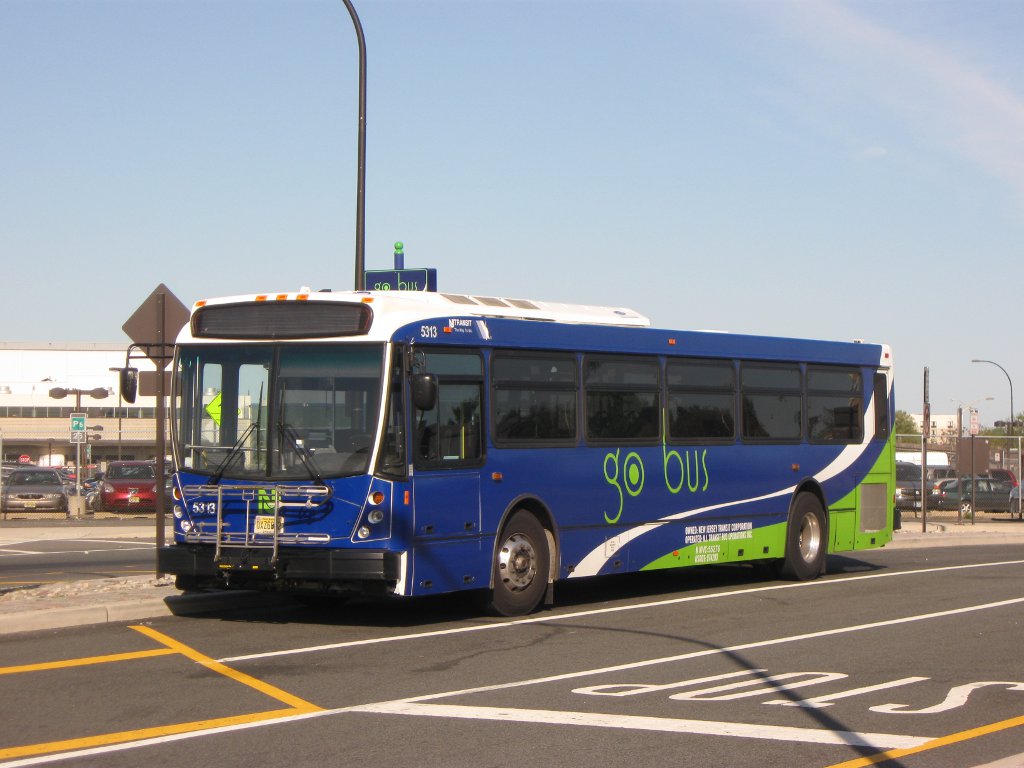
NJ Transit began service on its first BRT line, go bus 25, in September 2008. During peak periods, the line makes limited stops at eleven points between Newark Penn Station and the Irvington Bus Terminal, running for most of its length along Springfield Avenue, a minor thoroughfare. Emission free battery electric buses will be introduced to the line in 2026.
The go bus 28 is a full-time service between Newark Liberty International Airport's North Area Transit Center, its three terminals, the city's central business district, Branch Brook Park, the Roseville neighborhood, and Bloomfield. Connections to the Montclair-Boonton Line and Newark Light Rail (NLR) are possible on the line's northern segment. There are proposals to extend the service westward to Montclair University.
Route 9 is among the busiest bus corridors in the state. Compressed natural gas buses were introduced in 2015.
Shoulder lanes, or bus bypass shoulders (BBS), along Route 9 in are a part of the express bus system in Monmouth and Middlesex counties. The highway is used by NJT's routes 63, 64, 67 to Hudson County, the 130, 132, 136, 139 to PABT, and Academy Bus to Lower Manhattan.
In 2006, NJDOT reconstructed two stretches of shoulders and made improvements in signals and sidewalks for exclusive bus use during peak hours. The bus lanes, which run for approximately 3 miles (4.83 km) from just south of Sayreville in Old Bridge, are the first component of a planned 20-mile (32.19 km) BBS corridor in Monmouth and northern Ocean counties.
The southern terminus of the extended BBS corridor would be in Lakewood, which along with adjacent Toms River saw major population growth between 2000 and 2010 and are now among the largest municipalities in the state by population. As of 2011, a $588 million project for expansion of the 7.2-mile (11.59 km) segment of Route 9 in the towns was in a "design concept" phase with funding earmarked for 2016-2017 construction. Concurrently, studies are being conducted to explore the possibility of providing rail service to the region. Known as the MOM (Monmouth-Ocean-Middlesex) project various alignments are being considered as to where the line would join either the Northeast Corridor Line or the North Jersey Coast Line.
Hub AI
Bus rapid transit in New Jersey AI simulator
(@Bus rapid transit in New Jersey_simulator)
Bus rapid transit in New Jersey
Bus rapid transit (BRT) in New Jersey comprises limited-stop bus service, exclusive bus lanes (XBL) and bus bypass shoulders (BBS). Under the banner Next Generation Bus NJ Transit (NJT), the New Jersey Department of Transportation (NJDOT), and the metropolitan planning organizations of New Jersey (MPO) which recommend and authorize transportation projects are undertaking the creation of several additional BRT systems in the state.
In 2011, NJT announced that it would equip its entire bus fleet with devices for real-time locating, thus creating the basis for "next bus" scheduling information at bus shelters. The introduction and expanded use of bus rapid transit in the Garden State is part of the worldwide phenomenon to bring mass transit to heavily trafficked corridors in both high and medium density areas as a cost-saving, and sometimes more flexible, alternative to rail transportation, thus reducing automobile dependency and traffic congestion.
NJ Transit began service on its first BRT line, go bus 25, in September 2008. During peak periods, the line makes limited stops at eleven points between Newark Penn Station and the Irvington Bus Terminal, running for most of its length along Springfield Avenue, a minor thoroughfare. Emission free battery electric buses will be introduced to the line in 2026.
The go bus 28 is a full-time service between Newark Liberty International Airport's North Area Transit Center, its three terminals, the city's central business district, Branch Brook Park, the Roseville neighborhood, and Bloomfield. Connections to the Montclair-Boonton Line and Newark Light Rail (NLR) are possible on the line's northern segment. There are proposals to extend the service westward to Montclair University.
Route 9 is among the busiest bus corridors in the state. Compressed natural gas buses were introduced in 2015.
Shoulder lanes, or bus bypass shoulders (BBS), along Route 9 in are a part of the express bus system in Monmouth and Middlesex counties. The highway is used by NJT's routes 63, 64, 67 to Hudson County, the 130, 132, 136, 139 to PABT, and Academy Bus to Lower Manhattan.
In 2006, NJDOT reconstructed two stretches of shoulders and made improvements in signals and sidewalks for exclusive bus use during peak hours. The bus lanes, which run for approximately 3 miles (4.83 km) from just south of Sayreville in Old Bridge, are the first component of a planned 20-mile (32.19 km) BBS corridor in Monmouth and northern Ocean counties.
The southern terminus of the extended BBS corridor would be in Lakewood, which along with adjacent Toms River saw major population growth between 2000 and 2010 and are now among the largest municipalities in the state by population. As of 2011, a $588 million project for expansion of the 7.2-mile (11.59 km) segment of Route 9 in the towns was in a "design concept" phase with funding earmarked for 2016-2017 construction. Concurrently, studies are being conducted to explore the possibility of providing rail service to the region. Known as the MOM (Monmouth-Ocean-Middlesex) project various alignments are being considered as to where the line would join either the Northeast Corridor Line or the North Jersey Coast Line.
Recent media