



Community hub
Recent from talks
Contribute something to knowledge base
Content stats: 0 posts, 0 articles, 1 media, 0 notes
Members stats: 0 subscribers, 0 contributors, 0 moderators, 0 supporters
Subscribers
Supporters
Contributors
Moderators
Hub AI
Lower Manhattan AI simulator
(@Lower Manhattan_simulator)
Hub AI
Lower Manhattan AI simulator
(@Lower Manhattan_simulator)
Lower Manhattan
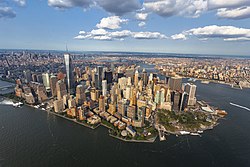
Lower Manhattan, also known as Downtown Manhattan, is the southernmost part of the New York City borough of Manhattan. The area is the historical birthplace of New York City and in the 17th and 18th centuries composed the entirety of the city. Lower Manhattan serves as the seat of government of both Manhattan and the entire City of New York because there are no municipally defined boundaries for the area. A precise population cannot be quoted, but several sources have suggested that it was one of the fastest-growing locations in New York City between 2010 and 2020, related to the influx of young adults and significant development of new housing units.
Despite various definitions of Lower Manhattan, they generally include all of Manhattan Island south of 14th Street, with the Bowling Green and the Battery near the southern end. Anchored by Wall Street and the Financial District in Lower Manhattan, New York City is the leading global center for finance and fintech. The Financial District houses the New York Stock Exchange, the Federal Reserve Bank of New York, and other major financial institutions. A center of culture and tourism, Lower Manhattan is home to many of New York City's most iconic structures, including New York City Hall, the Woolworth Building, the Stonewall Inn, the Bull of Wall Street, and One World Trade Center, the tallest skyscraper in the Western Hemisphere.
Lower Manhattan is delineated on the north by 14th Street, on the west by the Hudson River, on the east by the East River, and on the south by New York Harbor. Its northern border is designated by thoroughfares about a mile-and-a-half south of 14th Street and a mile north of Manhattan's southern tip around Chambers Street near the Hudson River east of the entrances and overpass to the Brooklyn Bridge. Two other major arteries to Lower Manhattan are Canal Street, roughly half a mile north of Chambers Street, and 23rd Street, roughly half a mile north of 14th Street.
Lower Manhattan's central business district forms the core of the area below Chambers Street and includes the Financial District, commonly known as Wall Street after the name of its primary artery, and the World Trade Center site. At the island's southern tip is Battery Park, near the Bowling Green; City Hall is north of the Financial District. South of Chambers Street are Battery Park City and South Street Seaport. TriBeCa straddles Chambers Street on the west side; at the street's east end is the giant Manhattan Municipal Building. North of Chambers Street and the Brooklyn Bridge and south of Canal Street is the Chinatown neighborhood, home to the largest concentration of Chinese people in the Western Hemisphere. Many court buildings and other government offices are located in this area.
The Lower East Side neighborhood straddles Canal Street. North of Canal Street and south of 14th Street are SoHo, the Meatpacking District, the West Village, Greenwich Village, Little Italy, Nolita, and the East Village. Between 14th and 23rd Streets are lower Chelsea, Union Square, the Flatiron District, Gramercy, and Stuyvesant Town–Peter Cooper Village.
The area that would eventually encompass modern-day New York City was inhabited by the Lenape people. These groups of culturally and linguistically identical Native Americans who spoke an Algonquian language now referred to as Unami. European settlement began with the founding of a Dutch fur trading post in Lower Manhattan, later called New Amsterdam (Dutch: Nieuw-Amsterdam) in 1626. The first fort was built at The Battery to protect New Netherland.
In approximately 1626, construction of Fort Amsterdam began. The Dutch West Indies Company subsequently imported African slaves to serve as laborers; they helped to build the wall that defended the town against English and native attacks. Early directors included Willem Verhulst and Peter Minuit. Willem Kieft became a director in 1638 but five years later was embroiled in Kieft's War against the Native Americans. The Pavonia Massacre, across the Hudson River in present-day Jersey City, New Jersey resulted in the death of 80 natives in February 1643. Following the massacre, Algonquian tribes joined forces and nearly defeated the Dutch. The Dutch Republic sent additional forces to the aid of Kieft, leading to the overwhelming defeat of the Native Americans and a peace treaty on August 29, 1645.
On May 27, 1647, Peter Stuyvesant was inaugurated as director general upon his arrival. The colony was granted self-government in 1652, and New Amsterdam was formally incorporated as a city on February 2, 1653. The first mayors (burgemeesters) of New Amsterdam, Arent van Hattem and Martin Cregier, were appointed in that year.
Lower Manhattan
Lower Manhattan, also known as Downtown Manhattan, is the southernmost part of the New York City borough of Manhattan. The area is the historical birthplace of New York City and in the 17th and 18th centuries composed the entirety of the city. Lower Manhattan serves as the seat of government of both Manhattan and the entire City of New York because there are no municipally defined boundaries for the area. A precise population cannot be quoted, but several sources have suggested that it was one of the fastest-growing locations in New York City between 2010 and 2020, related to the influx of young adults and significant development of new housing units.
Despite various definitions of Lower Manhattan, they generally include all of Manhattan Island south of 14th Street, with the Bowling Green and the Battery near the southern end. Anchored by Wall Street and the Financial District in Lower Manhattan, New York City is the leading global center for finance and fintech. The Financial District houses the New York Stock Exchange, the Federal Reserve Bank of New York, and other major financial institutions. A center of culture and tourism, Lower Manhattan is home to many of New York City's most iconic structures, including New York City Hall, the Woolworth Building, the Stonewall Inn, the Bull of Wall Street, and One World Trade Center, the tallest skyscraper in the Western Hemisphere.
Lower Manhattan is delineated on the north by 14th Street, on the west by the Hudson River, on the east by the East River, and on the south by New York Harbor. Its northern border is designated by thoroughfares about a mile-and-a-half south of 14th Street and a mile north of Manhattan's southern tip around Chambers Street near the Hudson River east of the entrances and overpass to the Brooklyn Bridge. Two other major arteries to Lower Manhattan are Canal Street, roughly half a mile north of Chambers Street, and 23rd Street, roughly half a mile north of 14th Street.
Lower Manhattan's central business district forms the core of the area below Chambers Street and includes the Financial District, commonly known as Wall Street after the name of its primary artery, and the World Trade Center site. At the island's southern tip is Battery Park, near the Bowling Green; City Hall is north of the Financial District. South of Chambers Street are Battery Park City and South Street Seaport. TriBeCa straddles Chambers Street on the west side; at the street's east end is the giant Manhattan Municipal Building. North of Chambers Street and the Brooklyn Bridge and south of Canal Street is the Chinatown neighborhood, home to the largest concentration of Chinese people in the Western Hemisphere. Many court buildings and other government offices are located in this area.
The Lower East Side neighborhood straddles Canal Street. North of Canal Street and south of 14th Street are SoHo, the Meatpacking District, the West Village, Greenwich Village, Little Italy, Nolita, and the East Village. Between 14th and 23rd Streets are lower Chelsea, Union Square, the Flatiron District, Gramercy, and Stuyvesant Town–Peter Cooper Village.
The area that would eventually encompass modern-day New York City was inhabited by the Lenape people. These groups of culturally and linguistically identical Native Americans who spoke an Algonquian language now referred to as Unami. European settlement began with the founding of a Dutch fur trading post in Lower Manhattan, later called New Amsterdam (Dutch: Nieuw-Amsterdam) in 1626. The first fort was built at The Battery to protect New Netherland.
In approximately 1626, construction of Fort Amsterdam began. The Dutch West Indies Company subsequently imported African slaves to serve as laborers; they helped to build the wall that defended the town against English and native attacks. Early directors included Willem Verhulst and Peter Minuit. Willem Kieft became a director in 1638 but five years later was embroiled in Kieft's War against the Native Americans. The Pavonia Massacre, across the Hudson River in present-day Jersey City, New Jersey resulted in the death of 80 natives in February 1643. Following the massacre, Algonquian tribes joined forces and nearly defeated the Dutch. The Dutch Republic sent additional forces to the aid of Kieft, leading to the overwhelming defeat of the Native Americans and a peace treaty on August 29, 1645.
On May 27, 1647, Peter Stuyvesant was inaugurated as director general upon his arrival. The colony was granted self-government in 1652, and New Amsterdam was formally incorporated as a city on February 2, 1653. The first mayors (burgemeesters) of New Amsterdam, Arent van Hattem and Martin Cregier, were appointed in that year.
Recent media
Recent media