


Community hub
Recent from talks
Contribute something to knowledge base
Content stats: 0 posts, 0 articles, 1 media, 0 notes
Members stats: 0 subscribers, 0 contributors, 0 moderators, 0 supporters
Subscribers
Supporters
Contributors
Moderators
Hub AI
Newark Light Rail AI simulator
(@Newark Light Rail_simulator)
Hub AI
Newark Light Rail AI simulator
(@Newark Light Rail_simulator)
Newark Light Rail
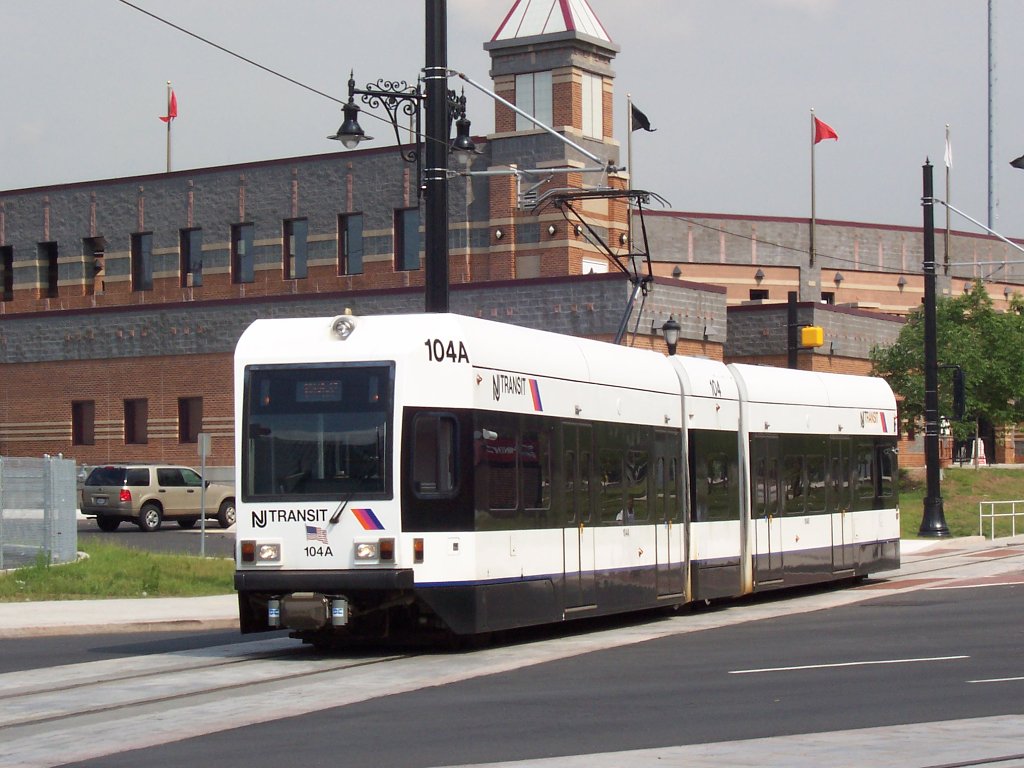
The Newark Light Rail (NLR) is a light rail system serving Newark, New Jersey, and surrounding areas, owned by New Jersey Transit and operated by its bus operations division. The service consists of two segments, the original Newark City Subway (NCS), and the extension to Broad Street station. The City Subway opened on May 26, 1935, while the combined Newark Light Rail service was officially inaugurated on July 17, 2006.
The Newark City Subway is the longer and older of the two segments. It is a "subway–surface" line which runs underground from Penn Station to Warren Street, and above-ground north of Warren Street. Before becoming a part of the Newark Light Rail service, it was also known as the #7-City Subway line, an NJT Bus Operations route number carried over from its days when it was part of Public Service's Transport of New Jersey subsidiary. The number still applies internally. During subway system closures, replacement buses would also bear the route number "7 City Subway".
The segment is 5.3 mi (8.5 km) long and runs between Grove Street in Bloomfield and Newark Penn Station, a major transportation hub with connections to the PATH rapid transit system to Manhattan, multiple bus routes, and both Amtrak and New Jersey Transit Rail Operations trains.
The line opened in 1935 along the old Morris Canal right-of-way, from Broad Street (now known as Military Park) to Heller Parkway (now replaced by the nearby Branch Brook Park station). Works Progress Administration artists decorated the underground stations with Art Deco scenes from life on the defunct Morris Canal. The southernmost part, south of Warren Street, was capped with a new road, known as Raymond Boulevard. Only one grade crossing was present on the original subway; the line crosses Orange Street at grade so it can pass over the below-grade Delaware, Lackawanna and Western Railroad (now NJT Morristown Line) immediately to the north. The original Newark City Subway line had its own right-of-way and did not share city streets with local traffic, except at the Orange Street grade crossing.
Operation of the complete subway to the newly built Penn Station was delayed until 1937. The terminal below Penn Station has five tracks, two incoming and three outgoing, connected by two loop tracks. This part of the subway included a grade-separated junction with a connection to the lower level of the Newark Public Service Terminal that was used for only a few months (June to September).
An extension to a wooden station at North 6th Street or Franklin Avenue was opened in 1940, located north of the present Branch Brook Park station. In 1953 the line was cut back about one block to accommodate construction of a turning loop, and a new station, still called Franklin Avenue, was opened adjacent to Anthony Street. The station was enlarged in 2002 and renamed Branch Brook Park.
The subway was operated by Transport of New Jersey (formerly Public Service Coordinated Transport) as its No. 7 line. Other streetcar routes used parts of the subway, reaching street trackage at the locations shown below, ending as each route was closed and replaced by bus service:
Until June 5, 1952, the Roseville Car House, on the south side of Main Street (on the No. 21 line) near the eastern city line of East Orange, was used for the No. 7 line. From that time until 2002, Newark Penn Station was used for storage and maintenance. A new shops and yard complex opened at the end of the extension to Grove Street.
Newark Light Rail
The Newark Light Rail (NLR) is a light rail system serving Newark, New Jersey, and surrounding areas, owned by New Jersey Transit and operated by its bus operations division. The service consists of two segments, the original Newark City Subway (NCS), and the extension to Broad Street station. The City Subway opened on May 26, 1935, while the combined Newark Light Rail service was officially inaugurated on July 17, 2006.
The Newark City Subway is the longer and older of the two segments. It is a "subway–surface" line which runs underground from Penn Station to Warren Street, and above-ground north of Warren Street. Before becoming a part of the Newark Light Rail service, it was also known as the #7-City Subway line, an NJT Bus Operations route number carried over from its days when it was part of Public Service's Transport of New Jersey subsidiary. The number still applies internally. During subway system closures, replacement buses would also bear the route number "7 City Subway".
The segment is 5.3 mi (8.5 km) long and runs between Grove Street in Bloomfield and Newark Penn Station, a major transportation hub with connections to the PATH rapid transit system to Manhattan, multiple bus routes, and both Amtrak and New Jersey Transit Rail Operations trains.
The line opened in 1935 along the old Morris Canal right-of-way, from Broad Street (now known as Military Park) to Heller Parkway (now replaced by the nearby Branch Brook Park station). Works Progress Administration artists decorated the underground stations with Art Deco scenes from life on the defunct Morris Canal. The southernmost part, south of Warren Street, was capped with a new road, known as Raymond Boulevard. Only one grade crossing was present on the original subway; the line crosses Orange Street at grade so it can pass over the below-grade Delaware, Lackawanna and Western Railroad (now NJT Morristown Line) immediately to the north. The original Newark City Subway line had its own right-of-way and did not share city streets with local traffic, except at the Orange Street grade crossing.
Operation of the complete subway to the newly built Penn Station was delayed until 1937. The terminal below Penn Station has five tracks, two incoming and three outgoing, connected by two loop tracks. This part of the subway included a grade-separated junction with a connection to the lower level of the Newark Public Service Terminal that was used for only a few months (June to September).
An extension to a wooden station at North 6th Street or Franklin Avenue was opened in 1940, located north of the present Branch Brook Park station. In 1953 the line was cut back about one block to accommodate construction of a turning loop, and a new station, still called Franklin Avenue, was opened adjacent to Anthony Street. The station was enlarged in 2002 and renamed Branch Brook Park.
The subway was operated by Transport of New Jersey (formerly Public Service Coordinated Transport) as its No. 7 line. Other streetcar routes used parts of the subway, reaching street trackage at the locations shown below, ending as each route was closed and replaced by bus service:
Until June 5, 1952, the Roseville Car House, on the south side of Main Street (on the No. 21 line) near the eastern city line of East Orange, was used for the No. 7 line. From that time until 2002, Newark Penn Station was used for storage and maintenance. A new shops and yard complex opened at the end of the extension to Grove Street.
Recent media
Recent media