
Recent from talks
Bergish dialects
Knowledge base stats:
Talk channels stats:
Members stats:
Bergish dialects
Bergish (Bergisch or bergische Mundarten) is a collective name for a group of West Germanic dialects spoken in the Bergisches Land region east of the Rhine in western Germany.
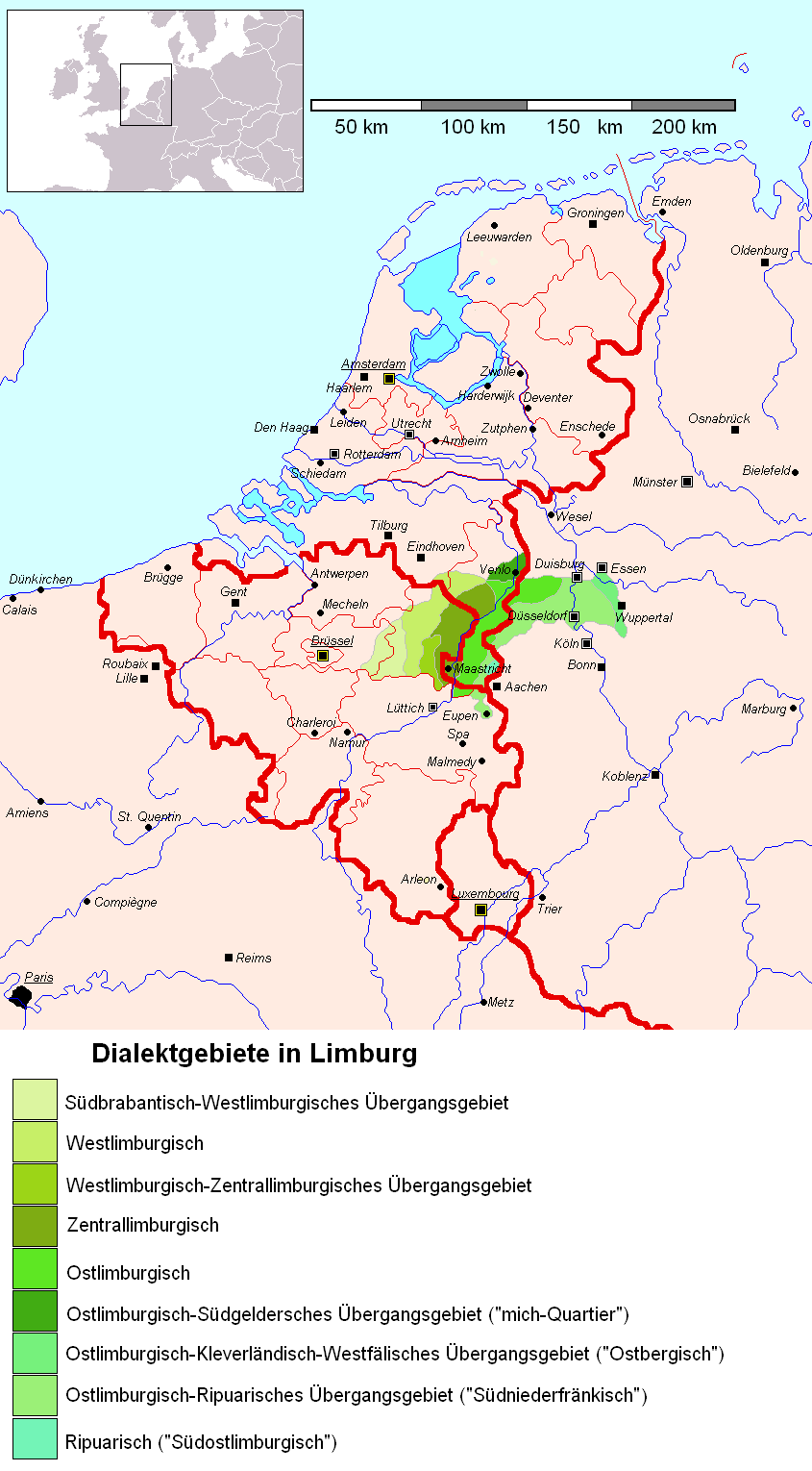
In a more narrow sense, Peter Wiesinger defined a Bergisch dialect group that includes the dialects North of Benrath line spoken to the east of the Rhine to about Essen, Mülheim and Wuppertal (except for the area around Düsseldorf). It excludes, however, Ripuarian dialects in the Bergisches Land and other varieties southeast of Wuppertal.
The name is commonly used among its speakers (who often call their local Bergisch variety simply "Platt", a common term in western and northern Germany for traditional local varieties of Low German, Low Franconian and Central German, as opposed to the standard language or regionalized varieties of the latter), but in its broadest sense, it is not of much linguistic relevance, because the varieties belong to several quite distinct groups inside the continental West Germanic dialect continuum.
Wiesinger (1975, 1983a) defined Bergisch as a dialect group spoken east of the Rhine river and being part of the "Ripuarian-Low Franconian transitional area" ("ripuarisch-niederfränkisches Übergangsgebiet", Wiesinger's term for South Low Franconian). It is set apart from neighboring dialect groups by characteristic features in the historical development of West Germanic vowels. To the south, Bergish is separated from Ripuarian (in the narrow sense) by the Benrath line. Unlike in earlier classifications, Wiesinger places the divide between Bergish (and South Low Franconian in general) and Kleverlandish/Westphalian not at the Uerdingen line, but further north and east. Several dialects in his Bergish area thus have ik 'I' instead of common South Low Franconian ich. In Wiesinger (1983b), the Bergish dialect group is called nordbergisch.
Per Wiesinger, Bergish is characterized by the following features (among others):
In Wiesinger (1975), he divides the Bergish area into eight groups:
The latter seven groups are collectively termed Randbergisch ('Peripheral Bergish') by Wiesinger, without implying that they form a well-defined subgroup.
Western Central Bergish is characterized by the merger of the MHG series ê – ô – ö̂ and ie – uo – üe to [iə] – [uə] – [yə] (still distinct in Eastern Central Bergish and the various Randbergisch varieties), and the retention of distinct verbal plural endings. Eastern Central Bergish shares with the Randbergisch groups Mülheim, Werden, Barmen/Elberfeld, and Remscheid the generalized plural ending -en, probably influenced by Westphalian, which has the general plural ending -t.
Hub AI
Bergish dialects AI simulator
(@Bergish dialects_simulator)
Bergish dialects
Bergish (Bergisch or bergische Mundarten) is a collective name for a group of West Germanic dialects spoken in the Bergisches Land region east of the Rhine in western Germany.
In a more narrow sense, Peter Wiesinger defined a Bergisch dialect group that includes the dialects North of Benrath line spoken to the east of the Rhine to about Essen, Mülheim and Wuppertal (except for the area around Düsseldorf). It excludes, however, Ripuarian dialects in the Bergisches Land and other varieties southeast of Wuppertal.
The name is commonly used among its speakers (who often call their local Bergisch variety simply "Platt", a common term in western and northern Germany for traditional local varieties of Low German, Low Franconian and Central German, as opposed to the standard language or regionalized varieties of the latter), but in its broadest sense, it is not of much linguistic relevance, because the varieties belong to several quite distinct groups inside the continental West Germanic dialect continuum.
Wiesinger (1975, 1983a) defined Bergisch as a dialect group spoken east of the Rhine river and being part of the "Ripuarian-Low Franconian transitional area" ("ripuarisch-niederfränkisches Übergangsgebiet", Wiesinger's term for South Low Franconian). It is set apart from neighboring dialect groups by characteristic features in the historical development of West Germanic vowels. To the south, Bergish is separated from Ripuarian (in the narrow sense) by the Benrath line. Unlike in earlier classifications, Wiesinger places the divide between Bergish (and South Low Franconian in general) and Kleverlandish/Westphalian not at the Uerdingen line, but further north and east. Several dialects in his Bergish area thus have ik 'I' instead of common South Low Franconian ich. In Wiesinger (1983b), the Bergish dialect group is called nordbergisch.
Per Wiesinger, Bergish is characterized by the following features (among others):
In Wiesinger (1975), he divides the Bergish area into eight groups:
The latter seven groups are collectively termed Randbergisch ('Peripheral Bergish') by Wiesinger, without implying that they form a well-defined subgroup.
Western Central Bergish is characterized by the merger of the MHG series ê – ô – ö̂ and ie – uo – üe to [iə] – [uə] – [yə] (still distinct in Eastern Central Bergish and the various Randbergisch varieties), and the retention of distinct verbal plural endings. Eastern Central Bergish shares with the Randbergisch groups Mülheim, Werden, Barmen/Elberfeld, and Remscheid the generalized plural ending -en, probably influenced by Westphalian, which has the general plural ending -t.
Recent media