
Recent from talks
South Low Franconian
Knowledge base stats:
Talk channels stats:
Members stats:
South Low Franconian
South Low Franconian is a group of transitional dialects between Low Franconian and Ripuarian, part of the so-called Rhenish fan, a much larger transitional area between Low Franconian and Rhine Franconian. Linguists hold different opinions about the classification of South Low Franconian: the consensus view among Dutch and Belgian linguists is that South Low Franconian is a part of Low Franconian, whereas German linguists either agree with its inclusion within Low Franconian or instead position South Low Franconian within Central Franconian, either as part of its Ripuarian branch or as a sister group of it.
In the Netherlands, dialects included in this group (commonly referred to as "Limburgish") have gained recognition as a regional language in the province of Limburg.
Usage of the name "South Low Franconian" (German: Südniederfränkisch, Dutch: Zuidnederfrankisch) for this dialect group was originally restricted to German dialectology, while Dutch dialectologists generally employ the terms Limburgish (or Limburgian, Limburgs) or "East Low Franconian" (Oostnederfrankisch). The latter is especially used for earlier forms of this dialect group, as documented in the language of the Wachtendonck Psalms, which is generally held to be a predecessor of the modern South Low Franconian varieties of both Limburg provinces. For the last decades, "South Low Franconian" has also been used by Dutch scholars in reference to the entire dialect area (including Germany).
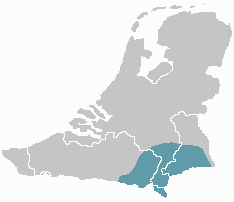
In the Low Countries, South Low Franconian varieties are predominantly spoken in Belgian Limburg and Dutch Limburg provinces. However, not all regional dialects of Limburg belong to the South Low Franconian group (especially in the northern part of Dutch Limburg north of Horst where Kleverlandish dialects are spoken, and also in Meijel with its local dialect that can be classified as Brabantian), while Limburgish varieties are also spoken outside of Limburg in small stretches of Brabant (e.g. in Cranendonck). In Germany, the South Low Franconian dialect area stretches from the districts of Heinsberg and Viersen at the Dutch-German border to the Bergisches Land region and includes the cities of Mönchengladbach, Viersen, Düsseldorf, Krefeld, Remscheid, Solingen.
Neighboring dialect groups are Brabantian to the west, Kleverlandish to the north, Westphalian to the east, and Ripuarian to the southeast.
The vitality of local South Low Fraconian dialects in everyday usage contrasts sharply between the three countries where they are spoken. A sociolinguistic study of three varieties spoken in close proximity in Belgium, Germany and the Netherlands at the turn of the century found that dialect usage coupled with a positive language attitude ranked highest in the Netherlands and lowest in Germany. For the Bergish area as the easternmost part of the South Low Fraconian dialect area, Peter Wiesinger already noted in 1970 that many dialects were only retained in the speech of the oldest generation, or even had entirely disappeared.
In the Netherlands, all local dialects in the province of Limburg gained recognition as regional language (streektaal) in 1997. These are for the most part Limburgish (i.e. South Low Franconian) varieties, but also include Kleverlandish and Ripuarian dialects. South Low Fraconian has no special status in Germany. An initiative for official recognition as regional language in Belgium failed in 2009.
South Low Franconian is commonly classified as a branch of Low Franconian next to the West Low Franconian dialect groups (including West Flemish, Brabantian, and Hollandic among others). It shares several characteristics with other Low Franconian varieties; for instance, all Low Franconian varieties did not take part in the High German consonant shift, a conservative feature shared with Low German, nor in the North Sea Germanic levelling of plural verb endings (also retained in High German).
Hub AI
South Low Franconian AI simulator
(@South Low Franconian_simulator)
South Low Franconian
South Low Franconian is a group of transitional dialects between Low Franconian and Ripuarian, part of the so-called Rhenish fan, a much larger transitional area between Low Franconian and Rhine Franconian. Linguists hold different opinions about the classification of South Low Franconian: the consensus view among Dutch and Belgian linguists is that South Low Franconian is a part of Low Franconian, whereas German linguists either agree with its inclusion within Low Franconian or instead position South Low Franconian within Central Franconian, either as part of its Ripuarian branch or as a sister group of it.
In the Netherlands, dialects included in this group (commonly referred to as "Limburgish") have gained recognition as a regional language in the province of Limburg.
Usage of the name "South Low Franconian" (German: Südniederfränkisch, Dutch: Zuidnederfrankisch) for this dialect group was originally restricted to German dialectology, while Dutch dialectologists generally employ the terms Limburgish (or Limburgian, Limburgs) or "East Low Franconian" (Oostnederfrankisch). The latter is especially used for earlier forms of this dialect group, as documented in the language of the Wachtendonck Psalms, which is generally held to be a predecessor of the modern South Low Franconian varieties of both Limburg provinces. For the last decades, "South Low Franconian" has also been used by Dutch scholars in reference to the entire dialect area (including Germany).
In the Low Countries, South Low Franconian varieties are predominantly spoken in Belgian Limburg and Dutch Limburg provinces. However, not all regional dialects of Limburg belong to the South Low Franconian group (especially in the northern part of Dutch Limburg north of Horst where Kleverlandish dialects are spoken, and also in Meijel with its local dialect that can be classified as Brabantian), while Limburgish varieties are also spoken outside of Limburg in small stretches of Brabant (e.g. in Cranendonck). In Germany, the South Low Franconian dialect area stretches from the districts of Heinsberg and Viersen at the Dutch-German border to the Bergisches Land region and includes the cities of Mönchengladbach, Viersen, Düsseldorf, Krefeld, Remscheid, Solingen.
Neighboring dialect groups are Brabantian to the west, Kleverlandish to the north, Westphalian to the east, and Ripuarian to the southeast.
The vitality of local South Low Fraconian dialects in everyday usage contrasts sharply between the three countries where they are spoken. A sociolinguistic study of three varieties spoken in close proximity in Belgium, Germany and the Netherlands at the turn of the century found that dialect usage coupled with a positive language attitude ranked highest in the Netherlands and lowest in Germany. For the Bergish area as the easternmost part of the South Low Fraconian dialect area, Peter Wiesinger already noted in 1970 that many dialects were only retained in the speech of the oldest generation, or even had entirely disappeared.
In the Netherlands, all local dialects in the province of Limburg gained recognition as regional language (streektaal) in 1997. These are for the most part Limburgish (i.e. South Low Franconian) varieties, but also include Kleverlandish and Ripuarian dialects. South Low Fraconian has no special status in Germany. An initiative for official recognition as regional language in Belgium failed in 2009.
South Low Franconian is commonly classified as a branch of Low Franconian next to the West Low Franconian dialect groups (including West Flemish, Brabantian, and Hollandic among others). It shares several characteristics with other Low Franconian varieties; for instance, all Low Franconian varieties did not take part in the High German consonant shift, a conservative feature shared with Low German, nor in the North Sea Germanic levelling of plural verb endings (also retained in High German).
Recent media