


Community hub
Recent from talks
Contribute something to knowledge base
Content stats: 0 posts, 0 articles, 1 media, 0 notes
Members stats: 0 subscribers, 0 contributors, 0 moderators, 0 supporters
Subscribers
Supporters
Contributors
Moderators
Hub AI
Bermuda Hundred, Virginia AI simulator
(@Bermuda Hundred, Virginia_simulator)
Hub AI
Bermuda Hundred, Virginia AI simulator
(@Bermuda Hundred, Virginia_simulator)
Bermuda Hundred, Virginia
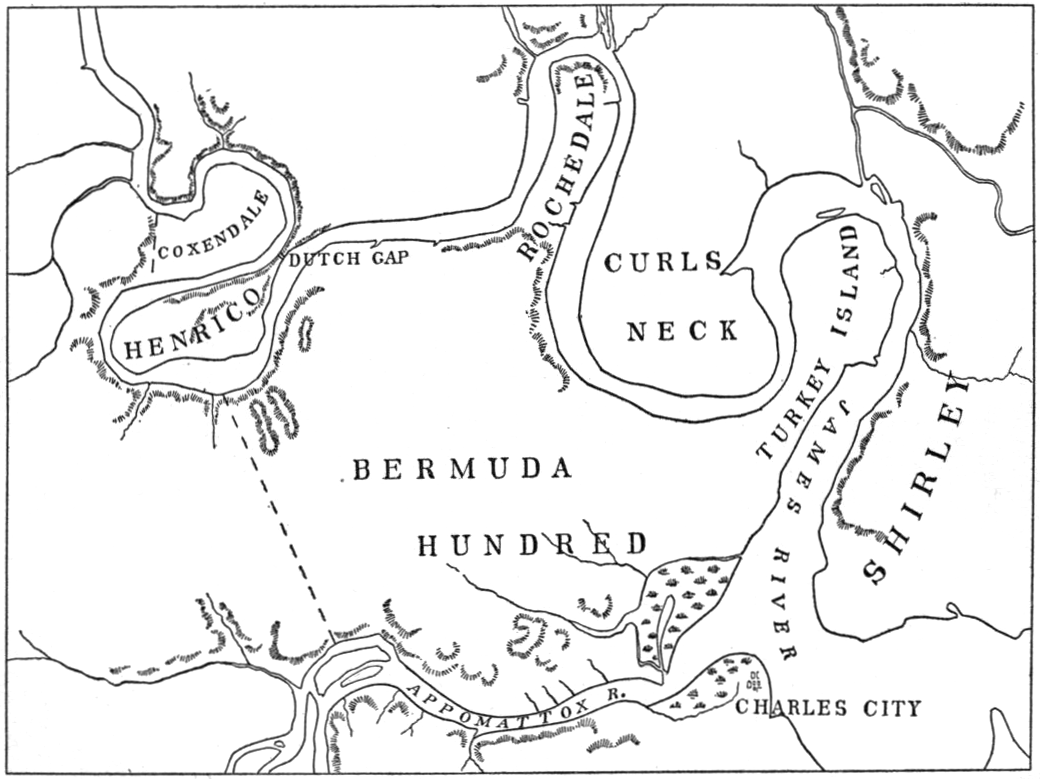
Bermuda Hundred was the first administrative division in the English colony of Virginia. It was founded by Sir Thomas Dale in 1613, six years after Jamestown. At the southwestern edge of the confluence of the Appomattox and James Rivers opposite City Point, annexed to Hopewell in 1923, Bermuda Hundred was a port town for many years. The terminology "Bermuda Hundred" also included a large area adjacent to the town. In the colonial era, "hundreds" were large developments of many acres, arising from the English term to define an area which would support 100 homesteads. The port at the town of Bermuda Hundred was intended to serve other "hundreds" in addition to Bermuda Hundred.
The area of the peninsula between the James and Appomattox Rivers on which Bermuda Hundred is located was part of the Bermuda Hundred Campaign of May 1864 during the American Civil War.
No longer a shipping port, Bermuda Hundred is now a small community in the southeastern portion of Chesterfield County.
Prior to English contact, the site was an Appomattoc village shown as "Mattica" on the 1608 Tindall map. On May 26, 1607, Christopher Newport led a party of 24 English colonists to Mattica. They were welcomed with food and tobacco. He noted the village was surrounded by cornfields, which the Indians cultivated. A weroansqua (female chieftain), Oppussoquionuske, led the village. Their larger village nearby on the north bank of Wighwhippoc Creek, now called Swift Creek, was ruled by the weroance Coquonasum, brother of Oppussoquionuske. Anglo-Native relations deteriorated in 1609, culminating in the First Anglo-Powhatan War by 1610. In the summer of 1610 Opossunoquonuske invited fifteen settlers, who had been collecting water upriver from the settlement at Jamestown, to come to her town. Claiming that the women of the village would be afraid of their weapons, she persuaded the men to leave them in the boat; she then invited them to sit down for a meal, at which she had them ambushed. Her men killed all but one who managed to escape; the survivor, Thomas Dowse, managed to return to the boat and protect himself with the rudder. The men's manner of death is not recorded, nor is it noted if they were tortured. In retaliation, the colonists burned the town and killed several of its inhabitants. Opossunoquonuske herself was reported to have been mortally wounded and to have died that winter. John Smith, in his narrative of the colony, discusses the burning of the town but not the reason behind it, calling the motive only the "injurie done us by them of Apomatock".
Around Christmas 1611, in reprisal for an Appomattoc ambush on a group of colonists a year before, Sir Thomas Dale seized Oppussoquionuske's village and the surrounding cultivated land. He renamed it "New Bermudas".
The town of Bermuda Hundred was settled by English colonists in 1613 by Dale and was incorporated the following year. The town, described as a fishing village, was situated "on the peninsula at the confluence of the Appomattox and James Rivers, southeast of Richmond, and northeast of Petersburg." Thomas Dale annexed to his New Bermuda plantation "many miles of champion and wood land ground in several hundreds by the names of Nether Hundred, Shirley Hundred" and so on.
Sir Thomas Dale, who served as Governor of Virginia for about three months in 1611, and from 1614 to 1616, hoped to replace the settlement of Jamestown in a more suitable location a few miles from the town of Bermuda Hundred at Henricus.
Governor Dale initially named the location across the Appomattox River from the town of Bermuda Hundred as "Bermuda Cittie" (sic). The latter was later renamed Charles City Point, and eventually just City Point, before it was annexed by the independent city of Hopewell in 1923. Some sources indicate that Dale called the entire region "New Bermuda" after the island.
Bermuda Hundred, Virginia
Bermuda Hundred was the first administrative division in the English colony of Virginia. It was founded by Sir Thomas Dale in 1613, six years after Jamestown. At the southwestern edge of the confluence of the Appomattox and James Rivers opposite City Point, annexed to Hopewell in 1923, Bermuda Hundred was a port town for many years. The terminology "Bermuda Hundred" also included a large area adjacent to the town. In the colonial era, "hundreds" were large developments of many acres, arising from the English term to define an area which would support 100 homesteads. The port at the town of Bermuda Hundred was intended to serve other "hundreds" in addition to Bermuda Hundred.
The area of the peninsula between the James and Appomattox Rivers on which Bermuda Hundred is located was part of the Bermuda Hundred Campaign of May 1864 during the American Civil War.
No longer a shipping port, Bermuda Hundred is now a small community in the southeastern portion of Chesterfield County.
Prior to English contact, the site was an Appomattoc village shown as "Mattica" on the 1608 Tindall map. On May 26, 1607, Christopher Newport led a party of 24 English colonists to Mattica. They were welcomed with food and tobacco. He noted the village was surrounded by cornfields, which the Indians cultivated. A weroansqua (female chieftain), Oppussoquionuske, led the village. Their larger village nearby on the north bank of Wighwhippoc Creek, now called Swift Creek, was ruled by the weroance Coquonasum, brother of Oppussoquionuske. Anglo-Native relations deteriorated in 1609, culminating in the First Anglo-Powhatan War by 1610. In the summer of 1610 Opossunoquonuske invited fifteen settlers, who had been collecting water upriver from the settlement at Jamestown, to come to her town. Claiming that the women of the village would be afraid of their weapons, she persuaded the men to leave them in the boat; she then invited them to sit down for a meal, at which she had them ambushed. Her men killed all but one who managed to escape; the survivor, Thomas Dowse, managed to return to the boat and protect himself with the rudder. The men's manner of death is not recorded, nor is it noted if they were tortured. In retaliation, the colonists burned the town and killed several of its inhabitants. Opossunoquonuske herself was reported to have been mortally wounded and to have died that winter. John Smith, in his narrative of the colony, discusses the burning of the town but not the reason behind it, calling the motive only the "injurie done us by them of Apomatock".
Around Christmas 1611, in reprisal for an Appomattoc ambush on a group of colonists a year before, Sir Thomas Dale seized Oppussoquionuske's village and the surrounding cultivated land. He renamed it "New Bermudas".
The town of Bermuda Hundred was settled by English colonists in 1613 by Dale and was incorporated the following year. The town, described as a fishing village, was situated "on the peninsula at the confluence of the Appomattox and James Rivers, southeast of Richmond, and northeast of Petersburg." Thomas Dale annexed to his New Bermuda plantation "many miles of champion and wood land ground in several hundreds by the names of Nether Hundred, Shirley Hundred" and so on.
Sir Thomas Dale, who served as Governor of Virginia for about three months in 1611, and from 1614 to 1616, hoped to replace the settlement of Jamestown in a more suitable location a few miles from the town of Bermuda Hundred at Henricus.
Governor Dale initially named the location across the Appomattox River from the town of Bermuda Hundred as "Bermuda Cittie" (sic). The latter was later renamed Charles City Point, and eventually just City Point, before it was annexed by the independent city of Hopewell in 1923. Some sources indicate that Dale called the entire region "New Bermuda" after the island.
Recent media
Recent media