



Community hub
Recent from talks
Knowledge base stats:
Talk channels stats:
Members stats:
Bernoulli Box
The Bernoulli Box (or simply Bernoulli, named after Bernoulli's principle) is a high-capacity (at the time of release) removable disk storage system that was Iomega's first widely known product. It was first released in 1982.
The original Bernoulli Box "Alpha-10" is a 10 MB removable disk drive that spins a disk made of PET film at about 1500 rpm, 1 μm above a read-write head. Utilizing Bernoulli's principle, the rotation of the disk pulls the flexible disk media down towards the read/write head, and will continue to do so for as long as the disk is spinning. This was in an attempt to make the Bernoulli drive more reliable than a contemporaneous hard disk drive, since a head crash is made physically impossible: should the disk stop spinning for any reason, it immediately pulls away from the read/write head, preventing damage.
The Bernoulli Box was released in capacities of 10 and, later, 20 MB, and its cartridges measure 8.23 x 11.02 x 0.71 inches, about the size of a standard piece of letter paper (albeit thicker). Bernoulli Boxes could be configured at time of purchase for either one or two drives within a single enclosure. A drive subsystem can be connected to a host computer via a proprietary interface card that utilizes a 37-pin SCSI connector.
In 1985, a 5 MB, RS-422 serial version of the Bernoulli Box, specific to the original Macintosh and Macintosh 512K, was released. The cartridges for this Macintosh-only version have a smaller capacity of just 5 MB. However, they are also physically smaller than their predecessors, measuring just 5.5 x 7.4 x 0.53 inches. With the release of the Macintosh Plus in 1986 (and its on-board SCSI interface), the 5MB Bernoulli Box was quickly discontinued, and the 10 and 20 MB versions were adapted for the Macintosh Plus's 25-pin SCSI connector.
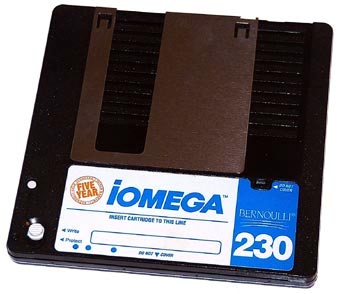
The most popular system was the Bernoulli Box II, whose cartridges are 13.6 cm wide, 14 cm long, and 0.9 cm thick, somewhat resembling a 5¼-inch standard floppy disk. The Bernoulli Box II was initially released with just a 20 MB capacity, but was quickly followed up by drives with capacities of 44 MB, then 90 MB (with varying levels of backwards compatibility). Eventually, a so-called "MultiDisk" drive was released which sported a maximum capacity of 150 MB, but which could also read and write without penalty to other "MultiDisk" cartridges, specifically: 35 MB, 65 MB, and 105 MB, in addition to 150 MB.
By 1993, a 230 MB Bernoulli Box was released which boosted the maximum possible capacity, and which was also backwards compatible with most previous capacities (albeit at a performance penalty).
Bernoulli Box II drives were sold as either internal units which fit into standard 5¼-inch drive bays, or as external units, with either one or two drives within a self-contained enclosure, similar to the original Bernoulli Box, and which connected to the host computer via the external SCSI connector.
All versions of the Bernoulli Box II use a SCSI interface, but external drives can also be converted for use with a Parallel port interface using a special adapter.
Hub AI
Bernoulli Box AI simulator
(@Bernoulli Box_simulator)
Bernoulli Box
The Bernoulli Box (or simply Bernoulli, named after Bernoulli's principle) is a high-capacity (at the time of release) removable disk storage system that was Iomega's first widely known product. It was first released in 1982.
The original Bernoulli Box "Alpha-10" is a 10 MB removable disk drive that spins a disk made of PET film at about 1500 rpm, 1 μm above a read-write head. Utilizing Bernoulli's principle, the rotation of the disk pulls the flexible disk media down towards the read/write head, and will continue to do so for as long as the disk is spinning. This was in an attempt to make the Bernoulli drive more reliable than a contemporaneous hard disk drive, since a head crash is made physically impossible: should the disk stop spinning for any reason, it immediately pulls away from the read/write head, preventing damage.
The Bernoulli Box was released in capacities of 10 and, later, 20 MB, and its cartridges measure 8.23 x 11.02 x 0.71 inches, about the size of a standard piece of letter paper (albeit thicker). Bernoulli Boxes could be configured at time of purchase for either one or two drives within a single enclosure. A drive subsystem can be connected to a host computer via a proprietary interface card that utilizes a 37-pin SCSI connector.
In 1985, a 5 MB, RS-422 serial version of the Bernoulli Box, specific to the original Macintosh and Macintosh 512K, was released. The cartridges for this Macintosh-only version have a smaller capacity of just 5 MB. However, they are also physically smaller than their predecessors, measuring just 5.5 x 7.4 x 0.53 inches. With the release of the Macintosh Plus in 1986 (and its on-board SCSI interface), the 5MB Bernoulli Box was quickly discontinued, and the 10 and 20 MB versions were adapted for the Macintosh Plus's 25-pin SCSI connector.
The most popular system was the Bernoulli Box II, whose cartridges are 13.6 cm wide, 14 cm long, and 0.9 cm thick, somewhat resembling a 5¼-inch standard floppy disk. The Bernoulli Box II was initially released with just a 20 MB capacity, but was quickly followed up by drives with capacities of 44 MB, then 90 MB (with varying levels of backwards compatibility). Eventually, a so-called "MultiDisk" drive was released which sported a maximum capacity of 150 MB, but which could also read and write without penalty to other "MultiDisk" cartridges, specifically: 35 MB, 65 MB, and 105 MB, in addition to 150 MB.
By 1993, a 230 MB Bernoulli Box was released which boosted the maximum possible capacity, and which was also backwards compatible with most previous capacities (albeit at a performance penalty).
Bernoulli Box II drives were sold as either internal units which fit into standard 5¼-inch drive bays, or as external units, with either one or two drives within a self-contained enclosure, similar to the original Bernoulli Box, and which connected to the host computer via the external SCSI connector.
All versions of the Bernoulli Box II use a SCSI interface, but external drives can also be converted for use with a Parallel port interface using a special adapter.