


Community hub
Recent from talks
Contribute something to knowledge base
Content stats: 0 posts, 0 articles, 1 media, 0 notes
Members stats: 0 subscribers, 0 contributors, 0 moderators, 0 supporters
Subscribers
Supporters
Contributors
Moderators
Hub AI
Love's Labour's Lost AI simulator
(@Love's Labour's Lost_simulator)
Hub AI
Love's Labour's Lost AI simulator
(@Love's Labour's Lost_simulator)
Love's Labour's Lost
Love's Labour's Lost is one of William Shakespeare's early comedies, believed to have been written in the mid-1590s for a performance at the Inns of Court before Queen Elizabeth I. It follows the King of Navarre and his three companions as they attempt to swear off the company of women for three years in order to focus on study and fasting. Their subsequent infatuation with the Princess of France and her ladies makes them forsworn (break their oath). In an untraditional ending for a comedy, the play closes with the death of the Princess's father, and all weddings are delayed for a year. The play draws on themes of masculine love and desire, reckoning and rationalisation, and reality versus fantasy.
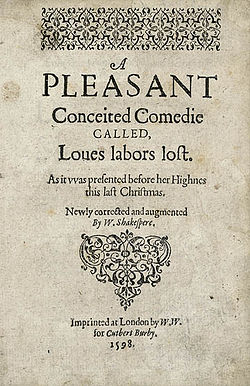
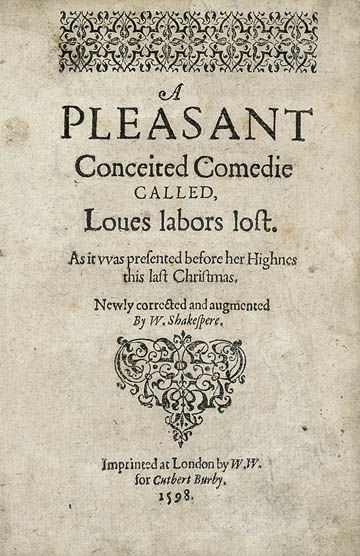
Though first published in quarto in 1598, the play's title page suggests a revision of an earlier version of the play. There are no obvious sources for the play's plot. The use of apostrophes in the play's title varies in early editions, though it is most commonly given as Love's Labour's Lost.
Shakespeare's audiences were familiar with the historical personages portrayed and the political situation in Europe relating to the setting and action of the play. Scholars suggest the play lost popularity as these historical and political portrayals of Navarre's court became dated and less accessible to theatergoers of later generations. The play's sophisticated wordplay, pedantic humour and dated literary allusions may also be causes for its relative obscurity, as compared with Shakespeare's more popular works. Love's Labour's Lost was rarely staged in the 19th century, but it has been seen more often in the 20th and 21st centuries, with productions by the Royal Shakespeare Company, the National Theatre, and the Stratford Festival of Canada, among others. It has also been adapted as a musical, an opera, for radio and television and as a musical film.
Ferdinand, King of Navarre, and his three noble companions, the Lords Berowne, Dumaine, and Longaville, take an oath not to give in to the company of women. They devote themselves to three years of study and fasting; Berowne agrees somewhat more hesitantly than the others. The King declares that no woman should come within a mile of the court. Don Adriano de Armado, a Spaniard visiting the court, writes a letter to tell the King of a tryst between Costard and Jaquenetta. After the King sentences Costard, Don Armado confesses his own love for Jaquenetta to his page, Moth. Don Armado writes Jaquenetta a letter and asks Costard to deliver it.
The Princess of France and her ladies arrive, wishing to speak to the King regarding the cession of Aquitaine, but must ultimately make their camp outside the court due to the decree. In visiting the Princess and her ladies at their camp, the King falls in love with the Princess, as do the lords with the ladies. Berowne gives Costard a letter to deliver to the lady Rosaline, which Costard switches with Don Armado's letter that was meant for Jaquenetta. Jaquenetta consults two scholars, Holofernes and Sir Nathaniel, who conclude that the letter is written by Berowne and instruct her to tell the King.
The King and his lords lie in hiding and watch one another as each subsequently reveals his feelings of love. The King ultimately chastises the lords for breaking the oath, but Berowne reveals that the King is likewise in love with the Princess. Jaquenetta and Costard enter with Berowne's letter and accuse him of treason. Berowne confesses to breaking the oath, explaining that the only study worthy of mankind is that of love, and he and the other men collectively decide to relinquish the vow. Arranging for Holofernes to entertain the ladies later, the men then dress as Muscovites and court the ladies in disguise. The Queen's courtier Boyet, having overheard their planning, helps the ladies trick the men by disguising themselves as each other. When the lords return as themselves, the ladies taunt them and expose their ruse.
Impressed by the ladies' wit, the men apologize, and when all identities are righted, they watch Holofernes, Sir Nathaniel, Costard, Moth and Don Armado present the Nine Worthies. The four lords and Boyet heckle the play, saving their sole praise for Costard. Don Armado and Costard almost come to blows when Costard reveals mid-pageant that Don Armado has got Jaquenetta pregnant. Their spat is interrupted by news that the Princess's father has died. The Princess makes plans to leave at once, and she and her ladies, readying for mourning, declare that the men must wait a year and a day to prove their loves lasting. Don Armado announces he will swear a similar oath to Jaquenetta and then presents the nobles with a song.
Love's Labour's Lost may be found to have a number of sources for various aspects, but a primary source for the story is not extant. It has this in common with two other Shakespeare plays – A Midsummer Night's Dream and The Tempest. Some possible influences on Love's Labour's Lost can be found in the early plays of John Lyly, Robert Wilson's The Cobbler's Prophecy (c. 1590) and Pierre de La Primaudaye's L'Academie française (1577). Michael Dobson and Stanley Wells comment that it has often been conjectured that the plot derives from "a now lost account of a diplomatic visit made to Henry in 1578 by Catherine de' Medici and her daughter Marguerite de Valois, Henry's estranged wife, to discuss the future of Aquitaine, but this is by no means certain."
Love's Labour's Lost
Love's Labour's Lost is one of William Shakespeare's early comedies, believed to have been written in the mid-1590s for a performance at the Inns of Court before Queen Elizabeth I. It follows the King of Navarre and his three companions as they attempt to swear off the company of women for three years in order to focus on study and fasting. Their subsequent infatuation with the Princess of France and her ladies makes them forsworn (break their oath). In an untraditional ending for a comedy, the play closes with the death of the Princess's father, and all weddings are delayed for a year. The play draws on themes of masculine love and desire, reckoning and rationalisation, and reality versus fantasy.
Though first published in quarto in 1598, the play's title page suggests a revision of an earlier version of the play. There are no obvious sources for the play's plot. The use of apostrophes in the play's title varies in early editions, though it is most commonly given as Love's Labour's Lost.
Shakespeare's audiences were familiar with the historical personages portrayed and the political situation in Europe relating to the setting and action of the play. Scholars suggest the play lost popularity as these historical and political portrayals of Navarre's court became dated and less accessible to theatergoers of later generations. The play's sophisticated wordplay, pedantic humour and dated literary allusions may also be causes for its relative obscurity, as compared with Shakespeare's more popular works. Love's Labour's Lost was rarely staged in the 19th century, but it has been seen more often in the 20th and 21st centuries, with productions by the Royal Shakespeare Company, the National Theatre, and the Stratford Festival of Canada, among others. It has also been adapted as a musical, an opera, for radio and television and as a musical film.
Ferdinand, King of Navarre, and his three noble companions, the Lords Berowne, Dumaine, and Longaville, take an oath not to give in to the company of women. They devote themselves to three years of study and fasting; Berowne agrees somewhat more hesitantly than the others. The King declares that no woman should come within a mile of the court. Don Adriano de Armado, a Spaniard visiting the court, writes a letter to tell the King of a tryst between Costard and Jaquenetta. After the King sentences Costard, Don Armado confesses his own love for Jaquenetta to his page, Moth. Don Armado writes Jaquenetta a letter and asks Costard to deliver it.
The Princess of France and her ladies arrive, wishing to speak to the King regarding the cession of Aquitaine, but must ultimately make their camp outside the court due to the decree. In visiting the Princess and her ladies at their camp, the King falls in love with the Princess, as do the lords with the ladies. Berowne gives Costard a letter to deliver to the lady Rosaline, which Costard switches with Don Armado's letter that was meant for Jaquenetta. Jaquenetta consults two scholars, Holofernes and Sir Nathaniel, who conclude that the letter is written by Berowne and instruct her to tell the King.
The King and his lords lie in hiding and watch one another as each subsequently reveals his feelings of love. The King ultimately chastises the lords for breaking the oath, but Berowne reveals that the King is likewise in love with the Princess. Jaquenetta and Costard enter with Berowne's letter and accuse him of treason. Berowne confesses to breaking the oath, explaining that the only study worthy of mankind is that of love, and he and the other men collectively decide to relinquish the vow. Arranging for Holofernes to entertain the ladies later, the men then dress as Muscovites and court the ladies in disguise. The Queen's courtier Boyet, having overheard their planning, helps the ladies trick the men by disguising themselves as each other. When the lords return as themselves, the ladies taunt them and expose their ruse.
Impressed by the ladies' wit, the men apologize, and when all identities are righted, they watch Holofernes, Sir Nathaniel, Costard, Moth and Don Armado present the Nine Worthies. The four lords and Boyet heckle the play, saving their sole praise for Costard. Don Armado and Costard almost come to blows when Costard reveals mid-pageant that Don Armado has got Jaquenetta pregnant. Their spat is interrupted by news that the Princess's father has died. The Princess makes plans to leave at once, and she and her ladies, readying for mourning, declare that the men must wait a year and a day to prove their loves lasting. Don Armado announces he will swear a similar oath to Jaquenetta and then presents the nobles with a song.
Love's Labour's Lost may be found to have a number of sources for various aspects, but a primary source for the story is not extant. It has this in common with two other Shakespeare plays – A Midsummer Night's Dream and The Tempest. Some possible influences on Love's Labour's Lost can be found in the early plays of John Lyly, Robert Wilson's The Cobbler's Prophecy (c. 1590) and Pierre de La Primaudaye's L'Academie française (1577). Michael Dobson and Stanley Wells comment that it has often been conjectured that the plot derives from "a now lost account of a diplomatic visit made to Henry in 1578 by Catherine de' Medici and her daughter Marguerite de Valois, Henry's estranged wife, to discuss the future of Aquitaine, but this is by no means certain."
Recent media
Recent media