Hubbry Logo
The TempestThe TempestMain
Open search
The Tempest
Community hub
The Tempest
logo
8 pages, 0 posts
0 subscribers
Be the first to start a discussion here.
The Tempest
The Tempest
from Wikipedia

The Tempest is a play by William Shakespeare, probably written in 1610–1611, and thought to be one of the last plays that he wrote alone. After the first scene, which takes place on a ship at sea during a tempest, the rest of the story is set on a remote island, where Prospero, a magician, lives with his daughter Miranda, and his two servants: Caliban, a savage monster figure, and Ariel, an airy spirit. The play contains music and songs that evoke the spirit of enchantment on the island. It explores many themes, including magic, betrayal, revenge, forgiveness and family. In Act IV, a wedding masque serves as a play-within-a-play, and contributes spectacle, allegory, and elevated language.

Key Information

Although The Tempest is listed in the First Folio as the first of Shakespeare's comedies, it deals with both tragic and comic themes, and modern criticism has created a category of romance for this and others of Shakespeare's late plays. The Tempest has been widely interpreted in later centuries. Its central character Prospero has been identified with Shakespeare, with Prospero's renunciation of magic signaling Shakespeare's farewell to the stage. It has also been seen as an allegory of Europeans colonizing foreign lands.

The play has had a varied afterlife, inspiring artists in many nations and cultures, on stage and screen, in literature, music (especially opera), and the visual arts.

Characters

[edit]
  • Prospero – the rightful Duke of Milan and a magician
  • Miranda – daughter to Prospero
  • Ariel – a spirit in service to Prospero
  • Caliban – an enslaved servant of Prospero
  • Alonso – King of Naples
  • Sebastian – Alonso's brother
  • Antonio – Prospero's brother, the usurping Duke of Milan
  • Ferdinand – Alonso's son
  • Gonzalo – an honest old councillor
  • Adrian – a lord serving under Alonso
  • Francisco – a lord serving under Alonso
  • Trinculo – the King's jester
  • Stephano – the King's drunken butler
  • Juno – Roman goddess of marriage
  • Ceres – Roman goddess of agriculture
  • Iris – Greek goddess of the rainbow and messenger of the gods
  • Master – master of the ship
  • Mariners
  • Boatswain – servant of the master

Plot

[edit]
The shipwreck in Act I, Scene 1, in a 1797 engraving by Benjamin Smith after a painting by George Romney

Act I

[edit]

Twelve years before the action of the play, Prospero, formerly Duke of Milan and a gifted sorcerer, had been usurped by his treacherous brother Antonio with the aid of Alonso, King of Naples. Escaping by boat with his infant daughter Miranda, Prospero flees to a remote island where he has been living ever since. There he used his magic to force the island's only inhabitant, Caliban, to protect him and Miranda. He also frees the spirit Ariel and binds him into servitude.

When a ship carrying his brother Antonio passes nearby, Prospero conjures up a storm with help from Ariel and the ship is destroyed. Antonio is shipwrecked, along with Alonso, Ferdinand (Alonso's son and heir to the throne), Sebastian (Alonso's brother), Gonzalo (Prospero's trustworthy minister), Adrian, and other court members.

Acts II and III

[edit]
Prospero and Miranda, by William Maw Egley, c. 1850

Prospero enacts a sophisticated plan to take revenge on his usurpers and regain his dukedom. Using magic, he separates the shipwreck survivors into groups on the island:

  • Ferdinand, who is rescued by Prospero and Miranda and given shelter. Prospero successfully manipulates the youth into a romance with Miranda.
  • Trinculo, the king's jester, and Stephano, the king's drunken butler, who encounter Caliban. Recognizing his miserable state, the three stage an unsuccessful "rebellion" against Prospero. Their actions provide the comic relief of the play.
  • Alonso, Sebastian, Antonio, Gonzalo, and two attendant lords (Adrian and Francisco). Antonio and Sebastian conspire to kill Alonso and Gonzalo so Sebastian can become King; Prospero and Ariel thwart the conspiracy. Later, Ariel takes the form of a harpy and torments Antonio, Alonso, and Sebastian, causing them to flee in guilt for their crimes against Prospero and each other.
  • The ship's captain and boatswain, along with the other surviving sailors, are placed into a magical sleep until the final act.

Act IV

[edit]

Prospero intends that Miranda, now aged 15, will marry Ferdinand, and he instructs Ariel to bring some other spirits and produce a masque.

The masque will feature classical goddesses, Juno, Ceres, and Iris, and will bless and celebrate the betrothal. The masque will also instruct the young couple on marriage, and on the value of chastity until then.

The masque is suddenly interrupted when Prospero realises he had forgotten the plot against his life. Once Ferdinand and Miranda are gone, Prospero orders Ariel to deal with the nobles' plot. Caliban, Trinculo, and Stephano are then chased off into the swamps by goblins in the shape of hounds.

Act V and Epilogue

[edit]

Prospero vows that once he achieves his goals, he will set Ariel free, and abandon his magic, saying:

I'll break my staff,
Bury it certain fathoms in the earth,
And deeper than did ever plummet sound
I'll drown my book.[1]

Ariel brings on Alonso, Antonio, and Sebastian. Prospero forgives all three. Prospero's former title, Duke of Milan, is restored. Ariel fetches the sailors from the ship, and then Caliban, Trinculo, and Stephano. Caliban, seemingly filled with regret, promises to be good. Stephano and Trinculo are ridiculed and sent away in shame by Prospero. Before the reunited group (all the noble characters with the addition of Miranda and Prospero) leave the island, Ariel is instructed to provide good weather to guide the king's ship back to the royal fleet and then to Naples, where Ferdinand and Miranda will be married. After this, Ariel is set free.

In an epilogue, Prospero requests that the audience set him free — with their applause.

Date and sources

[edit]
A depiction from Nicholas Rowe's 1709 edition of Shakespeare's plays of the stage direction of the opening of the 1674 adaptation

Date

[edit]

It is not known for certain exactly when The Tempest was written, but evidence supports the idea that it was probably composed sometime between late 1610 to mid-1611.[2][3] Evidence supports composition perhaps occurring before, after, or at the same time as The Winter's Tale.[2] It is considered one of the last plays that Shakespeare wrote alone. But it was not, as is sometimes claimed, Shakespeare's last play, since it is post-dated by his collaborations with John Fletcher: Henry VIII, Cardenio and The Two Noble Kinsmen.[4] Edward Blount entered The Tempest into the Stationers' Register on 8 November 1623. It was one of 16 Shakespeare plays that Blount registered on that date.[5]

Sources

[edit]
Silvester Jourdain's A Discovery of the Barmvdas

There is no obvious single source text for the plot of The Tempest: it appears to have been created by Shakespeare with several sources contributing.[6]

The Sea Venture: William Strachey's A True Reportory of the Wracke and Redemption of Sir Thomas Gates, Knight, an eyewitness report of the real-life shipwreck of the Sea Venture in 1609 on the island of Bermuda while sailing toward Virginia, may be considered a primary source for the opening scene, as well as a few other references in the play to conspiracies and retributions.[7] Although not published until 1625, Strachey's report was first recounted in his "Letter to an Excellent Lady", a private letter describing the incident and the earliest account of all. It was dated 15 July 1610, and it is thought that Shakespeare - who had personal connections with a number of members of the Virginia Company - may have seen the original sometime during that year.[8][9] At around the time Shakespeare could have read Strachey's letter, another Sea Venture survivor, Silvester Jourdain, published his account, A Discovery of The Barmudas, otherwise Called the Ile of Divels.[10] Also there is the Council of Virginia's 1610 pamphlet True Declaration of the state of the Colonie in Virginia, with a confutation of such scandalous reports as have tended to the disgrace of so worthy an enterprise.[11] Regarding the influence of Strachey on the play, Kenneth Muir says that although "there is little doubt that Shakespeare had read ... William Strachey's True Reportory" and other accounts, "the extent of the verbal echoes of [the Bermuda] pamphlets has, I think, been exaggerated. There is hardly a shipwreck in history or fiction which does not mention splitting, in which the ship is not lightened of its cargo, in which the passengers do not give themselves up for lost, in which north winds are not sharp, and in which no one gets to shore by clinging to wreckage."[12]

Montaigne's Of The Canibales: Gonzalo's description of his ideal society[13] thematically and verbally echoes Montaigne's essay Of the Canibales, translated into English in a version published by John Florio in 1603. Montaigne praises the society of the Caribbean natives: "It is a nation ... that hath no kinde of traffike, no knowledge of Letters, no intelligence of numbers, no name of magistrate, nor of politike superioritie; no use of service, of riches, or of poverty; no contracts, no successions, no dividences, no occupation but idle; no respect of kinred, but common, no apparrell but natural, no manuring of lands, no use of wine, corne, or mettle. The very words that import lying, falsehood, treason, dissimulation, covetousnes, envie, detraction, and pardon, were never heard of amongst them."[14]

Ovid's Metamorphoses: A source for Prospero's speech in act five, in which he bids farewell to magic[15] is an invocation by the sorceress Medea found in Ovid's poem Metamorphoses. Medea calls out:

Ye airs and winds; ye elves of hills, of brooks, of woods alone,
Of standing lakes, and of the night, approach ye every one,
Through help of whom (the crooked banks much wondering at the thing)
I have compelled streams to run clean backward to their spring.[16]

Shakespeare's Prospero begins his invocation:

Ye elves of hills, brooks, standing lakes and groves,
And ye that on the sands with printless foot
Do chase the ebbing Neptune, and do fly him
When he comes back ...[17][18]

Other Sources: Other shipwreck narratives probably drawn on by Shakespeare include those of Antonio Pigafetta contained in Richard Eden's travel anthologies of 1555 and 1557.[19] And some of the characters' names may derive from a 1594 History of Italy.[20]

The Tempest may take its overall structure from traditional Italian commedia dell'arte, which sometimes featured a magus and his daughter, their supernatural attendants, and a number of rustics. The commedia often featured a clown known as Arlecchino (or his predecessor, Zanni) and his partner Brighella, who bear a striking resemblance to Stephano and Trinculo; a lecherous Neapolitan hunchback who corresponds to Caliban; and the clever and beautiful Isabella, whose wealthy and manipulative father, Pantalone, constantly seeks a suitor for her, thus mirroring the relationship between Miranda and Prospero.[21] Other dramatic influences on Prospero's character include Greene's Friar Bacon, Marlowe's Dr. Faustus and Shakespeare's own Owen Glendower.[22] Bremo in Mucedorus may have influenced Caliban.[23]

Scholars have debated the influence of Virgil's Aeneid, which Robert Wiltenburg described as "the main source of the play ... not the source of the plot ... but the work to which Shakespeare is responding".[24]

Recently, scholars have also identified the influence on the Tempest of Marston's The Malcontent,[25] Beaumont and Fletcher's Philaster[25] and the anonymous romance Primaleon, Prince of Greece.[26]

Text

[edit]
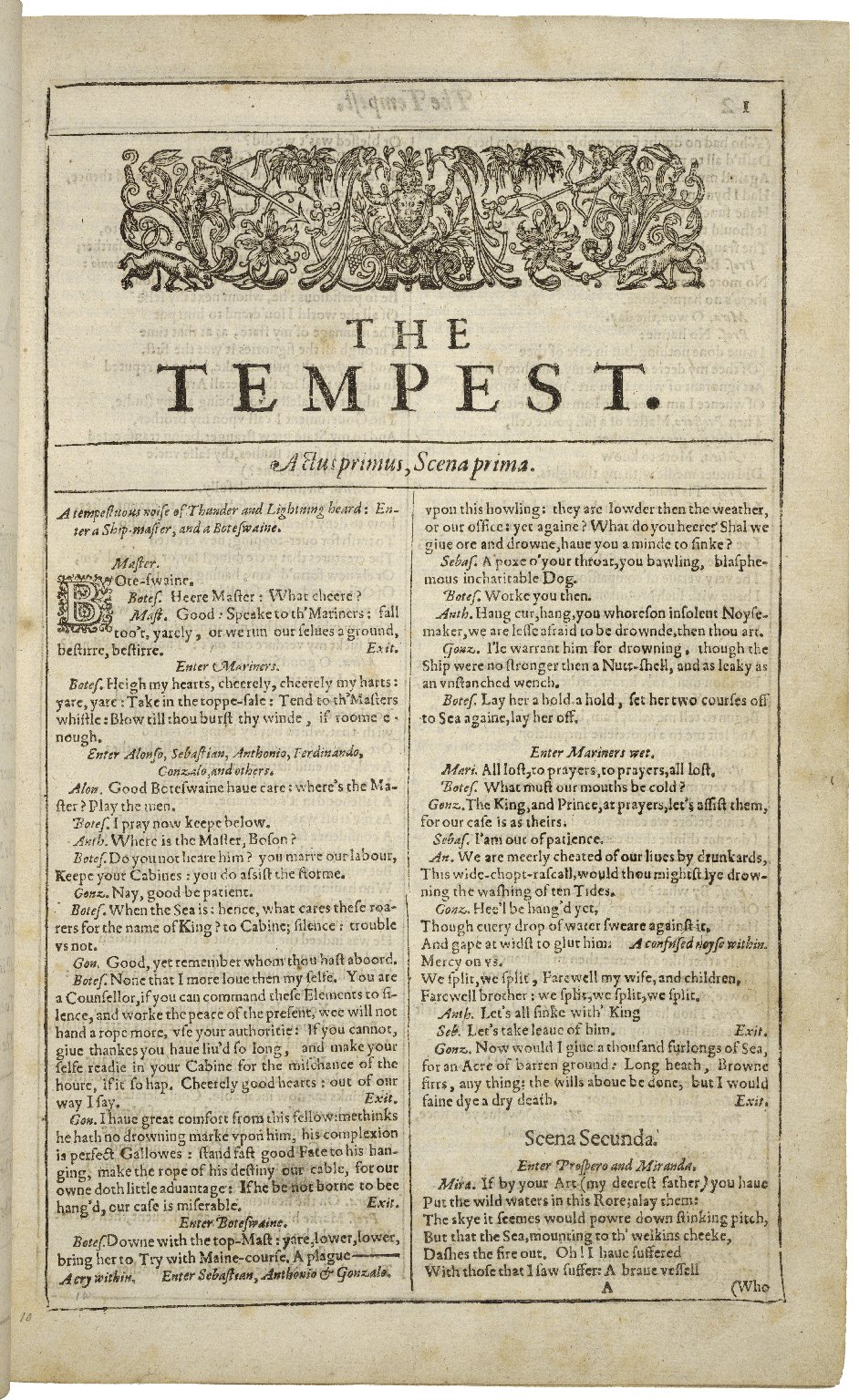
The first page of The Tempest, printed in the First Folio of 1623

The Tempest first appeared in print in 1623 in the collection of 36 of Shakespeare's plays entitled, Mr. William Shakespeare's Comedies, Histories, & Tragedies; Published according to the True and Original Copies, which is known as the First Folio. The plays, including The Tempest, were gathered and edited by John Heminges and Henry Condell.[27]

The Folio text was based on a handwritten manuscript of The Tempest prepared by Ralph Crane, a scrivener employed by the King's Men. Crane probably copied from Shakespeare's rough draft, and based his style on Ben Jonson's Folio of 1616. Crane is thought to have neatened texts, edited the divisions of acts and scenes, and sometimes added his own improvements. He was fond of joining words with hyphens, and using elisions with apostrophes, for example by changing "with the king" to read: "wi'th' King".[28] The elaborate stage directions in The Tempest may have been due to Crane; they provide evidence regarding how the play was staged by the King's Men.[29]

The entire First Folio project was delivered to the blind printer, William Jaggard, and printing began in 1622.[30] The Tempest is the first play in the publication. It was proofread and printed with special care; it is the most well-printed and the cleanest text of the thirty-six plays. To do the work of setting the type in the printing press, three compositors were used for The Tempest. In the 1960s, a landmark bibliographic study of the First Folio was accomplished by Charlton Hinman. Based on distinctive quirks in the printed words on the page, the study was able to individuate the compositors, and reveal that three compositors worked on The Tempest, who are known as Compositor B, C, and F. Compositor B worked on The Tempest's first page as well as six other pages. He was an experienced journeyman in Jaggard's printshop, who occasionally could be careless. In his role, he may have had a responsibility for the entire First Folio. The other two, Compositors C and F, worked full-time and were experienced printers.[27]

At the time, spelling and punctuation were not standardized, and varied from page to page, because each compositor had their individual preferences and styles. There is evidence that the press run was stopped at least four times, which allowed proofreading and corrections. However, a page with an error would not be discarded, so pages late in any given press run are the most accurate, and each of the final printed folios may vary in this regard. This was the common practice at the time. There is also an instance of a letter (a metal sort or a type) being damaged (possibly) during the course of a run and changing the meaning of a word: After the masque Ferdinand says,

Ferdinand's line as it appears in Shakespeare's First Folio published in 1623

Let me live here ever!
So rare a wondered father and a wise
Makes this place paradise! (4.1.122–124)

The word "wise" at the end of line 123 was printed with the traditional long "s" that resembles an "f". But in 1978 it was suggested that during the press run, a small piece of the crossbar on the type had broken off, and the word should be "wife". Modern editors have not come to an agreement—Oxford says "wife", Arden says "wise".[31][32][33]

Themes and motifs

[edit]

The theatre

[edit]

Our revels now are ended. These our actors,
As I foretold you, were all spirits and
Are melted into air, into thin air;
And like the baseless fabric of this vision,
The cloud-capped towers, the gorgeous palaces,
The solemn temples, the great globe itself,
Yea, all which it inherit, shall dissolve,
And, like this insubstantial pageant faded,
Leave not a rack behind. We are such stuff
As dreams are made on, and our little life
Is rounded with a sleep.

The Tempest is explicitly concerned with its own nature as a play, frequently drawing links between Prospero's art and theatrical illusion. The shipwreck was a spectacle that Ariel performed.[35] Prospero may even refer to the Globe Theatre when he describes the whole world as an illusion: "the great globe ... shall dissolve ... like this insubstantial pageant".[36] Ariel frequently disguises himself as figures from Classical mythology, for example a nymph, a harpy, and Ceres, acting as the latter in a masque that Prospero creates.[37]

The masque

[edit]

The masque in The Tempest is not itself a masque; rather, it is a dramatisation of a masque, while serving the narrative of the drama that contains it.[38] It is an example of Prospero's magic art: a performance in which Ariel and his fellows play the roles.[39][40] In it, the goddesses Iris, Ceres and Juno celebrate the betrothal of Miranda and Ferdinand.[41][42]

The language of the masque is stylized and artificial - to the point that some twentieth century critics dispraised it or considered it the work of another writer.[43]

The Tempest as a whole contains elements which are derived from the masque as its leading practitioner, Ben Jonson, was developing it: specifically a masque is a movement from conflict to harmony, as The Tempest is, and masques centre on antitheses, as seen - for example - in the depiction of Ariel and Caliban as exquisite -v- monstrous, grateful -v- ungrateful or air -v- earth.[44]

Revenge and forgiveness

[edit]

The tone of Prospero's speech towards his three enemies Antonio, Alonso and Sebastian throughout the play is of rage and vengeance. However, in the final act, Prospero tells Ariel "They being penitent, the sole drift of my purpose doth extend not a frown further."[45] But as Stephen Orgel notes in his introduction to the Oxford edition of the play, there is a condition in this speech which is not fulfilled: that Antonio is given no speech of remorse or contrition at the end of the play.[46]

Prospero freely forgives Alonso. But in his final speeches towards Antonio, Prospero's attitude vascillates: "You, brother mine, that entertained ambition ... I do forgive thee"[47] but then immediately reverses himself: "Unnatural though thou art!"[48] and reconsiders upon remembering the conspiracy to kill Alonso: "At this time I will tell no tales"[49] then almost reverses himself with: "Most wicked sir, whom to call brother would even infect my mouth"[50] and only then confirms his forgiveness, while giving Antonio no opportunity to repent: "I do forgive thy rankest fault - all of them; and require my dukedom of thee, which perforce I know thou must restore."[51][52]

The spareness of Shakespeare's writing in the last act give scope to the actor playing Prospero to decide whether it was always the intention to forgive his enemies or whether he is influenced by Ariel's advice to be "tender",[53] and similarly whether the change is gradual, is sudden, or is forced upon him by shame or expediency.[54]

Chastity

[edit]

An important aspect of Prospero's project is to secure his dynasty by marrying his daughter, Miranda, to the heir of Naples, Ferdinand, for whom she is only a suitable bride if she is a virgin.[55][56] Chastity had also become embodied as a royal virtue through the reign of Elizabeth, the "Virgin Queen".[55]

Miranda is seen as a sexual object by three characters:

  • Caliban, who according to Prospero "didst seek to violate the honour of mine child";[57]
  • Stephano, to whom Caliban says "she will become thy bed, I warrant, and bring thee forth brave brood";[58] and
  • Ferdinand, whose mutual love with Miranda is the most immediate threat to her chastity.

The latter leads to chastity becoming the primary theme of the masque in Act IV, prefixed by Prospero's warning to Ferdinand: "But if thou dost break her virgin-knot before all sanctimonious ceremonies may with full and holy rite be ministered, no sweet aspersion shall the heavens let fall to make this contract grow."[59] Venus and Cupid (who, in the mythology, initiated the abduction of Proserpina) are banished from the masque, and the songs of Ceres and Juno[60] celebrate chaste love.[61]

Magic

[edit]

Prospero has been described as practicing "theurgy", white magic, known in Shakespeare's time from neo-Platonic writers, and contrasted with "goety", black magic.[62] Contemporary Dr John Dee regarded himself as practicing this white magic, but all magic was condemned by the church and the state: King James in his book Daemonologie having declared it punishable by death.[63] Early modern plays about magic had portrayed it negatively: most famously in Marlowe's Doctor Faustus, but also, quite recently at the time The Tempest was written, in Jonson's satire The Alchemist, played by Shakespeare's own company, The King's Men, in which the central magician character, Subtle, is merely a con man.[64]

In another more positive interpretation, Prospero's magic is an extension of science. Francis Bacon (who was at the time King James's Attorney-General) had written in his Magnalia Naturae of the possibility of the new philosophy giving humans powers over storms, seasons, germination and harvests.[65]

Prospero often invokes the language of alchemy but his project is to transform not metals, but people: especially Caliban, and Prospero's former enemies Antonio, Sebastian and Alsonso.[66] And he has the signifiers that Elizabethan audiences would have associated with magical power: his books, his staff and his robe.[67]

In the end Prospero must abandon his magic. He must free himself from the temptation to use magic for revenge, and from the distraction from his ducal duties which had caused his fall from power twelve years earlier.[68][69]

Prospero and Sycorax

[edit]

Related to Prospero's magic is the contrast between himself and the unseen character Sycorax, Caliban's mother, an Algerian witch who inhabited the island and died prior to Prospero and Miranda's arrival. Prospero himself makes much of the distinction between his own magical skill and that of Sycorax - both in moral terms (his white magic against her black magic) and in terms of his greater powers - exemplified by the fact that Sycorax "could not again undo"[70] Ariel's imprisonment in a cloven pine and "It was mine [Prospero's] art ... that made gape the pine and let thee out."[71][68]

Scholar Stephen Orgel concludes that "attitudes towards magic in the play ... range from the most positive to the most negative"[69] but that twentieth century criticism emphasised the virtuous aspects of Prospero's magic: citing Frances Yates and Frank Kermode among those who praise Prospero's theurgy over the goety of Sycorax.[69] But Orgel goes on to reject this view as an oversimplification: pointing out that there is no evidence that the spirits controlled by Sycorax are any lower than (or, indeed, any other than) those controlled by Prospero, and also that Ariel is the unwilling servant of both.[72]

The moral superiority of Prospero over Sycorax is also undermined in Prospero's speech renouncing his magic[73] which many in Shakespeare's audiences would have known (see "Sources" above) was a quotation from the witch Medea in Ovid's Metamorphoses.[68][74]

Prospero as Shakespeare

[edit]

Thomas Campbell in 1838 was the first to consider that Prospero was meant to partially represent Shakespeare, but then abandoned that idea when he came to believe that The Tempest was an early play.[75] Even so, the idea has persisted in the critical canon that Prospero may be partly autobiographical.[75][76]

As it was probably Shakespeare's last solo play, The Tempest has often been seen as a valedictory for his career, especially in the passages beginning "Our revels now are ended..."[77] and "Ye elves of hills...".[78][79] Of the latter, Shakespeare's biographer Samuel Schoenbaum has suggested that it is more pertinent to Shakespeare than to Prospero, since there is nothing to suggested that at Prospero's command "Graves ... have wak'd their sleepers, ope'd, and let 'em forth"[80] – something Shakespeare has done, metaphorically, for many an historical character through his works.[81]

And in the epilogue of the play, Prospero enters into a parabasis (a direct address to the audience) in which he tells the audience "Let your indulgence set me free".[82] Because Prospero is often identified with Shakespeare himself in this final speech, both appear (in the words of Germaine Greer) to be "[not] so much bidding farewell to the stage as begging to be released from it".[83][84][85]

Criticism and interpretation

[edit]

Genre

[edit]

Comedy: The Tempest is listed first among the "Comedies" in the 1623 First Folio of Shakespeare's works.[86] The plot contains elements deriving from the Italian tradition of commedia dell'arte.[87] In Shakespeare's time, whether a work was classified as comedy was chiefly defined by the resolution of its plot: typically one ending in marriage.[88]

Tragicomedy: Although the plot contains similarities to Shakespeare's early comedies, its darker tone has led some twentieth-century critics including Joan Hartwig to label it a tragicomedy in the same tradition as contemporary mixed-mode plays such as the collaborations between Beaumont and Fletcher.[89] E. M. W. Tillyard argued that the classic principles of tragedy were divided between two of Shakespeare's late plays: destruction being explored more fully in The Winter's Tale, and regeneration more fully in The Tempest.[90]

Romance: Four of Shakespeare's late plays – Pericles, Cymbeline, The Winter's Tale and The Tempest – have become grouped together as his romances.[91][92] This places them in a tradition derived from third-century Greek narratives, and practiced by Elizabethan writers including Lyly, Lodge, Greene and Sidney.[91] These plays (in the words of Reginald Foakes) "create a world dominated by chance ... in which we are attuned to delight in and wonder at the unexpected."[93]

The Classical Unities

[edit]

Like The Comedy of Errors, The Tempest roughly adheres to the unities of time, place, and action.[94] Shakespeare's other plays rarely respected the three unities, taking place in separate locations miles apart and over several days or even years.[95] Of Shakespeare's other late romances, for example, The Winter's Tale contains a gap of sixteen years, and Cymbeline's action veers between Britain and Italy.[96] In contrast, The Tempest's events unfold in real time before the audience, taking around three hours.[97][98][96] All action is unified into one basic plot: Prospero's struggle to regain his dukedom; it is also confined to one place, a fictional island.

Location of Prospero's Island

[edit]

The action takes place on an enchanted island ruled by Prospero, which must be located in the Mediterranean Sea, since it is encountered by travelers attempting to sail from Tunis to Naples.[99][100] However it is often thought of in subsequent criticism as being in the North Atlantic: partly because of the play's association with the wreck of the Sea Venture (see "Sources" above) and Ariel's suggestion of its proximity to the "still-vexed Bermoothes"[101] both of which relate it to Bermuda, but also because of the colonial context of the play – and the way in which it subsequently came to be viewed by postcolonial critics – which suggest a setting in the New World.[102][103] Also indicative of a New World setting are the name of Sycorax's god, Setebos, which derives from South America, and the source of Gonzalo's Utopia in Montaigne's essay Of The Cannibals (see also "Sources" above).[104]

Prospero as Hero

[edit]

Throughout the critical history of the play until the mid-twentieth century, Prospero was generally regarded as an admirable figure: "prickly but essentially lovable" (in the words of Martin Butler).[105] But in more recent criticism and performance he has come to be seen as self-doubting and controlling and his attitude one of (in Martin Butler's words again) "suspicion, strain and paranoia".[106]

This shift in the attitude of critics is partly due to the absence of soliloquies in which Prospero can make his feelings known to the audience. Did he always intend to forgive his enemies, for example, or is his statement that "the rarer action is in virtue than in vengeance"[107] a conclusion he reaches during the currency of the play?[108] But it also reflects changing moral and political assumptions about the nature of rule, and of family.[108]

Postcolonial

[edit]
Ferdinand Lured by Ariel by John Everett Millais, 1850

The Tempest is one of the plays (alongside The Merchant of Venice and Othello) most analysed in a Postcolonial context,[109] and indeed is considered to be the work upon which postcolonial studies first took root.[110] The play has become, in the words of Peter Hulme, "emblematic of the founding years of England's colonialism".[111] From a postcolonial perspective, Prospero is seen as having imported to the island the social and moral structures of Milan (meaning, for early audiences, of London) by seizing rule, and making slaves of its inhabitants Caliban and Ariel.[112]

Traditionally, it was common to view The Tempest as an allegory of artistic creativity, with Prospero as all-knowing and benevolent.[113] Beginning in about 1950, with the publication of Psychology of Colonization by Octave Mannoni, postcolonial theorists have increasingly appropriated The Tempest and reinterpreted it in light of postcolonial theory. This new way of looking at the text explored the effect of the "coloniser" (Prospero) on the "colonised" (Ariel and Caliban). Although Ariel is often overlooked in these debates in favour of the more intriguing Caliban, he is nonetheless an essential component of them.[114] So, in the 1960s and 1970s, Caliban's "This island's mine... which thou tak'st from me"[115] became a rallying-cry for African and Caribbean intellectuals.[113]

But critics such as Meredith Anne Skura have pointed out the limits of the postcolonial approach, referencing its projection backwards onto a play from the 1610s of historical events which happened later, and stressing the point that, in the story, Prospero does not choose to colonise the island, but runs aground there after being set adrift.[116]

Feminist

[edit]

Feminist interpretations of The Tempest consider the play in terms of gender roles and relationships among the characters on stage, and consider how concepts of gender are constructed and presented by the text, and explore the supporting consciousnesses and ideologies, all with an awareness of imbalances and injustices.[117] Two early feminist interpretations of The Tempest are included in Anna Jameson's Shakespeare's Heroines (1832) and Mary Clarke's The Girlhood of Shakespeare's Heroines (1851).[118][119]

Prospero, Ariel and sleeping Miranda from a painting by William Hamilton

The Tempest is a play created in a male dominated culture and society, a gender imbalance the play explores metaphorically by having only one major female role, Miranda. Miranda is fifteen, intelligent, naive, and beautiful. The only humans she has ever encountered in her life are male. Prospero sees himself as her primary teacher, and asks if she can remember a time before they arrived to the island—he assumes that she cannot. When Miranda has a memory of "four or five women" tending to her younger self (1.2.44–47), it disturbs Prospero, who prefers to portray himself as her only teacher, and the absolute source of her own history—anything before his teachings in Miranda's mind should be a dark "abysm", according to him. (1.2.48–50) The "four or five women" Miranda remembers may symbolize the young girl's desire for something other than only men.[120][121]

Other women, such as Caliban's mother Sycorax, Miranda's mother and Alonso's daughter Claribel, are only mentioned. Because of the small role women play in the story in comparison to other Shakespeare plays, The Tempest has attracted much feminist criticism. Miranda is typically viewed as being completely deprived of freedom by her father. Her only duty in his eyes is to remain chaste. Ann Thompson argues that Miranda, in a manner typical of women in a colonial atmosphere, has completely internalised the patriarchal order of things, thinking of herself as subordinate to her father.[122]

Legacy

[edit]

Performance history

[edit]

Shakespeare's day

[edit]

A record exists of a performance of The Tempest on 1 November 1611 by the King's Men before James I and the English royal court at Whitehall Palace on Hallowmas night.[123] The play was one of the six Shakespeare plays (and eight others for a total of 14) acted at court during the winter of 1612–13 as part of the festivities surrounding the marriage of Princess Elizabeth with Frederick V, the Elector of the Palatinate of the Rhine.[124] There is no further public performance recorded prior to the Restoration; but in his 1669 preface to the Dryden/Davenant version, John Dryden states that The Tempest had been performed at the Blackfriars Theatre.[125] Careful consideration of stage directions within the play supports this, strongly suggesting that the play was written with Blackfriars Theatre rather than the Globe Theatre in mind.[126][127] But the mid-20th century critic Frank Kermode, while agreeing that The Tempest is a Blackfriars play, argued that it could easily have been accommodated at The Globe also, as others of Shakespeare's late romances were.[128]

Restoration and 18th century

[edit]

Adaptations of the play, not Shakespeare's original, dominated the performance history of The Tempest from the English Restoration until the mid-19th century.[129] Upon the restoration of the monarchy in 1660, Sir William Davenant's Duke's Company had the rights to perform The Tempest.[130] In 1667 Davenant and John Dryden made heavy cuts and adapted it as The Tempest, or The Enchanted Island. They tried to appeal to upper-class audiences by emphasising royalist political and social ideals: monarchy is the natural form of government; patriarchal authority decisive in education and marriage; and patrilineality preeminent in inheritance and ownership of property.[129] They also added characters and plotlines: Miranda has a sister, named Dorinda; Caliban also has a sister, named Sycorax. As a parallel to Shakespeare's Miranda/Ferdinand plot, Prospero has a foster-son, Hippolito, who has never set eyes on a woman.[131] Hippolito was a popular breeches role, a man played by a woman, popular with Restoration theatre management for the opportunity to reveal actresses' legs.[132] Scholar Michael Dobson has described The Tempest, or The Enchanted Island by Dryden and Davenant as "the most frequently revived play of the entire Restoration" and as establishing the importance of enhanced and additional roles for women.[133]

Oil sketch of Emma Hart, as Miranda, by George Romney

In 1674, Thomas Shadwell re-adapted Dryden and Davenant as an "opera" of the same name - meaning a play with sections that were to be sung or danced. Restoration playgoers appear to have regarded the Dryden/Davenant/Shadwell version as Shakespeare's: Samuel Pepys, for example, described it as "an old play of Shakespeares" in his diary. The opera was extremely popular, and "full of so good variety, that I cannot be more pleased almost in a comedy" according to Pepys.[134] Prospero in this version is very different from Shakespeare's: Eckhard Auberlen describes him as "reduced to the status of a Polonius-like overbusy father, intent on protecting the chastity of his two sexually naive daughters while planning advantageous dynastic marriages for them".[135] The operatic Enchanted Island was successful enough to provoke a parody, The Mock Tempest, or The Enchanted Castle, written by Thomas Duffett for the King's Company in 1675. It opened with what appeared to be a tempest, but turned out to be a riot in a brothel.[136]

A playbill for a 1757 production of The Tempest at the Drury Lane Theatre Royal

The Tempest was one of the staples of the repertoire of Romantic Era theatres. John Philip Kemble produced an acting version which was closer to Shakespeare's original, but nevertheless retained Dorinda and Hippolito.[137] Kemble was much-mocked for his insistence on archaic pronunciation of Shakespeare's texts, including "aitches" for "aches". It was said that spectators "packed the pit, just to enjoy hissing Kemble's delivery of 'I'll rack thee with old cramps, / Fill all they bones with aches'."[138][139]

19th century

[edit]
Miranda and Ferdinand by Angelica Kauffman, 1782

It was not until William Charles Macready's influential production in 1838 that Shakespeare's text established its primacy over the adapted and operatic versions which had been popular for most of the previous two centuries. The performance was particularly admired for George Bennett's performance as Caliban; it was described by Patrick MacDonnell—in his "An Essay on the Play of The Tempest" published in 1840—as "maintaining in his mind, a strong resistance to that tyranny, which held him in the thraldom of slavery".[140]

The Victorian era marked the height of the movement which would later be described as "pictorial": based on lavish sets and visual spectacle, heavily cut texts making room for lengthy scene-changes, and elaborate stage effects.[141] In Charles Kean's 1857 production of The Tempest, Ariel was several times seen to descend in a ball of fire.[142] The hundred and forty stagehands supposedly employed on this production were described by The Literary Gazette as "unseen ... but alas never unheard". Hans Christian Andersen also saw this production and described Ariel as "isolated by the electric ray", referring to the effect of a carbon arc lamp directed at the actress playing the role.[143]

In these Victorian productions it was widely accepted that the spectacle of the opening sea-storm was the highlight of the show, with the custom developing of dropping Shakespeare's lines from the opening scene altogether.[144] The next generation of producers, which included William Poel and Harley Granville-Barker, returned to a leaner and more text-based style.[145]

In the late 19th and early 20th centuries, Caliban, not Prospero, was perceived as the star act of The Tempest, and was the role which the actor-managers chose for themselves. Frank Benson researched the role by viewing monkeys and baboons at the zoo. On stage, described by one reviewer as "half-monkey, half-coconut", he hung upside-down from a tree and gibbered.[146][147]

At Benson's opening performance in 1891 a lecturer appeared before the play began, to explain the political resonances of the opening scene. However the actual scene was cut completely, to be replaced by a performance of Haydn's Der Sturm.[148]

20th century

[edit]
A charcoal drawing by Charles Buchel of Herbert Beerbohm Tree as Caliban in the 1904 production.

Continuing the late-19th-century tradition, in 1904 Herbert Beerbohm Tree wore fur and seaweed to play Caliban, with waist-length hair and apelike bearing, suggestive of a primitive part-animal part-human stage of evolution.[146] This "missing link" portrayal of Caliban became the norm in productions until Roger Livesey, in 1934, was the first actor to play the role with black makeup. In 1945 Canada Lee played the role at the Theatre Guild in New York, establishing a tradition of black actors taking the role, including Earle Hyman in 1960 and James Earl Jones in 1962.[149]

In 1916, Percy MacKaye presented a community masque, Caliban by the Yellow Sands, at the Lewisohn Stadium in New York. Amidst a huge cast of dancers and masquers, the pageant centres on the rebellious nature of Caliban but ends with his plea for more knowledge ("I yearn to build, to be thine Artist / And 'stablish this thine Earth among the stars- / Beautiful!") followed by Shakespeare, as a character, reciting Prospero's "Our revels now are ended" speech.[150][151]

John Gielgud played Prospero numerous times, and is, according to Douglas Brode, "universally heralded as ... [the 20th] century's greatest stage Prospero".[152] Scholar Martin Butler has described his Propspero as "a vigorous, forceful and intellectually alert individual, he always dominated the play, but was not easily likeable."[153]

In spite of the existing tradition of a black actor playing Caliban opposite a white Prospero, postcolonial interpretations of the play did not find their way onto the stage until the 1970s.[154] Performances in England directed by Jonathan Miller and by Clifford Williams explicitly portrayed Prospero as coloniser.[155][156] And later, in 1993, Sam Mendes directed a 1993 RSC production in which Simon Russell Beale's Ariel was openly resentful of the control exercised by Alec McCowen's Prospero. Controversially, in the early performances of the run, Ariel spat at Prospero, once granted his freedom.[157][158][159]

Psychoanalytic interpretations have proved more difficult to depict on stage.[156] Gerald Freedman's production at the American Shakespeare Theatre in 1979 and Ron Daniels' Royal Shakespeare Company production in 1982 both attempted to depict Ariel and Caliban as opposing aspects of Prospero's psyche, but neither was regarded as wholly successful.[160][161] Productions in the late 20th-century have gradually increased the focus placed on sexual tensions between the characters, including Prospero/Miranda, Prospero/Ariel, Miranda/Caliban, Miranda/Ferdinand and Caliban/Trinculo.[162]

Italian director Giorgio Strehler directed a Brecht-inspired version of the Tempest from 1978 which proved influential in containing the much-copied image of Prospero at the centre of the play's opening storm scene, orchestrating the visual effects around him.[163]

Japanese theatre styles have been applied to The Tempest. In 1988 and again in 1992 Yukio Ninagawa brought his version of The Tempest to the UK. It was staged as a rehearsal of a Noh drama, with a traditional Noh theatre at the back of the stage, but also using elements which were at odds with Noh conventions.[164][165] In 1992, Minoru Fujita presented a Bunraku (Japanese puppet) version in Osaka and at the Tokyo Globe.[166]

21st century

[edit]
Caliban rants at Prospero while Ariel looks on, in a 2014 production by OVO theatre company, St Albans, UK

The Tempest was performed at the Globe Theatre in 2000 with Vanessa Redgrave as Prospero, playing the role as neither male nor female, but with "authority, humanity and humour ... a watchful parent to both Miranda and Ariel".[167] While the audience respected Prospero, Jasper Britton's Caliban "was their man" (in Peter Thomson's words), in spite of the fact that he spat fish at the groundlings, and singled some of them out for humiliating encounters.[168]

By the end of 2005, BBC Radio had aired 21 productions of The Tempest, more than any other play by Shakespeare.[169]

In 2016 The Tempest was produced by the Royal Shakespeare Company. Directed by Gregory Doran, and featuring Simon Russell Beale as Prospero, the RSC's version used motion capture to project Ariel in real time as a "pixelated humanoid sprite" on stage. The performance was in collaboration with The Imaginarium and Intel, and featured (in the words of the London Standard's review) "some ... gorgeous, some interesting, and some gimmicky and distracting"[170] use of light, special effects, and set design.[170][171]

In 2019, Mohegan writer Madeline Sayet's solo show Where We Belong at Shakespeare's Globe engaged in a postcolonial speculation about the European characters' abandonment of the island at the play's end: wondering whether Caliban's native language would return to him.[172]

Music

[edit]
Caliban, Stephano and Trinculo dancing, detail of a painting by Johann Heinrich Ramberg

The Tempest has more music than any other Shakespeare play, and has proved more popular as a subject for composers than most of Shakespeare's plays. Scholar Julie Sanders ascribes this to the "perceived 'musicality' or lyricism" of the play.[173]

Two settings of songs from The Tempest which may have been used in performances during Shakespeare's lifetime have survived. These are "Full Fathom Five" and "Where The Bee Sucks There Suck I" in the 1659 publication Cheerful Ayres or Ballads, in which they are attributed to Robert Johnson, who regularly composed for the King's Men.[174] It has been common throughout the history of the play for the producers to commission contemporary settings of these two songs, and also of "Come Unto These Yellow Sands".[175]

Among those who wrote incidental music to The Tempest are:

  • Arthur Sullivan: his graduation piece, completed in 1861, was a set of incidental music to "The Tempest".[176] His score was still in use half a century later to add atmosphere the Old Vic's 1914 production.[177]
  • Ernest Chausson: in 1888 he wrote incidental music for La tempête, a French translation by Maurice Bouchor. This is believed to be the first orchestral work that made use of the celesta.[178][179]
  • Jean Sibelius: his 1926 incidental music was written for a lavish production at the Royal Theatre in Copenhagen. An epilogue was added for a 1927 performance in Helsinki.[180] He represented individual characters through instrumentation choices: particularly admired was his use of harps and percussion to represent Prospero, said to capture the "resonant ambiguity of the character".[181]

Ballet sequences have been used in many performances of the play since Restoration times.[182]

At least forty-six operas or semi-operas based on The Tempest exist.[183] Michael Tippett's 1971 opera The Knot Garden contains various allusions to The Tempest. In Act 3, a psychoanalyst, Mangus, pretends to be Prospero and uses situations from Shakespeare's play in his therapy sessions.[184] Michael Nyman's 1991 opera Noises, Sounds & Sweet Airs was first performed as an opera-ballet choreographed by Karine Saporta. The three vocalists, a soprano, contralto, and tenor, are voices rather than individual characters, with the tenor just as likely as the soprano to sing Miranda, or all three sing as one character.[185][186]

The soprano who sings the part of Ariel in Thomas Adès's 2004 opera The Tempest is stretched at the higher end of the register, highlighting the androgyny of the role.[187][188][189] Luca Lombardi's Prospero was premiered in April 2006 at Nuremberg Opera House. Ariel is sung by 4 female voices (S,S,MS,A) and has an instrumental alter ego on stage (flute). There is an instrumental alter ego (cello) also for Prospero.[190][191]

Stage musicals derived from The Tempest have been produced. A production called The Tempest: A Musical was produced at the Cherry Lane Theatre in New York City in December 2006, with a concept credited to Thomas Meehan and a script by Daniel Neiden (who also wrote the songs) and Ryan Knowles.[192] Neiden had previously been connected with another musical, entitled Tempest Toss'd.[193] In September 2013, The Public Theater produced a new large-scale stage musical at the Delacorte Theater in Central Park, directed by Lear deBessonet with a cast of more than 200.[194][195]

The Tempest has also influenced songs written in the folk and hippie traditions: for example, versions of "Full Fathom Five" were recorded by Marianne Faithfull for Come My Way in 1965 and by Pete Seeger for Dangerous Songs!? in 1966.[196]

Literature

[edit]
"Miranda" by Frederick Goodall, from the Graphic Gallery of Shakespeare's Heroines

Percy Bysshe Shelley was one of the earliest poets to be influenced by The Tempest. His "With a Guitar, To Jane" identifies Ariel with the poet and his songs with poetry. The poem uses simple diction to convey Ariel's closeness to nature and "imitates the straightforward beauty of Shakespeare's original songs".[197] Following the publication of Darwin's ideas on evolution, writers began to question mankind's place in the world and its relationship with God. One writer who explored these ideas was Robert Browning, whose poem "Caliban upon Setebos" (1864) sets Shakespeare's character pondering theological and philosophical questions.[198] The French philosopher Ernest Renan wrote a closet drama, Caliban: Suite de La Tempête (Caliban: Sequel to The Tempest), in 1878. This features a female Ariel who follows Prospero back to Milan, and a Caliban who leads a coup against Prospero, after the success of which he actively imitates his former master's virtues.[199] W. H. Auden's long poem The Sea and the Mirror is in three parts, Prospero's farewell to Ariel referring to the matters unresolved at the end of the play; a reflection by each of the supporting characters on their experiences and intentions; then a prose narrative "Caliban to the Audience" which takes a Freudian viewpoint, seeing Caliban as Prospero's libidinous secret self.[200][201]

The book Brave New World by Aldous Huxley references The Tempest in the title, and explores genetically modified citizens and the subsequent social effects. The novel and the phrase from The Tempest, Barclay "brave new world,"[202] have since been associated with public debate about humankind's understanding and use of genetic modification, in particular with regards to humans.[203]

Postcolonial ideas influenced late 20th-century writings. Aimé Césaire of Martinique, in his 1969 French-language play Une Tempête sets The Tempest in a colony suffering unrest, and prefuiguring black independence. The play portrays Ariel as a mulatto who, unlike the more rebellious black Caliban, feels that negotiation and partnership is the way to freedom from the colonisers.[204][205] Roberto Fernandez Retamar sets his version of the play in Cuba, and portrays Ariel as a wealthy Cuban (in comparison to the lower-class Caliban) who also must choose between rebellion or negotiation.[206][207] Barbadian poet E. P. Kamau Brathwaite in his 1969 poem "Caliban" identifies the character with the history of colonialism, between the first voyage of Columbus through to the Cuban Revolution.[208] Jamaican-American author Michelle Cliff's No Telephone to Heaven has a protagonist who identifies with both Caliban and Miranda.[209] And the figure of Caliban influenced numerous works of African literature in the 1970s, including Ngũgĩ wa Thiong'o of Kenya's A Grain of Wheat, and David Wallace of Zambia's Do You Love Me, Master?[210][211] In 1995, Sierra Leonean Lemuel Johnson's Highlife for Caliban imagined Caliban as king of his own kingdom.[212]

A similar phenomenon occurred in relation to feminist ideas in late 20th-century Canada, where several writers produced works inspired by Miranda, including The Diviners by Margaret Laurence, Prospero's Daughter by Constance Beresford-Howe and The Measure of Miranda by Sarah Murphy.[213] Other writers have feminised Ariel (as in Marina Warner's novel Indigo) or Caliban (as in Suniti Namjoshi's sequence of poems Snapshots of Caliban).[214]

Art

[edit]
William Hogarth's painting of The Tempest c. 1735.

From the mid-18th century, Shakespeare's plays, including The Tempest, began to appear as the subject of paintings.[215] In around 1735, William Hogarth produced his painting A Scene from The Tempest: "a baroque, sentimental fantasy costumed in the style of Van Dyck and Rembrandt".[215] The painting is based upon Shakespeare's text, containing no representation of the stage, nor of the (Davenant-Dryden centred) stage tradition of the time.[216] Henry Fuseli, in a painting commissioned for the Boydell Shakespeare Gallery (1789) modelled his Prospero on Leonardo da Vinci.[217][218] These two 18th-century depictions of the play indicate that Prospero was regarded as its moral centre: viewers of Hogarth's and Fuseli's paintings would have accepted Prospero's wisdom and authority.[219] John Everett Millais's Ferdinand Lured by Ariel (1851) is among the Pre-Raphaelite paintings based on the play. In the late 19th century, artists tended to depict Caliban as a Darwinian "missing-link", with fish-like or ape-like features, as evidenced in Joseph Noel Paton's Caliban, and discussed in Daniel Wilson's book Caliban: The Missing Link (1873).[220][199][221]

Joseph Noel Paton's Caliban

Charles Knight produced the Pictorial Edition of the Works of Shakespeare in eight volumes (1838–43). The work attempted to translate the contents of the plays into pictorial form. This extended not just to the action, but also to images and metaphors: Gonzalo's line about "mountaineers dewlapped like bulls" is illustrated with a picture of a Swiss peasant with a goitre.[222] In 1908, Edmund Dulac produced an edition of Shakespeare's Comedy of The Tempest with a scholarly plot summary and commentary by Arthur Quiller-Couch, lavishly bound and illustrated with 40 watercolour illustrations. The illustrations highlight the fairy-tale quality of the play, avoiding its dark side. Of the 40, only 12 are direct depictions of the action of the play: the others are based on action before the play begins, or on images such as "full fathom five thy father lies" or "sounds and sweet airs that give delight and hurt not".[223]

In 2015 Charmaine Lurch's installation Revisiting Sycorax gave a physical form to a figure only spoken about in Shakespeare's play, and intended to draw attention to the discrepancy between the presence of African women in the world and the way they are spoken of in European male dialogue.[224]

Screen

[edit]
The Tempest (1908)
Fyodor Paramonov as Caliban, Maly Theatre (Moscow), 1905

The Tempest first appeared on the screen in 1905. Charles Urban filmed the opening storm sequence of Herbert Beerbohm Tree's version at Her Majesty's Theatre for a 2+12-minute flicker, whose individual frames were hand-tinted, long before the invention of colour film. In 1908 Percy Stow directed The Tempest running a little over ten minutes, which is now a part of the British Film Institute's compilation Silent Shakespeare. It portrays a condensed version of Shakespeare's play in a series of short scenes linked by intertitles. At least two other silent versions, one from 1911 by Edwin Thanhouser, are known to have existed, but have been lost.[225]

The plot was adapted for the Western Yellow Sky, directed by William A. Wellman, in 1946.[226] The 1956 science fiction film Forbidden Planet set the story on a planet in space, Altair IV, instead of an island. Professor Morbius (Walter Pidgeon) and his daughter Altaira (Anne Francis) are the Prospero and Miranda figures, whose lives are disrupted by the arrival of a spaceship from Earth. Ariel is represented by the helpful Robby the Robot. Caliban is represented by the dangerous and invisible "monster from the id", a technologically enhanced projection of Morbius' psyche.[227]

Writing in 2000, Douglas Brode expressed the opinion that there had only been one screen "performance" of The Tempest since the silent era: he describes all other versions as "variations". That one performance is the Hallmark Hall of Fame version from 1960, directed by George Schaefer, and starring Maurice Evans as Prospero, Richard Burton as Caliban, Lee Remick as Miranda, and Roddy McDowall as Ariel. It cut the play to slightly less than ninety minutes. Critic Virginia Vaughan praised it as "light as a soufflé, but ... substantial enough for the main course".[225]

In 1979, Derek Jarman produced the homoerotic film The Tempest that used Shakespeare's language, but was most notable for its deviations from Shakespeare. One scene shows a corpulent and naked Sycorax (Claire Davenport) breastfeeding her adult son Caliban (Jack Birkett). The film reaches its climax with Elisabeth Welch belting out "Stormy Weather".[228][229] The central performances were Toyah Willcox's Miranda and Heathcote Williams's Prospero, a "dark brooding figure who takes pleasure in exploiting both his servants".[230]

Paul Mazursky's 1982 modern-language adaptation Tempest, with Philip Dimitrius (the Prospero character, played by John Cassavetes) as a disillusioned New York architect who retreats to a lonely Greek island with his daughter Miranda after learning of his wife Antonia's infidelity with Alonzo, dealt frankly with the sexual tensions of the characters' isolated existence. The Caliban character, the goatherd Kalibanos, asks Philip which of them is going to have sex with Miranda.[230]

John Gielgud wrote that playing Prospero in a film of The Tempest was his life's ambition. Eventually, the project was taken on by Peter Greenaway, who directed Prospero's Books (1991) featuring "an 87-year-old John Gielgud and an impressive amount of nudity".[231] Prospero is reimagined as the author of The Tempest, speaking the lines of the other characters, as well as his own.[152] Although the film was acknowledged as innovative for its "unprecedented visual complexity",[232] critical responses were frequently negative: John Simon called it "contemptible and pretentious".[233][234]

Closer to the spirit of Shakespeare's original, in the view of critics such as Brode, is Leon Garfield's abridgement of the play for S4C's 1992 Shakespeare: The Animated Tales series. The 29-minute production, directed by Stanislav Sokolov and featuring Timothy West as the voice of Prospero, used stop-motion puppets to capture the fairy-tale quality of the play.[235] Another "offbeat variation" (in Brode's words) was produced for NBC in 1998: Jack Bender's The Tempest featured Peter Fonda as Gideon Prosper, a Southern slave-owner forced off his plantation by his brother shortly before the Civil War. A magician who has learned his art from one of his slaves, Prosper uses his magic to protect his teenage daughter and to assist the Union Army.[236]

Director Julie Taymor's 2010 adaptation The Tempest starred Helen Mirren as Prospera, a female Prospero character: with the text adapted to establish a different backstory between Prospera and Antonio. The film was praised for its powerful visual imagery used in place of Shakespearean language.[237]

Citations

[edit]

References

[edit]

References to The Tempest are to the Arden Third Series edition (i.e. Vaughan and Vaughan 1999). Under its numbering system 4.1.148 means act 4, scene 1, line 148; and 5.E.20 means the epilogue following act 5, line 20.

  1. ^ The Tempest 5.1.54–57
  2. ^ a b Orgel 1987, pp. 63–64.
  3. ^ Vaughan & Vaughan 1999, pp. 1–6.
  4. ^ Orgel 1987, p. 63.
  5. ^ Pollard 2002, p. 111.
  6. ^ Barton 1968, p. 23.
  7. ^ Vaughan & Vaughan 1999, p. 287.
  8. ^ Vaughan & Vaughan 2011, pp. 41–42.
  9. ^ Orgel 1987, p. 32.
  10. ^ Vaughan & Vaughan 2011, p. 42.
  11. ^ Kermode 1954, p. xxvii.
  12. ^ Muir 2005, p. 280.
  13. ^ The Tempest 2.1.148-169
  14. ^ Vaughan & Vaughan 1999, p. 61.
  15. ^ The Tempest 5.1.33-57
  16. ^ Ovid 1567, p. book 7, page 165.
  17. ^ The Tempest 5.1.33-36
  18. ^ Vaughan & Vaughan 1999, pp. 58–59.
  19. ^ Vaughan & Vaughan 2011, p. 40.
  20. ^ Kermode 1954, p. lxix.
  21. ^ Vaughan & Vaughan 1999, p. 12.
  22. ^ Mowat & Werstine 2015, p. 215.
  23. ^ Kermode 1954, p. lix.
  24. ^ Orgel 1987, p. 39.
  25. ^ a b Vaughan & Vaughan 2011, p. 142.
  26. ^ Vaughan & Vaughan 2011, p. 147.
  27. ^ a b Vaughan & Vaughan 1999, p. 125.
  28. ^ The Tempest 1.2.112
  29. ^ Orgel 1987, pp. 56–62.
  30. ^ Laoutaris, Chris (23 April 2023). Shakespeare's book: the story behind the first folio and the making of Shakespeare (First Pegasus Books ed.). London: Pegasus Books. ISBN 978-1-63936-326-1.
  31. ^ Vaughan & Vaughan 1999, pp. 124–138.
  32. ^ Orgel 1987, pp. 178.
  33. ^ Coursen 2000, pp. 1–2.
  34. ^ The Tempest 4.1.148-158
  35. ^ Gibson 2006, p. 82.
  36. ^ Vaughan & Vaughan 1999, p. 254.
  37. ^ Orgel 1987, p. 27.
  38. ^ Orgel 1987, pp. 43–44.
  39. ^ Orgel 1987, p. 43.
  40. ^ Vaughan & Vaughan 1999, pp. 67.
  41. ^ Orgel 1987, p. 48.
  42. ^ Vaughan & Vaughan 1999, p. 69.
  43. ^ Vaughan & Vaughan 1999, p. 70.
  44. ^ Orgel 1987, p. 45.
  45. ^ The Tempest 5.1.28-30.
  46. ^ Orgel 1987, p. 51.
  47. ^ The Tempest 5.1.75-78.
  48. ^ The Tempest 5.1.79.
  49. ^ The Tempest 5.1.128-129.
  50. ^ The Tempest 5.1.130-131.
  51. ^ The Tempest 5.1.131-134.
  52. ^ Orgel 1987, p. 53.
  53. ^ The Tempest 5.1.19.
  54. ^ Butler 2007, p. lxi.
  55. ^ a b Orgel 1987, p. 49.
  56. ^ Vaughan & Vaughan 1999, pp. 70, 71.
  57. ^ The Tempest 1.2.248-349.
  58. ^ The Tempest 3.2.104-105.
  59. ^ The Tempest 4.1.14-19.
  60. ^ The Tempest 4.1.106-117
  61. ^ Vaughan & Vaughan 1999, pp. 70–71.
  62. ^ Vaughan & Vaughan 2011, p. 62.
  63. ^ Vaughan & Vaughan 2011, pp. 62–63.
  64. ^ Vaughan & Vaughan 2011, pp. 63–65.
  65. ^ Orgel 1987, p. 20.
  66. ^ Vaughan & Vaughan 2011, pp. 63–64.
  67. ^ Vaughan & Vaughan 2011, p. 64.
  68. ^ a b c Vaughan & Vaughan 2011, p. 66.
  69. ^ a b c Orgel 1987, p. 21.
  70. ^ The Tempest 1.2.291.
  71. ^ The Tempest 1.2.291-293.
  72. ^ Orgel 1987, pp. 21–22.
  73. ^ The Tempest 5.1.24-57.
  74. ^ Butler 2007, p. lii.
  75. ^ a b Orgel 1987, p. 10.
  76. ^ Vaughan & Vaughan 1999, p. 1.
  77. ^ The Tempest 4.1.148-163.
  78. ^ The Tempest 5.1.33-57.
  79. ^ Vaughan & Vaughan 1999, pp. 88–89.
  80. ^ The Tempest 5.1.48-49.
  81. ^ Schoenbaum 1987, p. 278.
  82. ^ The Tempest 5.E.20.
  83. ^ Greer 1986, p. 38.
  84. ^ Barton 1968, pp. 50–51.
  85. ^ Vaughan & Vaughan 1999, pp. 1, 285.
  86. ^ Vaughan & Vaughan 1999, pp. 1, 9.
  87. ^ Orlin 2003, p. 169.
  88. ^ Vaughan & Vaughan 1999, pp. 10, 12, in turn citing Joan Hartwig's 1972 Shakespeare's Tragicomic Vision.
  89. ^ Palmer 1991, pp. 104–105, quoting E. M. W Tillyard's 1938 "The Tragic pattern"..
  90. ^ a b Vaughan & Vaughan 1999, p. 11.
  91. ^ Orlin 2003, pp. 170–171.
  92. ^ Foakes 2003, p. 249.
  93. ^ Vaughan & Vaughan 1999, pp. 14–17.
  94. ^ Hirst 1984, pp. 34–35.
  95. ^ a b Butler 2007, p. xxxiii.
  96. ^ The Tempest 1.2.239 and 5.1.3-5
  97. ^ Vaughan & Vaughan 1999, p. 262n.
  98. ^ Vaughan & Vaughan 1999, p. 4.
  99. ^ Butler 2007, p. xxiii.
  100. ^ The Tempest 1.2.229.
  101. ^ Vaughan & Vaughan 1999, p. 98.
  102. ^ Butler 2007, pp. xxvii–xxviii.
  103. ^ Butler 2007, p. xxviii.
  104. ^ Butler 2007, p. xxxv.
  105. ^ Butler 2007, pp. xxxv–xxxvi.
  106. ^ The Tempest 5.1.27-28.
  107. ^ a b Butler 2007, p. xxxvi.
  108. ^ Singh 2019, p. 24.
  109. ^ Singh 2003, p. 499.
  110. ^ Singh 2019, p. 24, citing Peter Hulme's 1986 Colonial Encounters: Europe and the Native Caribbean.
  111. ^ Foakes 2003, p. 258.
  112. ^ a b Singh 2003, p. 501.
  113. ^ Cartelli 1995, pp. 82–102.
  114. ^ The Tempest 1.2.332-223
  115. ^ Butler 2007, p. lxxxiii.
  116. ^ Dolan 1991, p. 996.
  117. ^ Auerbach 1982, p. 210.
  118. ^ Disch & Hawkesworth 2018, p. 1-16.
  119. ^ Boğosyan 2013, pp. 67–69.
  120. ^ Orgel 1996, pp. 13–25.
  121. ^ Coursen 2000, pp. 87–88.
  122. ^ Orgel 1987, p. 1.
  123. ^ Chambers 1930, p. 343.
  124. ^ Dymkowski 2000, p. 5n.
  125. ^ Gurr 1989, pp. 91–102.
  126. ^ Vaughan & Vaughan 1999, pp. 6–7.
  127. ^ Kermode 1954, p. 151.
  128. ^ a b Vaughan & Vaughan 1999, p. 76.
  129. ^ Marsden 2002, p. 21.
  130. ^ Vaughan & Vaughan 1999, p. 77.
  131. ^ Marsden 2002, p. 26.
  132. ^ Dobson 1992, pp. 59–60.
  133. ^ Vaughan & Vaughan 1999, pp. 76–77.
  134. ^ Auberlen 1991.
  135. ^ Vaughan & Vaughan 1999, p. 80.
  136. ^ Vaughan & Vaughan 1999, pp. 82–83.
  137. ^ The Tempest 1.2.370-371
  138. ^ Moody 2002, p. 44.
  139. ^ Vaughan & Vaughan 1999, p. 89.
  140. ^ Schoch 2002, pp. 58–59.
  141. ^ Schoch 2002, p. 64.
  142. ^ Schoch 2002, pp. 67–68.
  143. ^ Butler 2007, p. lxvii.
  144. ^ Halliday 1964, pp. 486–487.
  145. ^ a b Vaughan & Vaughan 1999, pp. 93–95.
  146. ^ Butler 2007, p. lxxii.
  147. ^ Lindley 2002, p. 7.
  148. ^ Vaughan & Vaughan 1999, p. 113.
  149. ^ The Tempest 4.1.148-163
  150. ^ Vaughan & Vaughan 1999, pp. 96–98.
  151. ^ a b Brode 2001, p. 229.
  152. ^ Butler 2007, p. lxxi.
  153. ^ Vaughan & Vaughan 1999, pp. 113–114.
  154. ^ Hirst 1984, p. 50.
  155. ^ a b Vaughan & Vaughan 1999, p. 114.
  156. ^ Vaughan & Vaughan 1999, pp. 116–117.
  157. ^ Butler 2007, p. liv.
  158. ^ Vaughan & Vaughan 1999, pp. 121–123.
  159. ^ Saccio 1980.
  160. ^ Vaughan & Vaughan 1999, pp. 114–115.
  161. ^ Vaughan & Vaughan 1999, p. 123.
  162. ^ Vaughan & Vaughan 2011, pp. 149–150.
  163. ^ Dawson 2002, pp. 179–180.
  164. ^ Vaughan & Vaughan 2011, pp. 151–152.
  165. ^ Dawson 2002, p. 181.
  166. ^ Gay 2002, pp. 171–172.
  167. ^ Thomson 2002, p. 138.
  168. ^ Greenhalgh 2007, p. 186.
  169. ^ a b Hitchings 2016.
  170. ^ Working & Loughnane 2024, pp. 42–43.
  171. ^ Working & Loughnane 2024, p. 43.
  172. ^ Sanders 2007, p. 42.
  173. ^ Vaughan & Vaughan 1999, pp. 18–20.
  174. ^ Sanders 2007, p. 31.
  175. ^ Jacobs 1986, p. 24.
  176. ^ Orgel 1987, pp. 74–75.
  177. ^ Blades & Holland 2020.
  178. ^ Gallois 2001.
  179. ^ Ylirotu 2005.
  180. ^ Sanders 2007, p. 36.
  181. ^ Sanders 2007, p. 60.
  182. ^ Wilson, Sternfeld & White 2022.
  183. ^ Vaughan & Vaughan 1999, p. 112.
  184. ^ Tuttle 1996.
  185. ^ Johnson 1996.
  186. ^ Sanders 2007, p. 99.
  187. ^ Halliday 1964, pp. 410, 486.
  188. ^ Butler 2007, p. lxviii.
  189. ^ Griffel 2018, p. 381.
  190. ^ Tholl 2006.
  191. ^ McElroy 2006.
  192. ^ Avery 2006.
  193. ^ La Rocco 2013.
  194. ^ Simon 2013.
  195. ^ Sanders 2007, p. 189.
  196. ^ Vaughan & Vaughan 1999, pp. 87–88.
  197. ^ Vaughan & Vaughan 1999, p. 91.
  198. ^ a b Vaughan & Vaughan 1999, p. 92.
  199. ^ Vaughan & Vaughan 1999, pp. 110–111.
  200. ^ Mowat & Werstine 2015, pp. 201–202.
  201. ^ The Tempest 5.1.183
  202. ^ Barclay 2020.
  203. ^ Singh 2003, pp. 501–503.
  204. ^ Singh 2019, p. 84.
  205. ^ Nixon 1987, pp. 557–578.
  206. ^ Singh 2019, pp. 88–89.
  207. ^ Singh 2019, pp. 89–91.
  208. ^ Cartelli 1995, pp. 89, 90–91.
  209. ^ Vaughan & Vaughan 1999, p. 107.
  210. ^ Singh 2003, p. 503.
  211. ^ Butler 2007, p. xxix.
  212. ^ Vaughan & Vaughan 1999, p. 109.
  213. ^ Vaughan & Vaughan 1999, pp. 109–110.
  214. ^ a b Orgel 2007, p. 72.
  215. ^ Orgel 2007, pp. 72–73.
  216. ^ Orgel 2007, p. 76.
  217. ^ Vaughan & Vaughan 1999, pp. 83–85.
  218. ^ Vaughan & Vaughan 1999, pp. 83–84.
  219. ^ Wilson 1873, p. 32.
  220. ^ Tyrwhitt 1869, p. 364.
  221. ^ Orgel 2007, p. 81.
  222. ^ Orgel 2007, pp. 85–88.
  223. ^ Working & Loughnane 2024, p. 27.
  224. ^ a b Brode 2001, pp. 222–223.
  225. ^ Howard 2000, p. 296.
  226. ^ Vaughan & Vaughan 1999, pp. 111–112.
  227. ^ Vaughan & Vaughan 1999, pp. 118–119.
  228. ^ Brode 2001, pp. 224–226.
  229. ^ a b Vaughan & Vaughan 1999, p. 118.
  230. ^ Rozakis 1999, p. 275.
  231. ^ Howard 2003, p. 612.
  232. ^ Forsyth 2000, p. 291.
  233. ^ Brode 2001, pp. 229–231.
  234. ^ Brode 2001, p. 232.
  235. ^ Brode 2001, pp. 231–232.
  236. ^ Vaughan & Vaughan 2011, pp. 157–159.

Bibliography

[edit]

Further reading

[edit]
[edit]
Revisions and contributorsEdit on WikipediaRead on Wikipedia
from Grokipedia
is a play by , composed in late 1610 or early 1611 and first published in the 1623 collection of his works. The narrative centers on , the deposed of , who inhabits a remote with his daughter Miranda, the ethereal spirit Ariel whom he commands, and the brutish native whom he subjugates; employs his mastery of to engineer a tempest that shipwrecks his political enemies, including his usurping brother and the King of , thereby setting in motion a series of confrontations and revelations. The drama unfolds through 's orchestration of events that test loyalties, foster a romance between Miranda and 's son , and compel a reckoning with past betrayals, ultimately leading to abjure his enchantments in favor of reconciliation and return to . As one of Shakespeare's final unaided plays, The Tempest exemplifies his late style, blending elements of romance, spectacle, and philosophical inquiry into , , and . Its structure incorporates a inspired by real accounts of English voyages, such as the 1609 grounding of the Sea Venture in the Bermudas, which Shakespeare drew upon for atmospheric detail without direct replication. The play's exploration of mastery over nature and others—through Prospero's arcane arts and interactions with island denizens—has sustained scholarly interest in its portrayal of dominion, servitude, and liberation, though interpretations vary without consensus on allegorical intent. Performed frequently since its presumed courtly debut before King James I in 1611, The Tempest has influenced adaptations across , , and , cementing its status as a cornerstone of the Shakespearean canon.

Dramatis Personae

Principal Characters

Prospero serves as the protagonist and central figure, formerly the rightful Duke of , usurped by his brother twelve years before the play's action. Exiled to a remote with his infant daughter Miranda, Prospero acquires profound magical powers through intensive study of arcane books, enabling him to command spirits and manipulate natural elements, including the tempest that strands his former adversaries. His motivations blend revenge against betrayers with a desire for restoration and his daughter's betrothal, ultimately leading to of magic for . Miranda, Prospero's sole daughter, has resided on the island since infancy, possessing no memory of or prior life, raised in sheltered innocence under her father's tutelage. Approximately fifteen years old, she encounters , the Prince of , marking her first experience with romantic and external , which Prospero tests to ensure worthiness. Her compassion and naivety contrast the play's political machinations, embodying themes of discovery and purity. Ferdinand, son of King of , survives the shipwreck and labors under Prospero's imposed servitude to prove his suitability for Miranda, concealing his royal identity initially. Noble and dutiful, he pledges loyalty and love, facilitating the between and that resolves past enmities. Alonso, King of , bears responsibility for Prospero's original through with Antonio, and now grieves Ferdinand's presumed death amid the . His arc shifts from despair to redemption upon reunion and , underscoring the play's emphasis on and restoration. , Prospero's ambitious brother and current of , conspires with Sebastian to murder for power, revealing unrepentant treachery despite Prospero's . His silence in the face of highlights persistent villainy. Sebastian, 's brother and 's co-conspirator, plots during the group's vulnerability on the island, driven by opportunistic greed akin to 's usurpation. Like , he offers no contrition at the play's resolution. Gonzalo, an elderly, honest counselor to , previously aided Prospero's survival during by provisioning his sea voyage. Benevolent and philosophical, he envisions the as an ideal commonwealth, providing moral counterpoint to the plotters and facilitating .

Entities

Ariel serves as the central supernatural entity in The Tempest, depicted as an airy spirit bound to 's service after being freed from imprisonment in a cloven by the witch , who had confined him for refusing her commands. , upon discovering Ariel's plight twelve years prior to the play's events, released him and in return commanded his loyalty, enabling Ariel to execute feats such as raising the tempest that strands the shipwrecked nobles on the . Ariel's abilities include shape-shifting, , and swift aerial movement, manifesting in roles like the that accuses of usurpation during the illusory banquet in Act III, Scene iii. Beyond Ariel, commands a cadre of subordinate spirits, often channeled through Ariel, including elves, goblins, and other airy beings too refined for Sycorax's "abhorr'd commands." These spirits perform mundane island tasks, such as hauling logs for Prospero, and contribute to the play's magical spectacles. In Act IV, Scene i, Ariel summons a featuring spirits impersonating the classical deities Iris, Ceres, and Juno, who descend to bless the betrothal of and Miranda with vows of fertility and harmony. The , enacted by "meaner ministers" of Prospero's art, abruptly dissolves when Prospero recalls Caliban's conspiracy, underscoring the spirits' illusory and subservient nature. The elements, while potent in driving the plot, derive from 's learned rather than innate demonic pacts, distinguishing The Tempest from Shakespeare's earlier works with witches or ghosts by emphasizing rational control over ethereal forces. Ariel's eventual freedom in Act V, promised after faithful service, highlights a theme of contractual bondage among spirits, with Prospero affirming, "At the last / Thy airy spirit... shall be free." No other autonomous beings appear; entities like remain historical references, her demonic alliances contrasting Ariel's neutral, elemental allegiance.

Subordinate Figures

Stephano serves as the boisterous, alcohol-dependent butler to King of . After surviving the shipwreck, he encounters Trinculo and on the island, where his possession of liquor positions him as a mock in their brief, farcical rebellion against . His role underscores themes of and misplaced authority through drunken antics and delusions of grandeur. Trinculo acts as Alonso's , characterized by cowardice and a penchant for . Washed ashore separately, he hides under Caliban's during a , mistaking the creature for a fish, which sparks comedic confusion upon Stephano's arrival. Together with Stephano, he exploits Caliban's subservience, reveling in wine and finery before their scheme dissolves into chaos under Ariel's influence. The functions as the ship's , tasked with managing the deck crew amid the tempest. He defies the passengers' interference, prioritizing practical over noble rank, barking orders like "What cares these roarers for the name of ?" to Alonso's party. His blunt competence contrasts with the courtiers' panic, highlighting class tensions and the limits of authority at sea. The Mariners represent the anonymous crew members who execute the Boatswain's commands during the storm. They appear briefly in Act I, assisting in efforts to save the vessel, but vanish below decks as the play shifts focus to the island, symbolizing the expendable labor underpinning the nobility's voyage. and are minor lords in Alonso's entourage, providing background presence without significant agency. comments on the island's supposed mutations during Gonzalo's discourse, while offers fleeting comfort to the grieving king regarding Ferdinand's fate. Their roles amplify the group dynamics among the shipwrecked nobles, serving as silent witnesses to plots and reconciliations.

Plot Summary

Act I: The Storm and Arrival

Act I opens amid a violent at sea, with the master of a ship calling upon the to rally the crew and secure the vessel against the storm's fury. The passengers, including King Alonso of , his son , Alonso's brother Sebastian, the Duke of , and the counselor Gonzalo, crowd the deck, issuing commands and expressing alarm. The , focused on practical efforts to reef sails and pump water, rebukes the nobles for hindering the mariners and urges them below decks, asserting that their high birth affords no immunity from the sea's wrath. As the gale worsens, the nobles withdraw in resentment, with and Sebastian mocking Gonzalo's optimism; cries of "We split, we split!" and pleas for mercy resound from within the ship, suggesting imminent wreck. The scene shifts to the island, where , a sorcerer in a long robe, observes the storm's dispersal with his fifteen-year-old daughter Miranda, who weeps for the presumed drowned souls she glimpsed perishing. calms her, revealing that he orchestrated the tempest through his "art" but affirms all aboard reached shore unharmed, his intent calibrated to scatter rather than destroy. To quell her distress and impart their origins, lifts a spell of forgetfulness from Miranda's mind and narrates their : twelve years earlier, as rightful Duke of , immersed himself in liberal arts and studies, delegating governance to his brother , who, ambitious and allied with having aided 's usurpation in exchange for Milanese sovereignty—deposed him. Gonzalo, pitying the duke, stocked their boat with necessities, enabling and the then three-year-old Miranda to drift to this remote isle, devoid of inhabitants save for the witch Sycorax's deformed son . Prospero recounts subjugating after teaching him language, only for to attempt Miranda's violation, justifying his ongoing enslavement under threats of cramps and pinches. He then summons the airy spirit Ariel, whom —banished from for witchcraft and dead upon arrival—had imprisoned in a cloven pine for refusing her foul commands; liberated Ariel after a dozen years of torment, binding the spirit to service in exchange for future freedom. Ariel reports executing the tempest flawlessly: the ship dismantled but restorable, safe, mariners asleep in the harbor, and passengers dispersed— drawn toward 's cell by mournful music, the rest together in a thicket. dispatches Ariel to ensure 's approach, then instructs Miranda to retire; upon 's arrival, guided invisibly by Ariel's "Still-vexed Bermoothes" strains, Miranda beholds him wonderstruck as a divine being, igniting mutual attraction, while —recognizing as Alonso's heir—accuses him of treason and binds him with invisible bonds to test his worth, setting for their island encounters.

Acts II–III: Intrigues and Revelations

In Act II, Scene i, King of , his brother Sebastian, (Duke of Milan's usurper), Gonzalo, and others wander the island lamenting the presumed loss of , Alonso's son, in the storm. Gonzalo attempts to console Alonso by evoking the island's potential comforts, but and Sebastian deride his optimism, revealing their cynical dispositions. Ariel, invisible, enters playing solemn music that lulls all to sleep except and Sebastian; the two then conspire to murder Alonso and Gonzalo to seize the Naples throne, with urging Sebastian to mimic his own past betrayal of . Ariel's timely intervention awakens the sleepers, thwarting the plot and prompting the group's continued search. In Scene ii, the jester Trinculo encounters hiding beneath a to evade the tempest's aftereffects; mistaking him initially for a fish-like creature, Trinculo hides with him as rain falls. Stephano, the king's butler, arrives drunkenly with a bottle of sack, reuniting with Trinculo, and mistakes Stephano for a divine being sent to deliver him from 's tyranny, pledging servitude in exchange for liquor. The trio bonds over drink, with leading a praising the isle's "" and cursing , setting the stage for their emerging conspiracy against the magician. Act III opens in Scene i with Ferdinand laboring under Prospero's imposed log-carrying task, observed sympathetically by Miranda, who offers to share his burden despite Prospero's prohibition. Their exchange blossoms into mutual declarations of love, with Miranda confessing her inexperience yet profound affection and swearing fidelity, vowing to make her Queen of ; Prospero, watching unseen, approves the match while cautioning restraint. In Scene ii, Stephano, Trinculo, and continue reveling, with mapping the island and plotting Prospero's murder using a log as a cudgel, aiming to claim Miranda and rule under Stephano's nominal kingship; Ariel interrupts invisibly, sowing discord by mimicking Trinculo's voice and pinching them, driving to lead them toward Prospero's cell. The act culminates in Scene iii, where Alonso's exhausted party encounters a banquet brought by "strange shapes" performing a ; as they approach, Ariel manifests as a , vanishing the table and thundering accusations of their usurpation of Prospero's dukedom as the cause of Ferdinand's "death," leaving the guilty—, Sebastian, and —stricken with remorse while Gonzalo, , and remain unaffected. , observing from afar, commands Ariel to torment them further, enchanting the three principals into a paralyzed amid illusions of changing shapes.

Act IV: The Masque and Betrothal

In Act IV, Scene i, observes Ferdinand and Miranda playing chess and, satisfied with their mutual devotion, formally consents to their betrothal while sternly warning Ferdinand to abstain from sexual relations until after the marriage ceremony, emphasizing as a condition of his approval. He then instructs Ariel to conjure a —a spectacular allegorical performance featuring classical deities—to solemnize the union and invoke divine blessings upon the young couple. The masque opens with Iris, messenger of Juno (queen of the gods), descending to summon Ceres, goddess of agriculture and fertility, for the festivities; Iris assures Ceres that Venus and Cupid, symbols of carnal desire, have been restrained to prevent disruption, aligning with Prospero's insistence on premarital purity. Ceres joins Iris in praising the island's bountiful harvests, after which Juno arrives to pronounce a formal blessing, wishing the betrothed eternal springtime, fruitful increase in progeny, and harmonious seasons free from winter's chill or discord. The spectacle concludes with dances by nymphs and reapers, representing natural abundance and rustic joy, before Prospero interrupts the proceedings. This masque draws on Jacobean court traditions of elaborate, symbolic entertainments that blended mythology, dance, and music to celebrate royal or noble unions, though Shakespeare's version integrates it tightly into the play's dramatic structure rather than as a detachable interlude. Abruptly, Prospero recalls the ongoing conspiracy plotted by Caliban, Stephano, and Trinculo against his life, causing him to dissolve the in a fit of anger and distraction; he reflects philosophically on human existence as ephemeral and insubstantial, declaring, "We are such stuff / As dreams are made on, and our little life / Is rounded with a ." Ariel reports having lured the drunken conspirators toward Prospero's cell using Prospero's glittering apparel as bait, diverting them from their murderous intent; the trio enters, coveting the finery despite Caliban's warnings of enchantment, and is soon set upon by Ariel and spirits disguised as hunting dogs, who chase them howling into the island's depths. Prospero, resolving to confront and punish the plotters fully after ensuring Ferdinand's loyalty, underscores the scene's of celebratory and thwarted , highlighting themes of control and fragility in his enchanted domain.

Act V: Confrontations and Resolution

Prospero enters alone, contemplating the efficacy of his magic in tormenting his enemies—, , and Sebastian—while affirming his intent to pardon them, influenced by Gonzalo's prior benevolence toward him. He commands Ariel to release the spellbound lords from their madness, arraying himself in his ducal robes to signify over retribution. Ariel, expressing reluctance to leave 's service yet obeying, fetches the lords, who enter in a trance-like state, haunted by visions of their guilt. Prospero confronts Alonso first, revealing Ferdinand's supposed death as a fabricated illusion to mirror Alonso's past usurpation of 's dukedom; Alonso, struck with , begs forgiveness. Prospero then discloses Ferdinand alive and betrothed to Miranda, summoning the pair—who are discovered playing chess, symbolizing Ferdinand's patience and Miranda's innocence—to greet Alonso. and Sebastian, feigning contrition under Prospero's lingering magical influence, receive implicit pardon, though Prospero notes their unrepentant natures privately to the . Gonzalo, ever loyal, rejoices at the reunion, praising . Interrupting the noble reconciliation, Ariel drives in , Stephano, and Trinculo, bedraggled and repentant after their failed rebellion, with acknowledging 's godlike power and vowing future obedience: "What a thrice-double ass / Was I, to take this drunkard for a god?" , dismissing the comic trio to perform menial tasks in preparation for departure, asserts control over the island's narrative closure. He announces the company's imminent return to aboard the miraculously restored ship, freeing Ariel from servitude and commanding the spirits to prepare the fleet. In a pivotal renunciation, abjures his "rough magic," breaking his staff and drowning his book to relinquish supernatural dominion, declaring, "But this rough magic / I here abjure," thereby restoring natural order and human agency. This act underscores the play's resolution of colonial and vengeful impulses through forgiveness, enabling 's reclamation of Milanese rule without bloodshed, as the enchanted circle dissolves and the survivors prepare to depart the island.

Epilogue

Prospero delivers the Epilogue as a solitary figure on following the resolution of the play's conflicts, addressing the directly in a 20-line verse speech that breaks the dramatic . In it, he declares his renunciation of magic—"I have broke my staff, / Buried it certain fathoms in the earth, / And deeper than did ever plummet sound / I'll drown my book"—rendering himself as powerless as any spectator, and beseeches the 's "indulgence" to release him from the island, paralleling his earlier liberation of Ariel and . This plea culminates in a call for : "But release me from my bands / With the help of your good hands," framing the audience's response as the final act of and freedom that echoes the play's themes of and . The speech's meta-theatrical quality underscores The Tempest's self-reflexive elements, positioning as both character and performer dependent on collective approbation to exit the fiction, a device rare in Shakespeare's works where the speaker explicitly identifies as constrained by the play's "spell." Scholars note its invocation of audience agency as a performative , transforming passive viewers into agents of closure, though interpretations linking it directly to Shakespeare's —such as Prospero's mirroring the playwright's farewell—remain speculative, given that The Tempest was not Shakespeare's final composition and evidence for is absent. The thus reinforces the drama's meditation on authority's dissolution, with Prospero's humility before the "gentle breath" of applause signifying a transition from sovereign control to communal validation.

Composition and Sources

Date of Composition

Scholarly consensus dates the composition of The Tempest to 1610 or 1611. This timeframe is inferred from the play's allusions to contemporary accounts of the 's off in July 1609, including Jourdain's A Discovery of the Barmudas, Otherwise Called the Isle of Devils, published in 1610, and Strachey's manuscript report, likely circulated among elites by that year. Specific echoes encompass the tempest's onset during a voyage to , the vessel's disintegration without fatalities, the survivors' landing on an perceived as infernal yet providentially safe, and details of local and . The earliest documented performance took place on 1 November 1611 at Whitehall Palace before King James I, as recorded in the Office of the Revels accounts. Since court premieres were uncommon for untested works, the play's writing probably occurred months earlier, consistent with the availability of source materials in late 1610. No edition appeared prior to its inclusion in the 1623 , further supporting its status as one of Shakespeare's final solo-authored plays. Alternative datings, such as those proposing pre-1609 composition, lack substantiation from textual or historical evidence and contradict the demonstrable reliance on post-1609 publications.

Historical Inspirations and Influences

The primary historical inspiration for The Tempest derives from the 1609 shipwreck of the Sea Venture, the flagship of a nine-ship fleet dispatched from Plymouth, England, on May 2, 1609, to resupply the Jamestown colony in Virginia. Caught in a hurricane on July 24, 1609, the vessel struck a reef near Bermuda, previously uncharted by Europeans and reputed for mythical perils, yet all 150 aboard survived after the ship broke apart. The castaways remained on the uninhabited island for ten months, constructing two small vessels from salvaged materials—the Deliverance and Patience—which reached Jamestown on May 23, 1610, averting the colony's collapse. Accounts of this event, disseminated in London shortly after, profoundly shaped the play's opening tempest, , and isolated setting. Sylvester Jourdain's pamphlet A Discovery of the Barmudas, published in 1610, described the storm's fury and the island's eerie isolation, likening its "devils" to the play's supernatural elements like Ariel. William Strachey's True Reportory of the Wracke and Redemption of Sir Thomas Gates, circulated in by July 15, 1610, detailed the ordeal in vivid that parallels Prospero's of the tempest, including passengers' terror and the calm aftermath, influencing Shakespeare's composition around 1610–1611. These narratives, rooted in colonial expansion efforts under the , informed the play's motifs of survival, governance, and exotic locales without dictating its invented plot or characters. Philosophical influences include Michel de Montaigne's essay "Of Cannibals," translated into English by John Florio in 1603, which critiques European civilization through accounts of Brazilian indigenous peoples encountered during 16th-century explorations. Gonzalo's utopian speech in Act II, Scene I, envisioning an ideal commonwealth free of toil and vice, directly echoes Montaigne's praise for "natural" societies unspoiled by European vices, as in the essay's assertion that such peoples represent a "pattern of ideal perfection." This informs Caliban's portrayal as a "savage" figure, blending Montaigne's relativistic view of barbarism with travel literature's monstrous natives, though Shakespeare adapts it to explore themes of nurture versus nature rather than endorsing the essay's primitivism uncritically. Additional echoes appear in contemporary travel reports, such as the Virginia Company's True Declaration of 1610, which promoted Bermuda's settlement by dispelling fears of demons, mirroring the play's demystification of the island through Prospero's magic. While these sources provided empirical details on storms, islands, and "new world" encounters amid England's early 17th-century imperial ventures, The Tempest synthesizes them into a fictional narrative, unsubstantiated as direct allegory for specific colonial figures like Sir Thomas Gates or Admiral George Somers.

Textual Transmission

first appeared in print in the 1623 (Mr. William Shakespeares Comedies, Histories, & Tragedies), compiled by John Heminges and , where it serves as the opening play in the Comedies section. No editions of the play were published during Shakespeare's lifetime or prior to the Folio, distinguishing it from eighteen other Shakespeare plays that circulated in form. The Folio text is the sole early printed authority and forms the basis for all subsequent editions. Scholars identify the copy-text for the Folio's Tempest as a scribal transcribed by Ralph Crane, a professional who worked for the King's Men acting company. Crane's hand is recognized through distinctive features, including act and scene divisions, standardized speech prefixes, massed character entries, and elaborate stage directions atypical of prompt-books but common in his transcripts. This "fair copy" likely originated from Shakespeare's foul papers or a company , yielding a relatively clean and authoritative text with few apparent corruptions. The printing of The Tempest in the involved multiple compositors at the shop of Jaggard and Edward Blount, including Compositor B for the opening pages; the resulting text exhibits minimal substantive errors compared to other Folio plays. Modern scholarly editions, such as those by the Folger and Shakespeare, reproduce the with emendations only for evident typographical mistakes, preserving its status as the for the play's transmission.

Dramatic Form and Technique

Genre Classification

In the First Folio edition of Shakespeare's works published in 1623, The Tempest was categorized among the comedies, reflecting the editorial decision to group plays that end in and festive resolution rather than or catastrophe. This placement aligns with the play's avoidance of tragic downfall for principal characters and its inclusion of comic subplots involving figures like Trinculo, Stephano, and . However, the First Folio's classifications were not rigidly analytical but pragmatic, often based on performance traditions and thematic optimism rather than strict Aristotelian criteria. Modern scholarship frequently reclassifies The Tempest as a romance, a late Shakespearean genre characterized by themes of exile, redemption, magical intervention, and familial reunion, akin to , , and . This designation emphasizes the play's island setting, Prospero's control over events, and the orchestration of Miranda's betrothal to as a harmonizing conclusion, elements that transcend conventional comedy's focus on urban intrigue and mistaken identities. Romances, as a category, emerged in 19th-century to account for Shakespeare's final phase, where providential plots and aesthetic resolution prevail over the moral ambiguities of earlier comedies or tragedies. The play also exhibits tragicomic traits, blending potential —such as Prospero's usurpation and the storm's peril—with and ultimate , a hybrid form influenced by neoclassical models like those of Guarini but adapted to Shakespeare's experimental style. Critics note that while comedic in its grouping and romantic in its redemptive arc, The Tempest resists singular genre labels due to its integration of spectacle, elements, and philosophical undertones on power and illusion, defying the unities and expectations of or . This fluidity underscores Shakespeare's late innovation, prioritizing thematic synthesis over generic conformity.

Observance of the Classical Unities

The classical unities of time, place, and action, as interpreted from Aristotle's Poetics, prescribe that a dramatic work should feature a single, coherent plot (unity of action), occur within a single location (unity of place), and unfold over a period not exceeding 24 hours, ideally matching the performance duration (unity of time). Shakespeare's The Tempest adheres to these principles more rigorously than most of his plays, structuring its events to maintain dramatic compression and focus. The unity of time is observed through a timeline spanning roughly three hours, aligning with the approximate length of a performance in the early . In Act I, Scene ii, Ariel informs that the time is "past the mid season," indicating shortly after noon, while subsequent scenes progress to evening by Act V, with Prospero's schemes culminating before nightfall. explicitly references temporal constraints, as in Act I, Scene ii, where he urges haste because "the time 'twixt six and now / Must by us both be spent most preciously," reinforcing the play's real-time progression without extended lapses. Off-stage events, such as the shipwreck's aftermath, are reported directly by Ariel, preserving continuity without violating the temporal frame. Unity of place confines the action to Prospero's unnamed island and its immediate vicinity, creating a self-contained environment that mirrors the play's themes of isolation and control. The opening storm in Act I, Scene i, occurs on a ship near the shore, transitioning seamlessly to the island in Scene ii, with all subsequent locations—caves, woods, and beaches—specified as parts of this single setting. This restriction eliminates scene shifts to distant locales, unlike Shakespeare's histories or tragedies, and uses Prospero's magic to manipulate perceptions within the island's bounds, such as illusions of the ship intact. The unity of action centers on Prospero's orchestrated retribution and , integrating subplots like the Ferdinand-Miranda romance, the Antonio-Sebastian conspiracy, and the Stephano-Trinculo-Caliban revolt as subordinate threads that advance the main intrigue without extraneous diversions. Aristotle's emphasis on a plot with beginning, middle, and end, free from episodic irrelevancies, is evident in how Prospero's past usurpation drives the present events toward resolution, with each character's arc contributing causally to the denouement. This cohesion, achieved without the multi-year spans or parallel plots of plays like , underscores The Tempest's structural discipline, likely intentional in Shakespeare's late career. While neoclassical interpreters later praised such adherence, Shakespeare's application predates strict 17th-century enforcement in , reflecting familiarity with continental dramatic theory rather than rigid compliance.

Integration of Masque and Spectacle

In Act IV, scene i of The Tempest, conjures a masque performed by Ariel and other spirits to solemnize the betrothal of his daughter Miranda and , King of ' son. The spectacle opens with Iris invoking Ceres, goddess of agriculture and fertility, followed by Juno, queen of the gods, who bestows blessings of prosperity, abundance, and chaste union upon the couple: "Honour, riches, marriage-blessing, / Long continuance, and increasing, / Hourly joys be still upon you!" This ritualistic sequence draws directly from Jacobean court , which were elaborate entertainments commissioned for royal occasions, featuring masked performers in mythological roles, accompanied by music, song, dance, and mechanical stage effects to evoke wonder and affirm social harmony. Shakespeare integrates the not as mere interpolation but as a structural pivot that amplifies the play's spectacle while advancing its dramatic tensions. Historically, masques under James I, such as Ben Jonson's The Masque of Queens (1609), blended poetry with visual opulence to flatter patrons and embody Neoplatonic ideals of order emerging from chaos, often transitioning from anti-masques to harmonious resolutions. In The Tempest, Prospero's version mirrors this by contrasting the of nymphs and reapers with the island's underlying disruptions, yet it uniquely collapses mid-performance when Ariel interrupts to report Caliban’s conspiracy, prompting Prospero to disperse the "baseless fabric" of the vision: "Our revels now are ended." This rupture underscores the masque's thematic function, illustrating the fragility of Prospero's illusory control and the subordination of spectacle to narrative exigency, unlike Jonson's more contained forms where harmony prevails uninterrupted. The broader spectacle of the enhances The Tempest's fusion of theatrical magic and Elizabethan/Jacobean , where Prospero's "" manifests through described rather than enacted visuals—rich garments, "solemn music," and "pageants"—evoking the era's rudimentary yet evocative effects like trapdoors and flying machines used in productions. This integration elevates the play's romance genre by embedding courtly ritual within a remote, enchanted setting, symbolizing the restoration of legitimate through Ferdinand and Miranda's union while prefiguring the epilogue's of power. Critics note that the masque's brevity and textual embedding, rather than full staging in performance, reflect Shakespeare's adaptation of masque conventions to heighten meta-theatrical awareness, distinguishing it from pure spectacle by tying visual splendor to Prospero's moral reckoning.

Core Themes and Motifs

Power, Legitimate Authority, and Usurpation

In The Tempest, the usurpation of 's dukedom by his brother exemplifies the fragility of legitimate authority when neglected for abstract pursuits. recounts to Miranda that, twelve years before the play's action, conspired with , King of , to depose him as Duke of , exploiting 's immersion in "the liberal arts" and governance by proxy, which reframed as . 's rationale—that 's devotion to knowledge justified transforming into a vassal state of —highlights how ambition rationalizes betrayal, eroding hereditary rule without direct violence but through political maneuvering. This act underscores a causal chain: legitimate power derives from active stewardship, not mere inheritance, rendering vulnerable to those who prioritize pragmatic control. Prospero's subsequent dominion over the island inverts yet parallels this dynamic, raising questions of legitimacy in conquest. Arriving as castaways, and Miranda found the island inhabited solely by , offspring of the exiled witch , whom describes as a who imprisoned the spirit Ariel in a for refusing her "earthly powerful spell." liberated Ariel and initially educated in language, fostering a claim to benevolent rule, but 's attempted of Miranda prompted his subjugation as a slave, with wielding magic to enforce obedience. counters that "stole" the island, asserting inheritance from as prior occupant, yet this claim falters empirically: ruled through coercive sorcery, not structured governance, and the island's uninhabited state prior to her arrival undermines hereditary legitimacy absent broader . 's authority thus appears more defensible through imposed order and utility—freeing Ariel's potential and restraining 's savagery—than raw possession, though reliant on enforcement rather than consent. The play contrasts coercive power with legitimate via Prospero's arc toward restoration. His magical tempests and illusions initially mirror Antonio's underhanded seizure, compelling submission through fear, as seen in the subjugation of Stephano and Trinculo's abortive alongside . Yet, Prospero's deliberate renunciation of magic—"I'll drown my book"—and forgiveness of and in Act V shift to moral legitimacy, averting further usurpation cycles by prioritizing over vengeance. This culminates in Alonso's restitution of the dukedom and betrothal of to Miranda, affirming authority's endurance through ethical restraint and alliance, not perpetual domination. Such resolution posits that true power stabilizes via forgiveness-induced order, countering usurpation's chaos without excusing initial betrayals.

Revenge, Forgiveness, and Moral Order

, the exiled Duke of , engineers a tempest to shipwreck his usurping brother , the complicit of , and others responsible for his deposition twelve years prior, initiating a calculated pursuit of retribution through magical manipulations on the . This vengeful scheme exposes the characters' vices—Ariel's torments reveal 's and Sebastian's murderous ambitions, while 's illusions induce 's —yet underscores revenge's potential for perpetuating cycles of harm rather than resolution. Influenced by Ariel's empathetic of human suffering, "The good old lord, Gonzalo, his tears run down his beard... if you now beheld them, your affections would become tender," confronts the moral peril of unchecked retaliation. The pivotal shift occurs in Act V, where Prospero declares, "The rarer action is in than in vengeance," opting to forgive his enemies and renounce his "" to facilitate and societal reintegration. This choice, blending strategic —ensuring a peaceful return to without fomenting further enmity—with ethical maturation, aligns with Elizabethan values privileging mercy as a Christian imperative over . Scholars note that while Prospero's restores personal agency and averts , it demands prior from offenders, as Alonso's genuine penitence precedes , distinguishing it from unearned . Forgiveness culminates in the reestablishment of moral order: reclaims his dukedom, the union of Miranda and secures dynastic harmony between and , and even Caliban's subjugation reinforces hierarchical stability, though his subplot evokes unresolved tensions between savagery and civility. The play's denouement, with 's epilogue invoking audience mercy—"As you from crimes would pardon'd be / Let your indulgence set me free"—mirrors this theme, suggesting art's role in modeling over destructive vendettas. This resolution privileges causal realism: unchecked revenge disrupts equilibrium, whereas deliberate forgiveness, grounded in observed human frailty, enables enduring order without reliance on perpetual coercion.

The Savage and Civilization

In The Tempest, the motif of the savage versus civilization manifests primarily through , the island's indigenous inhabitant and son of the witch , whom describes as a "freckled whelp hag-born" deformed by itself. embodies primal instincts, resenting 's arrival that displaced his solitary dominion over the island, which he claims as inherited from . Despite 's efforts to impart language and civility—teaching him "to articulate" words initially used to name natural elements— reverts to cursing and brutish acts, including an attempted violation of Miranda, 's daughter. This failure underscores Shakespeare's skepticism toward the redeemability of innate savagery, as laments as "a born devil, on whose nature / Nurture can never stick," suggesting that alone cannot override inherent depravity. The play complicates this binary by revealing savagery within ostensibly civilized Europeans, such as and Sebastian, who, shipwrecked on the island, conspire to murder in a bid for power, exposing how political ambition erodes moral restraints absent societal structures. In contrast, Gonzalo envisions an Edenic free of sweat and toil, drawing from debates on natural man, yet the plot demonstrates that unchecked devolves into chaos, as seen in Stephano and Trinculo's drunken of Caliban's . Prospero's mastery through art and reason—wielding magic to subdue natural forces and spirits like Ariel—represents civilized dominion over chaos, aligning with a hierarchical view where rational authority tames the wild. Ultimately, the resolution affirms civilization's triumph: renounces vengeful sorcery for forgiveness, restoring by betrothing Miranda to under legitimate authority, while acknowledges his subjugation, retreating to his "cell" with a grudging recognition of 's . This motif reflects early 17th-century English perspectives on exploration and governance, prioritizing empirical observation of human limits over idealistic notions of the , as critiqued in influences like Montaigne's essays, which Shakespeare adapts to emphasize causal primacy of disposition over environment. Modern postcolonial interpretations often recast as a colonized victim, but such readings impose anachronistic equity concerns, diverging from the text's portrayal of his unrepentant malice and the of imposed order.

Illusion, Art, and Reality

In The Tempest, 's mastery of serves as a central mechanism for generating illusions that profoundly influence the perceptions and actions of other characters, effectively blurring the boundaries between artifice and tangible . employs his "" to conjure the initial tempest, fabricate a lavish banquet that dissolves into a delivering judgment, and orchestrate apparitions that deceive into believing Miranda deceased. These manipulations underscore 's role as a tool for to reclaim agency after usurpation, yet they also highlight its ephemeral quality, as illusions dissipate when 's attention wavers. The masque in Act IV, Scene i, exemplifies this interplay, functioning as a self-contained theatrical spectacle within the play where goddesses Ceres, Juno, and Iris bless Ferdinand and Miranda's betrothal through song and dance. explicitly terms his magic "" during this sequence, directing spirits in a that mirrors a court , complete with allegorical elements promoting and harmony. However, the masque abruptly vanishes upon 's recollection of Caliban's conspiracy, revealing the fragility of such constructed visions and prompting his reflection on human baseness: "We are such stuff / As dreams are made on." This interruption illustrates how , while capable of elevating , remains subordinate to underlying truths and distractions. Ariel, as Prospero's ethereal agent, embodies the illusory nature of performance, shapeshifting into forms like a or to enact deceptions that drive the plot toward . Characters such as Gonzalo perceive divine intervention in the storm's survival, while Stephano and Trinculo fall prey to fabricated clothing and sounds, mistaking for aid. Prospero's eventual of in Act V, drowning his book and breaking his staff, signifies a return to unadorned , paralleling Shakespeare's own purported from the stage around 1611. The further collapses the divide, with stepping out of character to appeal directly to the audience for release through , equating theatrical with the play's confines and emphasizing art's dependence on external validation to transcend mere fabrication. This metatheatrical device reinforces the theme that reality on the island—and by extension, in the theater—emerges from controlled deceptions, challenging spectators to discern authentic moral order amid .

Critical Interpretations

Prospero as the Artist Figure

Many literary critics interpret in The Tempest as an artist figure, drawing parallels between his magical abilities and the creative powers of a . Prospero explicitly refers to his magic as "art," derived from diligent study in his , which serve as the source of his dominion over the island's illusions and spirits. This extends to his of events, such as conjuring the initial tempest and subsequent apparitions, mirroring a dramatist's control over narrative and spectacle. A key manifestation of this artist role occurs in Act 4, Scene 1, where stages a masque featuring goddesses to celebrate Miranda and Ferdinand's betrothal, directly stepping into the position of director and creator of theatrical performance. Critics note that this embedded spectacle underscores the theme of art's capacity to blend and , with 's interruptions—such as dismissing the masque upon Caliban's plot revelation—highlighting the fragility of artistic constructs against chaotic external forces. Furthermore, his command over Ariel, a spirit who executes ethereal effects like harpy illusions and vanishing banquets, evokes the playwright's reliance on actors to realize imaginative visions. Scholars frequently posit as a self-portrait of , particularly given The Tempest's composition around 1610–1611 as one of his final solo works before retirement from the stage. 's renunciation of —breaking his staff and drowning his —parallels an artist's farewell to craft, as articulated in the where he seeks the audience's "indulgence" akin to freeing a performer. This reading, while dominant, has been critiqued for overemphasizing , yet it persists due to textual cues like Prospero's reflective authority over the play's resolution. The interpretation also explores art's moral dimensions, with Prospero's initial vengeful manipulations evolving toward , suggesting the responsible artist wields creative power not for domination but for restorative order. However, some analyses caution against idealizing Prospero, arguing his "art" borders on coercive rather than benign invention, though empirical textual evidence supports his ultimate ethical pivot as evidenced by the harmonious denouement.

Readings of Colonial Dynamics

Interpretations framing The Tempest as an of European emerged primarily in the late , influenced by movements in the and , rather than contemporaneous Jacobean readings which emphasized romance, magic, and personal redemption. Postcolonial critics often cast as a European colonizer imposing cultural and magical dominance on the island, with representing indigenous inhabitant and Ariel a subjugated collaborator. This view draws on 's declaration, "This island's mine" (Act 1, Scene 2, line 334), interpreted as native resistance, and 's initial efforts to educate in language and civility, seen as linguistic that ultimately fails, leading to enslavement. The play's proximate historical inspiration lies in the 1609 wreck of the , flagship of the Company's Third Supply fleet, which struck Bermuda reefs en route to Jamestown; survivors' accounts, published in pamphlets like A True Declaration of the estate... of the Collonie in Virginia (1610) and Sylvester Jordáin's A Discovery of the Barmudas (1610), described the storm, isolation, and providential survival, mirroring the play's opening tempest and enchanted isle. These documents, disseminated before The Tempest's likely composition in 1610–1611, reflect early English colonial ambitions in the Americas, including themes of mastery over nature and natives, yet Shakespeare adapts them into a framework where arrives via Ariel's magic, not conquest, and encounters no prior human society beyond the witch and her son . Prominent postcolonial adaptations, such as Aimé Césaire's Une Tempête (1969), recast Caliban as a black slave rebelling against Prospero's tyranny, emphasizing racial oppression and inverting the original to critique imperialism; Césaire portrays Prospero's magic as technological exploitation and Caliban's servitude as emblematic of Caribbean plantation economies. Similarly, critics like Roberto Fernández Retamar have invoked Caliban as a symbol of Latin American resistance to European hegemony, drawing on the character's physical monstrosity and resentment to argue the play encodes colonial dehumanization. Such readings posit Prospero's renunciation of power at the play's end (Act 5, Scene 1) as a hollow gesture, masking sustained European expansionism akin to England's Virginia ventures. Critiques of these interpretations highlight their anachronistic projection of 20th-century anticolonial ideologies onto a play that aligns more closely with Jacobean providentialism, where Prospero's authority restores moral order rather than perpetuates injustice. Caliban's attempted rape of Miranda (Act 1, Scene 2, lines 349–350) and plot to murder Prospero underscore his inherent savagery, justifying subjugation as self-defense rather than racial subjugation; unlike historical natives, Caliban is Sycorax's offspring, deformed and witch-bred from Algiers, not a pre-existing islander displaced by arrival. Ariel's gratitude to Prospero for liberation from Sycorax's imprisonment (Act 1, Scene 2, lines 245–250) further complicates victim narratives, portraying servitude as reciprocal aid in a spirit hierarchy, not colonial extraction. Moreover, pre-20th-century audiences, including colonial promoters, did not construe the play as allegorically condemning empire; its enslavement motifs invoke classical and biblical precedents, not New World racial dynamics, and Prospero's voluntary abjuration of magic symbolizes ducal reconciliation, not imperial retreat. Postcolonial literalism often overlooks these textual specifics, prioritizing ideological subversion over the play's internal logic of usurpation and forgiveness.

Gender Roles and Female Agency

The Tempest features only one speaking female character, Miranda, the daughter of , reflecting the male-dominated world of the play and the patriarchal norms of Jacobean , where women were largely confined to domestic roles and subordinate to male authority. , Caliban's deceased mother and a witch from , is referenced solely through Prospero's condemnatory accounts, portraying her as a figure of unchecked female power associated with malice and sorcery, in contrast to Prospero's controlled use of for protective and restorative ends. This binary depiction—Miranda as virtuous and submissive, Sycorax as monstrous and disruptive—aligns with contemporary gender that idealized purity while demonizing outside male oversight. Miranda, raised in isolation on the island for twelve years under Prospero's tutelage, exhibits limited agency shaped by her sheltered upbringing and paternal dominance, as evidenced by her unquestioning obedience and reliance on his narratives of their past. She displays compassion, intervening during the opening tempest to plead for the mariners' lives—"O, I have suffered / With those that I saw suffer"—demonstrating emotional initiative, yet this is framed within filial duty rather than independent action. Her swift infatuation with Ferdinand upon first sight—"I might call him / A thing divine, for nothing natural / I ever saw so noble"—and subsequent betrothal underscore her role in facilitating Prospero's political restoration through dynastic marriage, with her virginity preserved as a bargaining asset under his surveillance. Prospero's orchestration of their union, including spells to test Ferdinand's worthiness, reinforces patriarchal control over female sexuality and alliance formation, mirroring early modern practices where fathers arranged marriages for lineage and status. The masque invoked by for Miranda and Ferdinand's betrothal introduces ethereal female deities—Juno, Ceres, and Iris—who embody fertility, harmony, and idealized womanhood but serve as spectral illusions controlled by male magic, lacking personal volition. This epilogue to female representation highlights the play's containment of women within symbolic, non-threatening roles, with Miranda's eventual departure from the island into Ferdinand's Neapolitan court signifying her transition to another sphere of male governance. Scholarly feminist interpretations often critique this as emblematic of systemic , yet such views risk by applying 20th- and 21st-century egalitarian standards to a text rooted in hierarchical social orders where paternal authority ensured survival and order amid familial and political upheaval. In the play's causal framework, Miranda's constrained agency stems not from abstract but from her , isolation, and the necessities of 's and reclamation strategy, culminating in her willing embrace of marital union as fulfillment rather than entrapment.

Limitations of Ideological Critiques

Ideological critiques of The Tempest, such as postcolonial, feminist, and Marxist interpretations, frequently encounter limitations stemming from anachronistic applications of contemporary frameworks to a Jacobean text composed around 1611. These approaches often project modern political concerns onto the play, disregarding its early modern context, including influences like the 1609 shipwreck accounts and classical sources such as Virgil's , which emphasize providence and moral restoration over systemic . Such readings risk reductive , flattening multifaceted characters into ideological symbols and sidelining the play's internal logic of legitimate and redemption. Postcolonial interpretations, which gained prominence from the decolonization era, commonly cast as a colonial patriarch exploiting as an indigenous subaltern, yet this overlooks textual evidence of Caliban's inherent savagery—his attempted rape of Miranda (Act 1, Scene 2) and rejection of Prospero's civilizing efforts—portraying him not as a noble victim but a "thing of darkness" Prospero acknowledges as his own moral burden. Critics argue these views impose literalist readings that ignore the island's pre-colonial vacancy (inhabited only by Ariel and Sycorax's remnants) and the play's non-allegorical focus on personal usurpation rather than imperial conquest, leading to compelled symmetries between text and 20th-century that distort Shakespeare's intent. Moreover, such analyses often exhibit retrospective projection, applying post-1950s anti-colonial paradigms to a work predating formalized European in the , thus inviting over-readings unsupported by historical evidence of Shakespeare's limited engagement with specifics beyond pamphlet inspirations. Feminist readings highlight patriarchal control, particularly Prospero's orchestration of Miranda's betrothal, but undervalue her demonstrated agency: educated in "liberal arts" (Act 1, Scene 2) and actively defying her father by aiding (Act 3, Scene 1), Miranda emerges as a figure of moral discernment rather than mere pawn. Limitations arise when these critiques retroactively impose gender equity norms absent in 17th-century , neglecting the play's endorsement of hierarchical order as natural—Miranda's union restores dynastic legitimacy—and the absence of female oppression as a central theme, with invoked only as a cautionary , not a suppressed heroine. This approach can eclipse the text's emphasis on transcending power imbalances, reducing relational dynamics to binary domination without accounting for reciprocal duties in Shakespeare's . Marxist lenses, viewing class strife through Stephano and Trinculo's rebellion or Caliban's servitude, falter by romanticizing the servants as proto-revolutionaries, despite their drunken ineptitude and Caliban's alignment with base instincts over communal equity (Act 2, Scene 2). Such interpretations overextend to a romance prioritizing spiritual reconciliation—Prospero's of magic (Act 5, Scene 1)—over material dialectics, ignoring how the play critiques usurpation as moral failing, not class antagonism inherent to feudal structures. Broader ideological overreach across these schools promotes politicization of literature, where "everything is political," potentially eroding appreciation of aesthetic and philosophical depths in favor of agenda-driven , as evidenced by academia's shift toward theory-heavy analyses since the mid-20th century. These limitations underscore the value of text-centered approaches that respect historical specificity and authorial coherence over imposed narratives.

Reception and Legacy

Early Performances and Adaptations

The first recorded performance of The Tempest occurred on 1 November 1611 at Whitehall Palace before King James I and the English court, as documented in the Office of the Revels accounts. This event, staged by Shakespeare's company the King's Men, likely followed prior outings at the indoor or the outdoor , given the convention against debuting plays at court. The production emphasized spectacle, with effects for the storm and Ariel's appearances drawing on contemporary , though exact details remain sparse due to limited records. Another court performance took place in 1613, but theatrical activity ceased after Shakespeare's death in 1616 amid the closure of public playhouses under Puritan influence, with no documented revivals until the Restoration. The play entered print in the 1623 , compiled by John Heminges and , which preserved the text without prior editions and facilitated later stagings. Following the 1660 Restoration of the monarchy, theaters reopened, and The Tempest was adapted extensively to align with neoclassical preferences for expansions, heroic couples, and operatic elements. In 1667, and premiered The Tempest, or The Enchanted Island at Theatre, altering Shakespeare's original by introducing Prospero's sister (a duchess plotting usurpation) and Miranda's "twin" brother Hippolito, raised in isolation and ignorant of women, to create parallel romantic intrigues and heighten comic and spectacular aspects. This version, incorporating masque-like music by composers like in subsequent iterations, dominated performances for decades, reflecting the era's taste for augmented plots over fidelity to the source. Thomas Shadwell's 1674 operatic adaptation further emphasized songs and dances, establishing the play's popularity in adapted form through the late . These changes prioritized through added and moral clarifications, diverging from Shakespeare's concise structure.

18th–19th Century Interpretations

In the eighteenth century, neoclassical critics valued The Tempest for its adherence to dramatic unities of time, place, and action, viewing it as one of Shakespeare's more structured works despite its supernatural elements. , in his 1765 Notes to Shakespeare, praised the play's realistic portrayal of diverse social classes—princes, courtiers, and sailors—each speaking in character, combined with the interplay of airy spirits and earthly agents to underscore the perils of usurpation. He observed that its regularity stemmed incidentally from the plot's island confinement rather than contrived artistry, dismissing overly rigid unity requirements as impractical for dramatic effect. and contemporaries like regarded it as an enchanting fantasy, though occasionally strained by implausibility, aligning with the era's preference for moral instruction amid spectacle. Nineteenth-century Romantic interpreters shifted focus to the play's imaginative depth, emotional purity, and metaphysical illusions, often seeing as an emblem of creative genius. , in lectures from 1811–1819, emphasized Shakespeare's mastery in suspending disbelief through 's magic, arguing that the island's enchantments evoke a willing poetic faith rather than literal . He interpreted the and Ferdinand-Miranda romance as harmonious visions of ideal love and art, with 's renunciation of powers symbolizing the artist's transcendence over mere illusion. , in his 1817 Characters of Shakespeare's Plays, lauded the "purity of love" between Miranda and as untainted by courtly vice, heightened by 's protective manipulations, while portraying as the "climax of savageness" in stark contrast to civilized order. ranked The Tempest among Shakespeare's most inventive comedies, akin to , for its poetic evocation of nature's wonders and human frailty. These views reflected Romantic exaltation of individual over neoclassical restraint, influencing later artistic self-reflexive readings without imposing modern ideological overlays.

20th Century Stagings and Innovations

In the early 20th century, productions of The Tempest transitioned from 19th-century spectacles toward greater textual fidelity and simplicity. 's 1904 staging at His Majesty's Theatre in exemplified lingering Victorian grandeur, employing elaborate machinery for the storm scene, including wind machines and simulated waves, while Tree portrayed with earthy physicality to emphasize the character's primal nature. This approach prioritized visual effects over dialogue, drawing audiences through sensory immersion rather than Shakespeare's verse. By the 1930s, directors adopted modernist influences, as seen in Theodore Komisarjevsky's 1930 production at the Theatre, where played . Komisarjevsky, a Russian known for constructivist designs, integrated angular sets and lighting to evoke the island's otherworldly isolation, shifting focus from to psychological tension and character interiority. 's intellectual highlighted themes of artifice and control, aligning with interwar interests in power dynamics amid rising . Post-World War II stagings further innovated by delving into darker interpretations. Peter Brook's 1957 production, again featuring Gielgud as a brooding, obsessive , utilized shadowy cave designs by Loudon Sainthill to underscore themes of vengeance and reconciliation in a fractured context. This minimalist aesthetic, eschewing elaborate effects for stark realism, influenced subsequent revivals by prioritizing emotional authenticity over illusionistic tricks. Later 20th-century efforts, such as Michael Benthall's 1951 Shakespeare Memorial Theatre mounting, incorporated scenes with contemporary resonance, reflecting atomic-age anxieties through Prospero's renunciation of magic as a metaphor for technological . These innovations marked a broader trend toward interpretive depth, though academic-driven colonial allegories in some late-century productions often projected anachronistic ideologies onto the text without firm historical grounding.

21st Century Productions and Media Adaptations

In 2016, the Royal Shakespeare Company presented a technologically innovative production of The Tempest at the Barbican Theatre in , directed by Jeremy Herrin, where Ariel was portrayed as a digital avatar using motion-capture technology developed in collaboration with and Studios, allowing the sprite to perform dynamic aerial movements projected onto the stage. This adaptation emphasized Prospero's (played by ) control over ethereal elements through contemporary visual effects, running from February to April before transferring to . Phyllida Lloyd's all-female production, originating at the in 2016 as the finale to her Shakespeare trilogy, featured an incarcerated ensemble of women performing the play within a setting, with as a commanding inmate figure; it toured internationally, including a New York run at St. Ann's Warehouse in 2016. In 2023, the Shakespeare Center of and After Hours Theatre Company co-produced an immersive staging directed by Amy McKenzie, set aboard a storm-tossed ship where audiences interacted with the chaos of Act I, Scene 1, before transitioning to island scenes emphasizing themes of revenge and reconciliation; performances ran from March to April at a venue. Julie Taymor's 2010 film adaptation reimagined as the female Prospera, portrayed by , with as Miranda, as , and as Ariel; the screenplay altered the protagonist's while retaining much of Shakespeare's text, focusing on themes of and on a visually stylized island, and premiered at the before a . This production drew mixed reviews for its fidelity to the source amid experimental visuals but marked a notable inversion in a major screen version. Other media adaptations post-2000 have been sparse, with indirect influences appearing in films like Ex Machina (2014), which echoes Prospero-Caliban dynamics in its AI creator-creation relationship, though not a direct rendition.

References

Add your contribution
Related Hubs
User Avatar
No comments yet.