
Recent from talks
Beta-glucan
Knowledge base stats:
Talk channels stats:
Members stats:
Beta-glucan
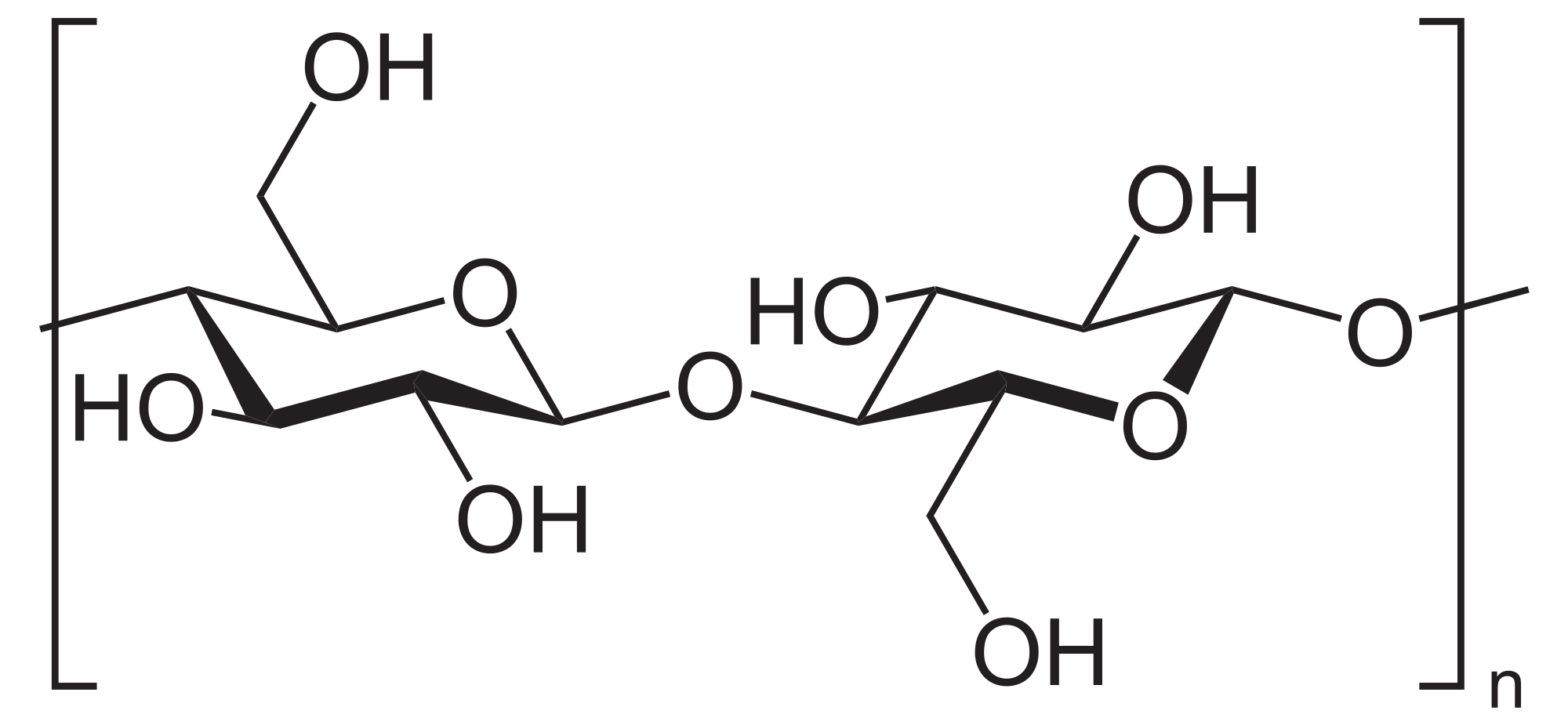
Beta-glucans, β-glucans comprise a group of β-D-glucose polysaccharides (glucans) naturally occurring in the cell walls of cereals, bacteria, and fungi, with significantly differing physicochemical properties dependent on source. Typically, β-glucans form a linear backbone with 1–3 β-glycosidic bonds but vary with respect to molecular mass, solubility, viscosity, branching structure, and gelation properties, causing diverse physiological effects in animals.
At dietary intake levels of at least 3 g per day, oat fiber β-glucan decreases blood levels of LDL cholesterol and so may reduce the risk of cardiovascular diseases. β-glucans are natural gums and are used as texturing agents in various nutraceutical and cosmetic products, and as soluble fiber supplements.
Cereal and fungal products have been used for centuries for medicinal and cosmetic purposes; however, the specific role of β-glucan was not explored until the 20th century. β-glucans were first discovered in lichens, and shortly thereafter in barley. A particular interest in oat β-glucan arose after a cholesterol lowering effect from oat bran reported in 1981.
In 1997, the FDA approved of a claim that intake of at least 3.0 g of β-glucan from oats per day decreased absorption of dietary cholesterol and reduced the risk of coronary heart disease. The approved health claim was later amended to include these sources of β-glucan: rolled oats (oatmeal), oat bran, whole oat flour, oatrim (the soluble fraction of alpha-amylase hydrolyzed oat bran or whole oat flour), whole grain barley and barley beta-fiber. An example of an allowed label claim: "Soluble fiber from foods such as oatmeal, as part of a diet low in saturated fat and cholesterol, may reduce the risk of heart disease. A serving of oatmeal supplies 0.75 grams of the 3.0 g of β-glucan soluble fiber necessary per day to have this effect." The claim language is in the Federal Register 21 CFR 101.81 Health Claims: "Soluble fiber from certain foods and risk of coronary heart disease (CHD)".
Glucans are arranged in six-sided D-glucose rings connected linearly at varying carbon positions depending on the source, although most commonly β-glucans include a 1-3 glycosidic link in their backbone. Although technically β-glucans are chains of D-glucose polysaccharides linked by β-type glycosidic bonds, by convention not all β-D-glucose polysaccharides are categorized as β-glucans. Cellulose is not conventionally considered a β-glucan, as it is insoluble and does not exhibit the same physicochemical properties as other cereal or yeast β-glucans.
Some β-glucan molecules have branching glucose side-chains attached to other positions on the main D-glucose chain, which branch off the β-glucan backbone. In addition, these side-chains can be attached to other types of molecules, like proteins, as in polysaccharide-K.
The most common forms of β-glucans are those comprising D-glucose units with β-1,3 links. Yeast and fungal β-glucans contain 1-6 side branches, while cereal β-glucans contain both β-1,3 and β-1,4 backbone bonds, but no β-1,3 branching. Seaweeds consist of a backbone that is primarily β-1,3-glucan, but with some β-1,6-glucan in the backbone as well as in side chains.
The frequency, location, and length of the side-chains may play a role in immunomodulation. Differences in molecular weight, shape, and structure of β-glucans dictate the differences in biological activity.
Hub AI
Beta-glucan AI simulator
(@Beta-glucan_simulator)
Beta-glucan
Beta-glucans, β-glucans comprise a group of β-D-glucose polysaccharides (glucans) naturally occurring in the cell walls of cereals, bacteria, and fungi, with significantly differing physicochemical properties dependent on source. Typically, β-glucans form a linear backbone with 1–3 β-glycosidic bonds but vary with respect to molecular mass, solubility, viscosity, branching structure, and gelation properties, causing diverse physiological effects in animals.
At dietary intake levels of at least 3 g per day, oat fiber β-glucan decreases blood levels of LDL cholesterol and so may reduce the risk of cardiovascular diseases. β-glucans are natural gums and are used as texturing agents in various nutraceutical and cosmetic products, and as soluble fiber supplements.
Cereal and fungal products have been used for centuries for medicinal and cosmetic purposes; however, the specific role of β-glucan was not explored until the 20th century. β-glucans were first discovered in lichens, and shortly thereafter in barley. A particular interest in oat β-glucan arose after a cholesterol lowering effect from oat bran reported in 1981.
In 1997, the FDA approved of a claim that intake of at least 3.0 g of β-glucan from oats per day decreased absorption of dietary cholesterol and reduced the risk of coronary heart disease. The approved health claim was later amended to include these sources of β-glucan: rolled oats (oatmeal), oat bran, whole oat flour, oatrim (the soluble fraction of alpha-amylase hydrolyzed oat bran or whole oat flour), whole grain barley and barley beta-fiber. An example of an allowed label claim: "Soluble fiber from foods such as oatmeal, as part of a diet low in saturated fat and cholesterol, may reduce the risk of heart disease. A serving of oatmeal supplies 0.75 grams of the 3.0 g of β-glucan soluble fiber necessary per day to have this effect." The claim language is in the Federal Register 21 CFR 101.81 Health Claims: "Soluble fiber from certain foods and risk of coronary heart disease (CHD)".
Glucans are arranged in six-sided D-glucose rings connected linearly at varying carbon positions depending on the source, although most commonly β-glucans include a 1-3 glycosidic link in their backbone. Although technically β-glucans are chains of D-glucose polysaccharides linked by β-type glycosidic bonds, by convention not all β-D-glucose polysaccharides are categorized as β-glucans. Cellulose is not conventionally considered a β-glucan, as it is insoluble and does not exhibit the same physicochemical properties as other cereal or yeast β-glucans.
Some β-glucan molecules have branching glucose side-chains attached to other positions on the main D-glucose chain, which branch off the β-glucan backbone. In addition, these side-chains can be attached to other types of molecules, like proteins, as in polysaccharide-K.
The most common forms of β-glucans are those comprising D-glucose units with β-1,3 links. Yeast and fungal β-glucans contain 1-6 side branches, while cereal β-glucans contain both β-1,3 and β-1,4 backbone bonds, but no β-1,3 branching. Seaweeds consist of a backbone that is primarily β-1,3-glucan, but with some β-1,6-glucan in the backbone as well as in side chains.
The frequency, location, and length of the side-chains may play a role in immunomodulation. Differences in molecular weight, shape, and structure of β-glucans dictate the differences in biological activity.
Recent media