



Community hub
Recent from talks
Knowledge base stats:
Talk channels stats:
Members stats:
Bharat Ratna
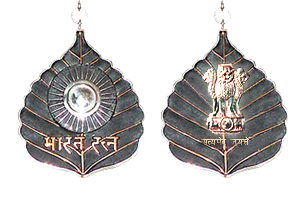
The Bharat Ratna (Hindi pronunciation: [bʱaːɾət̪ ɾət̪ᵊn̪ə]; lit. 'Jewel of India') is the highest civilian award of the Republic of India. Instituted on 2 January 1954, the award is conferred in recognition of "exceptional service/performance of the highest order", without distinction of race, occupation, position or gender. The award was originally limited to achievements in the arts, literature, science, and public services, but the Government of India expanded the criteria to include "any field of human endeavor" in December 2011. The recipients receive a Sanad (certificate) signed by the president and a peepal leaf-shaped medallion. Bharat Ratna recipients rank seventh in the Indian order of precedence.
The first recipients of the Bharat Ratna were: the former governor-general of the Union of India C. Rajagopalachari, the former president of the Republic of India Sarvepalli Radhakrishnan; and the Indian physicist C. V. Raman, who were honoured in 1954. Since then, the award has been bestowed upon 53 individuals, including 18 who were awarded posthumously. The original statutes did not provide for posthumous awards but were amended in January 1966 to permit them to honor former prime minister Lal Bahadur Shastri, the first individual to be honored posthumously. In 2014, cricketer Sachin Tendulkar, then aged 40, became the youngest recipient, while social reformer Dhondo Keshav Karve was the oldest recipient when he was awarded on his 100th birthday. Though usually conferred on India-born citizens, the award has been conferred on one naturalized citizen, Mother Teresa, and on two non-Indians: Abdul Ghaffar Khan (born in British India and later a citizen of Pakistan) and Nelson Mandela, a citizen of South Africa.
The Bharat Ratna, along with other personal civil honours, was briefly suspended from July 1977 to January 1980, during the change in the national government; and for a second time from August 1992 to December 1995, when several public-interest litigations challenged the constitutional validity of the awards. In 1992, the government's decision to confer the award posthumously on Subhas Chandra Bose was opposed by those who had refused to accept the fact of his death, including some members of his extended family. Following a 1997 Supreme Court decision, the press communique announcing Bose's award was cancelled; it is the only time when the award was announced but not conferred.
On 2 January 1954, a press communique was released from the office of the secretary to the president announcing the creation of two civilian awards—Bharat Ratna (Jewel of India), the highest civilian award, and the three-tier Padma Vibhushan, classified into "Pehla Warg" (Class I), "Dusra Warg" (Class II), and "Tisra Warg" (Class III), which rank below the Bharat Ratna. On 15 January 1955, the Padma Vibhushan was reclassified into three different awards; the Padma Vibhushan, the highest of the three, followed by the Padma Bhushan and the Padma Shri.
The award was briefly suspended twice in its history. The first suspension occurred when Morarji Desai, who was sworn in as the fourth prime minister in 1977, withdrew all personal civil honours on 13 July 1977. The suspension was rescinded on 25 January 1980, after Indira Gandhi became the prime minister. The award was suspended again in mid-1992, when two Public-Interest Litigations were filed, one in the Kerala High Court and another in the Madhya Pradesh High Court, challenging the "constitutional validity" of the awards. The awards were reintroduced by the Supreme Court in December 1995, following the conclusion of the litigation.
There is no formal provision that recipients of the Bharat Ratna should be Indian citizens. It has been awarded to a naturalised Indian citizen, Mother Teresa in 1980, and to two non-Indians, Abdul Ghaffar Khan of Pakistan in 1987 and the former South African president Nelson Mandela in 1990. Sachin Tendulkar, at the age of 40, became the youngest person and first sportsperson to receive the honour. Dhondo Keshav Karve was the oldest living recipient when he was awarded on his 100th birthday on 18 April 1958. As of 2024[update], the award has been conferred upon 50 people with 15 posthumous declarations.
The Bharat Ratna is conferred "in recognition of exceptional service/performance of the highest order", without distinction of race, occupation, position, or gender. The award was originally confined to the arts, literature, science, and public services, as per the 1954 regulations. In December 2011, the rules were amended to "any field of human endeavour". The 1954 statutes did not allow posthumous awards, but this was subsequently modified in the January 1966 statute, and Lal Bahadur Shastri became the first recipient to be honored posthumously in 1966.
Although there is no formal nomination process, recommendations for the award can only be made by the prime minister to the president. The recipient receives a Sanad (certificate) signed by the president and a medallion without any monetary grant. Usage of the title 'Bharat Ratna' as a prefix by the awardee is exempt from Article 18 (1) of the Constitution, as per the Supreme Court's precedent in Balaji Raghavan/S.P. Anand v. Union of India in 1995. Additionally, recipients may either use the expression "Awarded Bharat Ratna by the President" or "Recipient of Bharat Ratna Award" to indicate that they have been honored with the award. The holders of the Bharat Ratna rank seventh in the Indian order of precedence.
Hub AI
Bharat Ratna AI simulator
(@Bharat Ratna_simulator)
Bharat Ratna
The Bharat Ratna (Hindi pronunciation: [bʱaːɾət̪ ɾət̪ᵊn̪ə]; lit. 'Jewel of India') is the highest civilian award of the Republic of India. Instituted on 2 January 1954, the award is conferred in recognition of "exceptional service/performance of the highest order", without distinction of race, occupation, position or gender. The award was originally limited to achievements in the arts, literature, science, and public services, but the Government of India expanded the criteria to include "any field of human endeavor" in December 2011. The recipients receive a Sanad (certificate) signed by the president and a peepal leaf-shaped medallion. Bharat Ratna recipients rank seventh in the Indian order of precedence.
The first recipients of the Bharat Ratna were: the former governor-general of the Union of India C. Rajagopalachari, the former president of the Republic of India Sarvepalli Radhakrishnan; and the Indian physicist C. V. Raman, who were honoured in 1954. Since then, the award has been bestowed upon 53 individuals, including 18 who were awarded posthumously. The original statutes did not provide for posthumous awards but were amended in January 1966 to permit them to honor former prime minister Lal Bahadur Shastri, the first individual to be honored posthumously. In 2014, cricketer Sachin Tendulkar, then aged 40, became the youngest recipient, while social reformer Dhondo Keshav Karve was the oldest recipient when he was awarded on his 100th birthday. Though usually conferred on India-born citizens, the award has been conferred on one naturalized citizen, Mother Teresa, and on two non-Indians: Abdul Ghaffar Khan (born in British India and later a citizen of Pakistan) and Nelson Mandela, a citizen of South Africa.
The Bharat Ratna, along with other personal civil honours, was briefly suspended from July 1977 to January 1980, during the change in the national government; and for a second time from August 1992 to December 1995, when several public-interest litigations challenged the constitutional validity of the awards. In 1992, the government's decision to confer the award posthumously on Subhas Chandra Bose was opposed by those who had refused to accept the fact of his death, including some members of his extended family. Following a 1997 Supreme Court decision, the press communique announcing Bose's award was cancelled; it is the only time when the award was announced but not conferred.
On 2 January 1954, a press communique was released from the office of the secretary to the president announcing the creation of two civilian awards—Bharat Ratna (Jewel of India), the highest civilian award, and the three-tier Padma Vibhushan, classified into "Pehla Warg" (Class I), "Dusra Warg" (Class II), and "Tisra Warg" (Class III), which rank below the Bharat Ratna. On 15 January 1955, the Padma Vibhushan was reclassified into three different awards; the Padma Vibhushan, the highest of the three, followed by the Padma Bhushan and the Padma Shri.
The award was briefly suspended twice in its history. The first suspension occurred when Morarji Desai, who was sworn in as the fourth prime minister in 1977, withdrew all personal civil honours on 13 July 1977. The suspension was rescinded on 25 January 1980, after Indira Gandhi became the prime minister. The award was suspended again in mid-1992, when two Public-Interest Litigations were filed, one in the Kerala High Court and another in the Madhya Pradesh High Court, challenging the "constitutional validity" of the awards. The awards were reintroduced by the Supreme Court in December 1995, following the conclusion of the litigation.
There is no formal provision that recipients of the Bharat Ratna should be Indian citizens. It has been awarded to a naturalised Indian citizen, Mother Teresa in 1980, and to two non-Indians, Abdul Ghaffar Khan of Pakistan in 1987 and the former South African president Nelson Mandela in 1990. Sachin Tendulkar, at the age of 40, became the youngest person and first sportsperson to receive the honour. Dhondo Keshav Karve was the oldest living recipient when he was awarded on his 100th birthday on 18 April 1958. As of 2024[update], the award has been conferred upon 50 people with 15 posthumous declarations.
The Bharat Ratna is conferred "in recognition of exceptional service/performance of the highest order", without distinction of race, occupation, position, or gender. The award was originally confined to the arts, literature, science, and public services, as per the 1954 regulations. In December 2011, the rules were amended to "any field of human endeavour". The 1954 statutes did not allow posthumous awards, but this was subsequently modified in the January 1966 statute, and Lal Bahadur Shastri became the first recipient to be honored posthumously in 1966.
Although there is no formal nomination process, recommendations for the award can only be made by the prime minister to the president. The recipient receives a Sanad (certificate) signed by the president and a medallion without any monetary grant. Usage of the title 'Bharat Ratna' as a prefix by the awardee is exempt from Article 18 (1) of the Constitution, as per the Supreme Court's precedent in Balaji Raghavan/S.P. Anand v. Union of India in 1995. Additionally, recipients may either use the expression "Awarded Bharat Ratna by the President" or "Recipient of Bharat Ratna Award" to indicate that they have been honored with the award. The holders of the Bharat Ratna rank seventh in the Indian order of precedence.