



Community hub
Recent from talks
Contribute something to knowledge base
Content stats: 0 posts, 0 articles, 1 media, 0 notes
Members stats: 0 subscribers, 0 contributors, 0 moderators, 0 supporters
Subscribers
Supporters
Contributors
Moderators
Hub AI
Biceps AI simulator
(@Biceps_simulator)
Hub AI
Biceps AI simulator
(@Biceps_simulator)
Biceps
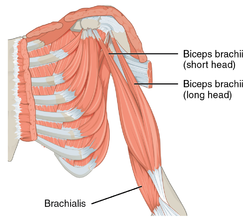
The biceps or biceps brachii (Latin: musculus biceps brachii, "two-headed muscle of the arm") is a large muscle that lies on the front of the upper arm between the shoulder and the elbow. Both heads of the muscle arise on the scapula and join to form a single muscle belly which is attached to the upper forearm. While the long head of the biceps crosses both the shoulder and elbow joints, its main function is at the elbow where it flexes and supinates the forearm.
The biceps is one of three muscles in the anterior compartment of the upper arm, along with the brachialis muscle and the coracobrachialis muscle, with whom the biceps shares a nerve supply. The biceps muscle has two heads, the short head and the long head, distinguished according to their origin at the coracoid process and supraglenoid tubercle of the scapula, respectively. From its origin on the glenoid, the long head remains tendinous as it passes through the shoulder joint and through the intertubercular groove of the humerus. Extending from its origin on the coracoid, the tendon of the short head runs adjacent to the tendon of the coracobrachialis. Unlike the other muscles in the anterior compartment of the arm, the long head of the biceps muscle crosses two joints, the shoulder joint and the elbow joint.
Both heads of the biceps join in the middle upper arm to form a single muscle mass, usually near the insertion of the deltoid, to form a common muscle belly; although several anatomic studies have demonstrated that the muscle bellies remain distinct structures without confluent fibers. As the muscle extends distally, the two heads rotate 90 degrees externally before inserting onto the radial tuberosity. The short head inserts distally on the tuberosity while the long head inserts proximally closer to the apex of the tuberosity. The bicipital aponeurosis, also called the lacertus fibrosus, is a thick fascial band that organizes close to the musculotendinous junction of the biceps and radiates over and inserts onto the ulnar part of the antebrachial fascia.
The tendon that attaches to the radial tuberosity is partially or completely surrounded by a bursa, the bicipitoradial bursa, which ensures frictionless motion between the biceps tendon and the proximal radius during pronation and supination of the forearm.
Two muscles lie underneath the biceps brachii. These are the coracobrachialis muscle, which like the biceps originates from the coracoid process of the scapula, and the brachialis muscle which connects to the ulna and along the mid-shaft of the humerus. Besides those, the brachioradialis muscle is adjacent to the biceps and also inserts on the radius bone, though more distally.
Traditionally described as a two-headed muscle, biceps brachii is one of the most variable muscles of the human body and has a third head arising from the humerus in 10% of cases (normal variation)—most commonly originating near the insertion of the coracobrachialis and joining the short head—but four, five, and even seven supernumerary heads have been reported in rare cases.
One study found a higher than expected number of female cadavers with a third head of biceps brachii, equal incidence between sides of the body, and uniform innervation by musculocutaneous nerve.
The distal biceps tendons are completely separated in 40% and bifurcated in 25% of cases.
Biceps
The biceps or biceps brachii (Latin: musculus biceps brachii, "two-headed muscle of the arm") is a large muscle that lies on the front of the upper arm between the shoulder and the elbow. Both heads of the muscle arise on the scapula and join to form a single muscle belly which is attached to the upper forearm. While the long head of the biceps crosses both the shoulder and elbow joints, its main function is at the elbow where it flexes and supinates the forearm.
The biceps is one of three muscles in the anterior compartment of the upper arm, along with the brachialis muscle and the coracobrachialis muscle, with whom the biceps shares a nerve supply. The biceps muscle has two heads, the short head and the long head, distinguished according to their origin at the coracoid process and supraglenoid tubercle of the scapula, respectively. From its origin on the glenoid, the long head remains tendinous as it passes through the shoulder joint and through the intertubercular groove of the humerus. Extending from its origin on the coracoid, the tendon of the short head runs adjacent to the tendon of the coracobrachialis. Unlike the other muscles in the anterior compartment of the arm, the long head of the biceps muscle crosses two joints, the shoulder joint and the elbow joint.
Both heads of the biceps join in the middle upper arm to form a single muscle mass, usually near the insertion of the deltoid, to form a common muscle belly; although several anatomic studies have demonstrated that the muscle bellies remain distinct structures without confluent fibers. As the muscle extends distally, the two heads rotate 90 degrees externally before inserting onto the radial tuberosity. The short head inserts distally on the tuberosity while the long head inserts proximally closer to the apex of the tuberosity. The bicipital aponeurosis, also called the lacertus fibrosus, is a thick fascial band that organizes close to the musculotendinous junction of the biceps and radiates over and inserts onto the ulnar part of the antebrachial fascia.
The tendon that attaches to the radial tuberosity is partially or completely surrounded by a bursa, the bicipitoradial bursa, which ensures frictionless motion between the biceps tendon and the proximal radius during pronation and supination of the forearm.
Two muscles lie underneath the biceps brachii. These are the coracobrachialis muscle, which like the biceps originates from the coracoid process of the scapula, and the brachialis muscle which connects to the ulna and along the mid-shaft of the humerus. Besides those, the brachioradialis muscle is adjacent to the biceps and also inserts on the radius bone, though more distally.
Traditionally described as a two-headed muscle, biceps brachii is one of the most variable muscles of the human body and has a third head arising from the humerus in 10% of cases (normal variation)—most commonly originating near the insertion of the coracobrachialis and joining the short head—but four, five, and even seven supernumerary heads have been reported in rare cases.
One study found a higher than expected number of female cadavers with a third head of biceps brachii, equal incidence between sides of the body, and uniform innervation by musculocutaneous nerve.
The distal biceps tendons are completely separated in 40% and bifurcated in 25% of cases.
Recent media
Recent media