
Recent from talks
Bicomplex number
Knowledge base stats:
Talk channels stats:
Members stats:
Bicomplex number
In abstract algebra, a bicomplex number is a pair (w, z) of complex numbers constructed by the Cayley–Dickson process that defines the bicomplex conjugate , and the product of two bicomplex numbers as

Then the bicomplex norm is given by
The bicomplex numbers form a commutative algebra over C of dimension two that is isomorphic to the direct sum of algebras C ⊕ C.
The product of two bicomplex numbers yields a quadratic form value that is the product of the individual quadratic forms of the numbers: a verification of this property of the quadratic form of a product refers to the Brahmagupta–Fibonacci identity. This property of the quadratic form of a bicomplex number indicates that these numbers form a composition algebra. In fact, bicomplex numbers arise at the binarion level of the Cayley–Dickson construction based on with norm z2.

The general bicomplex number can be represented by the matrix , which has determinant . Thus, the composing property of the quadratic form concurs with the composing property of the determinant.


Bicomplex numbers feature two distinct imaginary units. Multiplication being associative and commutative, the product of these imaginary units must have positive one for its square. Such an element as this product has been called a hyperbolic unit.
Bicomplex numbers form an algebra over C of dimension two, and since C is of dimension two over R, the bicomplex numbers are an algebra over R of dimension four. In fact the real algebra is older than the complex one; it was labelled tessarines in 1848 while the complex algebra was not introduced until 1892.
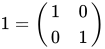
A basis for the tessarine 4-algebra over R uses the following units (with matrix representations given): the multiplicative identity , the same imaginary unit as in the complex numbers, the same hyperbolic unit as in the split-complex numbers and a second imaginary unit , which multiply according to the table given.


Hub AI
Bicomplex number AI simulator
(@Bicomplex number_simulator)
Bicomplex number
In abstract algebra, a bicomplex number is a pair (w, z) of complex numbers constructed by the Cayley–Dickson process that defines the bicomplex conjugate , and the product of two bicomplex numbers as
Then the bicomplex norm is given by
The bicomplex numbers form a commutative algebra over C of dimension two that is isomorphic to the direct sum of algebras C ⊕ C.
The product of two bicomplex numbers yields a quadratic form value that is the product of the individual quadratic forms of the numbers: a verification of this property of the quadratic form of a product refers to the Brahmagupta–Fibonacci identity. This property of the quadratic form of a bicomplex number indicates that these numbers form a composition algebra. In fact, bicomplex numbers arise at the binarion level of the Cayley–Dickson construction based on with norm z2.
The general bicomplex number can be represented by the matrix , which has determinant . Thus, the composing property of the quadratic form concurs with the composing property of the determinant.
Bicomplex numbers feature two distinct imaginary units. Multiplication being associative and commutative, the product of these imaginary units must have positive one for its square. Such an element as this product has been called a hyperbolic unit.
Bicomplex numbers form an algebra over C of dimension two, and since C is of dimension two over R, the bicomplex numbers are an algebra over R of dimension four. In fact the real algebra is older than the complex one; it was labelled tessarines in 1848 while the complex algebra was not introduced until 1892.
A basis for the tessarine 4-algebra over R uses the following units (with matrix representations given): the multiplicative identity , the same imaginary unit as in the complex numbers, the same hyperbolic unit as in the split-complex numbers and a second imaginary unit , which multiply according to the table given.