


Community hub
Recent from talks
Contribute something
Nothing was collected or created yet.
Isomorphism
View on Wikipedia | This article needs additional citations for verification. (September 2010) |


In mathematics, an isomorphism is a structure-preserving mapping or morphism between two structures of the same type that can be reversed by an inverse mapping. Two mathematical structures are isomorphic if an isomorphism exists between them, and this is often denoted as . The word is derived from Ancient Greek ἴσος (isos) 'equal' and μορφή (morphe) 'form, shape'.

The interest in isomorphisms lies in the fact that two isomorphic objects have the same properties (excluding further information such as additional structure or names of objects). Thus isomorphic structures cannot be distinguished from the point of view of structure only, and may often be identified. In mathematical jargon, one says that two objects are the same up to an isomorphism. A common example where isomorphic structures cannot be identified is when the structures are substructures of a larger one. For example, all subspaces of dimension one of a vector space are isomorphic and cannot be identified.
An automorphism is an isomorphism from a structure to itself. An isomorphism between two structures is a canonical isomorphism (a canonical map that is an isomorphism) if there is only one isomorphism between the two structures (as is the case for solutions of a universal property), or if the isomorphism is much more natural (in some sense) than other isomorphisms. For example, for every prime number p, all fields with p elements are canonically isomorphic, with a unique isomorphism. The isomorphism theorems provide canonical isomorphisms that are not unique.
The term isomorphism is mainly used for algebraic structures and categories. In the case of algebraic structures, mappings are called homomorphisms, and a homomorphism is an isomorphism if and only if it is bijective.
In various areas of mathematics, isomorphisms have received specialized names, depending on the type of structure under consideration. For example:
- An isometry is an isomorphism of metric spaces.
- A homeomorphism is an isomorphism of topological spaces.
- A diffeomorphism is an isomorphism of spaces equipped with a differential structure, typically differentiable manifolds.
- A symplectomorphism is an isomorphism of symplectic manifolds.
- A permutation is an automorphism of a set.
- In geometry, isomorphisms and automorphisms are often called transformations, for example rigid transformations, affine transformations, projective transformations.
Category theory, which can be viewed as a formalization of the concept of mapping between structures, provides a language that may be used to unify the approach to these different aspects of the basic idea.
Examples
[edit]Logarithm and exponential
[edit]Let be the multiplicative group of positive real numbers, and let be the additive group of real numbers.


The logarithm function satisfies for all so it is a group homomorphism. The exponential function satisfies for all so it too is a homomorphism.



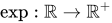


The identities and show that and are inverses of each other. So, are group isomorphisms that are inverse of each other.




The function is an isomorphism which translates multiplication of positive real numbers into addition of real numbers. This facility makes it possible to multiply real numbers using a ruler and a table of logarithms, or using a slide rule with a logarithmic scale.
Integers modulo 6
[edit]Consider the ring of the integers from 0 to 5 with addition and multiplication modulo 6. Also consider the ring of the ordered pairs where the first element is an integer modulo 2 and the second element is an integer modulo 3, with component-wise addition and multiplication modulo 2 and 3.


These rings are isomorphic under the following map: or in general
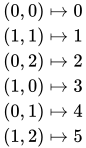

For example, which translates in the other system as


This is a special case of the Chinese remainder theorem which asserts that, if and are coprime integers, the ring of the integeers modulo is isomorphic to the direct product of the integers modulo and the integers modulo .


Relation-preserving isomorphism
[edit]If one object consists of a set X with a binary relation R and the other object consists of a set Y with a binary relation S then an isomorphism from X to Y is a bijective function such that:[1]


S is reflexive, irreflexive, symmetric, antisymmetric, asymmetric, transitive, total, trichotomous, a partial order, total order, well-order, strict weak order, total preorder (weak order), an equivalence relation, or a relation with any other special properties, if and only if R is.
For example, R is an ordering ≤ and S an ordering then an isomorphism from X to Y is a bijective function such that Such an isomorphism is called an order isomorphism or (less commonly) an isotone isomorphism.


If then this is a relation-preserving automorphism.

Applications
[edit]In algebra, isomorphisms are defined for all algebraic structures. Some are more specifically studied; for example:
- Linear isomorphisms between vector spaces; they are specified by invertible matrices.
- Group isomorphisms between groups; the classification of isomorphism classes of finite groups is an open problem.
- Ring isomorphisms between rings.
- Field isomorphisms are the same as ring isomorphism between fields; their study, and more specifically the study of field automorphisms is an important part of Galois theory.
Just as the automorphisms of an algebraic structure form a group, the isomorphisms between two algebras sharing a common structure form a heap. Letting a particular isomorphism identify the two structures turns this heap into a group.
In mathematical analysis, the Laplace transform is an isomorphism mapping hard differential equations into easier algebraic equations.
In graph theory, an isomorphism between two graphs G and H is a bijective map f from the vertices of G to the vertices of H that preserves the "edge structure" in the sense that there is an edge from vertex u to vertex v in G if and only if there is an edge from to in H. See graph isomorphism.


In order theory, an isomorphism between two partially ordered sets P and Q is a bijective map from P to Q that preserves the order structure in the sense that for any elements and of P we have less than in P if and only if is less than in Q. As an example, the set {1,2,3,6} of whole numbers ordered by the is-a-factor-of relation is isomorphic to the set {O, A, B, AB} of blood types ordered by the can-donate-to relation. See order isomorphism.


In mathematical analysis, an isomorphism between two Hilbert spaces is a bijection preserving addition, scalar multiplication, and inner product.
In early theories of logical atomism, the formal relationship between facts and true propositions was theorized by Bertrand Russell and Ludwig Wittgenstein to be isomorphic. An example of this line of thinking can be found in Russell's Introduction to Mathematical Philosophy.
In cybernetics, the good regulator theorem or Conant–Ashby theorem is stated as "Every good regulator of a system must be a model of that system". Whether regulated or self-regulating, an isomorphism is required between the regulator and processing parts of the system.
Category theoretic view
[edit]In category theory, given a category C, an isomorphism is a morphism that has an inverse morphism that is, and


Two categories C and D are isomorphic if there exist functors and which are mutually inverse to each other, that is, (the identity functor on D) and (the identity functor on C).


Isomorphism vs. bijective morphism
[edit]In a concrete category (roughly, a category whose objects are sets (perhaps with extra structure) and whose morphisms are structure-preserving functions), such as the category of topological spaces or categories of algebraic objects (like the category of groups, the category of rings, and the category of modules), an isomorphism must be bijective on the underlying sets. In algebraic categories (specifically, categories of varieties in the sense of universal algebra), an isomorphism is the same as a homomorphism which is bijective on underlying sets. However, there are concrete categories in which bijective morphisms are not necessarily isomorphisms (such as the category of topological spaces).
Isomorphism class
[edit]Since a composition of isomorphisms is an isomorphism, the identity is an isomorphism, and the inverse of an isomorphism is an isomorphism, the relation that two mathematical objects are isomorphic is an equivalence relation. An equivalence class given by isomorphisms is commonly called an isomorphism class.[2]
Examples
[edit]Examples of isomorphism classes are plentiful in mathematics.
- Two sets are isomorphic if there is a bijection between them. The isomorphism class of a finite set can be identified with the non-negative integer representing the number of elements it contains.
- The isomorphism class of a finite-dimensional vector space can be identified with the non-negative integer representing its dimension.
- The classification of finite simple groups enumerates the isomorphism classes of all finite simple groups.
- The classification of closed surfaces enumerates the isomorphism classes of all connected closed surfaces.
- Ordinals intuitively correspond to isomorphism classes of well-ordered sets (though there are technical set-theoretic issues involved).
- There are three isomorphism classes of the planar subalgebras of M(2,R), the 2 x 2 real matrices.
However, there are circumstances in which the isomorphism class of an object conceals vital information about it.
- Given a mathematical structure, it is common that two substructures belong to the same isomorphism class. However, the way they are included in the whole structure can not be studied if they are identified. For example, in a finite-dimensional vector space, all subspaces of the same dimension are isomorphic, but must be distinguished to consider their intersection, sum, etc.
- In homotopy theory, the fundamental group of a space at a point , though technically denoted to emphasize the dependence on the base point, is often written lazily as simply if is path connected. The reason for this is that the existence of a path between two points allows one to identify loops at one with loops at the other; however, unless is abelian this isomorphism is non-unique. Furthermore, the classification of covering spaces makes strict reference to particular subgroups of , specifically distinguishing between isomorphic but conjugate subgroups, and therefore amalgamating the elements of an isomorphism class into a single featureless object seriously decreases the level of detail provided by the theory.


Relation to equality
[edit]Although there are cases where isomorphic objects can be considered equal, one must distinguish equality and isomorphism.[3] Equality is when two objects are the same, and therefore everything that is true about one object is true about the other. On the other hand, isomorphisms are related to some structure, and two isomorphic objects share only the properties that are related to this structure.
For example, the sets are equal; they are merely different representations—the first an intensional one (in set builder notation), and the second extensional (by explicit enumeration)—of the same subset of the integers. By contrast, the sets and are not equal since they do not have the same elements. They are isomorphic as sets, but there are many choices (in fact 6) of an isomorphism between them: one isomorphism is



while another is

and no one isomorphism is intrinsically better than any other.[note 1]
Also, integers and even numbers are isomorphic as ordered sets and abelian groups (for addition), but cannot be considered equal sets, since one is a proper subset of the other.
On the other hand, when sets (or other mathematical objects) are specified only by their properties, without considering the nature of their elements, one often considers them to be equal. This is generally the case with solutions of universal properties. For examples, the polynomial rings , and are considered as equal, since they have the same universal property.
![{\displaystyle \mathbb {Z} [X,Y]}](https://wikimedia.org/api/rest_v1/media/math/render/svg/bc3c6bf9e1d05d96bc2ca6ee873498ac705b2516)
![{\displaystyle \mathbb {Z} [Y,X]}](https://wikimedia.org/api/rest_v1/media/math/render/svg/1a44bed5a924d275cdd21c694c8ae3e4f7b5716c)
![{\displaystyle (\mathbb {Z} [X])[Y]}](https://wikimedia.org/api/rest_v1/media/math/render/svg/056af6c2ce87804dbed9e7ea8475b15df2cb03b3)
For example, the rational numbers are formally defined as equivalence classes of pairs of integers, although nobody thinks of a rational number as a set (equivalence class). The universal property of the rational numbers is essentially that they form a field that contains the integers and does not contain any proper subfield. Given two fields with these properties, there is a unique field isomorphism between them. This allows identifying these two fields, since every property of one of them can be transferred to the other through the isomorphism. The real numbers that can be expressed as a quotient of integers form the smallest subfield of the reals. There is thus a unique isomorphism from this subfield of the reals to the rational numbers defined by equivalence classes. So, the rational numbers may be identified to the elements of a subset of the real numbers. However, in some contexts this identification is not allowed. For example, in computer languages and type theory, real numbers and rational numbers have different representations, and the identification must be replaced with a type conversion.
See also
[edit]
Notes
[edit]- ^ and have both the usual order of the integers. Viewed as ordered sets, there is only one isomorphism between them, namely


References
[edit]- ^ Vinberg, Ėrnest Borisovich (2003). A Course in Algebra. American Mathematical Society. p. 3. ISBN 9780821834138.
- ^ Awodey, Steve (2006). "Isomorphisms". Category theory. Oxford University Press. p. 11. ISBN 9780198568612.
- ^ Mazur 2007
Further reading
[edit]- Mazur, Barry (12 June 2007), When is one thing equal to some other thing? (PDF)
External links
[edit]
- "Isomorphism", Encyclopedia of Mathematics, EMS Press, 2001 [1994]
- Weisstein, Eric W. "Isomorphism". MathWorld.
| National | |
|---|---|
| Other | |

Isomorphism
View on GrokipediaDefinition and Properties
Formal Definition
In mathematics, an isomorphism is formally defined as a bijective morphism between two mathematical structures, meaning a one-to-one and onto mapping that preserves the operations or relations defining those structures.[8] For algebraic structures equipped with operations, such as groups or rings, an isomorphism is a bijective function satisfying for all , where denotes the binary operation on the respective structures (with analogous conditions for multi-ary operations or additional structure like inverses).[9] This definition generalizes to relational structures, where an isomorphism preserves all relations: for any -ary relation on , holds if and only if holds on .[8] The inverse mapping is itself an isomorphism, ensuring the structures are equivalently structured in both directions.[9] Two structures related by an isomorphism are denoted as isomorphic, often written or .[8]Key Properties
Isomorphisms are defined as bijective homomorphisms, meaning they are both injective and surjective mappings that preserve the structure of the objects involved. Injectivity ensures that distinct elements in the domain map to distinct elements in the codomain, while surjectivity guarantees that every element in the codomain is the image of exactly one element in the domain, establishing a perfect correspondence between the sets.[10] The structure-preserving aspect of isomorphisms maintains the operations and relations inherent to the mathematical objects. In algebraic contexts, such as groups, an isomorphism satisfies for all , where the operation is denoted multiplicatively; analogous preservation holds for addition in abelian groups or rings. For partially ordered sets, is an order isomorphism if if and only if , thereby conserving the relational order. Invertibility is a cornerstone property: every isomorphism admits an inverse that is itself an isomorphism, satisfying and . This follows from the bijectivity providing a set-theoretic inverse and the homomorphism property ensuring that preserves the structure in the reverse direction, as can be derived by applying to both sides.[9] Isomorphisms exhibit transitivity under composition: if and are isomorphisms, then their composition is also an isomorphism, with inverse . This property arises because the composition of bijective functions is bijective, and homomorphisms compose to preserve structure.[10] Isomorphic structures are indistinguishable up to equivalence, sharing all properties that are invariant under isomorphism, such as cardinality, order, or algebraic invariants like the center of a group. Thus, any intrinsic characteristic of one structure holds equivalently for its isomorphic counterpart, rendering them essentially identical in mathematical content.[11]Examples
Algebraic Examples
One prominent example of an isomorphism in group theory is the natural logarithm function, which establishes a group isomorphism between the multiplicative group of positive real numbers and the additive group of real numbers .[12] The map is bijective, with the exponential function serving as its inverse, and it preserves the group operation via the property for all .[13] This isomorphism highlights how logarithmic and exponential functions translate between multiplicative and additive structures in the real numbers.[14] In ring theory, the Chinese Remainder Theorem provides an explicit isomorphism for certain quotient rings of the integers. Specifically, when with and coprime, as rings.[15] For the case , where and , the isomorphism can be realized by the map , which is a bijective ring homomorphism preserving addition and multiplication modulo 6.[15] This construction generalizes to any coprime moduli, decomposing the ring structure into independent components.[14] Vector spaces over the same field exhibit isomorphisms when they have the same dimension, as linear algebra guarantees the existence of invertible linear transformations between them. For instance, the vector space is isomorphic to itself via any invertible matrix, such as a rotation matrix, which preserves vector addition and scalar multiplication. A rotation by an angle is represented by the matrix which is bijective and linear, thus defining a vector space isomorphism.[16] This example underscores that all finite-dimensional vector spaces of equal dimension are isomorphic, independent of their concrete realization.[14] In the study of finite groups, the symmetric group of order 6, consisting of all permutations of three elements, is isomorphic to the dihedral group of order 6, which represents the symmetries of an equilateral triangle.[17] The isomorphism arises by mapping permutations in to the rotations and reflections of the triangle's vertices, preserving the group operation of composition.[17] For example, the 3-cycle in corresponds to a 120-degree rotation in , and a transposition like corresponds to a reflection across the altitude from the third vertex.[18] This equivalence demonstrates how abstract permutation groups can model geometric symmetries.[14]Relational and Functional Examples
In the context of partially ordered sets (posets), an isomorphism is an order-preserving bijection, meaning a bijective function between posets and such that for all , if and only if . A classic example is the order isomorphism between the poset of natural numbers and the poset of even natural numbers , given by the doubling map . This map preserves the order relation because if , then , and it is bijective since every even number is hit exactly once and the inverse is for even .[19] In functional analysis, isomorphisms between spaces of functions and sequence spaces often rely on bases or expansions, though such mappings are typically limited in infinite-dimensional cases due to completeness or norm considerations. For instance, the vector space of all polynomials on , denoted , is isomorphic as a vector space to the space of finite-support sequences over the reals, , via the coefficient map that sends a polynomial to the sequence . This linear bijection preserves addition and scalar multiplication, establishing the structural equivalence between the two spaces.[2] Without additional structure like operations or orders, any two sets of the same cardinality are isomorphic via a bijection that simply pairs elements one-to-one. For example, the set of natural numbers and the set of integers have the same cardinality , and an explicit bijection is the zig-zag mapping that sends , positive integers to positives in order, and negative integers to negatives in reverse order: specifically, , for , and for . This bijection has no inverse in a relational sense beyond set membership but demonstrates the absence of intrinsic structure in pure sets.[20] Graph isomorphisms preserve the adjacency relation, defined as a bijection between vertex sets of graphs and such that for any vertices , is an edge in if and only if is an edge in . A simple example is the cycle graph on five vertices, which is isomorphic to itself under a rotation , preserving all adjacencies since neighbors of are and , mapping to neighbors of . This corresponds to adjacency matrices being equal up to simultaneous permutation of rows and columns by the same ordering.[21]Applications in Mathematics
In Algebra and Number Theory
In algebra, isomorphisms play a central role in the classification of finite abelian groups through the Fundamental Theorem of Finite Abelian Groups, which asserts that every such group is isomorphic to a direct product of cyclic groups of prime-power order. This decomposition allows for the unique determination (up to isomorphism) of the structure using either elementary divisors or invariant factors; for instance, the group is isomorphic to under the invariant factor form. The theorem, originally proved using group-theoretic methods, facilitates computations in group theory by reducing complex structures to products of simpler cyclic components, as seen in the earlier algebraic example of . In number theory, isomorphisms between the ideal class group of a quadratic field and the group of equivalence classes of binary quadratic forms of the corresponding discriminant enable the solution of certain Diophantine equations, such as those involving representation by quadratic forms. For imaginary quadratic fields with , this explicit isomorphism maps ideal classes to form classes under Gauss composition, allowing the class number to be computed via form reduction algorithms and aiding in the resolution of norm equations or solubility of quadratic congruences.[22] Such isomorphisms also connect to broader class field theory constructions, where form class groups isomorphic to ideal class groups generate abelian extensions that parameterize solutions to specific quadratic Diophantine problems.[23] Within representation theory, two representations of a finite group over the complex numbers are isomorphic if and only if they possess the same character, a class function that encodes the trace of the representation on each conjugacy class. This equivalence implies that isomorphic representations yield identical characters, which in turn support the decomposition of any representation into a direct sum of irreducibles via the inner product of characters on the group algebra.[24] The character table thus classifies representations up to isomorphism, streamlining the analysis of symmetry in algebraic structures like group actions on vector spaces. In cryptographic applications, particularly pairing-based schemes, isomorphisms between elliptic curve groups ensure security equivalence across different curve models, as computable isomorphisms preserve the hardness of the discrete logarithm problem in the source and target groups of asymmetric pairings. For curves suitable for bilinear maps, such as those with small embedding degrees, these isomorphisms allow protocol implementations to transfer security reductions without altering the underlying computational assumptions, thereby standardizing security levels in systems like identity-based encryption.[25]In Geometry and Topology
In geometry and topology, isomorphisms take the form of structure-preserving bijections between spaces equipped with additional geometric or topological structures. A key example is the homeomorphism, which serves as the isomorphism in the category of topological spaces. It is a continuous bijection with a continuous inverse that preserves open and closed sets without reference to any metric or distance. For instance, the circle is homeomorphic to the quotient space , where identifies the endpoints 0 and 1; this equivalence is established by the continuous map given by , which descends to a homeomorphism on the quotient.[26] In differential geometry, diffeomorphisms act as isomorphisms between smooth manifolds, requiring the map and its inverse to be smooth (infinitely differentiable). These preserve the differentiable structure, allowing local charts to align seamlessly. A classic example is the stereographic projection , where is the north pole; for a point , it is defined by , which is a diffeomorphism as both it and its inverse are smooth.[27] Linear isometries provide isomorphisms in the context of Euclidean spaces, which are inner product spaces where the isomorphism preserves the inner product, thereby maintaining lengths, angles, and distances. Orthogonal transformations, represented by orthogonal matrices satisfying , exemplify this: for vectors , . Rotations in , such as those generated by matrices with determinant 1, are particular cases that rigidly preserve orientation and geometry.[28][29] In complex analysis, holomorphic isomorphisms, or biholomorphisms, are bijective holomorphic functions with holomorphic inverses, preserving the complex structure and conformal angles. Möbius transformations, of the form with , form a prominent class; for example, the map is a biholomorphism from the unit disk to the upper half-plane , sending the unit circle to the real line.[30]Categorical Perspective
Isomorphisms in Categories
In category theory, an isomorphism is defined as a morphism in a category that admits an inverse morphism such that the compositions satisfy and , where and are the identity morphisms on and , respectively.[31] This definition generalizes the notion of structure-preserving bijections across different mathematical structures, emphasizing invertibility within the categorical framework.[31] In the category of sets, , isomorphisms correspond to bijective functions equipped with their functional inverses, preserving the set-theoretic structure up to relabeling of elements.[31] Similarly, in the category of groups, , where objects are groups and morphisms are group homomorphisms, an isomorphism is a bijective homomorphism whose inverse is also a homomorphism, ensuring that the group operations are preserved in both directions.[32] Functors, as structure-preserving maps between categories, inherently map isomorphisms to isomorphisms; if is an isomorphism, then for any functor , the image is invertible with inverse , since functors preserve identities and composition.[33] A concrete example is the forgetful functor , which sends a group to its underlying set and a homomorphism to its underlying function; this functor maps group isomorphisms to bijections in , thereby preserving the isomorphism relation.[34] Skeletons provide a way to simplify categories up to isomorphism by selecting a full subcategory where each isomorphism class has exactly one representative object, ensuring no two distinct objects are isomorphic while remaining equivalent to the original category via the inclusion functor.[35] This construction reduces redundancy in categories with many isomorphic objects, facilitating computations and classifications without altering the essential categorical structure.[35]Comparison with Bijective Morphisms
A bijective morphism in a category is a morphism f: A → B that induces a bijection between the underlying sets of A and B. While such morphisms are isomorphisms in the category of sets (Set), where the inverse is automatically a function, they do not always qualify as isomorphisms in categories with additional structure, as the inverse may fail to be a morphism.[36] In the category of topological spaces (Top), for instance, consider the map f: [0, 1) → S¹ defined by f(x) = (cos 2πx, sin 2πx), where [0, 1) has the subspace topology from ℝ and S¹ the subspace topology from ℝ². This f is continuous and bijective, hence a bijective morphism, but its inverse is discontinuous—for example, the preimage under f⁻¹ of an open arc around (1, 0) in S¹ is not open in [0, 1)—so f is not a homeomorphism.[37] Bijective morphisms and isomorphisms coincide in many algebraic categories with faithful forgetful functors to Set, such as the categories of groups (Grp) and rings (Ring), where a bijective homomorphism automatically has an inverse that preserves the operations. For example, in Ring, if φ: R → S is a bijective ring homomorphism, then φ⁻¹ preserves both addition and multiplication because φ(φ⁻¹(a) + φ⁻¹(b)) = φ(φ⁻¹(a)) + φ(φ⁻¹(b)) = a + b and similarly for multiplication. However, a mere bijection that preserves only addition but not multiplication in Ring is not even a morphism, underscoring that partial structure preservation combined with bijectivity does not suffice for an isomorphism.[36] Regarding endomorphisms, a bijective endomorphism is always an automorphism, as its inverse is also an endomorphism. In contrast, an idempotent endomorphism e: A → A satisfying e ∘ e = e (a projection) can only be bijective if e is the identity morphism, which is a trivial automorphism; non-identity idempotents are neither injective nor surjective in general.[36]Advanced Concepts
Isomorphism Classes
In mathematics, an isomorphism class is defined as the equivalence class of objects under the relation of being isomorphic, partitioning the collection of all relevant structures into disjoint sets where each set contains all objects structurally identical to a given representative. Formally, for an object in a category or collection, the isomorphism class is the set , where denotes the existence of an isomorphism between and . This equivalence relation—reflexive, symmetric, and transitive—arises because isomorphisms preserve all structural properties, allowing objects within a class to be treated interchangeably for classification purposes. These classes form quotient structures that simplify the study of categories by identifying isomorphic objects, often realized through skeletons or full subcategories selecting one representative per class. For instance, in group theory, the isomorphism classes of finite groups of a fixed order enumerate distinct group structures up to isomorphism, aiding classification efforts such as those for small orders where explicit lists of non-isomorphic groups are known. Similarly, in broader categorical settings, quotienting by isomorphisms yields structures like the set of isomorphism classes of modules over a ring, which captures essential diversity without redundancy.[38][32] Representative examples illustrate this partitioning: all vector spaces of dimension over the field belong to a single isomorphism class, as any two such spaces are isomorphic via a linear bijection, with dimension serving as the complete classifier. In graph theory, trees up to isomorphism form classes where two trees are equivalent if a vertex bijection preserves edges, enabling enumeration of distinct tree shapes for a given number of vertices.[2][39] Isomorphism classes are distinguished by invariants—properties unchanged under isomorphism—that provide criteria for membership. For finitely generated abelian groups, the rank (dimension of the free part) and invariant factors uniquely determine the class, per the fundamental theorem, ensuring two such groups are isomorphic if and only if these match. In topology, compact orientable surfaces are classified by genus, an invariant where surfaces of the same genus (e.g., the torus with genus 1) form one class up to homeomorphism, reflecting their shared connectivity and Euler characteristic. These invariants facilitate rigorous classification without enumerating every object.[40][41]Relation to Equality and Congruence
In mathematics, isomorphic structures are regarded as equivalent up to relabeling of their elements, meaning they share the same intrinsic properties despite potentially different presentations.[42] For instance, all circles of the same radius in the Euclidean plane are isometric as metric spaces under the induced distance metric, via translations or rotations, yet as distinct subsets of , they are not equal since their point sets differ./03%3A_Metric_Spaces/3.03%3A_Isometries) Congruence represents a specialized form of isomorphism in certain contexts. In geometry, congruence between figures is defined by an isometry—a distance-preserving bijection—such as a rigid motion (translation, rotation, or reflection), which preserves both shape and size, distinguishing it from more general isomorphisms that may not maintain metric properties. Similarly, in modular arithmetic, if , then the cosets and in the additive group coincide, forming the equivalence classes under the congruence relation modulo , with the quotient group capturing this structure isomorphically to the cyclic group of order . Philosophically, isomorphisms embody structural identity by preserving first-order logical properties, as articulated in Hilbert's axiomatic approach to geometry, where models related by isomorphism satisfy the same first-order sentences due to the bijection maintaining relations and operations. This preservation underscores why isomorphic structures are indistinguishable in terms of definable properties within first-order theories. However, determining isomorphism can be undecidable in certain settings; for example, the isomorphism problem for finitely presented groups is undecidable, as it reduces to undecidable word problems via results like the Adian–Rabin theorem.[43] Equality of structures trivially implies they are isomorphic via the identity map, as identical objects share all elements, operations, and relations without need for relabeling. Non-examples abound in set theory, even under the Axiom of Choice: consider the monoids (natural numbers under addition) and (shifted naturals); they are isomorphic via the shift function , yet distinct as sets since their elements differ.[44] The Axiom of Choice ensures such isomorphisms exist for structures like vector spaces of equal dimension over the same field but does not equate the underlying sets.References
- https://groupprops.subwiki.org/wiki/Dihedral_group