


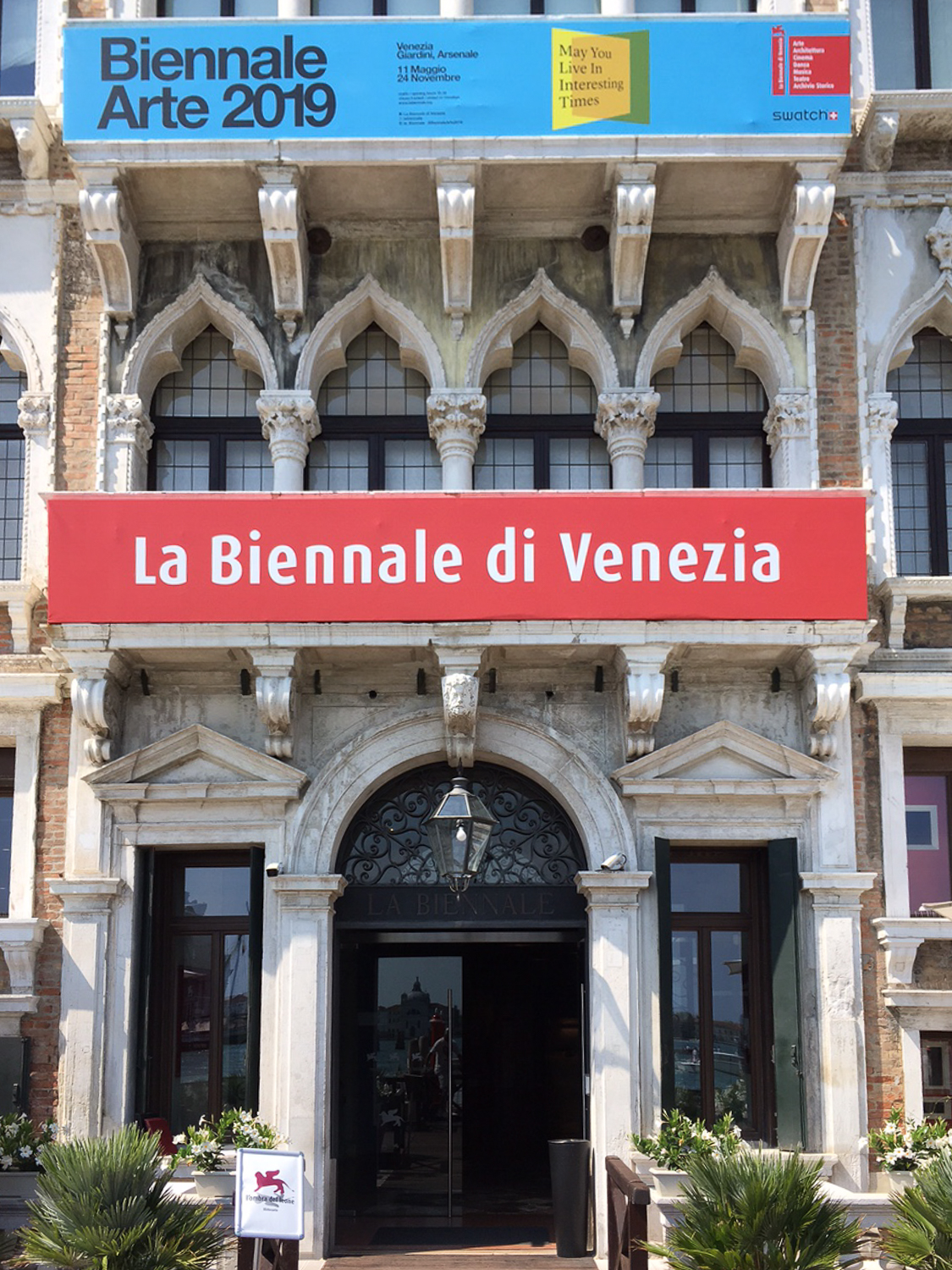
Community hub
Recent from talks
Contribute something to knowledge base
Content stats: 0 posts, 0 articles, 1 media, 0 notes
Members stats: 0 subscribers, 0 contributors, 0 moderators, 0 supporters
Subscribers
Supporters
Contributors
Moderators
Venice Biennale
The Venice Biennale (/ˌbiːɛˈnɑːleɪ, -li/ BEE-en-AH-lay, -lee; Italian: la Biennale di Venezia [la bi.enˈnaːle di veˈnɛttsja]) is an international cultural exhibition hosted annually in Venice, Italy. There are two main components of the festival, known as the Art Biennale (la Biennale d'Arte di Venezia) and the Architecture Biennale (la Biennale d'Architettura di Venezia), which are held in alternating years (hence the name). There are also four additional components, each usually held on an annual basis, comprising Biennale Musica, Biennale Teatro, Venice Film Festival, and Venice Dance Biennale. Between them they cover contemporary art, architecture, music, theatre, film, and contemporary dance. The main exhibition is held in Castello and has around 30 permanent pavilions built by different countries.
The Biennale has been organised every year since 1895, which makes it the oldest of its kind. Since 2021, the Art Biennale has taken place in even years and the Architecture Biennale in odd years.
On 19 April 1893, the Venetian City Council passed a resolution to set up an biennial exhibition of Italian Art ("Esposizione biennale artistica nazionale") to celebrate the silver anniversary of King Umberto I and Margherita of Savoy.
A year later, the council decreed "to adopt a 'by invitation' system; to reserve a section of the Exhibition for foreign artists too; to admit works by uninvited Italian artists, as selected by a jury."
The first Biennale, "I Esposizione Internazionale d'Arte della Città di Venezia (1st International Art Exhibition of the City of Venice)" (although originally scheduled for 22 April 1894) was opened on 30 April 1895, by the Italian King and Queen, Umberto I and Margherita di Savoia. The first exhibition was seen by 224,000 visitors.[citation needed] The exhibition took place in the Giardini.
The event became increasingly international in the first decades of the 20th century: from 1907 on, several countries installed national pavilions at the exhibition, with the first being from Belgium. In 1910 the first internationally well-known artists were displayed: a room dedicated to Gustav Klimt, a one-man show for Renoir, a retrospective of Courbet. A work by Picasso "Family of Saltimbanques" was removed from the Spanish salon in the central Palazzo because it was feared that its novelty might shock the public. By 1914 seven pavilions had been established: Belgium (1907), Hungary (1909), Germany (1909), Great Britain (1909), France (1912), and Russia (1914).
During World War I, the 1916 and 1918 events were cancelled. In 1920 the post of mayor of Venice and president of the Biennale was split. The new secretary general, Vittorio Pica brought about the first presence of avant-garde art, notably Impressionists and Post-Impressionists.
1922 saw an exhibition of sculpture by African artists. Between the two World Wars, many important modern artists had their work exhibited there. In 1928 the Istituto Storico d'Arte Contemporanea (Historical Institute of Contemporary Art) opened, which was the first nucleus of archival collections of the Biennale. In 1930 its name was changed into Historical Archive of Contemporary Art.
Venice Biennale
The Venice Biennale (/ˌbiːɛˈnɑːleɪ, -li/ BEE-en-AH-lay, -lee; Italian: la Biennale di Venezia [la bi.enˈnaːle di veˈnɛttsja]) is an international cultural exhibition hosted annually in Venice, Italy. There are two main components of the festival, known as the Art Biennale (la Biennale d'Arte di Venezia) and the Architecture Biennale (la Biennale d'Architettura di Venezia), which are held in alternating years (hence the name). There are also four additional components, each usually held on an annual basis, comprising Biennale Musica, Biennale Teatro, Venice Film Festival, and Venice Dance Biennale. Between them they cover contemporary art, architecture, music, theatre, film, and contemporary dance. The main exhibition is held in Castello and has around 30 permanent pavilions built by different countries.
The Biennale has been organised every year since 1895, which makes it the oldest of its kind. Since 2021, the Art Biennale has taken place in even years and the Architecture Biennale in odd years.
On 19 April 1893, the Venetian City Council passed a resolution to set up an biennial exhibition of Italian Art ("Esposizione biennale artistica nazionale") to celebrate the silver anniversary of King Umberto I and Margherita of Savoy.
A year later, the council decreed "to adopt a 'by invitation' system; to reserve a section of the Exhibition for foreign artists too; to admit works by uninvited Italian artists, as selected by a jury."
The first Biennale, "I Esposizione Internazionale d'Arte della Città di Venezia (1st International Art Exhibition of the City of Venice)" (although originally scheduled for 22 April 1894) was opened on 30 April 1895, by the Italian King and Queen, Umberto I and Margherita di Savoia. The first exhibition was seen by 224,000 visitors.[citation needed] The exhibition took place in the Giardini.
The event became increasingly international in the first decades of the 20th century: from 1907 on, several countries installed national pavilions at the exhibition, with the first being from Belgium. In 1910 the first internationally well-known artists were displayed: a room dedicated to Gustav Klimt, a one-man show for Renoir, a retrospective of Courbet. A work by Picasso "Family of Saltimbanques" was removed from the Spanish salon in the central Palazzo because it was feared that its novelty might shock the public. By 1914 seven pavilions had been established: Belgium (1907), Hungary (1909), Germany (1909), Great Britain (1909), France (1912), and Russia (1914).
During World War I, the 1916 and 1918 events were cancelled. In 1920 the post of mayor of Venice and president of the Biennale was split. The new secretary general, Vittorio Pica brought about the first presence of avant-garde art, notably Impressionists and Post-Impressionists.
1922 saw an exhibition of sculpture by African artists. Between the two World Wars, many important modern artists had their work exhibited there. In 1928 the Istituto Storico d'Arte Contemporanea (Historical Institute of Contemporary Art) opened, which was the first nucleus of archival collections of the Biennale. In 1930 its name was changed into Historical Archive of Contemporary Art.
Recent media
Recent media