


Community hub
Recent from talks
Contribute something
Nothing was collected or created yet.
Gustave Courbet
View on Wikipedia
Jean Désiré Gustave Courbet (UK: /ˈkʊərbeɪ/ KOOR-bay;[1] US: /kʊərˈbeɪ/ koor-BAY;[2] French: [ɡystav kuʁbɛ]; 10 June 1819 – 31 December 1877)[3] was a French painter who led the Realism movement in 19th-century French painting. Committed to painting only what he could see, he rejected academic convention and the Romanticism of the previous generation of visual artists. His independence set an example that was important to later artists, such as the Impressionists and the Cubists. Courbet occupies an important place in 19th-century French painting as an innovator and as an artist willing to make bold social statements through his work.
Key Information


Courbet's paintings of the late 1840s and early 1850s brought him his first recognition. They challenged convention by depicting unidealized peasants and workers, often on a grand scale traditionally reserved for paintings of religious or historical subjects. Courbet's subsequent paintings were mostly of a less overtly political character: landscapes, seascapes, hunting scenes, nudes, and still lifes. Courbet was imprisoned for six months in 1871 for his involvement with the Paris Commune and lived in exile in Switzerland from 1873 until his death four years later.
Biography
[edit]_-_WGA05486.jpg)
Gustave Courbet was born in 1819 to Régis and Sylvie Oudot Courbet in Ornans (department of Doubs). Anti-monarchical feelings prevailed in the household. (His maternal grandfather fought in the French Revolution.) Courbet's sisters, Zoé, Zélie, and Juliette were his first models for drawing and painting. After moving to Paris he often returned home to Ornans to hunt, fish, and find inspiration.[4]
Courbet went to Paris in 1839 and worked at the studio of Steuben and Hesse. An independent spirit, he soon left, preferring to develop his own style by studying the paintings of Spanish, Flemish and French masters in the Louvre, and painting copies of their work.[5]

Courbet's first works were an Odalisque inspired by the writing of Victor Hugo and a Lélia illustrating George Sand, but he soon abandoned literary influences, choosing instead to base his paintings on observed reality. Among his paintings of the early 1840s are several self-portraits, Romantic in conception, in which the artist portrayed himself in various roles. These include Self-Portrait with Black Dog (c. 1842–44, accepted for exhibition at the Salon of 1844), the theatrical Self-Portrait which is also known as Desperate Man (c. 1843–45), Lovers in the Countryside (1844, Musée des Beaux-Arts, Lyon), The Sculptor (1845), The Wounded Man (1844–54, Musée d'Orsay, Paris), The Cellist, Self-Portrait (1847, Nationalmuseum, Stockholm, shown at the 1848 Salon), and Man with a Pipe (1848–49, Musée Fabre, Montpellier).[6]
Trips to the Netherlands and Belgium in 1846–47 strengthened Courbet's belief that painters should portray the life around them, as Rembrandt, Hals and other Dutch masters had. By 1848, he had gained supporters among the younger critics, the Neo-romantics and Realists, notably Champfleury.[7]
Courbet achieved his first Salon success in the Salon of 1849 with his painting After Dinner at Ornans. The work, reminiscent of Chardin and Le Nain, earned Courbet a gold medal and was purchased by the state.[8] The gold medal meant that his works would no longer require jury approval for exhibition at the Salon[9]—an exemption Courbet enjoyed until 1857 (when the rule changed).[10]
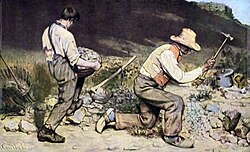
In 1849–50, Courbet painted The Stone Breakers (destroyed in the Allied Bombing of Dresden in 1945), which Proudhon admired as an icon of peasant life; it has been called "the first of his great works".[11] The painting was inspired by a scene Courbet witnessed on the roadside. He later explained to Champfleury and the writer Francis Wey: "It is not often that one encounters so complete an expression of poverty and so, right then and there I got the idea for a painting. I told them to come to my studio the next morning."[11]
Realism
[edit]
Courbet's work belonged neither to the predominant Romantic nor Neoclassical schools. History painting, which the Paris Salon esteemed as a painter's highest calling, did not interest him, for he believed that "the artists of one century [are] basically incapable of reproducing the aspect of a past or future century ..."[12] Instead, he maintained that the only possible source for living art is the artist's own experience.[12] He and Jean-François Millet would find inspiration painting the life of peasants and workers.[13]
Courbet painted figurative compositions, landscapes, seascapes, and still lifes. He courted controversy by addressing social issues in his work, and by painting subjects that were considered vulgar, such as the rural bourgeoisie, peasants, and working conditions of the poor. His work, along with that of Honoré Daumier and Jean-François Millet, became known as Realism. For Courbet realism dealt not with the perfection of line and form, but entailed spontaneous and rough handling of paint, suggesting direct observation by the artist while portraying the irregularities in nature. He depicted the harshness of life, and in doing so challenged contemporary academic ideas of art. One of the distinctive features of Courbet's Realism was his lifelong attachment to his native province, the Franche-Comté, and of his birthplace, Ornans.
The Stone Breakers
[edit]
Considered to be the first of Courbet's great works, The Stone Breakers of 1849 is an example of social realism that caused a sensation when it was first exhibited at the Paris Salon in 1850. The work was based on two men, one young and one old, whom Courbet discovered engaged in backbreaking labor on the side of the road when he returned to Ornans for an eight-month visit in October 1848. On his inspiration, Courbet told his friends and art critics Francis Wey and Jules Champfleury, "It is not often that one encounters so complete an expression of poverty and so, right then and there I got the idea for a painting."[14]
While other artists had depicted the plight of the rural poor, Courbet's peasants are not idealized like those in works such as Breton's 1854 painting, The Gleaners.[15]
During World War II, from 13 to 15 February 1945, the Allies continuously bombed the city of Dresden, Germany. German troops hastily loaded artworks from Dresden's galleries and museums onto trucks. The Stone Breakers was destroyed, along with 153 other paintings, when a transport vehicle moving the pictures to the Königstein Fortress, near Dresden, was bombed by Allied forces.[16]
A Burial at Ornans
[edit]
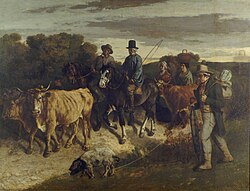
The Salon of 1850–1851[a] found him triumphant with The Stone Breakers, the Peasants of Flagey and A Burial at Ornans. The Burial, one of Courbet's most important works, records the funeral of his grand uncle[19] which he attended in September 1848. People who attended the funeral were the models for the painting. Previously, models had been used as actors in historical narratives, but in Burial Courbet said he "painted the very people who had been present at the interment, all the townspeople". The result is a realistic presentation of them and life in Ornans.
The vast painting, measuring 10 by 22 feet (3.0 by 6.7 meters), drew both praise and fierce denunciations from critics and the public, in part because it upset convention by depicting a prosaic ritual on a scale which would previously have been reserved for a religious or royal subject.
According to art historian Sarah Faunce, "In Paris, the Burial was judged as a work that had thrust itself into the grand tradition of history painting, like an upstart in dirty boots crashing a genteel party, and in terms of that tradition it was, of course, found wanting."[20] The painting lacks the sentimental rhetoric that was expected in a genre work: Courbet's mourners make no theatrical gestures of grief, and their faces seemed more caricatured than ennobled. The critics accused Courbet of a deliberate pursuit of ugliness.[20]
Eventually, the public grew more interested in the new Realist approach, and the lavish, decadent fantasy of Romanticism lost popularity. Courbet well understood the importance of the painting, and said of it, "Burial at Ornans was in reality the burial of romanticism."[21]

Courbet became a celebrity and was spoken of as a genius, a "terrible socialist" and a "savage".[22] He actively encouraged the public's perception of him as an unschooled peasant, while his ambition, his bold pronouncements to journalists, and his insistence on depicting his own life in his art gave him a reputation for unbridled vanity.[23]
Courbet associated his ideas of realism in art with political anarchism, and, having gained an audience, he promoted political ideas by writing politically motivated essays and dissertations. His familiar visage was the object of frequent caricature in the popular French press.[24]
In 1850, Courbet wrote to a friend:
...in our so very civilized society it is necessary for me to live the life of a savage. I must be free even of governments. The people have my sympathies, I must address myself to them directly.[25]
During the 1850s, Courbet painted numerous figurative works using common folk and friends as his subjects, such as Village Damsels (1852), The Wrestlers (1853), The Bathers (1853), The Sleeping Spinner (1853), and The Wheat Sifters (1854).
The Artist's Studio
[edit]
In 1855, Courbet submitted fourteen paintings for exhibition at the Exposition Universelle. Three were rejected for lack of space, including A Burial at Ornans and his other monumental canvas The Artist's Studio.[26] Refusing to be denied, Courbet took matters into his own hands. He displayed forty of his paintings, including The Artist's Studio, in his gallery called The Pavilion of Realism (Pavillon du Réalisme) which was a temporary structure that he erected next door to the official Salon-like Exposition Universelle.[26]
The work is an allegory of Courbet's life as a painter, seen as a heroic venture, in which he is flanked by friends and admirers on the right, and challenges and opposition to the left. Friends on the right include the art critics Champfleury, and Charles Baudelaire, and art collector Alfred Bruyas. On the left are figures (priest, prostitute, grave digger, merchant, and others) who represent what Courbet described in a letter to Champfleury as "the other world of trivial life, the people, misery, poverty, wealth, the exploited and the exploiters, the people who live off death."[27]
In the foreground of the left-hand side is a man with dogs, who was not mentioned in Courbet's letter to Champfleury. X-rays show he was painted later, but his role in the painting is important: he is an allegory of the then-current French Emperor, Napoleon III, identified by his famous hunting dogs and iconic twirled mustache. By placing him on the left, Courbet publicly shows his disdain for the emperor and depicts him as a criminal, suggesting that his "ownership" of France is an illegal one.[28]
Although artists like Eugène Delacroix were ardent champions of his effort, the public went to the show mostly out of curiosity and to deride him. Attendance and sales were disappointing,[29] but Courbet's status as a hero to the French avant-garde became assured. He was admired by the American James Abbott McNeill Whistler, and he became an inspiration to the younger generation of French artists including Édouard Manet and the Impressionist painters. The Artist's Studio was recognized as a masterpiece by Delacroix, Baudelaire, and Champfleury, if not by the public.
Seascapes
[edit],_c._1869.jpg)
While Courbet's seascapes, painted during his many visits to the northern coast of France in the late 1860s, were decidedly less controversial than his salon submissions, they furthered his contributions (willing or otherwise) to realism with their emphasis on both the beauty and danger of the natural world. There is a distinct range in the tones of this period with The Calm Sea (1869) depicting the serenity of the receded tide, and The Sailboat (c. 1869) showing a sailboat wrestling with violent tides.[30]
Realist manifesto
[edit]Courbet wrote a Realist manifesto for the introduction to the catalogue of this independent, personal exhibition, echoing the tone of the period's political manifestos. In it, he asserts his goal as an artist is "to translate the customs, the ideas, the appearance of my epoch according to my own estimation."[31]
The title of Realist was thrust upon me just as the title of Romantic was imposed upon the men of 1830. Titles have never given a true idea of things: if it were otherwise, the works would be unnecessary.
Without expanding on the greater or lesser accuracy of a name that nobody, I should hope, can really be expected to understand, I will limit myself to a few words of elucidation in order to cut short the misunderstandings.
I have studied the art of the ancients and the art of the moderns, avoiding any preconceived system and without prejudice. I no longer wanted to imitate the one than to copy the other; nor, furthermore, was it my intention to attain the trivial goal of "art for art's sake". No! I simply wanted to draw forth, from a complete acquaintance with tradition, the reasoned and independent consciousness of my own individuality.
To know in order to do, that was my idea. To be in a position to translate the customs, the ideas, the appearance of my time, according to my own estimation; to be not only a painter but a man as well; in short, to create living art – this is my goal. (Gustave Courbet, 1855)[32]
Notoriety
[edit]
In the Salon of 1857, Courbet showed six paintings. These included Young Ladies on the Banks of the Seine (Summer), depicting two prostitutes under a tree,[33] as well as the first of many hunting scenes Courbet was to paint during the remainder of his life: Hind at Bay in the Snow and The Quarry.[10]
Young Ladies on the Banks of the Seine, painted in 1856,[34] provoked a scandal. Art critics accustomed to conventional, "timeless" nude women in landscapes were shocked by Courbet's depiction of modern women casually displaying their undergarments.[35]
By exhibiting sensational works alongside hunting scenes, of the sort that had brought popular success to the English painter Edwin Landseer, Courbet guaranteed himself "both notoriety and sales".[36]
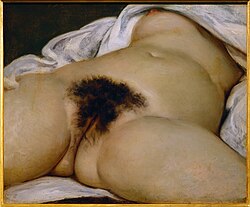
During the 1860s, Courbet painted a series of increasingly erotic works such as Femme nue couchée, culminating in The Origin of the World (L'Origine du monde) (1866), which depicts female genitalia and was not publicly exhibited until 1988,[37] and Sleep (1866), featuring two women in bed. The latter painting became the subject of a police report when it was exhibited by a picture dealer in 1872.[38]
Until about 1861, Napoléon's regime had exhibited authoritarian characteristics, using press censorship to prevent the spread of opposition, manipulating elections, and depriving Parliament of the right to free debate or any real power. In the 1860s, however, Napoléon III made more concessions to placate his liberal opponents. This change began by allowing free debates in Parliament and public reports of parliamentary debates. Press censorship, too, was relaxed and culminated in the appointment of the Liberal Émile Ollivier, previously a leader of the opposition to Napoléon's regime, as the de facto Prime Minister in 1870. As a sign of appeasement to the Liberals who admired Courbet, Napoleon III nominated him to the Legion of Honour in 1870. His refusal of the cross of the Legion of Honour angered those in power but made him immensely popular with those who opposed the prevailing regime.
-
 Femme nue couchée, 1862
 -
 Portrait of Jo (La belle Irlandaise), 1865–66, Metropolitan Museum of Art, a painting of Joanna Hiffernan, the probable model for Sleep
 -
 Le Sommeil (Sleep), 1866, Petit Palais, Musée des Beaux-Arts de la Ville de Paris
 -
 Young Bather, 1866
 -


Courbet and the Paris Commune
[edit]

On 4 September 1870, during the Franco-Prussian War, Courbet made a proposal that later came back to haunt him. He wrote a letter to the Government of National Defense, proposing that the column in the Place Vendôme, erected by Napoleon I to honour the victories of the French Army, be taken down. He wrote:
In as much as the Vendôme Column is a monument devoid of all artistic value, tending to perpetuate by its expression the ideas of war and conquest of the past imperial dynasty, which are reproved by a republican nation's sentiment, citizen Courbet expresses the wish that the National Defense government will authorize him to disassemble this column."[39]
Courbet proposed that the Column be moved to a more appropriate place, such as the Hotel des Invalides, a military hospital. He also wrote an open letter addressed to the German Army and to German artists, proposing that German and French cannons should be melted down and crowned with a liberty cap, and made into a new monument on Place Vendôme, dedicated to the federation of the German and French people. The Government of National Defense did nothing about his suggestion to tear down the column, but it was not forgotten.[40]

On 18 March, in the aftermath of the French defeat in the Franco-Prussian War, a revolutionary government called the Paris Commune briefly took power in the city. Courbet played an active part and organized a Federation of Artists, which held its first meeting on 5 April in the Grand Amphitheater of the School of Medicine. Some three hundred to four hundred painters, sculptors, architects, and decorators attended. There were some famous names on the list of members, including André Gill, Honoré Daumier, Jean-Baptiste-Camille Corot, Eugène Pottier, Jules Dalou, and Édouard Manet. Manet was not in Paris during the Commune and did not attend, and Corot, who was seventy-five years old, stayed in a country house and his studio during the Commune, not taking part in the political events.
Courbet chaired the meeting and proposed that the Louvre and the Musée du Luxembourg, the two major art museums of Paris, closed during the uprising, be reopened as soon as possible and that the traditional annual exhibit called the Salon be held as in years past, but with radical differences. He proposed that the Salon should be free of any government interference or rewards to preferred artists; no medals or government commissions would be given. Furthermore, he called for the abolition of the most famous state institutions of French art; the École des Beaux-Arts, the French Academy in Rome, the French School at Athens, and the Fine Arts section of the Institute of France.[42]
On 12 April, the executive committee of the Commune gave Courbet, though he was not yet officially a member of the Commune, the assignment of opening the museums and organizing the Salon. They issued the following decree at the same meeting: "The Column of the Place Vendôme will be demolished."[43] On 16 April, special elections were held to replace more moderate members of the Commune who had resigned their seats, and Courbet was elected as a delegate for the 6th arrondissement of Paris. He was given the title of Delegate of Fine Arts, and on 21 April he was also made a member of the Commission on Education. At the meeting of the commission on 27 April, the minutes reported that Courbet requested the demolition of the Vendôme column be carried out and that the column would be replaced by an allegorical figure representing the taking of power of the Commune on 18 March.[43]
Nonetheless, Courbet was a dissident by nature, and he was soon in opposition with the majority of the Commune members on some of its measures. He was one of a minority of Commune Members who opposed the creation of a Committee on Public Safety, modeled on the committee of the same name which carried out the Reign of Terror during the French Revolution.[44]
Courbet opposed the Commune on another more serious matter: the arrest of his friend Gustave Chaudey, a prominent socialist, magistrate, and journalist, whose portrait Courbet had painted. The popular Commune newspaper, Le Fils du Père Duchêne, accused Chaudey, when he was briefly deputy mayor of the 9th arrondissement before the Commune was formed, of ordering soldiers to fire on a crowd that had surrounded the Hôtel de Ville. Courbet's opposition was of no use; on 23 May 1871, in the final days of the Commune, Chaudey was shot by a Commune firing squad. According to some sources Courbet resigned from the Commune in protest.[45]
On 13 May, on the proposal of Courbet, the Paris house of Adolphe Thiers, the chief executive of the French government, was demolished, and his art collection confiscated. Courbet proposed that the confiscated art be given to the Louvre and other museums, but the director of the Louvre refused to accept it.[46] On 16 May, just nine days before the fall of the Commune, in a large ceremony with military bands and photographers, the Vendôme column was pulled down and broke into pieces. Some witnesses said Courbet was there, others denied it. The following day, the Federation of Artists debated dismissing directors of the Louvre and of the Luxembourg museums, suspected by some in the Commune of having secret contacts with the French government, and appointed new heads of the museums.

According to one legend, Courbet defended the Louvre and other museums against "looting mobs", but there are no records of any such attacks on the museums. The only real threat to the Louvre came during "Bloody Week", 21–28 May 1871, when a unit of Communards, led by a Commune general, Jules Bergeret, set fire to the Tuileries Palace, next to the Louvre.[47] The fire spread to the library of the Louvre, which was destroyed, but the efforts of museum curators and firemen saved the art gallery.[48]
After the final suppression of the Commune by the French army on 28 May, Courbet went into hiding in the apartments of different friends. He was arrested on 7 June. At his trial before a military tribunal on 14 August, Courbet argued that he had only joined the Commune to pacify it and that he had wanted to move the Vendôme Column, not destroy it. He said he had only belonged to the Commune for a short period, and rarely attended its meetings. He was convicted, but given a lighter sentence than other Commune leaders: six months in prison and a fine of five hundred francs. Serving part of his sentence in the Sainte-Pélagie Prison in Paris, he was allowed an easel and paints, but he could not have models pose for him. He did a famous series of still-life paintings of flowers and fruit during his confinement.[49]
Exile and death
[edit]
Courbet completed his prison sentence on 2 March 1872, but his problems caused by the destruction of the Vendôme Column were still not over. In 1873, the newly elected president of the Republic, Patrice de MacMahon, announced plans to rebuild the column, with the cost to be paid by Courbet. Unable to pay, Courbet went into a self-imposed exile in Switzerland to avoid bankruptcy. In the following years, he participated in Swiss regional and national exhibitions. Surveilled by the Swiss intelligence service, he enjoyed in the small Swiss art world the reputation as head of the "realist school" and inspired younger artists such as Auguste Baud-Bovy and Ferdinand Hodler.[50]
Important works from this period include several paintings of trout, "hooked and bleeding from the gills",[51] that have been interpreted as allegorical self-portraits of the exiled artist.[51] In his final years, Courbet painted landscapes, including several scenes of water mysteriously emerging from the depths of the earth in the Jura Mountains of the France–Switzerland border.[52] Courbet also worked on sculpture during his exile. Previously, in the early 1860s, he had produced a few sculptures, one of which – the Fisherman of Chavots (1862) – he donated to Ornans for a public fountain, but it was removed after Courbet's arrest.[53]
In May 1877, the state set the final cost of reconstructing the Vendôme Column at 323,000 francs for Courbet to repay in annual installments of 10,000 francs for the next 33 years.[54] On 31 December 1877, a day before the first installment was due,[55] Courbet died, aged 58, in La Tour-de-Peilz, Switzerland, of a liver disease aggravated by heavy drinking.
Gallery
[edit]- Self-portraits
-

-
 Self-portrait, 1842
 -
 Self-portrait (The Desperate Man), c. 1843–1845
 -
 The Cellist, Self-portrait, 1847, Nationalmuseum, Stockholm
 -
 Artist at His Easel, c. 1847–48, charcoal on paper

_-_WGA05478.jpg)
.jpg)


- Portraits
-
 Portrait of Paul Ansout, c. 1842–43
 -
 Portrait of H. J. van Wisselingh, 1846
 -
 Zélie Courbet, 1847
 -
 Portrait of Baudelaire, 1848
 -

-
 Spanish Woman, 1854
 -
 Gustave Mathieu, 1869, Sammlung Oskar Reinhart Am Römerholz, Winterthur


- Landscapes
-
 Rocks at Mouthier, 1855
 -
 Cliffs at Etretat, After the Storm, 1870
 -
 The Wave, 1870
 -
 Sea Coast in Normandy, 1867
 -
 The Pont Ambroix Languedoc, 1857
 -
 Laundresses at Low Tide, Étretat (1866 or 1869), oil on canvas, 21 3/8 × 25 7/8 in. (54.3 × 65.7 cm), Clark Art Institute
 -
 Stream in the Jura Mountains (The Torrent), 1872–73, Honolulu Museum of Art
 -
 Snow effect, c. 1860s
 -
 The Calm Sea, 1869, Metropolitan Museum of Art
 -
 Grotto of Sarrazine near Nans-sous-Sainte-Anne, c. 1875
 -
 The Castle of Chillon, 1874


,_oil_on_canves,_1872-3.jpg)
.jpg)


- Nudes
-
 Nude Woman with a Dog (Femme nue au chien)), c. 1861–62, Musée d'Orsay, Paris
 -

-
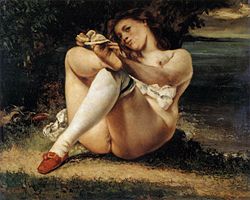 Les Bas Blancs (Woman with White Stockings), 1864, Barnes Foundation
 -
 Woman with a Parrot, 1866, Metropolitan Museum of Art, New York
 -
 The Woman in the Waves, 1868, Metropolitan Museum of Art, New York
 -
 The Source, 1868, Musée d'Orsay

.jpg)


- Other
-
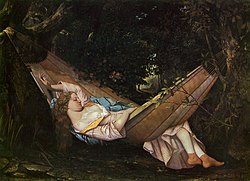 The Hammock, 1844
 -
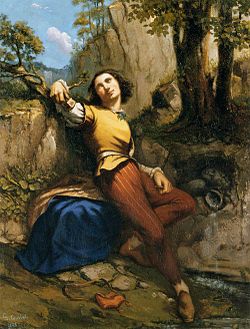 The Sculptor, 1845
 -
 After Dinner at Ornans, 1849
 -
 The Stone Breakers, 1849
 -
 Farmers of Flagey on the Return From the Market, 1850, Museum of Art, Besançon
 -
 The Wrestlers, 1853, Museum of Fine Arts, Budapest
 -
 The Sleeping Spinner, 1853
 -
 The Meeting ("Bonjour, Monsieur Courbet"), 1854, Musée Fabre, Montpellier
 -

-
 The Hunt Breakfast, 1858, Wallraf–Richartz Museum, Cologne
 -

-
 The Trellis, 1862, Toledo Museum of Art, Toledo, Ohio
 -
 Girl with Seagulls, 1865
 -
 The Fishing Boat, 1865, Metropolitan Museum of Art
 -
 The Greyhounds of the Comte de Choiseul, 1866
 -
 Killing a Deer, 1867, Museum of Art, Besançon


.JPG)


_The_Fishing_Boat_1865.jpg)


Legacy
[edit]
Courbet was admired by many artists. Claude Monet included a portrait of Courbet in his own version of Le Déjeuner sur l'herbe from 1865 to 1866 (Musée d'Orsay, Paris). Courbet's particular kind of realism influenced many artists to follow, notably among them the German painters of the Leibl circle,[56] James McNeill Whistler, and Paul Cézanne. Courbet's influence can also be seen in the work of Edward Hopper, whose Bridge in Paris (1906) and Approaching a City (1946) have been described as Freudian echoes of Courbet's The Source of the Loue and The Origin of the World.[57] His pupils included Henri Fantin-Latour, Hector Hanoteau and Olaf Isaachsen.
Courbet once wrote this in a letter:
I have always lived in freedom; let me end my life free; when I am dead let this be said of me: 'He belonged to no school, to no church, to no institution, to no academy, least of all to any régime except the régime of liberty.'[58]
Courbet and Cubism
[edit]
Two 19th-century artists prepared the way for the emergence of Cubism in the 20th century: Courbet and Cézanne.[60] Cézanne's contributions are well-known.[61] Courbet's importance was announced by Guillaume Apollinaire, poet-spokesperson for the Cubists. Writing in Les Peintres Cubistes, Méditations Esthétiques (1913) he declared, "Courbet is the father of the new painters."[62] Jean Metzinger and Albert Gleizes often portrayed Courbet as the father of all modern art.[62]
Both artists sought to transcend the conventional methods of rendering nature; Cézanne through a dialectical method revealing the process of seeing, Courbet by his materialism.[63] The Cubists would combine these two approaches in developing a revolution in art.[64]
On a formal level, Courbet wished to convey the physical characteristics of what he was painting: its density, weight, and texture. Art critic John Berger said: "No painter before Courbet was ever able to emphasize so uncompromisingly the density and weight of what he was painting."[65] This emphasis on material reality endowed his subjects with dignity.[66] Berger observed that the Cubist painters "were at great pains to establish the physical presence of what they were representing. And in this, they are the heirs of Courbet."[67]
Nazi-looted art
[edit]During the Third Reich (1933–1945) Jewish art collectors throughout Europe had their property seized as part of the Holocaust. Many artworks created by Courbet were looted by Nazis and their agents during this period and have only recently been reclaimed by the families of the previous owners.
Courbet's La Falaise d'Etretat was owned by the Jewish collector Marc Wolfson and his wife Erna, who both were murdered in Auschwitz. After disappearing during the Nazi occupation of France, it reappeared years later at the Musée d'Orsay.[68]
The great Hungarian Jewish collector Baron Mor Lipot Herzog owned several Courbet artworks, including Le Chateau de Blonay (Neige) (c. 1875, "The Chateau of Blonay (Snow)", now at the Budapest Museum of Fine Arts),[69] and Courbet's most infamous work — L'Origine du monde ("The Origin of the World"). His collection of 2000–2500 pieces was looted by Nazis and many are still missing.[70]
Gustav Courbet's paintings Village Girl With Goat, The Father, and Landscape With Rocks were discovered in the Gurlitt Trove of art stashed in Munich. It is not known to whom they belonged.[71][72]
Josephine Weinmann and her family, who were German Jews, had owned Le Grand Pont before they were forced to flee. The Nazi militant Herbert Schaefer acquired it and loaned it to the Yale University Art Gallery, against whom the Weinmanns filed a claim.[73]
The French Database of Art Objects at the Jeu de Paume (Cultural Plunder by the Einsatzstab Reichsleiter Rosenberg) has 41 entries for Courbet.[74]
In March 2023, a museum at the University of Cambridge, in the United Kingdom, returned a painting La Ronde Enfantine by Gustave Courbet, which was stolen in 1941 by the Nazis in Paris. The canvas belonged to a Jewish member of the Resistance. The Spoliation Advisory Panel, a body created in 2000 by the British government, concluded on 28 March "that the painting was stolen by the Nazi occupation forces because Robert Bing was Jewish".[75]
See also
[edit]Notes
[edit]References
[edit]- ^ "Courbet, Gustave". Lexico UK English Dictionary. Oxford University Press. Archived from the original on 27 August 2022.
- ^ "Courbet". Merriam-Webster.com Dictionary. Merriam-Webster. Retrieved 3 August 2019.
- ^ Frantz, Henri (1911). . In Chisholm, Hugh (ed.). Encyclopædia Britannica. Vol. 7 (11th ed.). Cambridge University Press. pp. 318–319.
- ^ Berman, Avis (April 2008). "Larger than Life". Smithsonian Magazine. Archived from the original on 2 July 2009. Retrieved 3 April 2008.
- ^ Masanès 2006, pp. 8–9
- ^ Frantz 1911.
- ^ Faunce & Nochlin 1988, p. 83
- ^ Masanès 2006, pp. 31–32
- ^ Masanès 2006, p. 30
- ^ a b Masanès 2006, p. 55
- ^ a b Masanès 2006, p. 31
- ^ a b Faunce & Nochlin 1988, p. 7
- ^ Haine, Scott (2000). The History of France (1st ed.). Greenwood Press. p. 112. ISBN 0-313-30328-2.
- ^ Boime, Albert (2008). Art in an Age of Civil Struggle, 1848–1871. Chicago Illinois: University of Chicago Press. p. 158. ISBN 9780226063423. Retrieved 9 June 2023.
- ^ "The Gleaners". National Gallery of Ireland. Retrieved 23 June 2023.
- ^ Collins, Michael (2022). Lost Masterpieces. London, England: DK Publishing. p. 160. ISBN 9780744077933. Retrieved 9 June 2023.
- ^ "Gustave Courbet's A Burial at Ornans". pbs.org. Archived from the original on 12 November 2012. Retrieved 29 August 2017.
- ^ Faunce & Nochlin 1988, p. 2
- ^ Faunce & Nochlin 1988, p. 79
- ^ a b Faunce & Nochlin 1988, p. 4
- ^ James, Jamie (2016). The Glamour of Strangeness: Artists and the Last Age of the Exotic. New York: Farrar, Straus and Giroux. p. 99. ISBN 9780374711320.
- ^ Faunce & Nochlin 1988, p. 8
- ^ Faunce & Nochlin 1988, pp. 8–9
- ^ "'Le chef de l'école du laid': Gustave Courbet in 19th-century caricatures. European studies blog". blogs.bl.uk. Archived from the original on 7 August 2020. Retrieved 18 September 2017.
- ^ Courbet, Gustave: artchive.com Archived 30 December 2009 at the Wayback Machine citing Perl, Jed: Gallery Going: Four Seasons in the Art World, 1991, Harcourt, ISBN 978-0-15-134260-0.
- ^ a b Masanès 2006, p. 52
- ^ Masanès 2006, p. 48
- ^ Toussaint, Helene (1978). Gustave Courbet, 1819–1877 : [exhibition] at the Royal Academy of Arts, 19 January – 19 March 1978 : [catalog]. London: Arts Council of Great Britain. [An exhibition organ. by the Réunion des Musées Nationaux. Organ. committee: Alan Bowness...] p. 265. ISBN 0-7287-0152-9.
- ^ Faunce & Nochlin 1988, p. 84
- ^ "Gustave Courbet | The Calm Sea". The Metropolitan Museum of Art. 1869. Retrieved 14 June 2023.
- ^ "The Metropolitan Museum of Art, Nineteenth-Century French Realism, Heilbrunn Timeline of Art History". October 2004. Archived from the original on 13 December 2018. Retrieved 1 December 2014.
- ^ "Exhibition and sale of forty paintings and four drawings by Gustave Courbet, Paris 1855, Courbet speaks, Musée d'Orsay". Archived from the original on 1 August 2016. Retrieved 1 December 2014.
- ^ Faunce & Nochlin 1988, p. 133
- ^ "Gustave Courbet – Les Demoiselles Au Bord De La Seine". art.yodelout.com. Archived from the original on 14 July 2014. Retrieved 5 July 2014.
- ^ "Young Ladies on the Bank of the Seine, National Galleries". www.nationalgallery.org. Archived from the original on 29 January 2015. Retrieved 5 July 2014.
- ^ Schwabsky 2008, p. 30
- ^ Schwabsky 2008, p. 34
- ^ Faunce & Nochlin 1988, p. 176
- ^ "Attendu que la colonne Vendôme est un monument dénué de toute valeur artistique, tendant à perpétuer par son expression les idées de guerre et de conquête qui étaient dans la dynastie impériale, mais que réprouve le sentiment d'une nation républicaine, [le citoyen Courbet] émet le vœu que le gouvernement de la Défense nationale veuille bien l'autoriser à déboulonner cette colonne". Archived from the original on 3 March 2016. Retrieved 14 December 2009.
- ^ Milza 2009, p. 294
- ^ Clark, T. J.; Clark, Timothy J. (1 January 1999). Image of the People: Gustave Courbet and the 1848 Revolution. Irvine, California: University of California Press. p. 111. ISBN 978-0-520-21745-4. Retrieved 22 January 2024.
- ^ Milza 2009, pp. 296–297
- ^ a b Riat 1906, p. 295
- ^ Milza 2009, pp. 294–295
- ^ See French Wikipedia article on Courbet.
- ^ Milza 2009, pp. 294–296, 297
- ^ Milza 2009, pp. 396–397
- ^ Héron de Villefosse, René (1959). Histoire de Paris. Bernard Grasset.
- ^ Riat 1906, pp. 120–122
- ^ Fischer 2009, pp. 57–80
- ^ a b Danto 1989, p. 100
- ^ Fumey, Gilles (2007). "Courbet, peintre du calcaire". Karstologia (in French). 50: 49–51. doi:10.3406/karst.2007.2611. Archived from the original on 8 July 2019. Retrieved 22 February 2019.
- ^ Herding 2023
- ^ Bénédite, Léonce (1912). "Gustave Courbet: With a Biographical and Critical Study".
- ^ "Proceedings of the ... Annual Meeting of the Western Society for French History". 1989.
- ^ Forster-Hahn 2001, p. 155
- ^ Wells, Walter, Silent Theater: The Art of Edward Hopper, London/New York: Phaidon, 2007.
- ^ Courbet, Gustave: Letters of Gustave Courbet, 1992, University of Chicago Press, Translated by Petra Ten-Doesschate Chu, ISBN 0-226-11653-0. (Google Books Archived 16 April 2016 at the Wayback Machine)
- ^ Berger 1965, p. 52: "You can see it in the way [Courbet] painted an apple or a wave, or in the way, he painted the heavy languor and creased dresses of two girls lying by the Seine."
- ^ Berger 1965, p. 51: "The preparations for the revolution of Cubism were begun in the nineteenth century by two artists: Courbet and Cézanne." and p. 55: "the revolutionary inheritance that the nineteenth century bequeathed to the twentieth century: the materialism of Courbet and the dialectic of Cézanne."
- ^ Berger 1965, p. 51: "The importance of Cézanne for the Cubists has been stressed so often that it has become a commonplace."
- ^ a b Guillaume Apollinaire, Les Peintres Cubistes (The Cubist Painters), 1913, (translated and analyzed by Peter F. Read, University of California Press, 25 October 2004, pp. 27, 137
- ^ Berger 1965, pp. 51–52: "Both Courbet and Cézanne change the emphasis of the painter's approach to nature: Courbet by his materialism, Cézanne in his dialectical view of the process of looking at nature."
- ^ Berger 1965, pp. 55–56: "The task was to combine the two. Followed up separately, each would lead to a cul-de-sac: Courbet's materialism would become mechanical; the force of gravity, which gave such dignity to his subjects, would become oppressive and literal. Cézanne's dialectic would become more and more disembodied and its harmony would be obtained at the price of physical indifference. Today, both examples are followed up separately." (italics in original).
- ^ Berger 1965, p. 52
- ^ Berger 1965, pp. 52–53: "Courbet, whilst still using paint on canvas, wanted to go beyond [pictorial] conventions and find the equivalent of the physical sensation of the material objects portrayed: their weight, their temperature, their texture. What perspective towards the horizon meant to Poussin, the force of gravity meant to Courbet." (italics in original).
- ^ Berger 1965, p. 58
- ^ "Tableaux spoliés. La France peut mieux faire". www.lootedart.com. Paris Match. Archived from the original on 5 February 2021. Retrieved 5 February 2021.
- ^ "After 75 Years and 15 Claims, a Bid to Regain Lost Art Inches Forward". www.lootedart.com. New York Times. Archived from the original on 5 February 2021. Retrieved 5 February 2021.
- ^ "Happy ending for looted Courbet painting in Paris exhibit". www.lootedart.com. International Herald Tribune. Archived from the original on 9 January 2021. Retrieved 5 February 2021.
- ^ Kimmelman, Michael (6 November 2013). "In a Rediscovered Trove of Art, a Triumph Over the Nazis' Will (Published 2013)". The New York Times. ISSN 0362-4331. Archived from the original on 12 November 2013. Retrieved 5 February 2021.
- ^ "Nazi-Seized Stash in Munich Includes Unknown Dix, Chagall". lootedart.com. Archived from the original on 22 June 2021. Retrieved 5 February 2021.
- ^ RENOLD, Professor Marc-André. "Cross-border restitution claims of art looted in armed conflicts and wars and alternatives to court litigations" (PDF). European Parliament's Committee on Legal Affairs. Archived (PDF) from the original on 31 August 2021. Retrieved 5 February 2021.
- ^ "Cultural Plunder by the Einsatzstab Reichsleiter Rosenberg: Database of Art Objects at the Jeu de Paume". errproject.org/jeudepaume/. Archived from the original on 18 June 2021.
- ^ "Museu inglês vai devolver quadro roubado por nazistas a herdeiros do dono 82 anos depois". G1. 29 March 2023. Retrieved 29 March 2023.
- Works cited
- Berger, John (1965). The Success and Failure of Picasso. Penguin Books, Ltd. ISBN 978-0-679-73725-4.
- Danto, Arthur (23 January 1989). "Courbet". The Nation. pp. 97–100.
- Faunce, Sarah; Nochlin, Linda (1988). Courbet Reconsidered. Issued on the occasion of an exhibition to open at the Brooklyn Museum Nov. 4, 1988 – Jan. 16, 1989, the Minneapolis Inst. of Arts Febr. 18 – April 30, 1989. Brooklyn, NY: Brooklyn Museum. ISBN 0-300-04298-1.
- Fischer, Matthias (2009). Der junge Hodler. Eine Künstlerkarriere 1872–1897. Wädenswil: Nimbus. ISBN 978-3-907142-30-1.
- Forster-Hahn, Françoise (2001). Spirit of an Age: Nineteenth-Century Paintings from the Nationalgalerie, Berlin. London: National Gallery Company. ISBN 1-85709-981-8.
- Herding, Klaus (August 2023). "Courbet, (Jean-Désiré-)Gustave". Grove Art Online. Oxford University Press.
- Milza, Pierre (2009). L'année terrible – La Commune (Mars–Juin 1871). Paris: Perrin. ISBN 978-2-262-03073-5.
- Masanès, Fabrice (2006). Gustave Courbet. Cologne: Taschen. ISBN 3-8228-5683-5.
- Riat, Georges (1906). Gustave Courbet – peintre. Paris: Floury. OCLC 902368834.
- Schwabsky, Barry (24 March 2008). "Daring Intransigence". The Nation. pp. 28–34. Archived from the original on 19 April 2016. Retrieved 9 September 2019.
- This article incorporates text from a publication now in the public domain: Frantz, Henri (1911). "Courbet, Gustave". In Chisholm, Hugh (ed.). Encyclopædia Britannica. Vol. 7 (11th ed.). Cambridge University Press.
Further reading
[edit]Monographs on the art and life of Courbet have been written by Estignard (Paris, 1874), D'Ideville (Paris, 1878), Silvestre in Les artistes français (Paris, 1878), Isham in Van Dyke's Modern French Masters (New York, 1896), Meier-Graefe, Corot and Courbet (Leipzig, 1905), Cazier (Paris, 1906), Riat (Paris, 1906), Muther (Berlin, 1906), Robin (Paris, 1909), Benedite (Paris, 1911) and Lazár Béla (Paris, 1911). Consult also Muther, History of Modern Painting, volume ii (London, 1896, 1907); Patoux, "Courbet" in Les artistes célèbres and La vérité sur Courbet (Paris, 1879); Le Men, Courbet (New York, 2008).
- Bond, Anthony, "Embodying the Real", Body. The Art Gallery of New South Wales (1997).
- Champfleury, Les Grandes Figures d'hier et d'aujourd'hui (Paris, 1861)
- Chu, Petra ten Doesschate. Courbet in Perspective. (Prentice Hall, 1977) ISBN 9780131844322
- Chu, Petra ten Doesschate and Gustave Courbet. Letters of Gustave Courbet. (Chicago: Univ Chicago Press, 1992) ISBN 0-226-11653-0
- Chu, Petra ten Doesschate. The Most Arrogant Man in France: Gustave Courbet and the Nineteenth-Century Media Culture. (Princeton, NJ: Princeton University Press, 2007) ISBN 0-691-12679-8
- Clark, Timothy J., Image of the People: Gustave Courbet and the 1848 Revolution (Berkeley: University of California Press, 1999); (Originally published 1973. Based on his doctoral dissertation along with The Absolute Bourgeois: Artists and Politics in France, 1848–1851), 208pp. ISBN 978-0-520-21745-4. (Considered the definitive treatment of Courbet's politics and painting in 1848, and a foundational text of Marxist art history.)
- "Courbet, Gustave (Jean-Désiré-Gustave)". Benezit Dictionary of Artists. Oxford University Press. October 2011. doi:10.1093/benz/9780199773787.article.B00043502. ISBN 978-0-19-989991-3.
- Faunce, Sara, "Feminist in Spite of Himself", Body. The Art Gallery of New South Wales (1997).
- Griffiths, Harriet & Alister Mill, Courbet's early Salon exhibition record, Database of Salon Artists, 1827–1850
- Howe, Jeffery (ed.), Courbet. Mapping Realism. Paintings from the Royal Museums of Fine Arts of Belgium and American Collections, exhibition catalogue, McMullen Museum of Art, Boston College, 1 September – 8 December 2013 [distributed by the University of Chicago Press]
- Hutchinson, Mark, "The history of The Origin of the World", Times Literary Supplement, 8 August 2007.
- Lemonnier, C, Les Peintres de la Vie (Paris, 1888).
- Lindsay, Jack. Gustave Courbet his life and art. Publ. Jupiter Books (London) Limited 1977.
- Mantz, "G. Courbet," Gaz. des beaux-arts (Paris, 1878)
- Morton, Mary and Charlotte Eyerman. Courbet and the Modern Landscape. (Los Angeles: J. Paul Getty Museum, 2006) ISBN 978-0-892-36836-5 Catalog for exhibition organized by the J. Paul Getty Museum (exhibited 21 February-14 May 2006), Walters Art Museum (exhibited 15 October 2006–7 January 2007) and the Museum of Fine Arts, Houston (exhibited 18 June–10 September 2006) https://www.getty.edu/publications/resources/virtuallibrary/0892368365.pdf
- Nochlin, Linda, Courbet (London: Thames & Hudson, 2007) ISBN 978-0-500-28676-0
- Nochlin, Linda, Realism: Style and Civilization (New York: Penguin, 1972).
- Rogers, David (2001). "Courbet, Gustave". In Brigstocke, Hugh (ed.). The Oxford Companion to Western Art. Oxford University Press. p. 159. ISBN 978-0-19-866203-7.
- Savatier, Thierry, El origen del mundo. Historia de un cuadro de Gustave Courbet. Ediciones TREA (Gijón, 2009). ISBN 978-84-9704-471-4
- Tennant Jackson, Jenny, "Courbet's Trauerspiel: Trouble with Women in the Painter's Studio." in G. Pollock (ed.), Visual Politics of Psychoanalysis, London: I.B.Tauris, 2013. ISBN 978-1-78076-316-3
- Zola, Émile, Mes Haines (Paris, 1879)
External links
[edit]


- 47 artworks by or after Gustave Courbet at the Art UK site
- Gustave Courbet papers at the University of Maryland Libraries
- Gustave Courbet, works at Musée d'Orsay, Paris Archived 7 August 2020 at the Wayback Machine
- Joconde, Portail des collections des musées de France
- Union List of Artist Names, Getty Vocabularies. ULAN Full Record Display for Gustave Courbet. Getty Vocabulary Program, Getty Research Institute. Los Angeles, California
- The Painter's Studio (L'atelier du peintre), on-line, in increased reality, Musée d'Orsay
- 'Le chef de l'école du laid': Gustave Courbet in 19th-century caricatures. European Studies Blog, British Library.
- Jennifer A. Thompson, "Marine by Gustave Courbet (cat. 948)," in The John G. Johnson Collection: A History and Selected Works, a Philadelphia Museum of Art free digital publication
- Courbet/Not Courbet 2006-2007 exhibition at the Walters Art Museum (companion exhibit to the Walters Art Museum Courbet and the Modern Landscape) (Courbet and the Modern Landscape also shown at the J. Paul Getty Museum and the Museum of Fine Arts, Houston)
- Gustave Courbet 2008 retrospective at the Metropolitan Museum of Art organized by the Musée d’Orsay; also shown at the Musée Fabre in Montpellier and Schirn Kunsthalle in Frankfurt
