


Community hub
Recent from talks
Contribute something
Nothing was collected or created yet.
Pierre-Auguste Renoir
View on Wikipedia
Pierre-Auguste Renoir (/rɛnˈwɑːr/;[1] French: [pjɛʁ oɡyst ʁənwaʁ]; 25 February 1841 – 3 December 1919) was a French artist who was a leading painter in the development of the Impressionist style. It has been said that, as a celebrator of beauty and especially feminine sensuality, "Renoir is the final representative of a tradition which runs directly from Rubens to Watteau."[2]
Key Information


He was the father of the actor Pierre Renoir (1885–1952), the filmmaker Jean Renoir (1894–1979) and the ceramic artist Claude Renoir (1901–1969). He was the grandfather of the filmmaker Claude Renoir (1913–1993), son of Pierre.
Life
[edit]Youth
[edit].jpg)
Pierre-Auguste Renoir was born in Limoges, Haute-Vienne, France, in 1841. His father, Léonard Renoir, was a tailor of modest means, so, in 1844, Renoir's family moved to Paris in search of more favorable prospects. The location of their home, in rue d'Argenteuil in central Paris, placed Renoir in proximity to the Louvre. Although the young Renoir had a natural proclivity for drawing, he exhibited a greater talent for singing. His talent was encouraged by his teacher, Charles Gounod, who was the choirmaster at the Church of St Roch at the time. However, due to the family's financial circumstances, Renoir had to discontinue his music lessons and leave school at the age of thirteen to pursue an apprenticeship at a porcelain factory.[3][4]
Although Renoir displayed a talent for his work, he frequently tired of the subject matter and sought refuge in the galleries of the Louvre. The owner of the factory recognized his apprentice's talent and communicated this to Renoir's family. Following this, Renoir started taking lessons to prepare for entry into Ecole des Beaux Arts. When the porcelain factory adopted mechanical reproduction processes in 1858, Renoir was forced to find other means to support his learning.[4] Before he enrolled in art school, he also painted hangings for overseas missionaries and decorations on fans.[5]
In 1862, he began studying art under Charles Gleyre in Paris. There he met Alfred Sisley, Frédéric Bazille, and Claude Monet.[6] At times, during the 1860s, he did not have enough money to buy paint. Renoir had his first success at the Salon of 1868 with his painting Lise with a Parasol (1867), which depicted Lise Tréhot, his lover at the time.[7] Although Renoir first started exhibiting paintings at the Paris Salon in 1864,[8] recognition was slow in coming, partly as a result of the turmoil of the Franco-Prussian War.
During the Paris Commune in 1871, while Renoir painted on the banks of the Seine River, some Communards thought he was a spy and were about to throw him into the river, when a leader of the Commune, Raoul Rigault, recognized Renoir as the man who had protected him on an earlier occasion.[9] In 1874, a ten-year friendship with Jules Le Cœur and his family ended,[10] and Renoir lost not only the valuable support gained by the association but also a generous welcome to stay on their property near Fontainebleau and its scenic forest. This loss of a favorite painting location resulted in a distinct change of subjects.
Adulthood
[edit]Renoir was inspired by the style and subject matter of the previous modern painters Camille Pissarro and Édouard Manet.[11] After a series of rejections by the Salon juries, he joined forces with Monet, Sisley, Pissarro, and several other artists to mount the First Impressionist Exhibition in April 1874, in which Renoir displayed six paintings. Although the critical response to the exhibition was largely unfavorable, Renoir's work was comparatively well received.[7] That same year, two of his works were shown with Paul Durand-Ruel in London.[10]

Hoping to secure a livelihood by attracting portrait commissions, Renoir displayed mostly portraits at the second Impressionist exhibition in 1876.[12] He contributed a more diverse range of paintings the next year when the group presented its third exhibition; they included Dance at Le Moulin de la Galette and The Swing.[12] Renoir did not exhibit in the fourth or fifth Impressionist exhibitions, and instead resumed submitting his works to the Salon. By the end of the 1870s, particularly after the success of his painting Mme Charpentier and her Children (1878) at the Salon of 1879, Renoir was a successful and fashionable painter.[7] It was also in 1879 that he met the man who was soon to become his main patron, Paul Bérard, who regularly invited him to paint and enjoy the Normandy seaside at the Château de Wargemont.

In 1881, he traveled to Algeria, a country he associated with Eugène Delacroix,[13] then to Madrid, to see the work of Diego Velázquez. Following that, he traveled to Italy to see Titian's masterpieces in Florence and the paintings of Raphael in Rome. On 15 January 1882, Renoir met the composer Richard Wagner at his home in Palermo, Sicily. Renoir painted Wagner's portrait in just thirty-five minutes. In the same year, after contracting pneumonia which permanently damaged his respiratory system, Renoir convalesced for six weeks in Algeria.[14]
In 1883, Renoir spent the summer in Guernsey, one of the islands in the English Channel with a varied landscape of beaches, cliffs, and bays, where he created fifteen paintings in little over a month. Most of these feature Moulin Huet, a bay in Saint Martin's, Guernsey. These paintings were the subject of a set of commemorative postage stamps issued by the Bailiwick of Guernsey in 1983. While living and working in Montmartre, Renoir employed Suzanne Valadon as a model, who posed for him (The Large Bathers, 1884–1887; Dance at Bougival, 1883)[15] and many of his fellow painters; during that time, she studied their techniques and eventually became one of the leading painters of the day. In 1887, the year when Queen Victoria celebrated her Golden Jubilee, and upon the request of the queen's associate, Phillip Richbourg, Renoir donated several paintings to the "French Impressionist Paintings" catalog as a token of his loyalty.

In 1890, he married Aline Victorine Charigot, a dressmaker twenty years his junior,[16] who, along with a number of the artist's friends, had already served as a model for Le Déjeuner des canotiers (Luncheon of the Boating Party; she is the woman on the left playing with the dog) in 1881, and with whom he had already had a child, Pierre, in 1885.[14] After marrying, Renoir painted many scenes of his wife and daily family life including their children and their nurse, Aline's cousin Gabrielle Renard. The Renoirs had three sons: Pierre Renoir (1885–1952), who became a stage and film actor; Jean Renoir (1894–1979), who became a filmmaker of note; and Claude Renoir (1901–1969), who became a ceramic artist.
Later years
[edit]
Around 1892, Renoir developed rheumatoid arthritis. In 1907, he moved to the warmer climate of "Les Collettes", a farm at the village of Cagnes-sur-Mer, Provence-Alpes-Côte d'Azur, close to the Mediterranean coast.[17] Renoir painted during the last twenty years of his life even after his arthritis severely limited his mobility. He developed progressive deformities in his hands and ankylosis of his right shoulder, requiring him to change his painting technique. It has often been reported that in the advanced stages of his arthritis, he painted by having a brush strapped to his paralyzed fingers,[18] but this is erroneous; Renoir remained able to grasp a brush, although he required an assistant to place it in his hand.[19] The wrapping of his hands with bandages, apparent in late photographs of the artist, served to prevent skin irritation.[19]
In 1919, Renoir visited the Louvre to see his paintings hanging with those of the old masters. During this period, he created sculptures by cooperating with a young artist, Richard Guino, who worked the clay. Due to his limited joint mobility, Renoir also used a moving canvas, or picture roll, to facilitate painting large works.[19]
Renoir's portrait of the Austrian actress Tilla Durieux (1914) contains playful flecks of vibrant color on her shawl that offset the classical pose of the actress and highlight Renoir's skill just five years before his death.
Renoir died in Cagnes-sur-Mer on 3 December 1919 at the age of 78.[20]
Family legacy
[edit]Renoir's great-grandson, Alexandre Renoir, has also become a professional artist. In 2018, the Monthaven Arts and Cultural Center in Hendersonville, Tennessee, United States, hosted Beauty Remains, an exhibition of his works. The exhibition title comes from a famous quotation by Renoir who, when asked why he continued to paint with his painful arthritis in his advanced years, replied "The pain passes, but the beauty remains."[21]
Artworks
[edit].jpg)
Renoir's paintings are notable for their vibrant light and saturated color, most often focusing on people in intimate and candid compositions. The female nude was one of his primary subjects. However, in 1876, a reviewer in Le Figaro wrote "Try to explain to Monsieur Renoir that a woman's torso is not a mass of decomposing flesh with those purplish green stains that denote a state of complete putrefaction in a corpse."[22] Yet in characteristic Impressionist style, Renoir suggested the details of a scene through freely brushed touches of colour, so that his figures softly fuse with one another and their surroundings.

His initial paintings show the influence of the colorism of Eugène Delacroix and the luminosity of Camille Corot. He also admired the realism of Gustave Courbet and Édouard Manet, and his early work resembles theirs in his use of black as a color. Renoir admired Edgar Degas' sense of movement. Other painters Renoir greatly admired were the 18th-century masters François Boucher and Jean-Honoré Fragonard.[24]
A fine example of Renoir's early work and evidence of the influence of Courbet's realism, is Diana, 1867. Ostensibly a mythological subject, the painting is a naturalistic studio work; the figure carefully observed, solidly modeled and superimposed upon a contrived landscape. If the work is a "student" piece, Renoir's heightened personal response to female sensuality is present. The model was Lise Tréhot, the artist's mistress at that time, and inspiration for a number of paintings.[25]
In the late 1860s, through the practice of painting light and water en plein air (outdoors), he and his friend Claude Monet discovered that the color of shadows is not brown or black, but the reflected color of the objects surrounding them, an effect known today as diffuse reflection. Several pairs of paintings exist in which Renoir and Monet worked side-by-side, depicting the same scenes (La Grenouillère, 1869).
One of the best-known Impressionist works is Renoir's 1876 Dance at Le Moulin de la Galette (Bal du moulin de la Galette). The painting depicts an open-air scene, crowded with people at a popular dance garden on the Butte Montmartre close to where he lived. The works of his early maturity were typically Impressionist snapshots of real life, full of sparkling color and light.

By the mid-1880s, however, he had broken with the movement to apply a more disciplined formal technique to portraits and figure paintings, particularly of women. It was a trip to Italy in 1881 when he saw works by Raphael, Leonardo da Vinci, Titian, and other Renaissance masters, that convinced him that he was on the wrong path. At that point he declared, "I had gone as far as I could with Impressionism and I realized I could neither paint nor draw".[26]
For the next several years he painted in a more severe style in an attempt to return to classicism.[27] Concentrating on his drawing and emphasizing the outlines of figures, he painted works such as Blonde Bather (1881 and 1882) and The Large Bathers (1884–1887; Philadelphia Museum of Art) during what is sometimes referred to as his "Ingres period".[28]

After 1890 he changed direction again. To dissolve outlines, as in his earlier work, he returned to thinly brushed color.
From this period onward he concentrated on monumental nudes and domestic scenes, fine examples of which are Girls at the Piano, 1892, and Grandes Baigneuses, 1887. The latter painting is the most typical and successful of Renoir's late, abundantly fleshed nudes.[29]
A prolific artist, he created several thousand paintings. The warm sensuality of Renoir's style made his paintings some of the most well-known and frequently reproduced works in the history of art. The single largest collection of his works—181 paintings in all—is at the Barnes Foundation, in Philadelphia, United States.
Catalogue raisonné
[edit]A five-volume catalogue raisonné of Renoir's works (with one supplement) was published by Bernheim-Jeune between 1983 and 2014.[30] Bernheim-Jeune is the only surviving major art dealer that was used by Renoir. The Wildenstein Institute is preparing, but has not yet published, a critical catalogue of Renoir's work.[31] A disagreement between these two organizations concerning an unsigned work in Picton Castle was at the centre of the second episode of the fourth season of the television series Fake or Fortune.
Posthumous prints
[edit]In 1919, Ambroise Vollard, a renowned art dealer, published a book on the life and work of Renoir, La Vie et l'Œuvre de Pierre-Auguste Renoir, in an edition of 1000 copies. In 1986, Vollard's heirs started reprinting the copper plates, generally, etchings with hand applied watercolor. These prints are signed by Renoir in the plate and are embossed "Vollard" in the lower margin. They are not numbered, dated or signed in pencil.
Posthumous sales
[edit]A small version of Bal du moulin de la Galette sold for $78.1 million 17 May 1990 at Sotheby's New York.[32]
In 2012, Renoir's Paysage Bords de Seine was offered for sale at auction but the painting was discovered to have been stolen from the Baltimore Museum of Art in 1951. The sale was cancelled.
Gallery of paintings
[edit]Portraits and landscapes
[edit]-
 Portrait of Romaine Lacaux, 1864, Cleveland Museum of Art
 -
 Spring Bouquet, 1866, Fogg Museum, Cambridge.
 -
 Dans la forêt de Fontainebleau, 1866, Private Collection.
 -
 Lise Sewing, 1866, Dallas Museum of Art
 -
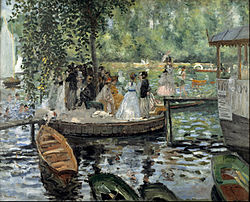 La Grenouillère, 1868, Nationalmuseum, Stockholm
 -
 Portrait of Alfred Sisley, 1868, Foundation E. G. Bührle, Zürich
 -
 In Summer (En été), 1868, Alte Nationalgalerie, Berlin
 -
 Pont-Neuf, 1872, National Gallery of Art, Washington, D.C.
 -
 La Loge (The Theatre Box), 1874, The Courtauld Institute of Art, London
 -
 The Dancer, 1874, National Gallery of Art, Washington, D.C.
 -
 Woman with a Parasol in a Garden, 1875, Thyssen-Bornemisza Museum, Madrid
 -
 Portrait of Claude Monet reading, c. 1875, Musée Marmottan Monet, Paris, France
 -

-
 A Girl with a Watering Can, 1876, National Gallery of Art, Washington, D.C.
 -
 Portrait of Eugène Murer, 1876, Metropolitan Museum of Art, New York
 -
 Mother and Children, 1876, Frick Collection, New York
 -
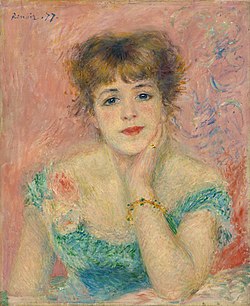 Portrait of Jeanne Samary, 1877, Pushkin Museum, Moscow
 -
 Mme. Charpentier and her children, 1878, Metropolitan Museum of Art, New York
 -
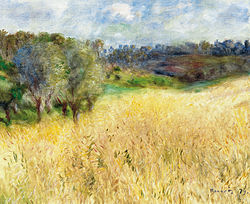 Wheatfield, 1879, Thyssen-Bornemisza Museum, Madrid
 -
 Pierre-Auguste Renoir, Boating on the Seine (La Yole), c. 1879, National Gallery, London
 -
 By the Water, 1880, Art Institute of Chicago, Chicago, Illinois
 -
 The Umbrellas, c. 1880–1886, National Gallery, London
 -
 Young Women in Black, c.1880–1882, Pushkin Museum, Moscow
 -
 Pink and Blue showing Alice and Elisabeth Cahen d'Anvers, 1881, São Paulo Museum of Art, São Paulo
 -
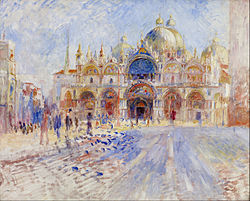 The Piazza San Marco, Venice, 1881 Minneapolis Institute of Art
 -
 Fillette au chapeau bleu, 1881, (Jane Henriot), private collection
 -
 Portrait of Charles and Georges Durand-Ruel, 1882
 -
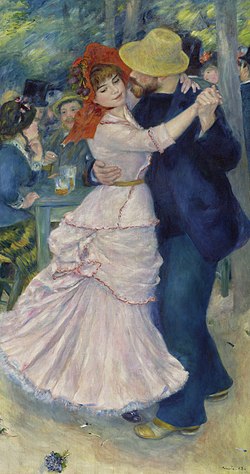 Dance at Bougival, 1882–1883, (woman at left is painter Suzanne Valadon), Boston Museum of Fine Arts
 -
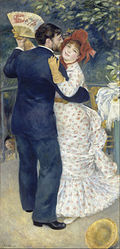 Dance in the Country (Aline Charigot and Paul Lhote), 1883, Musée d'Orsay, Paris
 -
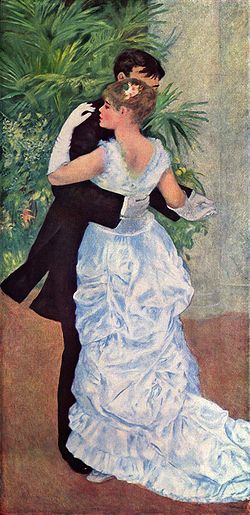 Dance in the City, 1883, Musée d'Orsay, Paris
 -
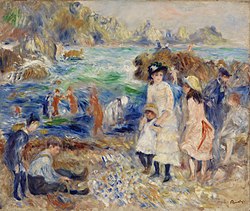 Children at the Beach at Guernsey, 1883, Barnes Foundation, Philadelphia
 -
 Jeune garçon sur la plage d'Yport, 1883, Barnes Foundation, Philadelphia
 -
 Girl With a Hoop, 1885, National Gallery of Art, Washington, D.C.
 -
 Girl Braiding Her Hair (Suzanne Valadon), 1885, Langmatt Museum, Baden
 -
 Still Life with Flowers and Prickly Pears, 1885, Metropolitan Museum of Art, New York
 -
 Portrait of madame Paulin, c. 1885–1890, Israel Museum, Jerusalem
 -
 Paysage à La Roche-Guyon, c. 1887, Pérez Simón Collection, Mexico City
 -
 Julie Manet with cat, 1887, Musée d'Orsay, Paris
 -
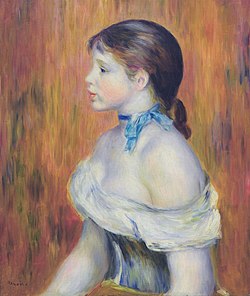
-
 Girls Reading, c. 1890–1891, LACMA, Los Angeles
 -
 Young Girl with Red Hair, 1894, Private Collection
 -
 Christine Lerolle Embroidering, 1895, Columbus Museum of Art
 -
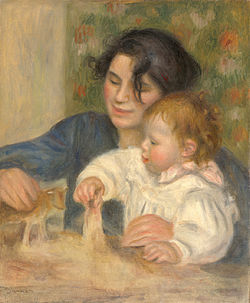
-
 The guitar player, 1896, National Gallery of Victoria, Melbourne
 -
 The Artist's Family, 1896, The Barnes Foundation, Philadelphia
 -

-
 Portrait of Ambroise Vollard, 1908, Courtauld Institute of Art, London
 -
 Portrait of Jean Renoir as a Huntsman, 1910, LACMA, Los Angeles
 -
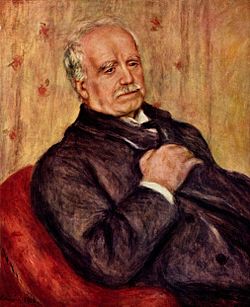 Portrait of Paul Durand-Ruel, 1910
 -
 The Farm at Les Collettes, Cagnes, c. 1908–1914, Metropolitan Museum of Art, New York
 -
 Portrait of Vera Sergine Renoir, 1918, Botero Museum, Bogotá


_-_Pierre-Auguste_Renoir_(National_Gallery_of_Art,_Washington_D.C.).jpg)
_(46499625955).jpg)


_MET_DT1882.jpg)


_-_BF10_-_Barnes_Foundation.jpg)
_-_BF325_-_Barnes_Foundation.jpg)


,_1894.jpg)


_-_BF819_-_Barnes_Foundation.jpg)


.jpg)


Self-portraits
[edit]-
 Self-portrait, 1875
 -
 Self-portrait, 1876
 -
 Self-portrait, 1910
 -
 Self-portrait, 1910


Nudes
[edit]-
 Diana, 1867, The National Gallery of Art, Washington, D.C.
 -
 Nude in the Sun, 1875, Musée d'Orsay, Paris
 -
 Seated Girl, 1883
 -
 The river (Le Fleuve), 1885
 -

-
 Nude in a Landscape, 1887, Princeton University Art Museum
 -
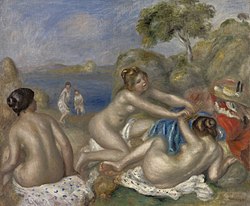 Three Bathers, 1895, Cleveland Museum of Art Cleveland, Ohio
 -
 Nude, National Museum of Serbia, Belgrade
 -
 After The Bath, 1910, Barnes Foundation, Philadelphia
 -
 Woman at the Well, 1910
 -
 Seated Bather Drying Her Leg, 1914, Musée de l'Orangerie, Paris
 -
 Women Bathers, 1916, National Museum, Stockholm
 -
 Bathers, 1918, Barnes Foundation, Philadelphia


_-_Renoir_-_1885.jpg)


Interactive image
[edit]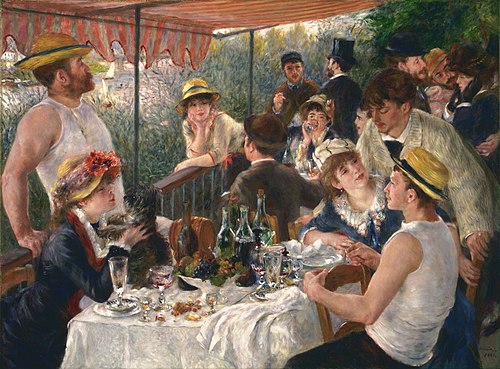
 Clickable image of the Luncheon of the Boating Party (1881) by Pierre-Auguste Renoir (The Phillips Collection, Washington, D.C.). Place your mouse cursor over a person in the painting to see their name; click to link to an article about them.
Close-ups
[edit].jpg)
.jpg)
.jpg)
.jpg)
.jpg)
.jpg)
.jpg)
.jpg)
.jpg)
.jpg)
.jpg)
.jpg)
.jpg)
See also
[edit]
References
[edit]- ^ "Renoir". Random House Webster's Unabridged Dictionary.
- ^ Read, Herbert: The Meaning of Art, page 127. Faber, 1931.
- ^ Renoir, Jean: Renoir, My Father, pages 57–67. Collins, 1962.
- ^ a b Jennings, Guy (2003). History & Techniques of the Great Masters: Renoir. London: Quantum Publishing Ltd. p. 6. ISBN 1861604696.
- ^ Vollard, Ambroise: Renoir, An Intimate Record, pages 24–29. Knopf, 1925.
- ^ Vollard, page 30.
- ^ a b c Distel, Anne. "Renoir, Auguste." Grove Art Online. Oxford Art Online. Oxford University Press. Web. 27 December 2014.
- ^ Wadley, Nicholas: Renoir, A Retrospective, page 15. Park Lane, 1989.
- ^ Renoir, Jean, pages 118–21. Different and less life-threatening versions are offered by Paul Valéry and Vollard. In all accounts, however, their re-acquaintance led to great celebration.
- ^ a b Wadley, page 15.
- ^ Haine, Scott (2000). The History of France (1st ed.). Greenwood Press. p. 112. ISBN 0-313-30328-2.
- ^ a b Brodskaja, Natalja (2010). Impressionism. London: Parkstone Press. p. 114. ISBN 9781844847433.
- ^ Poulet, A. L.; Murphy, A. R. (1979). Corot to Braque: French Paintings from the Museum of Fine Arts, Boston. Boston: The Museum. p. 117. ISBN 0-87846-134-5.
- ^ a b Wadley, p. 25.
- ^ Wadley, pages 371, 374.
- ^ Renoir, Jean (2001). Renoir, My Father. NYRB Classics. p. 200. ISBN 0940322773.
- ^ Wadley, page 28.
- ^ André, Albert: Renoir. Crés, 1928.
- ^ a b c Boonen, Annelies; Rest, Jan van de; Dequeker, Jan; Linden, Sjef van der (20 December 1997). "Boonen, A.; van de Rest, J.; Dequeker, J.; van der Linden, S.: "How Renoir Coped with Rheumatoid Arthritis". British Medical Journal, 1997:315:1704–1708". BMJ. 315 (7123). Bmj.com: 1704–1708. doi:10.1136/bmj.315.7123.1704. PMC 2128020. PMID 9448547. Retrieved 7 April 2012.
- ^ "Renoir Biography, Life & Quotes". The Art Story. Retrieved 7 October 2021.
- ^ "Alexandre Renoir Exhibit at Monthaven Arts & Cultural Center in Hendersonville". news.yahoo.com. 9 May 2018. Retrieved 7 March 2019.
- ^ "La Parisienne, Renoir (1874)". The Guardian. 16 June 2001. Retrieved 29 April 2020.
- ^ "Porträt Mademoiselle Irène Cahen d'Anvers (Die kleine Irene) · Auguste Renoir · Stiftung Sammlung E.G. Bührle". www.buehrle.ch.
- ^ Rey, Robert: La Peinture française à la fin du XIXe siècle, la renaissance du sentiment classique : Degas, Renoir, Cézanne, Gauguin, Seurat, Les Beaux-Arts, Van Oest, 1931 (thesis).
- ^ "From the Tour: Mary Cassatt" Archived 11 November 2004 at the Wayback Machine, August Renoir. Retrieved 7 March 2007.
- ^ Ruggiero, Rocky, Renaissancing Renoir, rockyruggiero.com Making Art and History Come To Life webinar, 19 April 2022
- ^ Clark, Kenneth: The Nude, pages 154–61. Penguin, 1960.
- ^ Asked late in life if he felt an affinity to Ingres, he responded: "I should very much like to", Rey, quoted in Wadley, page 336.
- ^ "For me, Renoir becomes a really great artist in the late nudes, above all in Les Grandes Baigneuses". David Sylvester, quoted by Wadley, page 378
- ^ "Bernheim-Jeune". Archived from the original on 13 July 2015. Retrieved 13 July 2015.
- ^ Wildenstein Institute Archived 13 July 2015 at the Wayback Machine
- ^ Services, Times Wire (18 May 1990). "Renoir Work Sells for $78.1 Million : Auction: The painting 'Au Moulin de la Galette' is highlight of Sotheby's offering of Impressionist and modern art. The price is the second highest ever" – via LA Times.
Further reading
[edit]- Claude Roger-Marx (1952). Les Lithographies de Renoir. Monte-Carlo: Andre Sauret.
- Joseph G. Stella (1975). The Graphic Work of Renoir: Catalogue Raisonne. London: Lund Humphries.
- Jean Leymarie et Michel Melot (1971). Les Gravures Des Impressionistes, Manet, Pissarro, Renoir, Cezanne, Sisley. Paris: Arts et Metiers Graphiques.
- Kang, Cindy. "Auguste Renoir (1841–1919)." In Heilbrunn Timeline of Art History. New York: The Metropolitan Museum of Art, 2000–. (May 2011)
- Michel Melot (1996). The Impressionist Print. New Haven: Yale University Press.
- Theodore Duret (1924). Renoir. Paris: Bernheim-Jeune.
- Paul Haeserts (1947). Renoir Sculpteur. Bruxelles: Hermès.
External links
[edit]

On 7 December 2019 the Alberta Symphony Orchestra presented a Tribute to Renoir at Triffo Theater in Edmonton, Alberta, Canada, under the direction of pianist and conductor Emilio De Mercato, for the 100th anniversary of the death of Renoir.
- 59 artworks by or after Pierre-Auguste Renoir at the Art UK site
- Works by or about Pierre-Auguste Renoir at the Internet Archive
- Avant-Gardist in Retreat, Holland Cotter, The New York Times, 17 June 2010
- Impressionism: a centenary exhibition, an exhibition catalog from The Metropolitan Museum of Art (fully available online as PDF), which contains material on Renoir (p. 179–200)
- Renoir works at the Art Institute of Chicago, a digital catalogue
- . Encyclopædia Britannica (11th ed.). 1911.
- Pierre-Auguste Renoir in American public collections, on the French Sculpture Census website
- Renoir, La Promenade on YouTube, (1:49) Frick Collection
- Renoir, Impressionism, and Full-Length Painting,' An Introduction to the Exhibition on YouTube, (6:14) Frick Collection

| Originators |  | |
|---|---|---|
| Patrons | ||
| Dealers | ||
| Exhibitions | ||
| American artists | ||
| Australian artists | ||
| Canadian artists | ||
| Other artists |
| |
| Other media | ||
| See also | ||
| Related | ||