Hubbry Logo
BiholomorphismBiholomorphismMain
Open search
Biholomorphism
Community hub
Biholomorphism
logo
8 pages, 0 posts
0 subscribers
Be the first to start a discussion here.
Biholomorphism
Biholomorphism
from Wikipedia
The complex exponential function mapping biholomorphically a rectangle to a quarter-annulus.

In the mathematical theory of functions of one or more complex variables, and also in complex algebraic geometry, a biholomorphism or biholomorphic function is a bijective holomorphic function whose inverse is also holomorphic.

Formal definition

[edit]

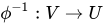
Formally, a biholomorphic function is a function defined on an open subset U of the -dimensional complex space Cn with values in Cn which is holomorphic and one-to-one, such that its image is an open set in Cn and the inverse is also holomorphic. More generally, U and V can be complex manifolds. As in the case of functions of a single complex variable, a sufficient condition for a holomorphic map to be biholomorphic onto its image is that the map is injective, in which case the inverse is also holomorphic.[1]

If there exists a biholomorphism , we say that U and V are biholomorphically equivalent or that they are biholomorphic.

Riemann mapping theorem and generalizations

[edit]

If every simply connected open set other than the whole complex plane is biholomorphic to the unit disc (this is the Riemann mapping theorem). The situation is very different in higher dimensions. For example, open unit balls and open unit polydiscs are not biholomorphically equivalent for In fact, there does not exist even a proper holomorphic function from one to the other.

Alternative definitions

[edit]

In the case of maps f : UC defined on an open subset U of the complex plane C, some authors[2] define a conformal map to be an injective map with nonzero derivative i.e., f’(z)≠ 0 for every z in U. According to this definition, a map f : UC is conformal if and only if f: Uf(U) is biholomorphic. Notice that per definition of biholomorphisms, nothing is assumed about their derivatives, so, this equivalence contains the claim that a homeomorphism that is complex differentiable must actually have nonzero derivative everywhere. Other authors[3] define a conformal map as one with nonzero derivative, but without requiring that the map be injective. According to this weaker definition, a conformal map need not be biholomorphic, even though it is locally biholomorphic, for example, by the inverse function theorem. For example, if f: UU is defined by f(z) = z2 with U = C–{0}, then f is conformal on U, since its derivative f’(z) = 2z ≠ 0, but it is not biholomorphic, since it is 2-1.

References

[edit]
Revisions and contributorsEdit on WikipediaRead on Wikipedia
from Grokipedia
A biholomorphism is a bijective holomorphic mapping f:Ω1Ω2f: \Omega_1 \to \Omega_2 between open subsets Ω1,Ω2Cn\Omega_1, \Omega_2 \subseteq \mathbb{C}^n such that its inverse f1:Ω2Ω1f^{-1}: \Omega_2 \to \Omega_1 is also holomorphic. In complex analysis, biholomorphic maps preserve the underlying complex structure of domains and manifolds, enabling the classification of geometric objects up to biholomorphic equivalence, where two spaces are considered equivalent if a biholomorphism exists between them. This equivalence is fundamental because it transfers analytic properties: a function on one domain is holomorphic if and only if its composition with a biholomorphism is holomorphic on the equivalent domain. In one complex variable (n=1n=1), the Riemann mapping theorem asserts that every simply connected proper open subset of C\mathbb{C} is biholomorphic to the unit disk D={zC:z<1}\mathbb{D} = \{ z \in \mathbb{C} : |z| < 1 \}, providing a canonical model for such domains and highlighting the flexibility of biholomorphic classification in this setting. However, in several complex variables (n2n \geq 2), the theory becomes more rigid; for instance, the unit ball Bn={zCn:z<1}B^n = \{ z \in \mathbb{C}^n : \|z\| < 1 \} and the unit polydisk Dn={zCn:zj<1 j=1,,n}D^n = \{ z \in \mathbb{C}^n : |z_j| < 1 \ \forall j = 1, \dots, n \} are biholomorphically inequivalent, as demonstrated by differences in their automorphism groups and boundary behavior./01%3A_Holomorphic_Functions_in_Several_Variables/1.04%3A_Inequivalence_of_Ball_and_Polydisc) Biholomorphisms extend naturally to complex manifolds, where they serve as structure-preserving isomorphisms, and their study reveals deep connections to Lie groups, rigidity phenomena, and applications in geometry and physics.

Fundamentals

Definition

A biholomorphic function, or biholomorphism, is a central concept in complex analysis that establishes a strong form of equivalence between domains in complex space. Holomorphic functions, which form the foundation for biholomorphisms, are complex-valued functions that are differentiable in the complex sense on an open set, meaning they satisfy the Cauchy-Riemann equations and possess a complex derivative everywhere in that domain. Formally, a function ϕ:UV\phi: U \to V between open connected subsets U,VCnU, V \subset \mathbb{C}^n is biholomorphic if it is holomorphic, bijective onto its image, and its inverse ϕ1:VU\phi^{-1}: V \to U is also holomorphic. The bijectivity condition ensures that ϕ\phi is an isomorphism in the category of complex domains, and the holomorphy of the inverse follows locally from the holomorphic inverse function theorem: if ϕ\phi is holomorphic and its Jacobian matrix (or derivative in one variable) is invertible at a point, then ϕ\phi is locally biholomorphic near that point with a holomorphic local inverse. Two domains UU and VV in Cn\mathbb{C}^n are said to be biholomorphically equivalent if there exists a biholomorphism ϕ:UV\phi: U \to V. This equivalence relation classifies complex domains up to holomorphic coordinate changes, preserving their intrinsic complex structure.

Basic Properties

Biholomorphisms exhibit conformality, meaning they preserve angles and orientation locally at every point. This follows from the fact that a biholomorphic map ϕ:ΩΩ\phi: \Omega \to \Omega' between open sets in C\mathbb{C} is holomorphic with ϕ(z)0\phi'(z) \neq 0 everywhere, as non-zero derivatives of holomorphic functions act as complex linear isomorphisms on tangent spaces, scaling and rotating but not reflecting. Biholomorphisms inherit the open mapping property from non-constant holomorphic functions, ensuring that the image of any open set under ϕ\phi is open in Cn\mathbb{C}^n. Since ϕ\phi is bijective and its inverse ϕ1\phi^{-1} is also holomorphic (hence non-constant), this property holds globally, distinguishing biholomorphisms from general holomorphic maps that may not be surjective or injective. As isomorphisms of complex manifolds, biholomorphisms preserve the underlying complex structure, mapping holomorphic functions on Ω\Omega bijectively to those on Ω\Omega' and inducing isomorphisms on sheaves of holomorphic sections. They also preserve holomorphic differential forms, as the pullback under ϕ\phi maintains the (p,q)(p,q)-type decomposition in the complexified cotangent bundle. Locally, near any point z0Ωz_0 \in \Omega, a biholomorphism ϕ\phi admits a multivariable power series (Taylor) expansion, where the linear term is given by the Jacobian matrix Dϕ(z0)D\phi(z_0) which is invertible, ensuring the map is a local biholomorphism by the inverse function theorem for holomorphic functions. This representation underscores the local invertibility and analyticity central to biholomorphic equivalence.

Results in One Complex Variable

Riemann Mapping Theorem

The Riemann mapping theorem states that any simply connected open subset UU of the complex plane C\mathbb{C}, where UCU \neq \mathbb{C}, is biholomorphic to the unit disk D={zC:z<1}\mathbb{D} = \{ z \in \mathbb{C} : |z| < 1 \}. More precisely, for any point aUa \in U, there exists a unique biholomorphism f:UDf: U \to \mathbb{D} such that f(a)=0f(a) = 0 and f(a)>0f'(a) > 0. This normalization ensures the mapping is uniquely determined up to automorphisms of the unit disk. The theorem was first stated by in his 1851 doctoral dissertation, where he sketched the result as part of his work on conformal mappings and Riemann surfaces. Although Riemann's argument relied on the Dirichlet principle, which faced criticism for lacking rigor, the first rigorous proofs for the general case were provided independently by and Paul Koebe in 1907. An influential treatment integrating the theorem into the broader framework of Riemann surfaces was provided by in his 1913 book Die Idee der Riemannschen Fläche. The existence of the biholomorphism is established using the theory of normal families and . Consider the family of holomorphic functions on UU that map into D\mathbb{D}, fix aa to 0, have positive at aa, and are injective; this family is uniformly bounded and thus normal by , allowing extraction of a convergent subsequence to a limit function. The limit is shown to be injective via Hurwitz's theorem and onto D\mathbb{D} by maximizing the derivative at aa and using properties of simply connected domains, such as the existence of analytic square roots. Uniqueness follows from the Schwarz lemma applied to the composition of two such mappings, implying they differ by an of D\mathbb{D}, which is eliminated by the normalization conditions. As a consequence, all simply connected proper subsets of C\mathbb{C} are conformally equivalent to one another via biholomorphisms.

Automorphisms and the Unit Disk

The of the unit disk D={zC:z<1}\mathbb{D} = \{ z \in \mathbb{C} : |z| < 1 \}, denoted Aut(D)\operatorname{Aut}(\mathbb{D}), consists of all biholomorphic maps from D\mathbb{D} to itself. These automorphisms are precisely the Möbius transformations of the form ϕ(z)=eiθza1aˉz,\phi(z) = e^{i\theta} \frac{z - a}{1 - \bar{a} z}, where a<1|a| < 1 and θR\theta \in \mathbb{R}. This explicit parametrization shows that each automorphism is determined by a point aDa \in \mathbb{D} (specifying a "translation") and a rotation angle θ\theta. The group Aut(D)\operatorname{Aut}(\mathbb{D}) acts transitively on D\mathbb{D}, meaning that for any two points z1,z2Dz_1, z_2 \in \mathbb{D}, there exists ϕAut(D)\phi \in \operatorname{Aut}(\mathbb{D}) such that ϕ(z1)=z2\phi(z_1) = z_2. The stabilizer of the origin, {ϕAut(D):ϕ(0)=0}\{ \phi \in \operatorname{Aut}(\mathbb{D}) : \phi(0) = 0 \}, comprises the rotations zeiθzz \mapsto e^{i\theta} z. This structure classifies Aut(D)\operatorname{Aut}(\mathbb{D}) up to conjugation as the group PSU(1,1)\operatorname{PSU}(1,1), the projective special unitary group of signature (1,1), which plays a key role in normalizing domains via the Riemann mapping theorem. In hyperbolic geometry, the biholomorphisms of D\mathbb{D} correspond exactly to the orientation-preserving isometries of the Poincaré disk model, where the hyperbolic metric is given by ds2=4dz2(1z2)2ds^2 = \frac{4|dz|^2}{(1 - |z|^2)^2}. These isometries preserve the hyperbolic distance, ensuring that Aut(D)\operatorname{Aut}(\mathbb{D}) realizes the full group of symmetries for the model. On the extended complex plane C^=C{}\hat{\mathbb{C}} = \mathbb{C} \cup \{\infty\}, known as the Riemann sphere, the automorphism group consists of all Möbius transformations ϕ(z)=az+bcz+d\phi(z) = \frac{az + b}{cz + d} with adbc0ad - bc \neq 0. For proper subdomains like D\mathbb{D}, the automorphisms are the subgroup of those Möbius transformations that map D\mathbb{D} bijectively to itself, restricting the full group to preserve the domain boundary in the spherical metric.

Equivalent Characterizations

Conformal Mappings

In complex analysis, a conformal mapping is defined as a holomorphic function f:UVf: U \to V between open domains U,VCU, V \subset \mathbb{C} such that f(z)0f'(z) \neq 0 for all zUz \in U. This condition ensures that the mapping preserves angles between intersecting curves at every point, up to orientation, because the derivative f(z)f'(z) acts as a complex multiplication, which scales and rotates tangent vectors uniformly without distortion. In the setting of one complex variable, biholomorphisms between domains in C\mathbb{C} are precisely the bijective conformal mappings. An injective holomorphic function with non-vanishing derivative is locally biholomorphic by the holomorphic inverse function theorem, and global injectivity ensures that the local inverses patch together to form a single-valued holomorphic inverse on the image, making the map a biholomorphism onto its image. This equivalence holds for connected open sets, as the monodromy theorem guarantees unique analytic continuation of the inverse branches without branching issues when the map is injective. Geometrically, conformal mappings preserve local shapes by maintaining the conformal modulus of quadrilaterals and the angles of infinitesimal figures, facilitating the study of domain equivalences. A prominent class of such maps, the Möbius transformations (rational functions of the form f(z)=az+bcz+df(z) = \frac{az + b}{cz + d} with adbc0ad - bc \neq 0), are biholomorphisms of the extended complex plane C^\hat{\mathbb{C}} that map generalized circles (circles or straight lines) to generalized circles, underscoring their role in preserving Euclidean and hyperbolic geometries. The notion of conformality in complex analysis differs from that in real multivariable calculus, where angle-preserving maps (with orthogonal Jacobian matrices up to scaling) may lack the global analyticity imposed by holomorphy; the complex version requires infinite differentiability and satisfies the Cauchy-Riemann equations, yielding stronger rigidity and orientation preservation.

Alternative Definitions

In the context of complex manifolds, a biholomorphism can be defined as an isomorphism between two complex manifolds MM and NN, meaning a bijective holomorphic map f:MNf: M \to N such that the induced map on structure sheaves f:ONfOMf^*: \mathcal{O}_N \to f_*\mathcal{O}_M is an isomorphism of sheaves of rings, ensuring that the inverse f1f^{-1} is also holomorphic with respect to the atlas charts where transition maps are biholomorphic. This formulation emphasizes the compatibility with the complex structure, where local coordinate charts ϕi:UiDiCn\phi_i: U_i \to D_i \subset \mathbb{C}^n on MM and ψj:VjEjCn\psi_j: V_j \to E_j \subset \mathbb{C}^n on NN satisfy that ψjfϕi1\psi_j \circ f \circ \phi_i^{-1} is biholomorphic on its domain. Equivalence to the standard definition follows from the fact that such isomorphisms preserve the holomorphic functions on open sets, as shown by the compatibility of transition functions in the atlases. Another variant arises in the study of domains in Cn\mathbb{C}^n, where a biholomorphism is characterized as a local biholomorphism— a holomorphic map with non-vanishing complex Jacobian determinant—that extends to a global biholomorphism via analytic continuation, particularly when the domains are simply connected. In one complex variable, for simply connected domains, the monodromy theorem ensures that local inverses glue uniquely to a global holomorphic inverse, provided the map is bijective. This extension relies on the path-connectedness and simply connectedness, allowing analytic continuation along paths without branching. A common misconception is the existence of holomorphic bijections between domains in Cn\mathbb{C}^n whose inverses are not holomorphic; however, no such examples exist, as the implicit function theorem guarantees that a holomorphic map with non-vanishing Jacobian is locally biholomorphic, and global bijectivity ensures the continuous global inverse is holomorphic everywhere by the identity theorem on overlaps of local charts. Historically, early formulations in several complex variables described biholomorphisms near a point via formal power series expansions in C[[zp]]\mathbb{C}[[z - p]] with an invertible Jacobian matrix at pp, ensuring local invertibility in the formal category before convergence is established. This approach, rooted in the work on normal forms for mappings, predates modern sheaf-theoretic definitions and focused on the convergence of series under non-degeneracy conditions of the Jacobian.

Examples and Applications

Specific Examples

A fundamental example of a biholomorphism is the affine transformation ϕ(z)=az+b\phi(z) = az + b, where a0a \neq 0 and bCb \in \mathbb{C}. This map is holomorphic on the entire complex plane C\mathbb{C} and bijective onto C\mathbb{C}, with inverse ϕ1(w)=(wb)/a\phi^{-1}(w) = (w - b)/a, establishing it as a biholomorphism from C\mathbb{C} to itself. Another illustrative example is the exponential map exp(z)\exp(z), which serves as a biholomorphism from the horizontal strip {zC:Imz<π/2}\{z \in \mathbb{C} : |\operatorname{Im} z| < \pi/2\} onto C(,0]\mathbb{C} \setminus (-\infty, 0]. The inverse is a branch of the complex logarithm, confirming the bijectivity and holomorphy in both directions. On the punctured complex plane C{0}\mathbb{C} \setminus \{0\}, the power maps zzkz \mapsto z^k for integer k0k \neq 0 are biholomorphic precisely when k=1|k| = 1, i.e., the maps zazz \mapsto az (with a0a \neq 0) and za/zz \mapsto a/z (with a0a \neq 0). These are holomorphic, injective, and surjective on C{0}\mathbb{C} \setminus \{0\}, with inverses of the same form. In contrast, the squaring map zz2z \mapsto z^2 on C{0}\mathbb{C} \setminus \{0\} is holomorphic but fails to be a biholomorphism, as it is two-to-one (not injective) while being surjective onto C{0}\mathbb{C} \setminus \{0\}. The automorphisms of the unit disk provide a class of non-trivial biholomorphisms from the disk to itself, given by Möbius transformations of the form eiθaz1aze^{i\theta} \frac{a - z}{1 - \overline{a} z} for θR\theta \in \mathbb{R} and a<1|a| < 1.

Applications in Complex Analysis

Biholomorphisms play a central role in the uniformization theorem, which classifies simply connected Riemann surfaces up to biholomorphic equivalence by showing that each is biholomorphic to one of three canonical models: the Riemann sphere, the complex plane, or the unit disk. This theorem, proved independently by Henri Poincaré and Paul Koebe in 1907, provides a foundational tool for understanding the global structure of Riemann surfaces through conformal equivalence. The Riemann mapping theorem serves as a key enabler for this result in the simply connected case. In solving boundary value problems, biholomorphisms simplify the Dirichlet problem for the Laplace equation by mapping arbitrary simply connected domains to the unit disk, where solutions can be explicitly constructed using the Poisson integral formula. This mapping preserves harmonic functions up to composition, allowing boundary data on the original domain to be transformed and solved in the disk before pulling back the result. Such techniques reduce computational complexity for irregular boundaries in potential theory. Biholomorphisms facilitate the transfer of function-theoretic properties between domains, such as boundedness, the location of zeros, or analytic continuation, by composing holomorphic functions across the mapping. For instance, if a function is bounded on one domain, its composition with a biholomorphism yields a bounded function on the equivalent domain, preserving essential analytic behaviors. Historically, Bernhard Riemann applied conformal mappings—precursors to modern biholomorphisms—in his 1851 habilitation thesis to model electrostatic fields and incompressible fluid flows, leveraging their angle-preserving invariance to solve two-dimensional potential problems. This work laid the groundwork for using biholomorphisms in physical applications, influencing developments in both electrostatics and hydrodynamics.

Extension to Several Complex Variables

Definitions and Distinctions

In several complex variables, a biholomorphic map ϕ:UV\phi: U \to V between open subsets U,VCnU, V \subset \mathbb{C}^n is defined as a holomorphic function that is bijective onto VV with a holomorphic inverse ϕ1:VU\phi^{-1}: V \to U. This condition implies that the Jacobian matrix of ϕ\phi is invertible everywhere in UU, ensuring local bijectivity and smoothness of the inverse. In contrast to the one-variable case, where biholomorphisms are simply conformal equivalences of Riemann surfaces, the higher-dimensional setting introduces additional rigidity due to the multivariable nature of holomorphy. A key distinction from the one-variable theory is the absence of a Riemann mapping theorem analog; not every bounded domain in Cn\mathbb{C}^n for n>1n > 1 is biholomorphic to the unit ball. For instance, the unit ball Bn={zCn:z<1}\mathbb{B}^n = \{ z \in \mathbb{C}^n : \|z\| < 1 \} and the unit polydisk Dn={zCn:zj<1 j}\mathbb{D}^n = \{ z \in \mathbb{C}^n : |z_j| < 1 \ \forall j \} are not biholomorphic when n>1n > 1, as demonstrated by Poincaré through of their automorphism groups and invariants akin to Cartan's uniqueness theorem, which enforces strict conditions on maps fixing a point with the identity. Local biholomorphisms exist generically by the for holomorphic maps: if the is invertible at a point, there is a neighborhood where ϕ\phi is biholomorphic. However, extending such maps globally across a domain is far more restrictive in higher dimensions, often failing due to topological or analytic obstructions absent in one variable. On complex manifolds, biholomorphisms are smooth diffeomorphisms that preserve the complex (holomorphic in local coordinates) with holomorphic inverses, extending the domain via charts. When the manifolds are Kähler, such maps pull back the Kähler form to another Kähler form compatible with the , preserving the metric up to a conformal scalar factor in the Hermitian sense.

Properties and Limitations

In several complex variables, biholomorphisms between strictly pseudoconvex domains exhibit significant rigidity, particularly regarding their behavior at the boundary. Specifically, a biholomorphic mapping between two bounded strictly pseudoconvex domains with C1C^1 boundaries extends continuously to the boundary as a . This extension result, known as Fefferman's extension theorem, implies that such biholomorphisms are uniquely determined by their boundary values, highlighting a form of boundary rigidity that contrasts with the more flexible situation in one variable. Further refinements show that if the boundaries are CC^\infty, the extension is a CC^\infty-, while for real-analytic boundaries, it is real-analytic. A notable limitation arises in the non-equivalence of certain model domains: there exist no proper holomorphic mappings from the unit polydisk Δn\Delta^n in Cn\mathbb{C}^n (n2n \geq 2) onto the unit ball BnB_n. This absence implies that the unit ball and polydisk are not biholomorphically equivalent, despite both being bounded pseudoconvex domains. The result underscores the geometric rigidity of biholomorphisms, as even proper (but non-bijective) maps fail between these domains, preventing any holomorphic equivalence. Cartan's uniqueness theorem provides another key rigidity property for automorphisms of bounded domains. For a bounded domain ΩCn\Omega \subset \mathbb{C}^n (n1n \geq 1), if f:ΩΩf: \Omega \to \Omega is a biholomorphic automorphism fixing a point pΩp \in \Omega with differential Df(p)=IDf(p) = I (the identity), then ff is the identity map on Ω\Omega. This theorem, originally proved by , extends to show that automorphisms fixing the origin are linear fractional transformations when Ω\Omega is the unit ball, but in general bounded domains, the fixed-point condition forces linearity at that point. Such uniqueness highlights the limited flexibility of automorphism groups in higher dimensions compared to one variable. Limitations of biholomorphisms also manifest in their interaction with global analytic on Stein manifolds. Oka's theorem asserts that Stein manifolds satisfy the holomorphic : any continuous map from a Stein space to an Oka manifold (a generalization of Stein) is homotopic to a holomorphic map, and under certain conditions, biholomorphisms preserve this Oka . However, non-biholomorphic mappings can fail to preserve solvability of the problems; for instance, while the first problem (constructing meromorphic functions with prescribed ) is always solvable on Stein manifolds, pulling back solutions under a non-biholomorphic proper map from a non-Stein domain may encounter obstructions, leading to failures in coherence or extension. This illustrates how biholomorphisms rigidly preserve the Stein structure essential for such analytic solvability, whereas weaker maps do not.

References

Add your contribution
Related Hubs
User Avatar
No comments yet.