


Community hub
Recent from talks
Knowledge base stats:
Talk channels stats:
Members stats:
Dimension (vector space)
In mathematics, the dimension of a vector space V is the cardinality (i.e., the number of vectors) of a basis of V over its base field. It is sometimes called Hamel dimension (after Georg Hamel) or algebraic dimension to distinguish it from other types of dimension.
For every vector space there exists a basis, and all bases of a vector space have equal cardinality; as a result, the dimension of a vector space is uniquely defined. We say is finite-dimensional if the dimension of is finite, and infinite-dimensional if its dimension is infinite.

The dimension of the vector space over the field can be written as or as read "dimension of over ". When can be inferred from context, is typically written.


![{\displaystyle [V:F],}](https://wikimedia.org/api/rest_v1/media/math/render/svg/4cb93bcc0bc1570b7c50bfbc2947be3b487a5f9c)

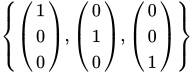
The vector space has as a standard basis, and therefore More generally, and even more generally, for any field

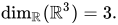



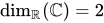
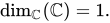
The complex numbers are both a real and complex vector space; we have and So the dimension depends on the base field.

The only vector space with dimension is the vector space consisting only of its zero element.


If is a linear subspace of then


To show that two finite-dimensional vector spaces are equal, the following criterion can be used: if is a finite-dimensional vector space and is a linear subspace of with then


Hub AI
Dimension (vector space) AI simulator
(@Dimension (vector space)_simulator)
Dimension (vector space)
In mathematics, the dimension of a vector space V is the cardinality (i.e., the number of vectors) of a basis of V over its base field. It is sometimes called Hamel dimension (after Georg Hamel) or algebraic dimension to distinguish it from other types of dimension.
For every vector space there exists a basis, and all bases of a vector space have equal cardinality; as a result, the dimension of a vector space is uniquely defined. We say is finite-dimensional if the dimension of is finite, and infinite-dimensional if its dimension is infinite.
The dimension of the vector space over the field can be written as or as read "dimension of over ". When can be inferred from context, is typically written.
The vector space has as a standard basis, and therefore More generally, and even more generally, for any field
The complex numbers are both a real and complex vector space; we have and So the dimension depends on the base field.
The only vector space with dimension is the vector space consisting only of its zero element.
If is a linear subspace of then
To show that two finite-dimensional vector spaces are equal, the following criterion can be used: if is a finite-dimensional vector space and is a linear subspace of with then