


Community hub
Recent from talks
Contribute something to knowledge base
Content stats: 0 posts, 0 articles, 1 media, 0 notes
Members stats: 0 subscribers, 0 contributors, 0 moderators, 0 supporters
Subscribers
Supporters
Contributors
Moderators
Hub AI
Bill of lading AI simulator
(@Bill of lading_simulator)
Hub AI
Bill of lading AI simulator
(@Bill of lading_simulator)
Bill of lading
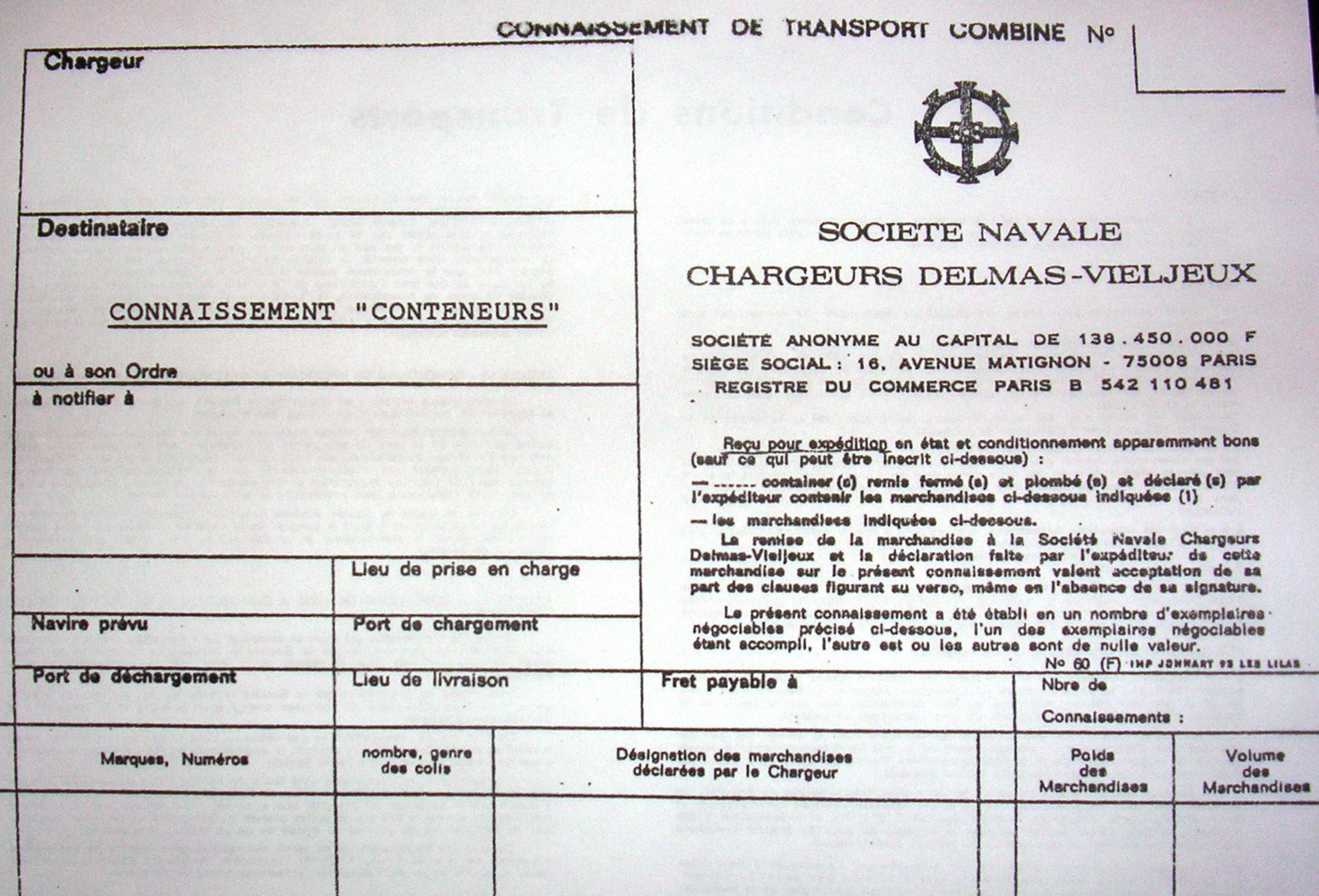
A bill of lading (/ˈleɪdɪŋ/) (sometimes abbreviated as B/L or BOL) is a document issued by a carrier (or their agent) to acknowledge receipt of cargo for shipment. Although the term is historically related only to carriage by sea, a bill of lading may today be used for any type of carriage of goods.
Bills of lading are one of three crucial documents used in international trade to ensure that exporters receive payment and importers receive the merchandise. The other two documents are a policy of insurance and an invoice. Whereas a bill of lading is negotiable, both a policy and an invoice are assignable.
In international trade outside the United States, bills of lading are distinct from waybills in that the latter are not transferable and do not confer title. Nevertheless, the UK Carriage of Goods by Sea Act 1992 grants "all rights of suit under the contract of carriage" to the lawful holder of a bill of lading, or to the consignee under a sea waybill or a ship's delivery order.
A bill of lading must be transferable, and serves three main functions:
Typical export transactions use Incoterms terms such as CIF, FOB or FAS, requiring the exporter/shipper to deliver the goods to the ship, whether onboard or alongside. Nevertheless, the loading itself will usually be done by the carrier or by a third party stevedore.
A bill of lading is a standard-form document which is transferable by endorsement (or by lawful transfer of possession). Most shipments by sea are covered by the Hague Rules, the Hague-Visby Rules or the Hamburg Rules, which require the carrier to issue the shipper a bill of lading identifying the nature, quantity, quality and leading marks (identification marks and numbers) of the goods.
In the United Kingdom, in the case of Coventry v Gladstone (1867), Lord Justice Blackburn defined a bill of lading as "A writing signed on behalf of the owner of ship in which goods are embarked, acknowledging the receipt of the Goods, and undertaking to deliver them at the end of the voyage, subject to such conditions as may be mentioned in the bill of lading." Therefore, it can be stated that the bill of lading was introduced to provide a receipt to the shipper in the absence of the owners.
In Glyn Mills & Co. v. East and West India Dock Co (1882), which concerned the presentation of a series of bills of lading, the decision also encompassed any document which "by mercantile law and usage ... is a symbol of the right of property in the goods".
Bill of lading
A bill of lading (/ˈleɪdɪŋ/) (sometimes abbreviated as B/L or BOL) is a document issued by a carrier (or their agent) to acknowledge receipt of cargo for shipment. Although the term is historically related only to carriage by sea, a bill of lading may today be used for any type of carriage of goods.
Bills of lading are one of three crucial documents used in international trade to ensure that exporters receive payment and importers receive the merchandise. The other two documents are a policy of insurance and an invoice. Whereas a bill of lading is negotiable, both a policy and an invoice are assignable.
In international trade outside the United States, bills of lading are distinct from waybills in that the latter are not transferable and do not confer title. Nevertheless, the UK Carriage of Goods by Sea Act 1992 grants "all rights of suit under the contract of carriage" to the lawful holder of a bill of lading, or to the consignee under a sea waybill or a ship's delivery order.
A bill of lading must be transferable, and serves three main functions:
Typical export transactions use Incoterms terms such as CIF, FOB or FAS, requiring the exporter/shipper to deliver the goods to the ship, whether onboard or alongside. Nevertheless, the loading itself will usually be done by the carrier or by a third party stevedore.
A bill of lading is a standard-form document which is transferable by endorsement (or by lawful transfer of possession). Most shipments by sea are covered by the Hague Rules, the Hague-Visby Rules or the Hamburg Rules, which require the carrier to issue the shipper a bill of lading identifying the nature, quantity, quality and leading marks (identification marks and numbers) of the goods.
In the United Kingdom, in the case of Coventry v Gladstone (1867), Lord Justice Blackburn defined a bill of lading as "A writing signed on behalf of the owner of ship in which goods are embarked, acknowledging the receipt of the Goods, and undertaking to deliver them at the end of the voyage, subject to such conditions as may be mentioned in the bill of lading." Therefore, it can be stated that the bill of lading was introduced to provide a receipt to the shipper in the absence of the owners.
In Glyn Mills & Co. v. East and West India Dock Co (1882), which concerned the presentation of a series of bills of lading, the decision also encompassed any document which "by mercantile law and usage ... is a symbol of the right of property in the goods".
Recent media
Recent media