


Community hub
Recent from talks
Contribute something
Nothing was collected or created yet.
Dockworker
View on Wikipedia

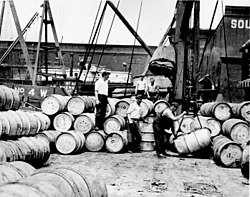
A dockworker (also called a docker, longshoreman, lumper, stevedore, wharfie, or wharfman) is a waterfront manual laborer who loads and unloads ships.[1]
As a result of the intermodal shipping container revolution, the required number of dockworkers has declined by over 90% since the 1960s.[2][failed verification]
Etymology
[edit]The word stevedore (/ˈstiːvɪˌdɔːr/) originated in Portugal or Spain, and entered the English language through its use by sailors.[3] It started as a phonetic spelling of estivador (Portuguese) or estibador (Spanish), meaning a man who loads ships and stows cargo, which was the original meaning of stevedore (though there is a secondary meaning of "a man who stuffs" in Spanish); compare Latin stīpāre meaning to stuff, as in to fill with stuffing. In Ancient and Modern Greek, the verb στοιβάζω (stivazo) means pile up.[4][5] In Great Britain and Ireland, people who load and unload ships are usually called dockers; in Australia, they are called stevedores, dockworkers or wharfies; and, in the United States and Canada, the term longshoreman, derived from man-along-the-shore (or alongshore + man), is used.[6][7] Before the extensive use of container ships and shore-based handling machinery in the United States, longshoremen referred exclusively to the dockworkers, while stevedores, part of a separate trade union, worked on the ships operating their cranes and moving cargo.
History
[edit]Dockworkers, also known as longshoremen and stevedores, have existed since ancient times. The role of dockworkers has evolved significantly over the centuries as maritime trade has grown and modernized:
- Ancient times: The Phoenicians, Greeks, and Romans all relied on dockworkers to load and unload cargo from ships at port cities such as Carthage, Athens, and Ostia.[8][9][10][11]
- Medieval period: In the Middle Ages, dockworkers played a crucial role in the trade networks of Europe. The Hanseatic League, a powerful trading confederation in Northern Europe, employed dockworkers to handle goods at major ports like Lübeck and Bruges.[12]
- Industrial Revolution: The Industrial Revolution brought steam-powered ships and railways, leading to increased trade volumes and the need for more efficient handling of cargo. Dockworkers organized into unions to protect worker rights and improve working conditions, leading to the formation of organizations such as the International Longshoremen's Association in the United States.[13]
- Containerization: The latter 20th century saw the introduction of containerization, which revolutionized the shipping industry by standardizing how goods were transported, leading to faster turnaround times and increased efficiency. Dockworker use declined by 90%, with those remaining principally operating heavy machinery such as cranes.[14][15] A dramatic increase in global trade was seen, a result of improved technology and liberalized trade treaties.[16]
Loading and unloading ships
[edit]| Admiralty and maritime law |
|---|
 |
| History |
| Features |
| Contract of carriage / charterparty |
| Parties |
| Judiciaries |
| International organizations |
| International conventions |
|
| International Codes |
Loading and unloading ships requires knowledge of the operation of loading equipment, the proper techniques for lifting and stowing cargo, and the correct handling of hazardous materials. In addition, workers must be physically strong and able to follow orders attentively. Many longshoremen are needed to unload a ship. A ship can only be at a port for a limited amount of time, so their work must be completed quickly.
In earlier days before the introduction of containerization, men who loaded and unloaded ships had to tie down cargoes with rope. A type of stopper knot is called the stevedore knot. Securely tying up parcels of goods is called stevedore lashing or stevedore knotting. While loading a general cargo vessel, they use dunnage, which are pieces of wood (or nowadays sometimes strong inflatable dunnage bags) set down to keep the cargo out of any water that might be lying in the hold or are placed as shims between cargo crates for load securing.
Today, the vast majority of non-bulk cargo is transported in intermodal containers.[17] The containers arrive at a port by truck, rail, or another ship and are stacked in the port's storage area. When the vessel that will be transporting them arrives, the containers it is offloading are unloaded by a crane. The containers either leave the port by truck or rail or are stored until they are placed on another ship. Once the ship is offloaded, the containers it leaves with are brought to the dock by truck. A crane lifts the containers from the trucks onto the ship. As the containers pile up on the ship, the workers connect them to the vessel and the other already-placed containers. The jobs involved include the crane operators, the workers who connect the containers to the ship and each other, the truck drivers who transport the containers from the dock and storage area, the workers who track the containers in the storage area as they are loaded and unloaded, as well as various supervisors. Those workers at the port who handle and move the containers are likely to be considered stevedores or dockworkers.
Before containerization, freight was often handled with a longshoreman’s hook, a tool which became emblematic of the profession (mainly on the west coast of the United States and Canada).[18]
Traditionally, stevedores had no fixed job but would arrive at the docks in the morning seeking employment for the day. London dockers called this practice standing on the stones,[19] while in the United States, it was referred to as shaping up or assembling for the shape-up.[20][21]
Dock workers have been a prominent part of the modern labor movement.[22]


Notable dockworkers
[edit] | This section needs additional citations for verification. (April 2021) |
Former stevedores and dockworkers include:
- Crispus Attucks – American patriot
- Harry Bridges – founder of the International Longshore and Warehouse Union (ILWU)
- Joey Coyle – basis for the movie Money for Nothing
- Jack Dash – British dock workers' trade union leader
- Peter Fraser – Prime Minister of New Zealand (1940–1949)
- Danny Greene – American mobster
- Eric Hoffer – philosopher and social critic
- Patrick Joseph "P.J." Kennedy – American businessman and grandfather of 35th U.S. President John F. Kennedy
- Keith William Richards – Actor
- Artie Lange – actor and comedian
- Tom Mann – British trade unionist and organizer of the London Dock Strike of 1889
- Peter MacKay – Canadian former government minister and conservative party leader (a stevedore for two summers while a teenager)[23]
- Bruce Nelson – labor historian, author of Workers on the Waterfront
- Benito Quinquela Martín – painter from Buenos Aires, Argentina. His works reflect the work at the docks in La Boca, a portuary district of Buenos Aires.
- Stan Weir – blue-collar intellectual and sociologist, founder of Singlejack Press
In popular culture
[edit]- In 1949, reporter Malcolm Johnson was awarded a Pulitzer Prize for a 24-part investigative series titled Crime on the Waterfront, published in the New York Sun.
- The material from Malcolm Johnson's investigative series was fictionalized and used as a basis for the influential film On the Waterfront (1954), starring Marlon Brando as a longshoreman, and the working conditions on the docks figure significantly in the film's plot. On the Waterfront was a critical and commercial success that received twelve Academy Award nominations and won eight, including Best Picture, Best Actor for Brando, Best Supporting Actress for Eva Marie Saint, and Best Director for Elia Kazan. The American Film Institute ranked it the 8th-greatest American movie of all time in 1997 and 19th in 2007.[24]
- Playwright Arthur Miller was involved in the early stages of the development of On the Waterfront; his play A View from the Bridge (1955) also deals with the troubled life of a longshoreman.[25]
- In season 2 of the HBO series The Wire, which first aired in 2003, the Stevedore Union and its members working in Baltimore, particularly Frank Sobotka, figure prominently in the second season's story.[26][27]
- The 2013 video game Grand Theft Auto V features a character, Floyd Hebert, who works as a longshoreman at the city port. One of the main characters, Trevor Philips, uses Floyd's job to prepare a cargo ship robbery during the game's storyline.
See also
[edit]
- 1913 Sligo Dock strike
- Admiralty law
- Battle of Ballantyne Pier (Canada)
- Dockers Union (disambiguation)
- Dunnage
- Federated Ship Painters and Dockers Union
- History of Squamish and Tsleil-Waututh longshoremen, 1863–1963
- International Longshore and Warehouse Union (United States)
- Liverpool dockers' strike (1995–98) (UK)
- Mersey Docks and Harbour Company
- Mudlark
- National Union of Dock Labourers
- Scottish Union of Dock Labourers
- Teamster
- Weeks Marine
- 2024 United States port strike
References
[edit]- ^ "Dockworker". Dictionary.com. Retrieved August 27, 2023.
- ^ Khan, Khalil U. (15 September 2014). "Stevedoring & The Role of Stevedores in Shipping". The International Institute of Marine Surveying (IIMS). Retrieved 7 April 2021.
- ^ David Maclachlan (1875). A Treatise on the Law of Merchant Shipping. W. Maxwell & Son. pp. 387–.
- ^ "Modern Greek Verbs – στοιβάζω, στοίβαξα, στοιβάχτηκα, στοιβαγμένος – I pile up". moderngreekverbs.com.
- ^ "Stevedores – definition of stevedores by The Free Dictionary". TheFreeDictionary.com.
- ^ "America on the Move collection". Archived from the original on June 12, 2007.
- ^ Harper, Douglas. "longshoreman (n.)". Online Etymology Dictionary. Retrieved 1 October 2024.
- ^ Hazzard, Shirley (2008). The Ancient Shore: Dispatches from Naples.
- ^ Horejs, Barbara (2003). Ports of Trade: Al Mina and Geometric Greek Pottery in the Levant.
- ^ Casson, Lionel (1959). The Ancient Mariners: Seafarers and Sea Fighters of the Mediterranean in Ancient Times.
- ^ Casson, Lionel (1994). Seafaring in Ancient Times.
- ^ Meier, Dirk (October 15, 2009). Seafarers, Merchants, and Pirates in the Middle Ages.
- ^ "The position of dockers and sailors in 1897 and the International Federation of Ship, Dock and River Workers". www.marxists.org. Retrieved 2024-02-14.
- ^ "Labor on the Waterfront". South Street Seaport Museum. Retrieved 2024-02-14.
- ^ "The ILWU Story". ILWU. Retrieved 2024-02-14.
- ^ Kim, Kap Hwan; Günther, Hans-Otto, eds. (2007). Container Terminals and Cargo Systems: Design, Operations Management, and Logistics Control Issues. Springer.
- ^ Marc Levinson (2006). The Box, How the Shipping Container Made the World Smaller and the World Economy Bigger. Princeton Univ. Press. ISBN 0-691-12324-1.
- ^ "Uniform Containerization of Freight: Early Steps in the Evolution of an Idea". Business History Review. 43 (1): 84–87. 1969. doi:10.2307/3111989. JSTOR 3111989. S2CID 246479077.
- ^ Standing on the Stones BFI Film and TV Database, London Dockers (1964)
- ^ "shape-up". Dictionary.com. Random House Unabridged Dictionary. Retrieved 2008-05-15.
- ^ Blum, Howard (March 13, 1978). "The 'Shape-Up' on Piers Gives Way to 'Show- Up'". The New York Times. Retrieved 2019-10-13.
- ^ "British History in depth: Banners of the British Labour Movement". BBC.
- ^ MacKay, Peter (August 25, 2012). "Peter MacKay learned to appreciate Arctic life working as a stevedore". National Post. Retrieved March 13, 2023.
- ^ Rapf, Joanna E. (2003). On the Waterfront. Cambridge University Press.
- ^ Epstein, Arthur D. (1965). "A Look at A View from the Bridge". Texas Studies in Literature and Language. 7 (1): 109–122.
- ^ Warren, Kenneth W. (2011). "Sociology and The Wire". Critical Inquiry. 38 (1): 200–207. doi:10.1086/661649. S2CID 161316328.
- ^ Herbert, Daniel (2012). "'It Is What It Is': The Wire and the Politics of Anti-Allegorical Television Drama". Quarterly Review of Film and Video. 29 (3): 191–202. doi:10.1080/10509200903120047. S2CID 155014315.
Further reading
[edit]- Arnesen, Eric (1994). Waterfront Workers of New Orleans: Race, Class, and Politics, 1863–1923.
- Connolly, Michael C. (2010). Seated by the Sea: The Maritime History of Portland, Maine, and Its Irish Longshoremen. University Press of Florida.
- Callebert, Ralph (2017). On Durban's Docks: Zulu Workers, Rural Households, Global Labor. University of Rochester Press.
- Davis, Colin J. (2003). Waterfront Revolts: New York and London Dockworkers, 1946–61.
- Land, Isaac (2007). "Liberty on the Waterfront: American Maritime Culture in the Age of Revolution". Journal of Social History. 40 (3): 731–743. doi:10.1353/jsh.2007.0051. S2CID 143564724.
- Mello, William J. (2010). New York Longshoremen: Class and Power on the Docks.
- Nelson, Bruce (1990). Workers on the Waterfront: Seamen, Longshoremen, and Unionism in the 1930s.
- Parnaby, Andrew (2008). Citizen Docker: Making a New Deal on the Vancouver Waterfront, 1919–1939.
- Phillips, Jim (2005). "Class and Industrial Relations in Britain: The 'Long' Mid-century and the Case of Port Transport, 1920–70" (PDF). Twentieth Century British History. 16 (1): 52–73. doi:10.1093/tcbh/hwi009.
- Safford, Jeffrey J. (2008). "The Pacific Coast Maritime Strike of 1936: Another View". Pacific Historical Review. 77 (4): 585–615. doi:10.1525/phr.2008.77.4.585.
- Vaughan Wilson, Matt (2008). "The 1911 Waterfront Strikes in Glasgow: Trade Unions and Rank-and-File Militancy in the Labour Unrest of 1910–1914". International Review of Social History. 53 (2): 261–292. doi:10.1017/S0020859008003441.
- Velasco e Cruz, Maria Cecília (2006). "Puzzling Out Slave Origins in Rio de Janeiro Port Unionism: The 1906 Strike and the Sociedade de Resistência dos Trabalhadores em Trapiche e Café". Hispanic American Historical Review. 86 (2): 205–245. doi:10.1215/00182168-2005-002.
- "Longshore Workers and Their Unions". Waterfront Workers History Project.
External links
[edit]

- "The Irish on the Docks of Portland" by Michael Connolly
| International | |
|---|---|
| National | |
| Other | |

Dockworker
View on GrokipediaDefinition and Role
Core Responsibilities and Daily Tasks
Dockworkers, often referred to as longshoremen or stevedores, primarily handle the loading and unloading of cargo from ships at commercial ports and harbors. Core responsibilities encompass operating heavy equipment such as cranes, forklifts, and conveyor systems to transfer containers, bulk commodities, and break-bulk goods between vessels and dockside storage or transport vehicles.[13][14] They also secure cargo using lashings, braces, and dunnage to prevent movement during sea voyages, inspect shipments for damage or contamination upon arrival or departure, and verify manifests against physical counts to ensure inventory accuracy.[15][16] Daily tasks commence with workers reporting to a dispatch hall or shape-up point, where assignments are allocated via seniority-based rotations or bidding systems managed by labor unions like the International Longshoremen's Association (ILA).[17] Once assigned to a vessel or berth, dockworkers rig lifting gear, including slings, hooks, and spreader beams, and collaborate with teams to execute loading plans that optimize vessel stability and efficiency, often under time pressures dictated by tidal windows or ship schedules.[18][14] Throughout shifts, which typically span 8 to 12 hours and may involve night or weekend work, they perform physical labor such as lashing cargo, sweeping decks to remove debris, and conducting safety checks on equipment to comply with regulations from bodies like the Occupational Safety and Health Administration (OSHA).[19][20] Additional routine duties include maintaining dock areas by clearing hazards, mooring or unmooring vessels using ropes and winches, and documenting all movements via electronic or paper logs for customs and billing purposes.[15] In mechanized ports, workers increasingly monitor automated systems, troubleshoot minor malfunctions, and interface with port logistics software to track container locations via RFID or GPS tags.[21] Safety protocols demand constant vigilance, with tasks like signaling crane operators and enforcing lockout-tagout procedures to mitigate risks from falling objects or heavy lifts, contributing to injury rates that, per U.S. Bureau of Labor Statistics data from 2023, exceed national averages for material-moving occupations.[22]Required Skills and Training
Dockworkers require robust physical capabilities, including strength and stamina to handle heavy loads and endure long shifts in demanding conditions, such as varying weather and repetitive manual tasks.[18][17] Visual acuity is also essential, often verified through mandatory vision tests to ensure safe operation of equipment and identification of hazards.[18] Technical skills encompass proficiency in cargo handling, equipment operation like forklifts, cranes, and pallet jacks, and basic maintenance to prevent operational failures.[23][13] Safety knowledge, including compliance with protocols for manual handling, working at heights, and hazard recognition, is critical due to the high-risk environment involving heavy machinery and precarious loads.[24][25] Soft skills such as effective communication for coordinating team efforts, problem-solving for troubleshooting logistics issues, and attention to detail for accurate inventory and load securing support efficient port operations.[17][26] Basic mathematical abilities for measurements and reading skills for manifests round out foundational competencies.[18] Entry typically demands a high school diploma or equivalent, with prior warehouse or transportation experience preferred for faster adaptation.[27][13] Training occurs primarily through on-the-job instruction, lasting 1-2 weeks for core tasks, supplemented by employer-provided programs in equipment use and safety.[28][29] Certifications are often required, including Transportation Worker Identification Credential (TWIC) for port access, OSHA safety training for hazard awareness, and specialized endorsements for operating heavy machinery like forklifts or cranes.[25][30] Medical fitness assessments ensure candidates can withstand physical demands without undue risk.[24] Union-affiliated programs, such as those under the International Longshoremen's Association or similar bodies, may provide structured apprenticeships emphasizing practical skills, though formal multi-year programs are less common than in trades like construction.[31]Historical Development
Origins and Pre-Mechanized Era
The role of the dockworker traces back to ancient maritime civilizations, where manual labor was essential for loading and unloading ships engaged in trade. The Phoenicians, active from approximately 1200 BCE, and ancient Greeks relied on workers to handle cargo using basic tools like ropes and pulleys along Mediterranean routes, facilitating the exchange of goods such as grain, spices, and textiles.[32][33] These early practices established the core function of dock labor: transferring commodities between vessels and land without mechanical aids, dependent entirely on human strength and coordination.[32] In the Middle Ages and pre-industrial era, expanding trade networks in Europe and colonial outposts intensified demand for dockworkers, who continued to employ rudimentary methods including winches powered by manpower or draft animals, hooks, and ramps to manage cargoes in sacks, barrels, and bales.[32] Ports served as economic hubs, but labor conditions were grueling, marked by long hours, exposure to harsh weather, and frequent accidents from heavy lifting or precarious shipboard footing, with minimal safety measures.[34] Hiring often occurred casually at the docks, leading to irregular employment and competition among workers, many of whom specialized in handling specific cargo types to optimize stowage for voyage stability.[35] During the 18th century in North American ports like New York, dock labor frequently involved enslaved Black men, whose physical strength met the demands of unloading diverse imports amid a shape-up system prone to corruption and favoritism.[34] Productivity hinged on gang-based teamwork, where experienced workers directed novices to ensure efficient hold packing and prevent cargo shifts at sea, a process limited by the absence of powered equipment until hydraulic and steam cranes emerged in the 1830s and 1840s.[34] This pre-mechanized phase underscored the profession's reliance on empirical knowledge of weight distribution and material properties, fostering skills that persisted despite later technological shifts.[35]Industrial Revolution to Early 20th Century
The Industrial Revolution, commencing in Britain around 1760 and spreading to other regions by the early 19th century, dramatically expanded global trade volumes, necessitating a larger workforce of dockworkers to handle the loading and unloading of ships in burgeoning ports such as London, New York, and Liverpool. Steam-powered vessels and iron hulls, introduced from the 1830s onward, enabled larger cargoes of commodities like cotton, sugar, and timber, transforming dock labor from sporadic artisanal tasks into a semi-permanent occupation characterized by gangs of workers coordinated by stevedores.[33][35] In major U.S. ports, the opening of the Erie Canal in 1825 further stimulated demand, with longshoremen organizing locally amid episodic strikes to address irregular employment.[35] Working conditions remained grueling, dominated by a casual labor system where workers gathered daily at dock gates for "shape-up" or "call-on" hiring, leading to chronic underemployment, wage competition from labor surpluses, and physical hazards from manual handling of heavy loads without safety equipment. In London's docks, for instance, laborers endured 12- to 14-hour shifts in all weather, with exploitation rife among immigrant newcomers unfamiliar with local customs.[36][6] Wages were often insufficient for sustenance, prompting early union efforts; the first modern longshoremen's union formed in New York in 1864, though initial organizations were fragile due to employer resistance and labor abundance.[6] Significant labor unrest marked the era, exemplified by the Great London Dock Strike of August 1889, where approximately 100,000 workers, including dockers and allied trades, demanded a minimum wage of sixpence per hour—the "dockers' tanner"—halting port operations for five weeks and securing partial victories through public sympathy and arbitration.[37] Similar actions occurred in Hamburg in 1896–1897, involving up to 17,000 strikers seeking better pay and conditions, though it ended in defeat after 11 weeks, highlighting the challenges of international solidarity amid fragmented bargaining. In the U.S., strikes like the 1901 New York waterfront action underscored ongoing tensions over casual hiring and safety.[35] Mechanization was nascent and uneven; while basic tools like hooks and barrows persisted, steam cranes appeared in some ports by the late 19th century, slightly easing brute manual labor but not substantially reducing workforce needs until later decades. Dock work retained its reliance on physical strength and gang coordination, with employers prioritizing speed over innovation to minimize turnaround times for steamships. By the early 20th century, up to 1920, these dynamics entrenched dockworkers as a volatile sector of the industrial proletariat, prone to cyclical booms and busts tied to trade fluctuations.[38][35]Post-World War II and Containerization
Following World War II, the American shipping industry experienced a significant boom driven by increased global trade and reconstruction efforts, leading to expanded employment opportunities for dockworkers who were nearly universally unionized by organizations such as the International Longshoremen's Association (ILA) on the Atlantic and Gulf coasts and the International Longshore and Warehouse Union (ILWU) on the Pacific Coast.[35] This period saw persistent labor militancy, exemplified by the 1948 ILWU strike that began on September 2 and lasted 95 days, halting West Coast port operations amid disputes over hiring halls and union leadership amid the Red Scare and the Taft-Hartley Act; the strike ended with employer concessions that preserved union control and fostered a cooperative framework for subsequent decades.[39] Dockworkers secured improved wages, benefits, and job security through such actions, though work remained physically demanding and irregular under the lingering shape-up hiring system in some ports. Traditional break-bulk cargo handling dominated, requiring large gangs of workers to manually load and unload disparate goods like crates, bales, and sacks, often resulting in inefficiencies, high pilferage, and labor costs comprising up to 50% of shipping expenses.[40] Mechanization efforts, including early palletization and cranes, began incrementally but did not fundamentally alter the labor-intensive nature until the advent of containerization. In 1956, entrepreneur Malcolm McLean pioneered modern containerization with the maiden voyage of the SS Ideal X on April 26, transporting 58 standardized aluminum containers from Port Newark, New Jersey, to Houston, Texas, thereby detaching trailers from trucks for direct ship loading and enabling intermodal transport.[40] This innovation drastically cut loading times from weeks to hours, reduced shipping costs by approximately 25%, and minimized damage and theft by sealing cargo in uniform steel boxes handled by cranes rather than manual stevedoring.[40] By the 1960s, containerization spread rapidly, transforming port operations and reducing the need for extensive dockside labor forces as ships required fewer workers—often dozens instead of hundreds per vessel—leading to significant employment declines in traditional longshoring roles despite overall trade volume growth.[35][41] Unions negotiated work preservation rules and royalties on container handling to mitigate job losses, but the shift compelled relocation of stuffing and stripping operations inland, fundamentally reshaping dockworker employment from casual, shape-up gangs to more skilled, mechanized positions in container terminals.[35]Work Processes and Techniques
Manual and Mechanized Loading/Unloading
Manual loading and unloading of ships involved dockworkers using physical strength and basic tools to handle cargo such as bags, crates, barrels, and bulk goods directly from ship holds to docks or vice versa. Workers employed techniques like cargo nets slung over hatches, hooks to pierce sacks or bales, and slings to bundle items for hoisting via shipboard pulleys or yardarms rigged as improvised cranes.[42][43] Teams coordinated in gangs to balance loads, preventing shifts that could cause falls or crushing injuries, a process that remained largely unchanged for millennia until the industrial era.[35] This labor-intensive method exposed workers to hazards including heavy lifting strains, precarious footing on shifting cargo, and risks from swinging loads, contributing to high accident rates in ports like New York and New Orleans during the early 20th century.[44][45] The transition to mechanized techniques began with the adoption of steam-powered winches and derricks in the late 19th century, enabling faster hoisting of heavier loads without sole reliance on human muscle.[43] By the mid-20th century, forklifts and mobile cranes supplemented manual efforts, allowing palletized cargo to be moved efficiently across docks. The 1956 introduction of standardized shipping containers revolutionized processes, as dockworkers shifted to operating specialized equipment like gantry cranes, straddle carriers, and reach stackers to lift and stack 20- or 40-foot units weighing up to 30 tons each.[46] In container terminals, quay cranes mounted on rails transfer loads from ship decks to trucks or rail, while terminal tractors shuttle containers to storage yards for sorting by automated guided vehicles or human-operated handlers.[47][48] Mechanization dramatically boosted productivity; pre-container ships required weeks for loading due to piecemeal handling, whereas modern methods achieve turnarounds in days or hours, with ports like Rotterdam processing over 15 million containers annually via coordinated crane gangs. Safety improved through reduced manual lifting, though new risks emerged, such as machinery malfunctions or container drops, prompting conventions like ILO No. 152 for protective gear and training in equipment operation.[49] Dockworkers now focus on lashing securement, hazard inspections, and signaling to crane operators, blending residual manual tasks with oversight of automated systems to ensure stable stacking and prevent tip-overs.[45][50]Equipment Operation and Port Logistics
Dockworkers, also known as longshoremen or stevedores, operate a range of specialized machinery essential for container handling in modern ports. Ship-to-shore gantry cranes, fixed at the quayside, are primary equipment for transferring intermodal containers between vessels and the terminal; these cranes feature trolleys that run along the boom to lift standard 20- or 40-foot containers directly from ship decks.[51] [52] Operators, trained in precise control systems, manage hoist, trolley, and gantry movements to achieve safe lifts, often handling loads exceeding 20 metric tons per container.[53] Rubber-tired gantry cranes (RTGs) and rail-mounted gantry cranes are employed in yard operations for stacking and reshuffling containers, powered typically by electricity from overhead lines or diesel generators, enabling vertical stacking up to six or seven high.[54] Additional machinery includes reach stackers, which use extendable booms and top-spreaders to lift and stack containers in tight yard spaces without fixed rails, and terminal tractors that tow chassis for horizontal transport across the terminal.[48] [55] Forklifts and straddle carriers handle smaller or specialized loads, such as empty containers or break-bulk cargo, with operators ensuring secure attachment via twist-locks or slings to prevent shifts during movement.[51] All operations adhere to safety protocols, including load verification and signaling, as dockworkers must certify equipment functionality before use to mitigate risks like mechanical failure.[56] In port logistics, dockworkers integrate equipment operation with broader supply chain coordination, executing stowage plans that dictate container placement for vessel stability, weight distribution, and efficient discharge at subsequent ports.[57] They verify cargo manifests against physical loads, inspect for damage or discrepancies, and sequence movements to align with vessel berthing schedules and inland transport handoffs, such as to trucking firms retrieving containers from terminal gates.[56] [28] This role ensures minimal dwell times—typically targeting under 24 hours for containers—and optimizes throughput, with terminals processing upwards of 30-50 moves per crane hour during peak operations, directly impacting port competitiveness and global trade flows.[58] Collaboration with terminal superintendents involves real-time adjustments for tidal constraints or weather, prioritizing hazardous cargo segregation per international standards like the IMDG Code.[27]Labor Unions and Industrial Relations
Formation of Major Unions
The International Longshoremen's Association (ILA) was founded in 1892 in the Great Lakes region as a federation of local dockworker unions, primarily to address irregular employment through the shape-up system, hazardous working conditions, and low wages prevalent in manual cargo handling.[59] Early organization began with Chicago locals led by Daniel Keefe, who expanded representation amid competition from non-union labor and employer resistance, achieving affiliation with the American Federation of Labor by 1898.[60] By 1900, membership reached approximately 50,000 across U.S. ports from Maine to Texas, focusing on standardizing pay scales and reducing accidents from uncoordinated gangs.[59] The ILA's structure emphasized craft-based locals, which later extended to Atlantic and Gulf coasts, contrasting with emerging industrial union models. Tensions over leadership conservatism and strike tactics led West Coast ILA affiliates to disaffiliate in 1937, forming the International Longshore and Warehouse Union (ILWU) as an independent entity aligned with the Congress of Industrial Organizations (CIO).[61] This split stemmed directly from the 1934 West Coast waterfront strike, involving 35,000 workers who halted shipping for 83 days to demand union-controlled hiring halls, a six-hour day, and overtime pay, culminating in federal intervention via the National Longshoremen's Board.[35] Led by figures like Harry Bridges, the ILWU prioritized rank-and-file democracy and broader worker solidarity, securing contracts that eliminated the shape-up and introduced coastwise bargaining by 1937.[62] Unlike the ILA's East Coast focus, the ILWU represented over 20,000 initial members in Pacific ports, Hawaii, and Canada, adapting to regional needs like anti-Asian exclusion-era organizing.[61] These formations reflected causal pressures from industrialization: rising cargo volumes post-1890s demanded collective leverage against employers' divide-and-rule tactics, with empirical strike data showing pre-union fatality rates exceeding 1 per 1,000 workers annually in major ports.[35] Globally, analogous unions emerged, such as Australia's Waterside Workers' Federation in 1872 to combat casual labor exploitation in wool and coal exports, though U.S. models like the ILA and ILWU set precedents for militancy and jurisdictional scope.[59]Key Strikes and Contract Negotiations
The 1934 West Coast Waterfront Strike, involving approximately 35,000 longshoremen under the International Longshoremen's Association (ILA), began on May 9 and lasted 83 days across Pacific ports from Seattle to San Diego, demanding union hiring halls, a six-hour workday, and higher wages to address exploitative shape-up hiring systems and employer control.[63][61] Violence erupted on July 5, known as Bloody Thursday, when police killed two strikers and injured over 100 in San Francisco, prompting a four-day general strike that pressured employers and led to federal arbitration under the National Longshoremen's Board, resulting in union recognition, coastwise bargaining, and the establishment of the International Longshore and Warehouse Union (ILWU) in 1937 after splitting from the ILA.[61][5] Subsequent ILWU strikes reinforced these gains amid post-war mechanization threats; the 1946 strike endured 95 days, securing a 25-cent hourly wage increase and improved health benefits through arbitration, while the 1949 Hawaii dock strike, lasting 177 days, achieved similar wage hikes and solidified ILWU presence despite territorial government opposition.[63] The 1971-1972 strike, spanning 134 days across West Coast ports, protested President Nixon's wage-price controls and employer refusal to exempt ILWU contracts, tying up hundreds of ships but ultimately yielding limited concessions after Taft-Hartley injunctions and internal union divisions weakened leverage.[63][64] Negotiations often centered on "manning" rules requiring specific worker numbers per operation to preserve jobs against containerization, with ILWU contracts historically limiting employer flexibility in automation.[61] On the East Coast, ILA strikes were rarer due to master contracts covering 45,000 workers at 36 ports; the 1977 strike, lasting about six weeks, demanded wage parity with inflation and resulted in an 84-cent hourly increase over three years, elevating base pay to $10.40 by 1980 after solidarity from West Coast ILWU slowdowns.[65][66] The 2024 ILA strike, from October 1 to 3, halted operations at 14 major ports handling 50% of U.S. containerized imports, driven by demands for 77% wage hikes over six years to offset inflation and a ban on automation technologies like remote cranes and automated gates that could displace jobs.[67][68] It ended with a tentative pact for a 62% compounded raise to $63 hourly by 2030 and deferred automation talks, but ongoing 2025 negotiations under the United States Maritime Alliance (USMX) risked further disruptions, highlighting persistent tensions over productivity versus job security.[69][70] These events underscore dockworker unions' leverage from port bottlenecks in global supply chains, where strikes have historically extracted concessions by inflicting daily economic costs estimated at $3-5 billion in the 2024 case, though critics argue outdated work rules inflate labor expenses by up to 30% compared to automated ports elsewhere.[67][5] Contract terms typically include guaranteed minimum hours, pension contributions exceeding industry norms, and jurisdictional controls limiting non-union labor, reflecting causal trade-offs between short-term worker protections and long-term port competitiveness.[68]Criticisms of Union Practices and Work Rules
Criticisms of dockworker union practices often center on rigid work rules that prioritize job preservation over operational efficiency, leading to higher labor costs and slower cargo throughput compared to international peers. For instance, unions like the International Longshore and Warehouse Union (ILWU) on the West Coast and the International Longshoremen's Association (ILA) on the East and Gulf Coasts enforce manning requirements that mandate full gangs of workers for tasks, even when smaller teams or mechanized alternatives could suffice, a practice akin to historical featherbedding where employers are compelled to hire excess personnel.[71][72] These rules limit worker flexibility, prohibiting cross-training or task-shifting without union approval, which contributes to U.S. ports handling fewer moves per hour—around 25-30 containers per crane—versus over 40 in automated facilities abroad.[73] Featherbedding manifests in systems like the ILWU's casual labor pool, where only about half of registered longshoremen are required to report for daily work, yet all receive guaranteed pay and benefits, inflating payroll without proportional output.[74] Critics argue this distorts incentives, as employers must register and compensate a larger workforce than needed, raising per-container costs by up to 30% relative to non-union or automated ports in Asia and Europe.[72] Similarly, ILA contracts have resisted reductions in gang sizes or allowances for productivity-enhancing technologies, such as remote-controlled cranes, viewing them as threats to employment rather than opportunities for reallocating labor to higher-value tasks.[73] Frequent strikes and contract disputes exemplify how union leverage enforces these practices, imposing substantial economic costs. The 2002 West Coast port lockout, triggered by ILWU demands to retain outdated work rules amid mechanization talks, halted operations for 11 days and cost the U.S. economy an estimated $1-2 billion daily in lost trade and productivity.[75] More recently, the ILA's October 2024 strike across 36 East and Gulf Coast ports, lasting three days over wages and automation curbs, disrupted 35% of U.S. imports and exports, with daily losses projected at $3.5-5 billion including supply chain ripple effects like delayed manufacturing and inventory shortages.[76][77] Detractors contend such actions, often resolved with concessions like 60% wage hikes without corresponding productivity gains, entrench inefficiencies, as evidenced by U.S. ports' lagging global rankings in container handling speed despite high union wages averaging $200,000 annually including overtime.[78][75] Resistance to automation further underscores these critiques, with unions securing contract language that bans or restricts technologies like automated guided vehicles and optical scanners without extensive negotiation, prioritizing job security over long-term competitiveness.[79] The 2024 ILA agreement, for example, explicitly prohibited full automation at new terminals, potentially delaying efficiency improvements that could double throughput while reducing injury risks from manual handling.[73] Economists note that while unions cite job displacement—projecting thousands of losses—this overlooks retraining precedents from partial mechanization in the 1960s, where productivity-sharing deals preserved employment levels amid containerization's rise, suggesting ideological opposition rather than inevitable unemployment drives the stance.[80] Overall, these practices are faulted for contributing to U.S. ports' vulnerability in global trade, where competitors like Rotterdam achieve semi-automation without equivalent union constraints, handling 50% more volume per berth.[72]Technological Evolution and Automation
Introduction of Key Technologies
The mechanization of dockwork began with the adoption of cranes and early lifting devices in the late 19th and early 20th centuries, transitioning operations from manual handling to powered equipment. Electric cranes, which enhanced efficiency in loading and unloading, first entered service in major ports around 1891, as seen in Hamburg's Baakenhafen where the initial usable model marked the decline of steam-powered alternatives.[81] By the 1940s and 1950s, employers introduced lift trucks to boost productivity amid rising cargo volumes, allowing dockworkers to move palletized goods more rapidly than traditional methods involving slings and winches.[82] These devices, evolving from early 20th-century prototypes like the 1917 lift truck, integrated hydraulic lifting with wheeled mobility, fundamentally altering the physical demands of cargo transfer on quaysides.[83] Containerization emerged as a pivotal technology in 1956, pioneered by entrepreneur Malcolm McLean, who sought to streamline intermodal transport by standardizing cargo in durable, stackable steel boxes. On April 26, 1956, McLean's converted tanker Ideal X departed Port Newark carrying 58 containers to Houston, demonstrating the viability of loading entire truck trailers onto ships without unpacking, slashing handling times from days to hours and reducing damage rates. [84] This innovation necessitated new dockside equipment, including gantry cranes designed for vertical stacking and horizontal spreader bars for secure attachment, enabling dockworkers to shift from labor-intensive break-bulk stowing to coordinated unitized operations.[85] Subsequent refinements, such as the widespread use of forklifts paired with pallets in the mid-20th century, further optimized yard logistics by facilitating ground-level sorting and short-haul transfers before crane handover.[86] By the 1960s, West Coast U.S. ports integrated these machines to mechanize cargo once handled manually, negotiating labor agreements to balance technological gains with job protections.[87] These technologies collectively laid the groundwork for automation by standardizing workflows, though initial implementations relied heavily on skilled operators to navigate variable ship geometries and weather conditions.[88]Modern Automation Systems
Modern automation systems in container ports primarily consist of integrated technologies designed to handle container movements with minimal human intervention, including automated guided vehicles (AGVs) for horizontal transport, automated stacking cranes (ASCs) for yard storage, and remote- or semi-automated quay cranes for ship loading/unloading.[89][90] These systems rely on supporting technologies such as radio-frequency identification (RFID) for tracking, optical character recognition (OCR) for container identification, and software for real-time optimization of routes and stacking.[90] AGVs, battery-powered and driverless, navigate port yards using magnetic strips, lasers, or GPS to shuttle containers between quay, yard, and gate areas, decoupling transport from storage processes to enable continuous operations.[91][92] ASCs, rail-mounted gantry cranes operating on fixed tracks in the yard, automatically stack and retrieve containers up to 6-8 high and deep, using anti-sway mechanisms and integrated control systems to maximize density and throughput.[90][93] Quay-side automation often involves ship-to-shore cranes with automated trolley movements or remote operator controls, though full automation of quay operations remains rare due to variable ship conditions.[94] Central terminal operating systems (TOS) orchestrate these elements via AI-driven algorithms for scheduling, collision avoidance, and energy management, allowing 24/7 functionality in controlled environments.[89][95] Prominent implementations include the Maasvlakte II terminal in Rotterdam, Netherlands, which began operations in 2013 using AGVs and ASCs for fully automated handling, achieving container moves of over 2.5 million TEU annually by integrating IoT for vessel tracking and predictive maintenance.[96][97] In Singapore, the Pasir Panjang Terminal deployed AGVs as early as 2010, expanding to hybrid automation with ASCs to handle peak volumes exceeding 30 million TEU across the port system.[98][96] The Port of Long Beach, California, introduced dozens of German-made AGVs in 2017 for inter-terminal transport, marking one of the earliest U.S. adoptions of such systems amid slower overall automation progress compared to Asian and European peers.[92] Recent expansions, such as PSA Belgium's Europa Terminal in Antwerp testing ASCs with truck-loading in 2025, demonstrate ongoing retrofits to brownfield sites using modular ASC installations.[99]| Technology | Function | Key Ports/Examples | Implementation Notes |
|---|---|---|---|
| AGVs | Horizontal container transport | Rotterdam (Maasvlakte II, 2013); Long Beach (2017); Singapore (Pasir Panjang, 2010) | Battery-powered, GPS/laser-guided; reduces manual trucking by 50-70% in automated zones.[92][100] |
| ASCs | Yard stacking/retrieval | Antwerp (Europa, testing 2025); Rotterdam (Delta, 2025 deliveries) | Rail-mounted; enables denser stacking (up to 1:1.5 block ratios); over 300 units commissioned globally by 2010.[101][93] |
| Quay Automation | Ship-to-shore handling | Limited full auto; remote ops in Singapore/Rotterdam | OCR/RFID integration; quay cranes often semi-automated due to weather/vessel variability.[94][90] |
Debates Over Job Displacement and Productivity Gains
Automation in container terminals has sparked debates over its effects on dockworker employment, with empirical evidence indicating net job displacement despite claims of broader economic benefits. A 2021 report by the International Transport Forum (ITF) at the OECD analyzed global container port automation and found that it typically results in significant reductions in manual labor requirements, as automated systems like remote-controlled cranes and automated guided vehicles (AGVs) replace human operators for loading, unloading, and horizontal transport. For instance, the ITF cited cases where fully automated terminals reduced stevedore staffing by up to 50-70% compared to manual operations, attributing this to the elimination of routine tasks such as lashing and unhooking containers.[94] In the United States, a 2022 analysis commissioned by the International Longshore and Warehouse Union (ILWU) estimated that partial automation at terminals in Long Beach and Los Angeles eliminated 572 full-time equivalent dockworker jobs between 2020 and 2021, representing about 5% of the workforce at those facilities.[105] Unions such as the ILWU and the International Longshoremen's Association (ILA) argue that these losses exacerbate income inequality and community economic decline, particularly in port-adjacent areas reliant on direct handling employment, and have resisted further adoption through contract negotiations and strikes, including the 2024 East Coast port labor action where automation bans were a central demand.[106][107] Counterarguments emphasize that while direct dockworker roles diminish, automation generates ancillary positions in maintenance, software oversight, and engineering, potentially offsetting losses through higher-skilled, better-paid jobs, though studies show these often number far fewer than displaced manual positions. The ITF report noted that automated terminals require specialized technicians, but the net labor demand per throughput unit declines, with global examples like Europe's Maasvlakte II terminal in Rotterdam showing a shift from hundreds of operators to dozens of remote controllers.[94] Proponents, including port operators and economists, contend that resisting automation hampers competitiveness; a 2022 survey by the Associated Press and Northwestern University found U.S. port stakeholders estimating potential operating cost reductions of 25-55% and productivity increases of 10-35% from automation, enabling higher cargo volumes that could sustain indirect employment in trucking, warehousing, and logistics.[108] However, the same ITF analysis challenged blanket productivity superiority, finding that automated ports are not inherently more efficient than well-organized manual ones, as factors like layout, IT integration, and labor flexibility drive throughput more than equipment type, with some automated facilities underperforming due to high downtime from technical failures and elevated capital costs—often 20-30% higher upfront than manual setups.[94][109] These tensions reflect causal trade-offs: automation lowers variable labor costs and enhances 24/7 operations in labor-scarce environments, as seen in Singapore's Tuas Mega Port, which plans full automation by 2040 to handle projected volume growth without proportional workforce expansion. Yet, a 2023 UCLA Labor Center study on the San Pedro Bay complex projected that expanding automation could displace up to 10,000 direct and indirect jobs by 2030 if not mitigated by retraining or revenue-sharing, underscoring how localized union power in the U.S.—unlike in Asia or Europe—has delayed adoption, preserving jobs short-term but risking cargo diversion to automated rivals.[110][111] Empirical data thus supports displacement as a direct outcome, while productivity gains remain context-dependent, often accruing to terminal owners via cost savings rather than uniform throughput boosts, fueling ongoing negotiations over technology governance and worker protections.[94]Safety, Health, and Risks
Primary Occupational Hazards
Dockworkers face elevated risks of fatal and nonfatal injuries due to the physically demanding nature of loading, unloading, and handling cargo in dynamic port environments. The fatality rate for workers in marine terminals and port operations stands at 15.9 per 100,000 full-time equivalent workers, far exceeding the national average of approximately 3.5 per 100,000 across all industries.[112] [113] Nonfatal injury and illness rates are also markedly high, at 4,916 per 100,000 workers in these sectors, often involving musculoskeletal disorders from repetitive heavy lifting and awkward postures.[112] Vehicular accidents represent the most common cause of fatalities, typically involving workers being struck or run over by trucks, front-end loaders, straddle carriers, or forklifts operating in congested dock areas with limited visibility.[114] These incidents arise from factors such as inadequate signaling, speeding, or failure to maintain safe distances during cargo movement. Falls and drowning rank as the second leading fatal hazard, occurring when workers slip from heights on stacked containers, ship decks, or gangways, or fall into water during operations near edges without proper barriers or harnesses.[114] Material handling accidents, including collapses of unstable cargo stacks, falling loads from cranes, or tip-overs from overloaded forklifts, contribute significantly to both deaths and severe injuries like crush traumas.[114] Nonfatal injuries predominate in manual material handling, with overexertion from lifting containers, pallets, or irregular cargo loads leading to strains, sprains, and herniated discs; these account for a substantial portion of cases requiring days away from work in related laborer roles.[115] Slips, trips, and falls on wet, oily, or cluttered surfaces further exacerbate risks, particularly during adverse weather or on uneven pier infrastructure.[116] Exposure to noise from machinery and hazardous substances like dust, fumes, or chemicals in cargo can result in long-term health issues, including hearing loss and respiratory conditions, though these are less immediately acute than mechanical hazards.[117] Historical data from union reports indicate fatality rates exceeding 17 per 100,000 in the late 2000s, underscoring persistent vulnerabilities despite regulatory efforts.[118]Regulatory Frameworks and Injury Statistics
In the United States, the Occupational Safety and Health Administration (OSHA) regulates dockworker safety primarily through 29 CFR Part 1918, which outlines standards for longshoring operations, including requirements for safe access to vessels via gangways with handrails, adequate lighting in work areas, certification of lifting gear, and protection against falls from heights exceeding eight feet.[119] These regulations, revised in 1997, emphasize hazard prevention in marine cargo handling, such as securing hatches and ensuring stable working surfaces to mitigate risks from shifting loads.[120] OSHA also mandates training on equipment operation and emergency procedures, with enforcement through inspections and citations for violations like improper lashing of containers.[121] Internationally, the International Labour Organization (ILO) provides frameworks via the Occupational Safety and Health (Dock Work) Convention, 1979 (No. 152), ratified by over 30 countries, which requires employers to provide training on risks, ensure proper lighting and ventilation in dock areas, and conduct risk assessments for operations involving hazardous cargo.[49] This convention builds on earlier instruments like the Dock Work Convention, 1973 (No. 137), which promotes vocational training and welfare provisions tailored to dockworkers' exposure to weather, heavy machinery, and repetitive physical demands.[122] Compliance varies by nation, with stronger implementation in ILO member states prioritizing empirical hazard data over generalized guidelines. Injury statistics reveal dock work's elevated risks compared to average occupations. The U.S. Bureau of Labor Statistics reported 5,283 total fatal occupational injuries in 2023, with transportation incidents—prevalent in maritime sectors—accounting for a significant portion, though specific longshoring data aggregates under water transportation support activities showing rates exceeding the national average of 3.5 per 100,000 full-time equivalents.[123] OSHA's analysis of longshoring fatalities identifies common causes including falls from vessels (often due to unguarded edges), being struck by falling cargo, and crushing injuries from cranes or slings, with over 100 such incidents documented in fatal facts case studies from 1997 onward.[124] Non-fatal injuries frequently involve musculoskeletal strains from manual handling, comprising a majority of claims, alongside lacerations and fractures from equipment mishaps; for instance, Centers for Disease Control data on marine transportation highlights elevated rates of these in cargo handling subsectors.[112]| Common Injury Type | Primary Causes | Approximate Share of Incidents |
|---|---|---|
| Musculoskeletal disorders | Heavy lifting, repetitive motions | 40-50% (per NIOSH maritime overviews)[112] |
| Falls from height | Unsecured walkways, hatches | Leading fatality cause per OSHA[124] |
| Struck by objects | Cargo shifts, crane failures | ~30% of traumatic injuries[124] |
| Crushing/amputations | Pinch points in rigging | Frequent in lashing operations[125] |
Economic and Broader Impacts
Role in Global Trade and Supply Chains
Dockworkers serve as essential intermediaries in global supply chains by managing the loading, unloading, and transfer of cargo at seaports, which function as critical nodes connecting ocean-going vessels to inland transportation networks. Maritime transport carries over 80% of the volume of international goods trade, a proportion that rises above 90% for many developing countries, underscoring the dependence of global commerce on efficient port operations.[126] In 2023, seaborne trade volume reached 12.3 billion tons, rebounding from prior contractions and highlighting the scale of cargo handled by port labor.[127] This workforce coordinates the movement of standardized containers, bulk commodities like ores and grains, and specialized cargoes, enabling the just-in-time delivery systems that minimize inventory costs and support manufacturing and retail sectors worldwide. The adoption of containerization since the mid-20th century has amplified the strategic importance of dockworkers, who now primarily handle intermodal containers comprising the bulk of non-bulk trade value. These workers utilize gantry cranes, straddle carriers, and terminal tractors to process millions of twenty-foot equivalent units (TEUs), ensuring rapid vessel turnaround to maintain shipping schedules and reduce demurrage fees that propagate through supply chains. For dry and liquid bulk cargoes, which dominate tonnage volumes, dockworkers oversee conveyor belts, grabs, and pumps, mitigating risks of contamination or spillage that could disrupt commodity markets. Their proficiency directly affects port dwell times and throughput capacity, with inefficiencies potentially adding 10-20% to total logistics costs in trade-dependent economies.[128] In integrated supply chains, dockworkers' role extends beyond physical handling to interfacing with trucking, rail, and customs processes, optimizing multimodal freight flows that underpin globalization. Ports with high labor productivity, often measured in moves per hour, correlate with lower export costs and enhanced competitiveness, as evidenced by analyses of major gateways like those in East Asia and Europe. Disruptions in port labor, though addressed in other contexts, reveal the fragility of these chokepoints, where even short delays can cascade into shortages of critical inputs for industries from automotive to pharmaceuticals.[129] Thus, dockworkers remain indispensable to the resilience and velocity of global trade, balancing human oversight with mechanized systems amid evolving demands for speed and volume.[130]