


Community hub
Recent from talks
Contribute something
Nothing was collected or created yet.
Billy Mays
View on Wikipedia
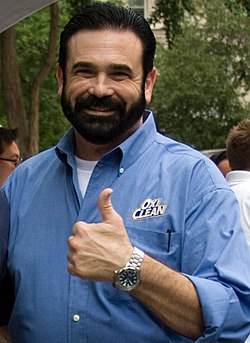
William Darrell Mays Jr. (July 20, 1958 – June 28, 2009)[2][3] was an American television direct-response advertisement salesperson. Throughout his career, he promoted a wide variety of products, including OxiClean, Orange Glo, Kaboom, Zorbeez, and Mighty Mendit. His promotions aired mainly on the Home Shopping Network through his company, Mays Promotions, Inc., although they have aired on other syndicated networks. Mays's infomercials were known for his catch phrase "Hi, Billy Mays here", and his shouted delivery of lines.
Key Information


Mays and his business partner, Anthony Sullivan, were also featured on PitchMen, a Discovery Channel television series that documented their work. His distinctive beard, attire, loud voice, and impassioned sales pitches made him a recognized television presence in the United States and Canada.[4][5]
Early life
[edit]Mays was born on July 20, 1958, in McKees Rocks, Pennsylvania to Joyce Palm[6] and Billy Mays Sr, where he was raised in nearby Pittsburgh.[2][7] He was a student at Sto-Rox High School,[2][7] and later West Virginia University, where he was a walk-on linebacker on its football team during his two years there.[8]
Career
[edit]Early work
[edit]After dropping out of college, Mays worked for his father's hazardous waste company before moving to Atlantic City, New Jersey, in 1983.[2] On the Atlantic City boardwalk, Mays sold the Washmatik portable washing device to passersby,[9] along with other "As Seen on TV" products.[2] In Atlantic City, he said, "I was taught to pitch by a lot of old pitchmen. That's the kind of style I have."[2]
Mays then traveled to home shows, auto shows, and state fairs across the United States for a period of twelve years, selling various maintenance products and tools, including cleaning products and food choppers.[9]
Television pitching
[edit]At a Pittsburgh, Pennsylvania home show in 1993, Mays struck up a friendship with rival salesman Max Appel, founder of Orange Glo International, a Denver-based manufacturer of cleaning products. He was then hired by the company to promote their line of cleaners, OxiClean, Orange Clean, Orange Glo, and Kaboom, on the Home Shopping Network in St. Petersburg, Florida.[10] That same year he also befriended another future pitchman, Anthony Sullivan. Customer response to Mays's sales pitches was enthusiastic, and sales sharply increased after his first day, although some reviews were poor. He was very well known for shouting during infomercials. For example, The Washington Post staff writer Frank Ahrens called him and other similar television salesmen "a full-volume pitchman, amped up like a candidate for a tranquilizer-gun takedown".[11]
In October 2000, Mays shot an infomercial for the then-three-year-old OxiClean corporation. He became a staple of the brand and the wider company, Orange Glo. Later on he appeared in Kaboom infomercials.
Mays was the CEO and founder of Mays Promotions, Inc., based at his home in Odessa, Florida.[4] His services as a pitchman became highly sought-after, and he appeared in commercials for many diverse "As Seen On TV" products such as Mighty Putty. Mays claimed to be an avid user of the products he promoted.[12]
In December 2008, Mays began appearing in ads for ESPN's online service, ESPN360.[13] These ads were a slight departure for Mays as they were designed to be parodies of his and other infomercial clichés. He also made a live appearance during the 2008 Champs Sports Bowl promoting ESPN's and ABC's January 1, 2009, bowl games. Prior to his death, Mays had signed a deal with Taco Bell to film infomercial-style commercials for the chain. Shooting was scheduled to begin in August 2009.[14]
On March 26, 2009, Mays appeared on The Tonight Show with Jay Leno.[15][16]
On April 15, 2009, the Discovery Channel began airing PitchMen, a documentary series that featured Mays and Anthony Sullivan in their jobs in direct-response marketing.[17] After Mays's death, Discovery Channel aired a special Billy Mays tribute special, Pitchman: A Tribute to Billy Mays.[18]
He and Sullivan also appeared on The Tonight Show with Conan O'Brien on June 23, 2009,[19][20] five days before his death.
Personal life
[edit]Mays's first marriage was to Dolores "Dee Dee" Mays, which ended in divorce.[21] He had a son with Dolores named Billy Mays III (born August 12, 1986) who worked as a production assistant alongside his father on the PitchMen television show.[6] Mays had a daughter, Elizabeth, with his second wife, Deborah Mays. His daughter was three years old at the time of his death.[21][22]
In an interview during the 2008 presidential election, Mays said he was a Republican.[23] He was also a Catholic.[24]
Death
[edit]
Mays was found unresponsive by his wife in his Tampa, Florida, home on the morning of June 28, 2009.[25] He was pronounced dead at 7:45 a.m., aged 50, appearing to have died sometime overnight.[3][26] The Associated Press reported there were no indications that the house had been burglarized, and that police did not suspect foul play.[26] Mays had told his wife the previous evening that he had felt unwell, and initially, there was incorrect speculation that he died from a head injury he experienced on a flight he had taken earlier in the day, in which the plane sustained a rough landing after blowing its tires.[27]
After an initial autopsy on June 29, 2009, Vernard Adams, the Hillsborough County, Florida medical examiner, stated that Mays suffered from hypertensive heart disease and that heart disease was the likely cause of his death. According to a toxicology report released August 7, 2009, heart disease was the "primary cause of death" and cocaine was listed as a "contributory cause of death."[28][29] In response to the release of the toxicology report, the Mays family issued a press release stating, "We are extremely disappointed by the press release released by the Hillsborough County medical examiner's office. We believe it contains speculative conclusions that are frankly unnecessary and tend to obscure the conclusion that Billy suffered from chronic, untreated hypertension" and said in the release that they were considering "an independent evaluation of the autopsy results".[30]
The medical examiner concluded that "cocaine use caused or contributed to the development of his heart disease, and thereby contributed to his death," the office said in a press release. The office said Mays last used cocaine in the few days before his death but was not under the influence of the drug when he died. Hillsborough County spokeswoman Lori Hudson said that nothing in the toxicology report indicated the frequency of Mays' cocaine use. Cocaine can raise the arterial blood pressure, directly cause hypertrophy of the left ventricle, and accelerate the formation of atherosclerosis in the coronary arteries, the release said. However, in October 2009, the results of a second medical examination, commissioned by Mays' family, concluded that cocaine was not a "significant contributing factor" to his death.[31]
According to subsequent news reports,[32] the toxicology tests also showed levels of painkillers hydrocodone, oxycodone, and tramadol, as well as anti-anxiety drugs alprazolam and diazepam. Mays suffered from hip problems and was scheduled to have had hip replacement surgery on June 29, a day after he was found dead.
Mays' funeral was held on July 3, 2009, in his hometown of McKees Rocks, Pennsylvania. The pallbearers wore blue shirts and khaki pants at the funeral, much like Mays wore when he advertised his products.[33] He is buried in Mount Calvary Cemetery.[34]
In the immediate aftermath of his death, many companies pulled ads featuring Mays from the air.[35] By mid-July, with his family's consent, some ads were put back into rotation,[36] alongside newer ones that Mays had filmed prior to his death.[36][35]
In popular culture
[edit]His catchphrase and infomercials made Billy Mays a notable icon in popular culture, with many shows, YouTube videos, and films lampooning him. In the South Park episode "Dead Celebrities", Mays's ghost appears repeatedly to Ike Broflovski, trying to sell him products from the afterlife with his catchphrase "Hi, Billy Mays here with the...". Mays's son, Billy III, a self-proclaimed South Park fan, said he loved "Dead Celebrities", and found its portrayal of his father to be both tasteful and respectful.[37]
He was portrayed by comedian Colin J. Sweeney in the season 1 episode of Epic Rap Battles of History, "Billy Mays vs. Ben Franklin". In the middle of the battle, Mays dies and has his second verse covered by a fellow infomercial pitchman, Vince Offer, portrayed by ERB co-creator Nice Peter.[38]
Products pitched
[edit]| Product | Description |
|---|---|
| Awesome Auger[39] | A gardening tool |
| Big City Slider Station[2][39] | A mini-burger cooker |
| Crocodile Cutter[40] | A cutter for metal and other materials |
| DC Snowboards | Snowboards |
| The Ding King[41] | A dent repairing device |
| DualSaw[42] | A circular saw with two blades |
| Engrave-it | An engraving tool for metal surfaces |
| ESPN360[7] | A broadband service |
| EZ Bundler | A strapping tool that bundles objects together |
| EZ Crunch Bowl[42] | A breakfast cereal bowl that separates cereal from milk, preserving the cereal's crunchiness |
| Flies Away[43] | A fly trap |
| Gator Blades | Precision heavy duty windshield wiper blades |
| Gopher[44] | A tool for grabbing out-of-reach objects |
| Grabit | A screw removal tool |
| Grater Plater[43] | A ceramic plate with grater teeth |
| Green Now![42] | Lawn fertilizer in a can |
| Grip Wrench[2] | A strap wrench |
| Handy Switch[39] | A wireless electric switch |
| Hercules Hook[39] | A hook for hanging objects on a wall |
| iCan health insurance[39][41] | A health insurance benefit group |
| Impact Gel | A shoe insert |
| iTie[44] | A necktie with a hidden pocket |
| Jupiter Jack | A cell phone speaker system for the car |
| Kaboom![2] | Tile and shower cleaner |
| Magic Carry | A harness system that allows the user to pick up two or three times what they can lift normally |
| Mighty Mendit[41] | A bonding agent for mending cloth |
| Mighty Putty[39][45] | An epoxy putty adhesive |
| Mighty Putty Steel[45] | A metal alloy adhesive putty |
| Mighty Putty Wood[45] | A non-shrinking epoxy putty for wood |
| Mighty Shine | A soft powder that removes rust and tarnish from metal objects |
| Mighty Tape[45] | A self-fusing silicone rubber waterproof tape |
| Orange Glo[2] | A wood cleaner |
| OxiClean[39][41] | A general purpose cleaner |
| Pest Patrol [46] | A pest repellent which relied on ultrasonic frequencies. |
| Quick Chop[43] | A chopping device |
| Quik Strip[47] | A wire stripper |
| Safety Beep[48] | A stick-on alert device for vehicles moving in reverse |
| Samurai Shark[39] | A knife sharpener |
| Simoniz Fix-It[39] | A scratch remover |
| Simoniz Liquid Diamond[49] | Car polish |
| Six Shooter[49] | A cordless power drill able to hold up to six different bits |
| Steam Buddy | A lightweight steam iron |
| Tool Band-it [43] | A magnetic armband for holding hand tools |
| Turbo Tiger[2] | A vacuum cleaner |
| Ultimate Chopper[39] | A kitchen tool |
| Vidalia Slice Wizard[41] | A kitchen tool |
| WashMatik[2][39] | A hose that pumps water from a bucket without being hooked up to a faucet |
| What Odor?[43] | An odor-removing fluid |
| Zorbeez[39] | A chamois cloth |
References
[edit]- ^ a b Belcher, Walt; Poltilove, Josh; Reyes, Ray; Osowski, Chip; Shepherd, Natalie (June 28, 2009). "TV pitchman Billy Mays found dead in Tampa home". Tampa Bay Online. Archived from the original on June 30, 2009. Retrieved June 28, 2009.
- ^ a b c d e f g h i j k l "Raw Data: Billy Mays Biography". Fox News. June 28, 2009. Archived from the original on July 1, 2009. Retrieved June 29, 2009.
- ^ a b "Report: 'Infomercial King' Billy Mays Found Dead in Home". Fox News. June 28, 2009. Archived from the original on April 7, 2013. Retrieved June 28, 2009.
- ^ a b Segal, David (August 19, 2008). "Shill Game: With His Booming Voice, Billy Mays Projects That Sales Will Rise". The Washington Post. Archived from the original on November 11, 2012. Retrieved June 28, 2009.
- ^ "Infomercial pitchman Billy Mays found dead". CTV News At 11. CTV.ca. June 28, 2009.
{{cite news}}: CS1 maint: deprecated archival service (link) - ^ a b Billy Mays, Anthony Sullivan, Billy Mays III, Deborah Mays, Elizabeth Mays, Joyce Palm (June 2009). PitchMen: Billy's Legacy (Internet video). Discovery Channel. Archived from the original (Adobe Flash) on July 4, 2009. Retrieved July 1, 2009.
- ^ a b c Brandolph, Adam (December 29, 2008). "'Life's a pitch' for McKees Rocks native Billy Mays". Pittsburgh Tribune-Review. Archived from the original on April 16, 2009. Retrieved June 30, 2009.
- ^ O'Keeffe, Brian (April 6, 2009). "Secrets of the TV pitchmen". CNN Money. CNN. Retrieved November 8, 2009.
- ^ a b Rigsby, G.G. (May 3, 2002). "As seen on TV: Billy Mays hawks it all for a price". Tampa Bay Business Journal. Retrieved April 21, 2007.
- ^ Albright, Mark (July 24, 2006). "Company Sold, Local Pitchman Keeps His Job". Tampa Bay Times.
- ^ Ahrens, Frank (September 26, 2004). "Miracle Infomercials— TV's Hard Sells Are a $256 Billion Business". The Washington Post. p. F01.
- ^ Stacy, Mitch (December 29, 2002). "As seen on TV, pitchman Billy Mays cleans up with shtick — In-your-face salesman peddles fixes for car dents to cleaning products". The Cincinnati Enquirer. Associated Press. Retrieved April 21, 2007.
{{cite news}}: CS1 maint: deprecated archival service (link) - ^ Gianatasio, David (December 23, 2008). "Billy Mays wants to sell you some ESPN360". AdWeek. Archived from the original on December 2, 2018. Retrieved December 27, 2008.
- ^ "Billy Mays Was Set to be Taco Bell's Pitchman". TMZ. June 29, 2009.
- ^ Leno, Jay. "Dana Carvey, Billy Mays, Prince". The Tonight Show with Jay Leno. Season 17. Episode 52. NBC.
- ^ Karen Herbst (April 1, 2009). Billy Mays On Leno For Impact Gel Friday 3/27/09. Youtube. Archived from the original on June 19, 2024. Retrieved June 19, 2024.
{{cite AV media}}: CS1 maint: bot: original URL status unknown (link) - ^ Discovery Press Release (March 2, 2009). "Discovery Channel Announces New Series "Pitchmen" Premiering April 15". Reality TV Fans. Archived from the original on March 7, 2009. Retrieved June 28, 2009.
- ^ Steve Jones (Series Producer) (July 9, 2009). "Pitchman: A Tribute to Billy Mays". Pitchmen. Season 1. Episode Special. Discovery.
- ^ "The Tonight Show with Conan O'Brien: Lisa Kudrow, Billy Mays & Anthony Sullivan, Elvis Costello". TV.com. June 23, 2009. Archived from the original on July 1, 2009. Retrieved June 28, 2009.
- ^ O'Brien, Conan (June 22, 2009). "Lisa Kudrow, Billy Mays & Anthony Sullivan, Elvis Costello". The Tonight Show with Conan O'Brien. Season 1. Episode 17. NBC.
- ^ a b "OxiClean pitchman dies at age 50". Austin American-Statesman. June 29, 2009. Archived from the original on September 17, 2012. Retrieved June 30, 2009.
- ^ "Billy Mays III Remembers His Dad on Florida Radio Show". The Jacksonville Observer. June 29, 2009. Archived from the original on November 23, 2018. Retrieved July 9, 2012.
- ^ Grove, Lloyd (October 9, 2008). "World According to... Billy Mays". Portfolio.com. Archived from the original on November 20, 2008.
- ^ "Gallery: Billy Mays Funeral". The Herald-Dispatch. July 5, 2009. Retrieved July 22, 2024.
- ^ RAW DATA: Chilling Billy Mays 911 Tape Archived July 23, 2009, at the Wayback Machine. Fox News. Monday, June 28, 2009. Retrieved on June 28, 2009.
- ^ a b "Cops: TV pitchman Billy Mays found dead". NBC News. Associated Press. June 28, 2009. Retrieved June 28, 2009.
- ^ "Did Rough Plane Landing Cause Mays' Death?". Fox News. Associated Press. June 29, 2009. Archived from the original on August 4, 2009. Retrieved August 8, 2009.
- ^ "Cocaine linked to Billy Mays death". The Situation Room with Wolf Blitzer. CNN.
- ^ "Autopsy: Cocaine contributed to Billy Mays' death". USA Today. Associated Press. August 7, 2009. Retrieved July 9, 2012.
- ^ Deborah Mays (August 7, 2009). "Statement from Billy Mays' Family In Response to Medical Examiner's Report" (Press release). Businesswire.com. RFB Communications Group.
- ^ "Mays' family: Review finds no chronic cocaine use". USA Today. Associated Press. October 15, 2009. Archived from the original on October 18, 2009. Retrieved August 13, 2020.
- ^ "Mays' family contests cocaine report". NBC News. August 7, 2009. Retrieved June 9, 2010.
- ^ "Joe Mandak (July 3, 2009). "Product pitchman Mays remembered as natural seller". Associated Press. Archived from the original on August 10, 2018. Retrieved February 15, 2013.
- ^ Scott Wilson, Resting Places: The Burial Sites of More Than 14,000 Famous Persons, p. 492
- ^ a b Hennigan, W.J (July 10, 2009). "Billy Mays pitches from beyond the grave". L.A Times. Retrieved February 4, 2016.
- ^ a b STELTER, BRIAN (July 13, 2009). "Billy Mays Is Gone, but His Infomercials Go On". The New York Times. Retrieved February 4, 2016.
- ^ "Billy Mays III encouraging fans nationwide to dress like his deceased dad for Halloween". Tampa Bay Times. October 26, 2009. Archived from the original on September 18, 2016. Retrieved September 18, 2016.
- ^ Nice Peter (June 23, 2011). "Billy Mays vs Ben Franklin. Epic Battles of History". YouTube. Archived from the original on December 15, 2021.
- ^ a b c d e f g h i j k l Segal, David (August 19, 2008). "Shill Game: With His Booming Voice, Billy Mays Projects That Sales Will Rise". The Washington Post. Retrieved June 30, 2009.
- ^ blenheimears (March 10, 2016). "Rare Billy Mays ad - The Crocodile Cutter - YouTube". Youtube. Archived from the original on December 15, 2021. Retrieved November 29, 2020.
- ^ a b c d e Maltby, Emily (June 29, 2009). "Billy Mays: An industry loses its voice". CNN Money. CNN. Archived from the original on July 3, 2009. Retrieved June 19, 2024.
- ^ a b c "PitchMen". Discovery Channel. Archived from the original on April 11, 2009.
- ^ a b c d e "Top Ten Billy Mays Commercials". As Seen On TV Video. June 29, 2009. Archived from the original on July 24, 2018. Retrieved June 30, 2009.
- ^ a b Barrett, Annie (June 29, 2009). "Billy Mays got Conan interested in the Gopher, iTie, and even 'The Tonight Show' last week". Entertainment Weekly.
{{cite magazine}}: CS1 maint: deprecated archival service (link) - ^ a b c d Bien, Lisa; DeVine, Colleen (July 9, 2009). "Mighty Brand Infomercials Back on the Air: Continuing Billy Mays' Legacy with New Mighty Products" (Press release). Reuters. Retrieved July 9, 2012.
{{cite press release}}: CS1 maint: deprecated archival service (link) - ^ JTWC10 (June 21, 2022). "Billy Mays - Pest Patrol (2001)". YouTube. Archived from the original on January 18, 2023. Retrieved January 18, 2023.
{{cite web}}: CS1 maint: bot: original URL status unknown (link) CS1 maint: numeric names: authors list (link) - ^ Keller, Mike (November 10, 2004). "QuikStrip LLC and MediaCorp Worldwide Hits a Grand Slam with the addition of Billy Mays to their QuikStrip Direct Response Television Campaign" (Press release). MediaCorp Worldwide. PRWeb. Archived from the original on February 3, 2023. Retrieved February 3, 2023.
- ^ tomturboswaggingsdumpster2598 (November 19, 2019). "Billy Mays - Safety Beep". YouTube. Archived from the original on December 15, 2021.
{{cite web}}: CS1 maint: numeric names: authors list (link) - ^ a b Uncle John's Unsinkable Bathroom Reader. Uncle John's Bathroom Reader Annual. Printers Row. 2011. p. 459. ISBN 978-1-60710-460-5. Retrieved February 3, 2023.
External links
[edit]
- Billy Mays at IMDb
- Billy Mays on Twitter
