Hubbry Logo
Circular sawCircular sawMain
Open search
Circular saw
Community hub
Circular saw
logo
8 pages, 0 posts
0 subscribers
Be the first to start a discussion here.
Circular saw
Circular saw
from Wikipedia
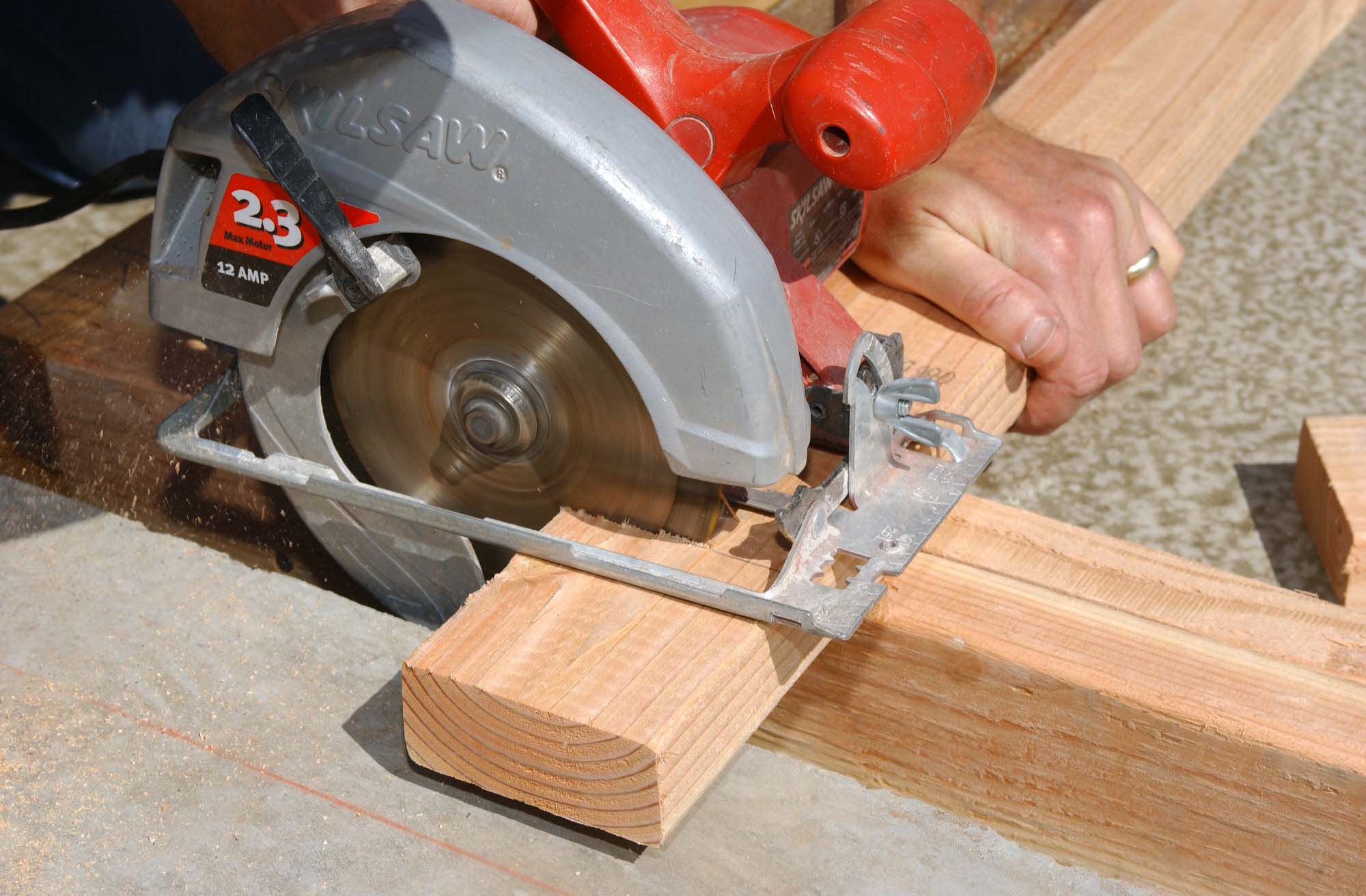
A hand-held circular saw is the most conventional circular saw.
This miter saw is a circular saw mounted to swing to crosscut wood at an angle.
A table saw.
Tractor-driven circular saw

A circular saw or a buzz saw, is a power-saw using a toothed or abrasive disc or blade to cut different materials using a rotary motion spinning around an arbor. A hole saw and ring saw also use a rotary motion but are different from a circular saw. Circular saws may also be loosely used for the blade itself. Circular saws were invented in the late 18th century and were in common use in sawmills in the United States by the middle of the 19th century.

A circular saw is a tool for cutting many materials such as wood, masonry, plastic, or metal and may be hand-held or mounted to a machine. In woodworking the term "circular saw" refers specifically to the hand-held type and the table saw and chop saw are other common forms of circular saws. "Skilsaw" and "Skil saw" have become generic trademarks for conventional hand-held circular saws in the United States of America. Circular saw blades are specially designed for each particular material they are intended to cut and in cutting wood are specifically designed for making rip-cuts, cross-cuts, or a combination of both. Circular saws are commonly powered by electricity, but may be powered by a gasoline engine or a hydraulic motor which allows it to be fastened to heavy equipment, eliminating the need for a separate energy source.[1]

History

[edit]

There is evidence for the prehistorical use of circular saws by people of Indus Valley Civilization during the Bronze Age. The same was excavated from the archeological site of Lothal, Gujarat.[2][3]

The modern-day circular saw was invented around the end of the 18th century as a rip-saw to convert logs into lumber in sawmills and various claims have been made as to who invented it. Before the design was invented, logs were sawn by hand using a pit saw or using powered saws in a sawmill using an up-and-down saw with a reciprocating motion. The rotary nature of the circular saw requires more power to operate but cuts faster because the teeth are in constant motion. The sound of the circular saw is different from the sound of an up-and-down saw and earned it the nickname buzz-saw.

Sawmills first used smaller diameter circular saws to resaw dimension lumber such as lath and wall studs and for edging boards. As the technology advanced large diameter saw blades began to be used for the head saws and to cut clapboards.

Claims to the invention of the circular saw include:

  • A common claim is for a little-known sailmaker named Samuel Miller of Southampton, England who obtained a patent in 1777 for a saw windmill.[4][5] However, the specification for this only mentions the form of the saw incidentally, indicating that it was probably not his invention.[original research?]
  • Gervinus of Germany is often credited with inventing the circular saw in 1780.[6]
  • Walter Taylor of Southampton had the blockmaking contract for Portsmouth Dockyard. In about 1762, he built a saw mill where he roughed out the blocks. This was replaced by another mill in 1781. Descriptions of his machinery there in the 1790s show that he had circular saws. Taylor patented two other improvements to blockmaking but not the circular saw.[7][8][9] This suggests either that he did not invent it or that he published his invention without patenting it (which would mean it was no longer patentable).
  • Another claim is that it originated in the Netherlands in the sixteenth or seventeenth century.[10]
  • The use of a large circular saw in a saw mill is said to have been invented in 1813 by Tabitha Babbitt, a Shaker inventor, after she noted the inefficiency of the traditional while using her spinning wheelsaw pits used by the sawyers in her community and sought an improvement.[11][5][12] This claim is now mostly discredited.[13][14]
  • The Barringer, Manners and Wallis factory in Rock Valley, Mansfield, Nottinghamshire also claims to be the site of the invention.[citation needed]

Process

[edit]

Typically, the material to be cut is securely clamped or held in a vise, and the saw is advanced slowly across it. In variants such as the table saw, the saw is fixed and the material to be cut is slowly moved into the saw blade. As each tooth in the blade strikes the material, it makes a small chip.[15] The teeth guide the chip out of the workpiece, preventing it from binding the blade.

Characteristics

[edit]
  • Cutting is by teeth on the edge of a metal blade or by an abrasive wheel
  • The cut has narrow kerf and relatively smooth surface finish
  • Cuts are straight and relatively accurate
  • The saw usually leaves burrs on the cut edge of metal and plastic (which should then be addressed with sand paper)
  • Saw setting should be done geometrically[clarification needed]

Types of circular saws

[edit]

In addition to hand-held circular saws (see below), different saws that use circular saw blades include:

Sawmill blades

[edit]
Portable sawmill circular saw blade about 60 cm (2.0 ft) diameter.

Originally, circular saws in mills had smaller blades and were used to resaw lumber after it passed through an "up and down" (muley or sash) saw leaving both vertical and circular saw marks on different sides of the same piece. These saws made it more efficient to cut small pieces such as lath. After 1813 or 1822 saw mills use large circular saws, up to 3 metres (9.8 ft) in diameter. Large saws demand more power than up-and-down saws and did not become practical for sawing timbers until they were powered by steam engines. They are either left or right-handed, depending on which side of the blade the plank falls away from. Benching determines which hand the saw is. Saws of this size typically have a shear pin hole, off axis, that breaks if the saw is overloaded and allows the saw to spin free. The most common version is the ITCO (insert tooth cut-off) which has replaceable teeth. Sawmill blades are also used as an alternative to a radial arm saw.

Cordwood saws

[edit]
Allis-Chalmers B with a cordwood saw setup

Cordwood saws, also called buzz saws in some locales, use blade of a similar size to sawmills. Where a sawmill rips (cuts with the grain) a cordwood saw crosscuts (cuts across the grain). Cordwood saws can have a blade from 20 inches (510 mm) to more than 36 inches (910 mm) diameter depending on the power source and intended purpose. Cordwood saws are used to cut logs and slabs (sawmill waste) into firewood. The cubic meter and cord (unit) are common measurements of standing timber (by estimation) or rough logs. "Cordwood" means unsplit logs 4 feet (1.2 m) long. In the nineteenth and early twentieth centuries, farmers would supply householders in town with cordwood, which would then be re-sawn and split to a length and circumference suitable for woodburning heaters and ranges. Almost all these devices were designed to accept 16-inch (410 mm) sticks, conveniently a piece of cordwood cut into three equal lengths. Once a piece of cordwood had been re-sawn to three 16-inch pieces, it could easily be split to stovewood size with an ax.

Most cordwood saws consist of a frame, blade, mandrel, cradle, and power source. The cradle is a tilting or sliding guide that holds logs during the cutting process. Certain cordwood saws are run from a belt from a farm tractor power takeoff pulley. Others, mounted on a tractor's three-point hitch, connect to the rear power takeoff shaft. Self-powered models are equipped with small gasoline engines or even large electric motors as power sources. The mandrel is a shaft and set of bearings that support and transfer power to the blade. The frame is a structure that supports the cradle and blade at a convenient working height.

Cordwood saws were once very popular in rural America. They were used to cut smaller wood into firewood in an era when hand powered saws were the only other option. Logs too large for a cordwood saw were still cut by hand. Chainsaws [16] have largely replaced cordwood saws for firewood preparation today. Still, some commercial firewood processors and others use cordwood saws to save wear and tear on their chainsaws. Most people consider cordwood saws unsafe and outdated technology.

Hand-held circular saws for wood

[edit]
An unusually large hand-held circular saw for cutting timbers with a roughly 16 in (410 mm) blade.

In woodworking the term circular saw is most commonly used to refer to a hand-held, electric circular saw designed for cutting wood, but may be used for cutting other materials with different blades. Circular saws can be either left or right-handed, depending on the side of the blade where the motor sits. A left-handed saw is typically easier to use if held in the right hand, and contrariwise for the right-handed saw, because the user does not need to lean across the saw to see the cutting line.

Blades for cutting wood are almost universally tungsten carbide tipped (TCT), but high-speed steel (HSS) blades are also available. The saw base can be adjusted for depth of cut and can tilt up to 45° and sometimes 50° in relation to the blade. Adjusting the depth of cut helps minimize kickback. Different diameter blades are matched to each saw and are available ranging from 14 to 61 centimetres (5.5–24.0 in).

Saws can have two different types of linkages between the motor and the blade. In the type known colloquially as a sidewinder, the blade is mounted directly on the motor's driveshaft. In a worm-drive saw, the blade is driven by a perpendicularly mounted motor using worm gears, which give higher torque.

The worm-drive portable circular saw was invented in 1923 by Edmond Michel. In 1924 Michel formed a partnership with Joseph Sullivan, and together they started the Michel Electric Handsaw Company, with the sole purpose of manufacturing and marketing the saw invented by Michel. The company later renamed itself Skilsaw Inc. Portable circular saws are often still called Skilsaws or Skil saws. Its successor is still sold by Skil as the model 77. To get around the Skilsaw patents, Art Emmons of Porter-Cable invented the direct-drive sidewinder saw in 1928. Recently[when?] smaller cordless circular saws with rechargeable batteries have become popular.

Cold saw for metal

[edit]

Cold saw machines are circular saws that are used in many metal cutting operations. The saw blades used are quite large in diameter and operate at low rotational speeds, and linear feeds. There are three common types of blades used in circular saws; solid-tooth, segmental tooth, and the carbide inserted-tooth. The circular saw is typically fed into the workpiece horizontally, and as the saw advances into the material, it severs the material by producing narrow slots. The material is usually held in place during the cutting operation by means of a vise. The chips produced by cutting are carried away from the material by both the teeth of the blade as well as the coolant or other cutting fluid used.

Abrasive saws

[edit]
Circular saw with a diamond blade for cutting asphalt and concrete.

The rotary motion of a circular saw lends itself to cutting hard materials like concrete, asphalt, metal, tile, brick, and stone with an abrasive saw such as a tile saw. Diamond blades and cut off wheels are commonly used in these applications.

See also

[edit]

References

[edit]
[edit]
Revisions and contributorsEdit on WikipediaRead on Wikipedia
from Grokipedia
A circular saw is a equipped with a rotating toothed metal disc blade designed to cut through materials such as , , , , and composites by spinning at high speeds. The blade, typically made of with carbide-tipped teeth for , is mounted on an arbor and typically powered by an , allowing for straight, angled, or curved cuts depending on the model and technique. Invented in the late 18th century, the circular saw revolutionized and by enabling faster and more precise material processing compared to traditional handsaws. The earliest documented patent for a circular saw machine was granted to Samuel Miller in in 1777 (British Patent #1152), describing a device powered by pulleys and chains to saw wood, stone, and . Although early designs faced limitations due to , the tool gained practicality in the early ; in the United States, is often credited—according to Shaker tradition, though the claim is disputed—with inventing a functional circular saw blade attachment for a Shaker around 1810, inspired by her . By the 1920s, innovations like Art Emmons' portable handheld circular saw (1929) and Raymond DeWalt's (1922) expanded its applications, transitioning from stationary mill equipment to versatile portable devices. Modern circular saws are categorized into several types based on and power source, including handheld models for on-site work, table saws for stationary precision cutting, and specialized variants like cold saws for . They are widely used in , , , and for tasks such as lumber, boards, and beveling edges, with selection determining suitability for specific materials. Safety features, such as guards and anti-kickback mechanisms, are standard to mitigate risks like binding or kickback, emphasizing the need for proper handling and maintenance.

Introduction

Definition and Purpose

A is a rotary equipped with a toothed or that spins at high speeds to perform cuts on various materials. It typically features a motor-driven disc, often handheld or mounted, designed for straight-line cutting in demanding applications. This tool is widely employed to slice through substances like wood, metal, and stone, with selection determining suitability for specific tasks. The primary purposes of a circular saw revolve around efficient division in professional and industrial settings, including to cut parallel to the , to sever to the , and beveling for angled edges. These functions support key operations in for framing and sheathing, for precise , for structural fabrication, and for component production. Circular saws originated as an advancement over manual handsaws, transitioning to powered mechanisms that dramatically enhance cutting efficiency by minimizing physical effort and accelerating workflow. Compared to handsaws, they offer superior precision for straight cuts, faster execution for repetitive tasks, and greater versatility across material types and cut orientations.

Basic Components

The core components of a circular saw enable its primary function as a for straight cuts in various materials. The motor, typically electric and rated at 15 amps or 1 to 2 horsepower for corded models, provides the driving force, while battery-powered variants use lithium-ion packs for portability. The , a disc-shaped element with cutting teeth around its periphery, is mounted on a spindle connected to the motor. The base plate, also known as the , is a flat metal platform that rests on the workpiece to guide the cut and maintain stability. The offers ergonomic grip for control, often positioned rearward with an auxiliary front handle on some models for two-handed operation. guards, including an upper fixed guard enclosing the top of the and a lower retractable guard that exposes the blade only during entry into the material, protect the operator from contact. Auxiliary parts enhance precision and usability. The power switch, usually a trigger integrated into the main handle, activates the motor and often includes a lock-off mechanism to prevent accidental starts. The bevel adjustment allows the base plate to tilt for angled cuts, typically from 0° to 45° or 56°. Depth adjustment mechanisms, such as knobs or levers, raise or lower the blade relative to the base to control cut depth, often up to 2.5 inches at 90°. Some models include a rip fence, a parallel guide attached to the base for straight ripping cuts along the grain. Blades are commonly carbide-tipped for enhanced durability and longevity, especially when cutting hardwoods or abrasives, though high-carbon steel variants suit softer materials. Motors are rated in horsepower for corded tools or voltage/amperage for , with worm-drive configurations providing higher via geared transmission compared to direct-drive sidewinder designs. These elements integrate through the motor driving the spindle, which rotates the at speeds typically ranging from 3,000 to 6,000 RPM under load, enabling efficient material removal. Blade types vary for specific materials, such as finer teeth for versus coarser for dimensional .

History

Early Development

The circular saw originated with a patent granted to Samuel Miller, a sailmaker from , , on November 4, 1777, for a machine designed to saw wood, stone, and more efficiently than traditional linear saws. This invention represented a significant modification of existing saw designs, incorporating a rotating toothed disk driven by mechanical power, and was particularly suited for applications given Miller's maritime background. Although circular blades may have existed earlier in rudimentary forms, Miller's marked the first documented mechanized circular saw system. By the early , circular saws began gaining adoption in American sawmills for timber processing, revolutionizing the efficiency of wood cutting over manual pit saws. A notable figure in this development was , a member of the Harvard Shaker community in , who is credited—though the attribution remains disputed—with creating the first practical circular saw for sawmill use around 1810 to 1813. Observing the wasteful backstroke of pit saws, Babbitt attached a notched tin disk to a spinning wheel in the Shaker workshop, enabling continuous cutting motion; however, she never patented the design, adhering to Shaker principles that viewed inventions as communal property rather than individual achievements. This innovation helped transition sawmills from labor-intensive methods to more productive mechanized operations, though earlier European patents like Miller's indicate the concept predated her work. The shift toward portability occurred in the 1920s in the , driven by electrical Edmond Michel, who developed the first electric handheld circular saw in 1924 while working on agricultural machinery in . Partnering with investor Joseph W. Sullivan, Michel founded the Michel Electric Handsaw Company in , refining the prototype into the Model E—the world's first production portable electric circular saw—released in 1928. This lightweight, worm-drive design, powered by a , allowed on-site cutting without stationary mills, marking a pivotal step from industrial to versatile field use. Throughout its early history up to the early , the circular saw encountered several technical and operational hurdles that limited its reliability and widespread use. Blades frequently warped due to frictional heat buildup during prolonged operation, causing inaccuracies and breakage in high-speed cuts. Power sources like steam engines imposed further constraints, delivering inconsistent and speed that strained the machinery and reduced output in sawmills. posed the most pressing concern, as unguarded rotating blades in industrial environments led to frequent severe injuries and fatalities, with 19th-century sawmills operating without modern regulations or protective features. These challenges spurred incremental improvements, paving the way for the transition to more stable in later decades.

Modern Advancements

Following , refinements in electric motors for circular saws focused on enhancing portability, efficiency, and durability to meet the demands of booms. Manufacturers like improved motor designs by incorporating lighter universal motors that operated on AC or DC power, building on wartime innovations such as air-driven Thor motors adapted for handheld use. These advancements reduced weight and increased reliability, allowing saws to handle prolonged operation in diverse environments. Concurrently, worm-drive designs gained prominence in the 1950s, exemplified by 's continued production and expansion of the Model 77, which featured a worm gear system for superior delivery. This configuration provided higher power transmission compared to direct-drive models, enabling efficient cutting through dense materials like and metal without excessive strain on the motor. The introduction of battery-powered circular saws in the marked a significant shift toward greater mobility, freeing users from power cords during fieldwork. Early models relied on nickel-cadmium batteries, offering limited runtime but expanding applications in remote sites. By the , lithium-ion battery advancements revolutionized these tools, enabling higher-voltage systems such as 18V platforms that delivered extended runtime, faster charging, and lighter weight without sacrificing power. Brands like and pioneered these 18V lithium-ion saws, which matched corded performance for professional tasks like framing and . In the 1990s and 2010s, precision and safety features proliferated, including laser guides for accurate cut lines, dust extraction ports for improved worksite cleanliness, and electronic braking systems to halt blade rotation swiftly. Laser guides, patented as early as 1995, projected a beam to align cuts, reducing errors in low-visibility conditions. Dust extraction ports, emerging from 1990s patents, connected to vacuums to capture up to 90% of airborne particles, addressing health concerns from wood dust. Electronic brakes, evolving from 1960s miter saw technology, reversed motor polarity to stop blades in 2 seconds or less, minimizing risk during accidental releases. Recent 2020s developments emphasize intelligent and , with smart sensors for kickback prevention and deeper integration into CNC systems. Festool's KickbackStop, using sensors to detect jams and halt the motor in milliseconds, debuted in plunge-cut saws to counter sudden backward forces. Milwaukee's AUTOSTOP, released in 2025 on M18 FUEL models, employs accelerometers to shut off power during severe kickbacks, enhancing user protection in dynamic cuts. In , CNC circular saws now incorporate Industry 4.0 features like AI-driven adaptive controls and Ethernet connectivity for real-time monitoring, as seen in systems from and Amada, boosting precision and throughput in automated production lines.

Operating Principles

Cutting Mechanism

The cutting mechanism of a circular saw involves the motor imparting rotational to the blade, which spins the teeth at high speeds to shear through a wedging action that separates fibers and frictional forces that remove chips. This begins with the blade's teeth acting as wedges that penetrate and deform the , creating a resultant cutting resistance composed of deformation resistance, chip deflection, and between the tooth and workpiece. The required increases with greater depth of cut and tooth edge radius but decreases with higher rake angles, typically resulting in cutting power calculated as the product of this and the blade's peripheral speed, often 50-100 m/s depending on . The cutting process follows specific steps to ensure precision and : first, align the with the marked cut line using a guide or to maintain accuracy; next, adjust the depth so it protrudes approximately 1/4 inch (6 ) below the surface to minimize tear-out and exposure; then, activate the motor and allow the to reach full speed before contact; finally, advance the saw at a controlled feed rate to prevent binding, where excessive resistance can cause the to stall or kick back. Proper feed rate management is critical, as advancing too slowly leads to overheating from prolonged tooth- contact, while excessive speed increases resistance and power draw; for , a balanced rate maintains chip loads of about 0.002-0.006 inches per to optimize efficiency without thermal buildup. Fundamental physics of the cut involve tooth geometry tailored for chip removal and heat dissipation: alternate top bevel (ATB) teeth, with alternating left and right bevels at 10-20 degrees, slice across the grain for smoother crosscuts by shearing fibers cleanly; flat top grind (FTG) teeth, featuring square tops, excel in along the grain by efficiently ejecting larger chips through deeper gullets, reducing clogging. The relationship between blade RPM (typically 3,000-5,000 for portable models) and feed speed ensures each engages briefly, preventing friction-induced overheating; for instance, at 4,000 RPM with 24 teeth, a feed rate yielding 0.003 inches chip load per avoids excessive while clearing chips effectively. Material interaction during cutting produces a kerf—the slot width left behind—determined by the body thickness plus the tooth set (lateral bend for clearance), typically 1/8 inch (3.2 mm) for standard wood-cutting , which dictates the volume of removed and influences cut precision and waste. This kerf width ensures the body does not bind while allowing efficient chip evacuation, with narrower kerfs (e.g., thin-kerf designs at 2.4 mm) reducing loss in precision work but requiring stable feeds to avoid deflection. Tooth configurations like ATB or FTG, as detailed in specifications, further optimize kerf quality by controlling chip formation and .

Blade Specifications

Circular saw blades are characterized by several key specifications that determine their compatibility and performance with various saw models and cutting tasks. The blade diameter typically ranges from 6 to 16 inches, with common sizes including 7-1/4 inches for handheld circular saws, 10 inches for table saws, and 12 inches for miter saws, allowing for cuts of corresponding depths. The arbor size, which is the central hole for mounting the blade to the saw's spindle, is standardized at 5/8 inch for most circular saw blades, though 1-inch arbors are used in some larger stationary saws to ensure and prevent slippage. count varies from 24 to 80, where lower counts (24-40) facilitate faster cuts in solid woods, and higher counts (60-80) produce smoother finishes for or finish work. The hook angle, or of the teeth, influences cutting aggression; positive angles (10° to 20°) are ideal for along the , promoting efficient material removal, while negative angles (-5° to 0°) reduce tear-out during crosscuts to the . Blade materials significantly affect durability and suitability for different workloads. High-speed steel (HSS) blades are commonly used for cutting softwoods and non-ferrous metals due to their affordability and ease of , though they dull faster under heavy use. Carbide-tipped blades, featuring inserts on the teeth, offer superior hardness and heat resistance for hardwoods, composites, or materials, providing up to 10 times the longevity of HSS blades in demanding applications. Design elements such as gullet configuration and kerf dimensions optimize chip ejection and cutting efficiency. Gullets, the curved spaces between teeth, are engineered for effective removal of and chips, with rounded profiles to prevent stress cracks and ensure smooth operation during prolonged cuts. Kerf, the width of the cut produced by the , is typically 1/8 inch for full-kerf designs that provide stability in powerful saws, while thinner kerfs (around 3/32 inch) reduce material and motor strain by minimizing drag, though they require precise handling to avoid deflection. The plate thickness, often slightly less than the kerf to allow for tooth set, balances rigidity against for clean, accurate cuts. Selecting the appropriate blade involves matching specifications to the workpiece and saw capabilities. For material compatibility, fine-tooth blades (60+ teeth) are recommended for or laminates to minimize splintering and tear-out on veneered surfaces, whereas coarse teeth suit dimensional for quicker, rougher cuts. RPM ratings on blades must align with the saw's maximum speed—typically 3,000 to 6,000 RPM for handheld models—to prevent overheating, excessive wear, or blade failure, ensuring safe and efficient performance.

Types of Circular Saws

Portable Handheld Saws

Portable handheld circular saws are compact, battery-powered or corded tools designed for on-site mobility, allowing users to make straight or angled cuts in wood and similar materials without fixed workstations. These saws typically weigh between 5 and 10 pounds, making them easy to maneuver during extended use in or settings. Key design features include lightweight construction for reduced user fatigue, with common configurations featuring either a sidewinder motor—where the motor is parallel to the blade for a slimmer profile—or a worm-drive gearbox, which positions the motor perpendicular to the blade for enhanced and durability. The standard blade size is 7-1/4 inches, providing a balance of cutting depth (up to 2-1/2 inches at 90 degrees) and portability suitable for most framing . Many models incorporate ergonomic handles, spindle locks for quick blade changes, and adjustable bases for depth control. These saws are widely applied in framing, decking, and DIY projects, where their mobility enables quick cuts on job sites or in tight spaces. Corded variants offer unlimited runtime for heavy-duty tasks, while cordless models, powered by lithium-ion batteries, provide freedom from extension cords and can deliver up to 750 crosscuts through 2x4 per charge, depending on battery capacity and material. Operation involves either freehand cuts for rough work or guided cuts using straightedges or tracks for precision, with bevel capacities reaching up to 56 degrees to accommodate angled like roof rafters. Users adjust the base plate to set depth and , then plunge or lower the into the material while maintaining firm control to ensure straight lines. These saws rely on the rotational cutting action of toothed blades to shear through wood fibers efficiently. The primary advantages of portable handheld saws include high portability for field use and versatility across common tasks, but they demand operator skill to prevent inaccuracies such as wandering cuts or kickback. Since their in the 1920s by Edmond Michel, who developed the first electric handheld model in 1923, these tools have become staples in for enabling efficient, on-the-go cutting.

Stationary Saws

Stationary circular saws are fixed-position machines designed for workshop use, offering enhanced precision and the ability to handle larger workpieces compared to portable models. These saws provide a stable platform for repetitive cuts, making them essential for professional environments where accuracy and efficiency are paramount. Common types include table saws, radial arm saws, and miter saws, each optimized for specific cutting tasks while incorporating features like robust for vibration-free operation. Table saws feature a flat table surface with the circular protruding through a slot, equipped with a rip fence for straight longitudinal cuts and a miter gauge for angled crosscuts. They typically use larger blades measuring 10 to 12 inches in , allowing for deeper cuts up to several inches, and are powered by ranging from 3 to 5 horsepower, enabling heavy-duty through hardwoods. Enclosed base cabinets help contain and improve by reducing airborne particles, while tilting arbors or tables facilitate compound cuts for bevels and miters. These saws are widely applied in , furniture making, and small production runs, where their stability supports precise, high-volume work on panels and boards. Radial arm saws consist of a circular mounted on a sliding horizontal arm above a fixed table, excelling in long stock with minimal . Blades in these saws also range from 10 to 12 inches, with power outputs up to 5 horsepower for versatile operations including bevels, miters, and dadoes. The arm's adjustable positioning allows for precise setup, and many models include dust collection ports integrated into the arm and table for cleaner operation. Like table saws, they support tilting mechanisms for compound angles and are favored in furniture production and for their ability to perform multiple cut types from a single setup. Miter saws, also known as chop saws, feature a circular mounted on a pivoting that lowers onto the workpiece for accurate crosscuts and miter angles. They typically use 10- or 12-inch s and are powered by motors from 1.5 to 3 horsepower, with adjustable angles up to 50 degrees left and right for miters, and capabilities in compound models. Widely used for trim, molding, and framing, miter saws provide quick, precise cuts on narrower and often include guides for alignment. Stationary saws gained popularity in late 19th-century sawmills for processing lumber efficiently, with designs evolving from early water-powered models to electric versions by the early . The , patented in 1922, further advanced workshop capabilities by introducing versatile overhead cutting. Safety features, such as interlocks to prevent accidental starts and blade guards, became standard in the 1970s following regulatory advancements under the Act, significantly reducing injury risks in industrial and workshop settings.

Specialized Cutting Saws

Specialized circular saws are engineered for specific materials and applications beyond general , incorporating unique designs and operating mechanisms to achieve precise, efficient cuts in challenging substances like metals, , and composites. These tools prioritize material compatibility, dust management, and cut quality, often featuring adaptations such as low-speed motors or specialized abrasives to minimize heat, burrs, or airborne particles. Cold saws represent a key variant for , employing (HSS) blades—often with coatings like TiN for enhanced durability—at low rotational speeds ranging from 50 to 500 RPM. This configuration enables "cold" cutting of metals such as mild steel and structural tubing, where frictional heat is dissipated through the chips rather than the workpiece, resulting in clean, burr-free edges without requiring or lubricants. The high-torque, low-speed operation distinguishes cold saws from high-speed alternatives, reducing and maintaining workpiece integrity for applications in fabrication and . Abrasive saws, commonly referred to as chop saws in metal contexts or masonry saws for harder materials, utilize thin discs or diamond-impregnated blades to slice through non-wood substances like , , tile, and stone. Chop saws employ aluminum oxide or similar wheels that through metal via high-speed and downward , ideal for quick cut-offs in and . Masonry variants feature segmented rims for against materials, with wet-cutting models incorporating feeds to cool the and suppress silica , while dry options rely on extraction systems for indoor use. These saws excel in producing straight, rapid cuts but generate more heat and sparks than cold saws. Among woodworking-specific adaptations, biscuit joiners function as compact circular saws with a small, 4-inch mounted at a 45-degree to plunge-cut narrow slots or dados into wood edges for inserting compressed-wood s, forming reinforced butt joints without visible fasteners. The tool's fence ensures repeatable depth and alignment, making it suitable for and furniture assembly where precision is essential. In roofing and siding applications, fiber cement shears employ dual counter-rotating toothed wheels—typically carbide-tipped—to shear fiber cement boards up to 1/2-inch thick, avoiding the dust and chipping associated with standard circular saw blades and complying with standards for silica exposure. These shears attach to drills or operate standalone, enabling portable, low-dust cuts on-site.

Safety and Maintenance

Operational Hazards

One of the primary operational hazards associated with circular saws is kickback, which occurs when the rotating binds against the workpiece, causing the saw or material to jerk backward suddenly toward the operator. This can result from improper blade height, dull blades, or lack of proper safeguards, leading to loss of control and potential ejection of the workpiece. Another significant risk is direct contact, which can cause severe lacerations, amputations, or fractures, particularly to the hands and fingers, as the high-speed (often exceeding 5,000 RPM) slices through and upon accidental contact. Additionally, of fine particles generated during cutting—especially from or metal—poses respiratory hazards, including , chronic , and , due to the irritant and potentially carcinogenic nature of . Electrical risks further compound the dangers, with electric shock possible from frayed cords, wet conditions, or cutting through the power cord itself, potentially leading to burns, falls, or . Noise exposure from circular saw operation typically exceeds 90-100 dBA, surpassing the threshold for hearing damage after prolonged use, which can result in or without protection. According to data from the National Electronic Injury Surveillance System (NEISS), upper extremity injuries from power saws, including circular saws, accounted for an estimated 1.38 million visits in the United States from 2003 to , with portable circular power saws responsible for approximately 13.6% of these cases, or roughly 9,400 annually on average. To mitigate these hazards, circular saws are equipped with built-in features such as blade guards that cover the teeth except during the cut, reducing contact risks, electric brakes that stop the quickly after trigger release, and other mechanisms to enhance safety. (PPE) is essential, including safety goggles or face shields to protect against flying particles, dust masks or respirators for inhalation prevention, gloves for handling, and hearing protection to limit exposure below OSHA's permissible limit of 90 dBA over an 8-hour time-weighted . Proper on tool handling, , and secure workpiece support is critical to further reduce incidents, as emphasized by OSHA guidelines.

Maintenance Practices

Proper maintenance of circular saws is crucial for ensuring safe operation, optimal performance, and extended tool lifespan, as emphasized by occupational safety standards. Blades must be regularly maintained and sharpened to minimize risks such as kickback and , in accordance with OSHA regulations under 29 CFR 1910.213(s)(2). Manufacturers recommend inspecting the saw before each use to verify the condition of guards, cords, and alignment, preventing accidents from worn components. Always disconnect power or remove the battery prior to any to avoid accidental startup. Cleaning practices focus on removing dust and debris that can impair functionality. Weekly, blow out air vents and internal areas with compressed dry air while wearing ANSI Z87.1-compliant to clear accumulation. Wipe non-metallic parts with a cloth dampened in and mild , avoiding solvents or immersion near electrical components; for the blade and guards, use a or to dislodge stubborn residue. Clean the shoe plate and arbor area after each use to maintain alignment and prevent . For blade-specific cleaning, remove gum, pitch, or resin buildup using a gum remover, hot , or —never —to preserve cutting efficiency. Blade maintenance involves routine and care to ensure sharp, undamaged edges. Examine blades for dullness, chipping, warping, or before use, and replace or sharpen as needed to avoid motor overload and poor cuts. Use only manufacturer-recommended blades with matching arbor size and type to prevent or binding. Do not lubricate the or lower guard, but apply a light to the washer and arbor bolt for smooth operation. For carbon brushes in brushed models, replace them when worn to the limit mark, using identical parts and breaking them in for about 10 minutes under no load. Lubrication is limited to specific moving parts, as most modern circular saws feature self-lubricating ball and roller bearings that require no user intervention. Apply manufacturer-specified oil sparingly to the blade guard pivot, depth adjustment , and mechanism every few months or if stiffness occurs, wiping away excess to avoid attracting . Annual gear case inspection and should be performed by an authorized service center to maintain internal components. For storage and professional service, keep the saw in a dry, cool environment, unplugged, and ideally in a protective case with the covered or removed to prevent damage. All repairs, adjustments, or part replacements must use identical OEM components and be handled by qualified technicians at authorized centers to preserve safety and warranty. Non-serviceable elements like batteries and chargers should be returned for if damaged.

References

Add your contribution
Related Hubs
User Avatar
No comments yet.