
Recent from talks
Biological network
Knowledge base stats:
Talk channels stats:
Members stats:
Biological network
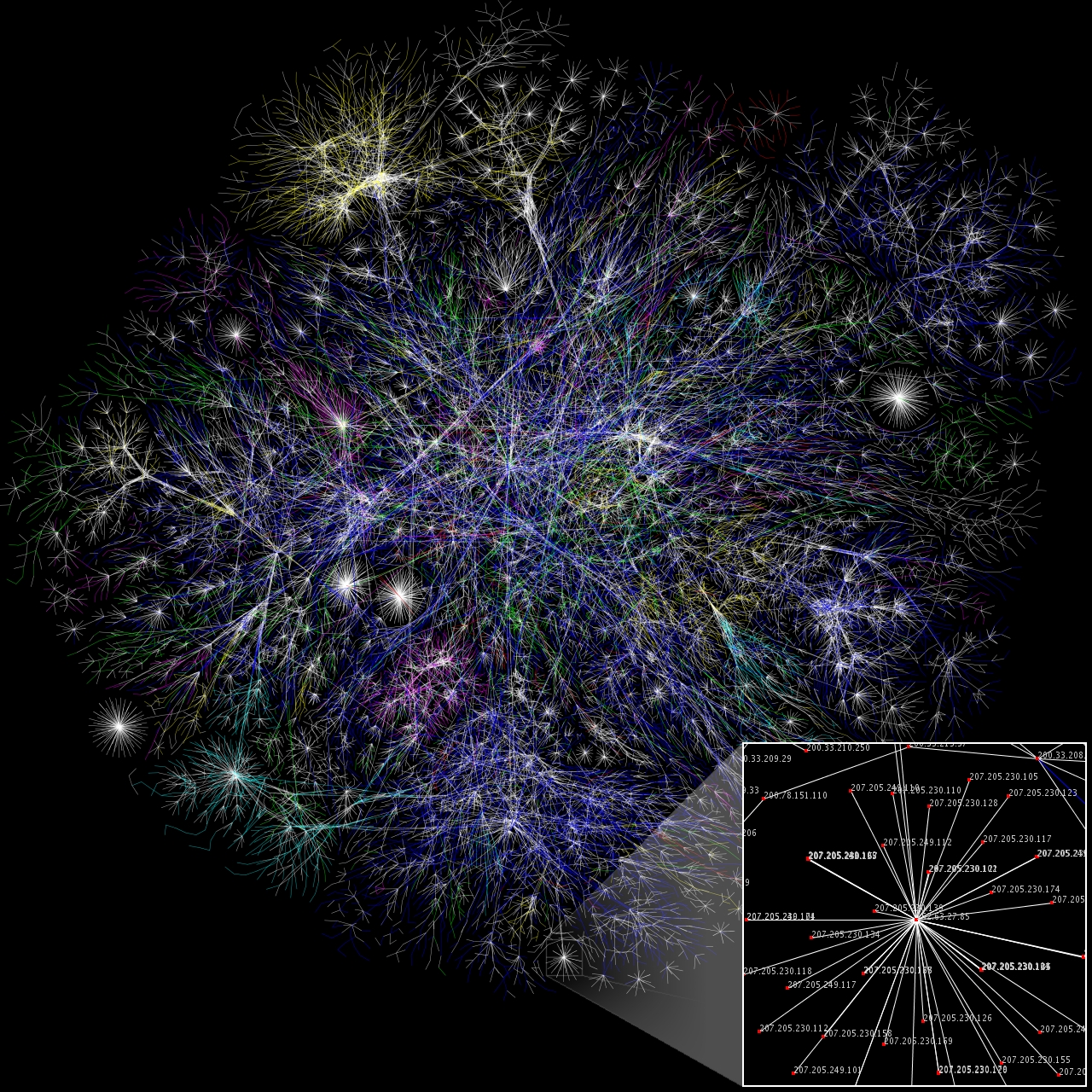
A biological network is a method of representing systems as complex sets of binary interactions or relations between various biological entities. In general, networks or graphs are used to capture relationships between entities or objects. A typical graphing representation consists of a set of nodes connected by edges.
As early as 1736 Leonhard Euler analyzed a real-world issue known as the Seven Bridges of Königsberg, which established the foundation of graph theory. From the 1930s-1950s the study of random graphs were developed. During the mid 1990s, it was discovered that many different types of "real" networks have structural properties quite different from random networks. In the late 2000s, scale-free and small-world networks began shaping the emergence of systems biology, network biology, and network medicine. In 2014, graph theoretical methods were used by Frank Emmert-Streib to analyze biological networks.
In the 1980s, researchers started viewing DNA or genomes as the dynamic storage of a language system with precise computable finite states represented as a finite-state machine. Recent complex systems research has also suggested some far-reaching commonality in the organization of information in problems from biology, computer science, and physics.
Protein-protein interaction networks (PINs) represent the physical relationship among proteins present in a cell, where proteins are nodes, and their interactions are undirected edges. Due to their undirected nature, it is difficult to identify all the proteins involved in an interaction. Protein–protein interactions (PPIs) are essential to the cellular processes and also the most intensely analyzed networks in biology. PPIs could be discovered by various experimental techniques, among which the yeast two-hybrid system is a commonly used technique for the study of binary interactions. Recently, high-throughput studies using mass spectrometry have identified large sets of protein interactions.
Many international efforts have resulted in databases that catalog experimentally determined protein-protein interactions. Some of them are the Human Protein Reference Database, Database of Interacting Proteins, the Molecular Interaction Database (MINT), IntAct, and BioGRID. At the same time, multiple computational approaches have been proposed to predict interactions. FunCoup and STRING are examples of such databases, where protein-protein interactions inferred from multiple evidences are gathered and made available for public usage.[citation needed]
Recent studies have indicated the conservation of molecular networks through deep evolutionary time. Moreover, it has been discovered that proteins with high degrees of connectedness are more likely to be essential for survival than proteins with lesser degrees. This observation suggests that the overall composition of the network (not simply interactions between protein pairs) is vital for an organism's overall functioning.
The genome encodes thousands of genes whose products (mRNAs, proteins) are crucial to the various processes of life, such as cell differentiation, cell survival, and metabolism. Genes produce such products through a process called transcription, which is regulated by a class of proteins called transcription factors. For instance, the human genome encodes almost 1,500 DNA-binding transcription factors that regulate the expression of more than 20,000 human genes. The complete set of gene products and the interactions among them constitutes gene regulatory networks (GRN). GRNs regulate the levels of gene products within the cell and in-turn the cellular processes.
GRNs are represented with genes and transcriptional factors as nodes and the relationship between them as edges. These edges are directional, representing the regulatory relationship between the two ends of the edge. For example, the directed edge from gene A to gene B indicates that A regulates the expression of B. Thus, these directional edges can not only represent the promotion of gene regulation but also its inhibition.
Hub AI
Biological network AI simulator
(@Biological network_simulator)
Biological network
A biological network is a method of representing systems as complex sets of binary interactions or relations between various biological entities. In general, networks or graphs are used to capture relationships between entities or objects. A typical graphing representation consists of a set of nodes connected by edges.
As early as 1736 Leonhard Euler analyzed a real-world issue known as the Seven Bridges of Königsberg, which established the foundation of graph theory. From the 1930s-1950s the study of random graphs were developed. During the mid 1990s, it was discovered that many different types of "real" networks have structural properties quite different from random networks. In the late 2000s, scale-free and small-world networks began shaping the emergence of systems biology, network biology, and network medicine. In 2014, graph theoretical methods were used by Frank Emmert-Streib to analyze biological networks.
In the 1980s, researchers started viewing DNA or genomes as the dynamic storage of a language system with precise computable finite states represented as a finite-state machine. Recent complex systems research has also suggested some far-reaching commonality in the organization of information in problems from biology, computer science, and physics.
Protein-protein interaction networks (PINs) represent the physical relationship among proteins present in a cell, where proteins are nodes, and their interactions are undirected edges. Due to their undirected nature, it is difficult to identify all the proteins involved in an interaction. Protein–protein interactions (PPIs) are essential to the cellular processes and also the most intensely analyzed networks in biology. PPIs could be discovered by various experimental techniques, among which the yeast two-hybrid system is a commonly used technique for the study of binary interactions. Recently, high-throughput studies using mass spectrometry have identified large sets of protein interactions.
Many international efforts have resulted in databases that catalog experimentally determined protein-protein interactions. Some of them are the Human Protein Reference Database, Database of Interacting Proteins, the Molecular Interaction Database (MINT), IntAct, and BioGRID. At the same time, multiple computational approaches have been proposed to predict interactions. FunCoup and STRING are examples of such databases, where protein-protein interactions inferred from multiple evidences are gathered and made available for public usage.[citation needed]
Recent studies have indicated the conservation of molecular networks through deep evolutionary time. Moreover, it has been discovered that proteins with high degrees of connectedness are more likely to be essential for survival than proteins with lesser degrees. This observation suggests that the overall composition of the network (not simply interactions between protein pairs) is vital for an organism's overall functioning.
The genome encodes thousands of genes whose products (mRNAs, proteins) are crucial to the various processes of life, such as cell differentiation, cell survival, and metabolism. Genes produce such products through a process called transcription, which is regulated by a class of proteins called transcription factors. For instance, the human genome encodes almost 1,500 DNA-binding transcription factors that regulate the expression of more than 20,000 human genes. The complete set of gene products and the interactions among them constitutes gene regulatory networks (GRN). GRNs regulate the levels of gene products within the cell and in-turn the cellular processes.
GRNs are represented with genes and transcriptional factors as nodes and the relationship between them as edges. These edges are directional, representing the regulatory relationship between the two ends of the edge. For example, the directed edge from gene A to gene B indicates that A regulates the expression of B. Thus, these directional edges can not only represent the promotion of gene regulation but also its inhibition.
Recent media